
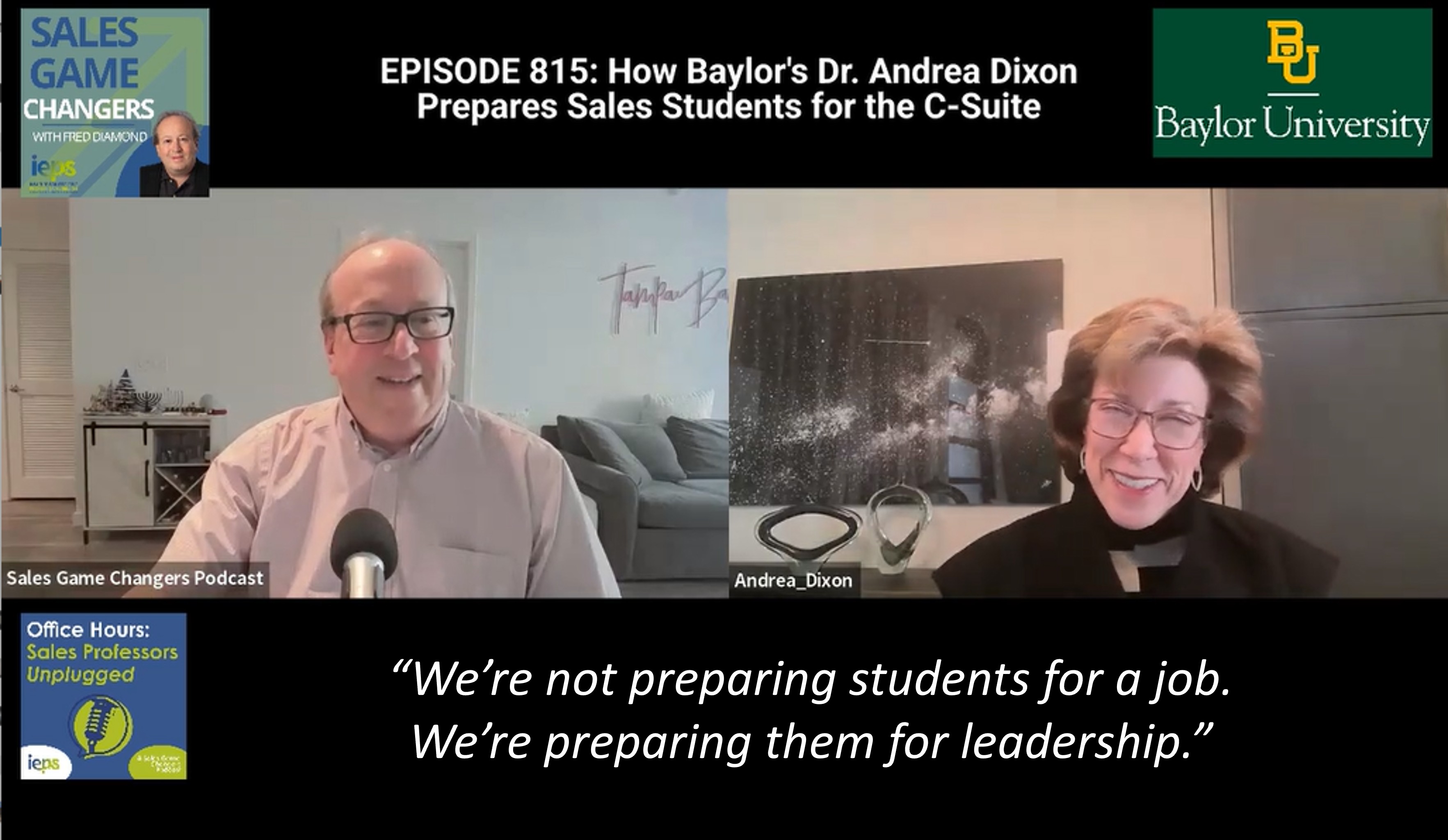
Watch the video of this podcast on YouTube here.
This is an Office Hours – Sales Professors Unplugged sub-brand of the Sales Game Changers Podcast.
The Sales Game Changers Podcast was recognized by YesWare as the top sales podcast. Read the announcement here.
FeedSpot named the Sales Game Changers Podcast at a top 20 Sales Podcast and top 8 Sales Leadership Podcast!
Subscribe to the Sales Game Changers Podcast now on Apple Podcasts!
Purchase Fred Diamond’s best-sellers Love, Hope, Lyme: What Family Members, Partners, and Friends Who Love a Chronic Lyme Survivor Need to Know and Insights for Sales Game Changers now!
On today’s show, we interviewed Dr. Andrea Dixon, Executive Director, Center for Professional Selling, Baylor University.
Find Dr. Dixon on LinkedIn.
DR. DIXON’S TIP: “We can’t just be preparing students for an initial role. We have to prepare students for their career and for life.”
THE PODCAST BEGINS HERE
Fred Diamond: I’m excited to be talking to you today. Tell us a little more about yourself and the Center for Professional Selling at Baylor. Just to confirm, isn’t this the first program of its kind?
Andrea Dixon: Yes, it is. Baylor was actually the first in the sales space. In 1985, Dean Richard Scott worked with Dr. Stan Madden, who was the chair of the marketing department at the time. Their goal was to launch something that would allow Baylor to have a distinctive, and this was actually Stan Madden’s idea. He provided the support and coverage that was needed to allow the faculty working in this area to build really the first set of curriculum in the sales space.
Fred Diamond: We’re going to be talking about the curriculum in a second. I want to touch on a couple things. When we were discussing Baylor’s program and our show that we’re doing today, you shared with me that when your students graduate, they will have met more than 900 corporate professionals. That’s an astounding number. How do they achieve that?
Andrea Dixon: We have both a major and a program, and we can get into some of the details later on, but the way that we work with our corporate partners is we are more interested in our partners time engagement, because they play a key role in helping us with student development. Students are engaged in our Top Gun program, for example, in the fall. We’ve had to move off campus because it’s so large in terms of the number of executives who participate. We’ll have 275 executives participate in that program working with our students. It’s across all of these different initiatives that they have the opportunity to engage with executives.
Fred Diamond: The pro sales curriculum, it’s unique in terms of what’s taught and how it is taught. Tell us more about the professional selling program.
Andrea Dixon: We have both a major and a program. The major from an academic perspective involves six different courses and the credit hours and so forth that the students register and whatnot. What’s unique about the way we approach our curriculum is we have a lockstep curriculum, which means students have to take the same six courses in order to graduate. That’s unique in the sense that most universities have provided students with a lot of different elective opportunities. While that may seem to be a benefit to the student, what that does is that actually distributes an uneven outcome in terms of student preparation. When students actually graduate from Baylor, our partners and the employers know exactly what students have learned because they’ve all come through that same curriculum.
Our curriculum is founded on a competency model. We’ve taken 12 higher order competencies. Those actually serve as the foundation for all of the exercises and activities in the coursework or in the curriculum, as well as in the program. Those 12 higher order competencies spread are actually underpinned by 49 specific skills. Each of those 49 skills are actually tagged into a minimum of three activities across the curriculum and three activities across the program. What that does, in fairness, is we’re delivering an iterative learning process where students are actually engaging in a particular skill building area multiple times prior to graduation. The concept that you’re going to introduce something to students, they learn about it, they take a test, and they’re proficient, is not really the thought process that we use at Baylor. We look at it almost like a professional athlete, musician, or what have you. You have to actually iterate on those skills over time to formulate a level of mastery in order to be able to use that skill on an ongoing basis.
Fred Diamond: When we were talking about the 12 competency models, you said something which I thought was fascinating. You said that you’re preparing your students for the C-suite. Eventually that’s where you want them to get to. One of the key focuses is also around developing this executive presence. Talk a little bit more about why that is the philosophy and how you get there.
Andrea Dixon: I think what’s important to recognize is we can’t just be preparing students for an initial role. If we’re doing so, then we’re operating more through what might be a trade mentality or what have you. We have to prepare students for their career and for life. We’re interested and our competencies are based on what’s necessary, not just for a business to business professional seller, but these competencies map onto the same kinds of competencies you have to have to operate in the C-suite. That’s important because we want our students to be able to contribute and create value for an organization over time, not just in an initial role. We’ve seen success with the model. I came in 2009, started with the competency model in 2010, and we now already have three of our students in chief executive, chief sales, or presidential roles just over the last 15 years.
Fred Diamond: Tell us a little more about yourself. You mentioned 2009, tell us a little bit about your history and what eventually got you to this point.
Andrea Dixon: I always tell students, what you’re preparing and learning will fit together in a way that at the time you’re sitting in it you won’t understand. I have an undergraduate degree in marketing, an undergraduate degree in management, and an undergraduate degree in theater. Understanding how you build momentum theatrically really plays out nicely in the business world. I tell students all the time, your understanding of human interaction may come from some of your other courses that you, at the time that you’re taking them, students have a tendency to say, “I just have to take this. I don’t really need it.” You’re going to need more of that content that happens across the university than what you think.
Went on after my undergraduate to work in advertising and marketing research in a customer interfacing role. That’s where I really understood what I didn’t understand about sales and started to develop a passion for learning. But I had to learn on the job. My undergraduate degree was in marketing, and I learned a lot of the sociology and psychology that’s associated with the discipline along the way and while I picked up my MBA. I was not really looking to go into academia. I pursued the PhD with a thought of having a market research firm. At the time, that was really going to be my focus, was to be able to launch my own firm. But then we found out we were pregnant with twins and life takes twisting curves along the way and decided that I wanted to be able to do a good job, both in my full-time role, but also in my role at home, and felt that I could do that more in an academic setting. That was the pivot for me.
Worked in industry after my PhD, went back for two years doing a real deep dive for a trade association in Washington where we had 43 companies sign on to really a study initiative of the best practices of top-performing sales orgs. These companies identified for us their mid-level sales teams and their top-level sales teams. Then I got paid to study them for two years, which was great fun, and gave us a great opportunity to understand the integration of theory and practice through that work. Went on to the University of Cincinnati and worked there in the marketing department and led a master’s program in marketing, when Baylor gave me a call and made the transition down here to Baylor University.
That’s when I saw what we had done at Baylor was mapping what was done historically in a university setting, a basic major. Students would register, they could sign up. It was whatever was taught in the courses was whatever a faculty member wanted to teach. It wasn’t an integrated model. I had looked at what we had learned through that two-year deep study of top sales orgs and said, “Well, if we reset the major, let’s reset the whole set of activities to map onto what a top-performing sales organization does.” That happens from the point of students wanting to get involved. They have to apply, and they have to actually go through a pretty rigorous process to get in. That process actually mirrors what happens in a top-level sales org. It’s not easy to join those orgs. They make it very, very clear that if you’re coming in, that you’re going to work and have a pace that’s going to be very different than any other type of organization. But the learning and the growth that happens in that type of cohort is pretty phenomenal. Our students really love, once they’re in, the learning happens in more of a 360 format. It’s not just faculty to student or executive to student. It’s a lot of peer-to-peer learning as well.
Fred Diamond: Dr. Dixon, we could probably speak here for another eight hours on the studies that you did for those two years. We’re going to have to talk about that for a second here. I run the Institute for Effective Professional Selling. We have a designation called the Premier Sales Employer. We also have one called Premier Women in Sales Employer, which recognizes companies that are top of their game for selling professionals. Without talking for hours, give us some highlights on what are some of the discovery that you had that high-performing sales teams have that others don’t.
Andrea Dixon: One of the real simple ones to explain right off the bat has to do with their recruiting and selection process. We did a deep dive, about 80 in-depth interviews, and then that was followed by a survey across those 43 companies. If I remember the numbers, there were a couple thousand that participated in that. Then we went back out into the field for additional qualitative research, just on that one study, on recruiting and selection. We were able to map the goal set approach that top organizations use, that at a very simple level has two additional goals that you don’t see replicated in a mid-tier organization. A mid-tier organization will go through the process of trying to screen, initially determining will and ability, and then selecting winners. Makes sense. Seems logical. But what we found at the top was actually they do a screening process first, but before they even assess the individual’s will and ability to do the job, they do an assessment of fit.
At the time that we had the quantitative research, it didn’t map onto what we were seeing both in industry research or in academic research. This idea that you would do this more extensive bit assessment prior to figuring out whether or not the individual had the will and ability to do the job. What those top leaders said was, if I assess the will and ability, all of a sudden I’m falling in love with the candidate because they can do the job, but they may not be able to do the job in our environment. They actually spend time making that assessment of fit prior to even assessing the will and ability because they want to make sure that they’re getting the right type of psychographic talent that’s going to come in. In a sense, what you’re doing in a top organization, and this is the language we use at Baylor, we are not going to give you a large number of plow horses. We’re not going to be the place that you’re going to come and hire 300 people. You are going to find your pacesetters or your racehorses here, and an organization needs both, but you need to have those racehorses because of the psychographic profile they bring in, and the way that they pull that entire bell curve to the right for your organization and help to accelerate its growth.
In those top sales orgs, we found that mindset in that they would make that assessment a fit prior to assessing will and ability. Then they returned to screening because they felt that they had learned some things about the candidate, and they allowed themselves the thought process that as we return to screening, we’re actually doing additional cutting of candidates. Whereas in a mid-tier organization, once I have you, I know you can do the job, the idea of cutting you is so foreign. You would hear people talk about bringing this candidate on, and I would listen to them and I would say, “Gosh, you don’t seem excited about this candidate you’re bringing in.” The language really revolved around, “Well, they made it through our process,” but they had lost the excitement about the candidate, but the process didn’t allow them the ability to re-distance themselves and deselect at that point in time. It was just fascinating seeing how these top-performing organizations safeguarded the profile of the types of people they brought in as it related to developing those kinds of racehorses.
Fred Diamond: Tell us a little bit more about when the student graduates from Baylor, the racehorses, if you will. What kind of roles do they go into? I love the way you just distinguished between we’re not popping out like hundreds of people into, I’m presuming, early type of positions. But give us a sense of your graduates, and I like what you said before, a number of them have already achieved CEO status and it’s actually quite remarkable. Give us a sense of that.
Andrea Dixon: It’s interesting. What we saw about five or six years ago, or maybe six or seven years ago, we saw a number of sales programs starting to build strong inside sales models and building a sales tech stack. We met as a faculty and looked at what was happening, and we said, “You know what? That’s a strategy for entry level,” and that’s a strategy that we felt was not going to be a long-term competitive advantage. It really was fortuitous for us to bypass that focus because so much of those roles have actually been replaced by AI anyway. We kept a very strong emphasis on being able to develop our student skills, not only in being able to work across a very complex buying center, but to be able to manage. If you think about it, what we’re doing is we’re developing people who are able to go into an organization and help others manage their change management process.
I had a chance to chat with some of the folks that have done the research on change management more generally. Most of that work has been done in the context of myself sitting within my organization orchestrating change. What we’re doing is we’re working at that crossroads where our alumni are out there orchestrating change. I had a call earlier today speaking with an alum who was actually going to be working with someone in an organization. I said, “What are you doing in that call on Christmas week?” Well, it’s someone who’d been in the firm for 25 years, is wanting to go along the direction of what this alum, the seller has recommended, but wants the seller to equip him better to sell his boss. It’s basically the practice work for the internal selling that needs to happen.
The idea of creating that kind of mindset and that context, that’s just a current example of what people need to be able to do today. That’s what we’re trying to equip them in order to have them understand those opportunities and be able to develop that kind of value. We also moved with a stronger emphasis on having a key global account management, a capstone within our curriculum. I’ll use a young alum example who went out of Baylor six years ago, spent two years in a large industrial firm in outside sales, went two years to a Fortune 250 tech company in strategic accounts, then went to a cyber firm in a named role. Now at year seven, and this is a student who graduated early, so she was 21, she graduated, she’s 28, handling a global account management role for a Fortune 100 company and her annual quota is 100 million dollars. Her counterpart on this account is a 62-year-old woman.
That’s just the nature of how we’re developing students so that they’re able to go into an organization, progress rapidly because of the way they’re able to distribute value and create value, and then be able to manage in the face of all of the questions of their youth and their inexperience, but the companies quickly recognize that the foundational learning has given them an experience mechanism, that we’re going on the model of an expert having 10,000 hours. When our students graduate, our seniors have 100 to 130 role play videos on their role play account, just to give you that perspective.
Fred Diamond: That’s actually quite remarkable, a 28-year-old having that type of a responsibility. Without mentioning this person’s name of course, what are some of her other characteristics that allowed her to come through your program? I’m presuming she’s not a unicorn or an outlier, I’m presuming, outlier is a better word, that there’s more who recognize Baylor for this or going through the programs. Not every company is going to be a great partner because not every company is looking for that, or able, like you mentioned, the mid-size. Talk a little more about some of the personality or some of the characteristics of the people that you’re graduating that allows them to get to this particular stage in their career so quickly.
Andrea Dixon: It’s interesting, Fred. They’re coming from a variety of different backgrounds, but their backgrounds all have different areas where they’ve created success. I think that’s what we’ve been able to expand on what maybe some people stereotype model is. If I want a strong competitive person, I need to find someone who’s been in athletics. That can work very effectively for a company, but that is only one model of success that involves competition. We have a student who was the number one duck carving champion nationally, that’s wooden ducks. That’s success. We’re looking for a profile when students are applying that they’ve gone into an area, they’ve developed a passion for that area, and they’ve developed some success and expertise. We have a student leading a social dance club and has tripled the size of that organization. I’m giving you some different kinds of examples. We’ve had the president of the men’s choir.
Out of the arts world, out of the athletics world, we have D1 athletes in the stable as well. Across the spectrum, there are students who have this innate desire to do something with a level of excellence. The students who apply and don’t end up becoming a part of the program are typically a student who is a fine student, but they don’t have that burning desire to prove to themselves what they can accomplish. I think that’s probably the most unique aspect that we’re selecting for. That also is a difference.
My colleagues run a lot of good programs across the country. One of the places that’s very difficult for them to compete with on us is we don’t run an open enrollment program. Students can’t just declare this as a major. They have to apply to get in. They have to complete an application, they have to interview three students in the program. They have to watch the PBS Science of Selling video, they have to write essays, and then they have to go through an actual interview process all designed to make sure that we push that psychological push pull that was in those top sales org’s profile is making it difficult to get in because the student has to fight his or her way in, demonstrating that real strong desire for that type of growth.
Fred Diamond: From a logistics perspective, when does the student apply? Do they apply coming out of high school or after their freshman year? How does that work?
Andrea Dixon: When I first got here, we were lucky if we could fill that junior class. Now we’re in a position where we’re running a cohort model where our senior class is filled, our junior class is filled, and I probably have 10 seats left in the sophomore class, and we’re filling the freshman class. We had eight come in in the fall that came right off the high school campus and participated the week before classes started in our Top Gun program. That’s really where we see the profile. If you think about it, a 17-year-old who said, “I want to do sales,” that’s a different candidate than a student who just says, “Well, I’m going to go in this major because some of my friends are talking about it.” We’ve been able to manage the process over time to get to that level of both engagement with students and visibility so that we’re having students actually select Baylor to come for a sales major.
Fred Diamond: Dr. Dixon, one thing we talked about was a lot of the stuff that you’ve been doing is helping academic, the college world, understand the corporate world, and vice versa for that matter, when things like recruiting happen and things like that. Tell us a little bit more about that and what are some things you could share that you’ve been working hard to educate both sides on?
Andrea Dixon: I think on the corporate side, it’s important for them to recognize that the phrase of this student population not being prepared or not being interested in working is wrong. It’s just dead wrong. The student today is not lazy. The student today is really desiring to be challenged. The vast majority of them really do want to work hard, but they have to be able to see it paying off and going toward something that’s meaningful. On the corporate side, we spend a lot of time helping them understand the potential that the students have so that they don’t bring them in and give them work that doesn’t keep the student excited. That’s probably our biggest challenge, Fred, is if someone hires them in and doesn’t keep them engaged and allowing them to work hard, the student gets frustrated very, very quickly.
At the same time, what we’re trying to do is help our colleagues and our partners in the academy understand that students want to be able to learn and they want to be able to demonstrate that learning. They want to see how that learning is connected to both theory and to practice. Unfortunately, you find in academia, people take that and go in a dichotomy. They either go with a very heavy theoretical approach with lectures and multiple-choice exams and what have you, testing whether or not you understood the theory, or they go toward a very heavy just practice-oriented lens where students are doing things they know they relate to what’s going on in business, but they don’t understand why.
The beauty of the intersection between having been both an industrial researcher and an academic researcher is academic research helps us understand why something ought to work. We need to be able to help students understand what they need to do, but they need to understand why they need to do that. I think that’s the place that we’re trying to play very uniquely in terms of helping folks understand you need both perspectives. You need both a very strong theoretical perspective. At the same time, that theory has to come to life in an exercise that a student can see being replicated in an industry setting.
Fred Diamond: Dr. Dixon, is there anything else that we missed? Is there anything that you want to bring up that you want to get out to our Sales Game Changers Podcast audience?
Andrea Dixon: I think going along the lines of that idea of practice, one of the things that we have built into our model, again, I mentioned several times about the fact we have a curriculum and a program, and the program piece of it is that iterative opportunity for our students to practice and hone their craft. If you think about it, what you’re doing is you’re learning how to do something, but you need the chance to do that over and over again in order to become, I have to play scales and I have to learn how to manage those scales in order to be able to use those scales in a musical piece, for example. We built an internal set of sales competitions to give our students that kind of iterative practice from a business development competition, an ethics competition, a face-to-face sales competition, a team-based capability competition, where they have to actually understand what their profile is and what they bring to the team, and then how the team actually is positioning themselves relative to a client’s needs.
All of these different types of internal competitions provide those students with that opportunity to get in the game over and over and over again. Our model was built also recognizing we’re in Waco, Texas. We aren’t situated in Dallas, where we’re right around the corner for most of these larger organizations. We built our model so that most of our competitions are judged electronically. You can be a judge from the convenience of your home or your office and have the opportunity to look at talent. Our students then have the ability to, for every one of our competitions, they get five sets of feedback from every competition. If I’m doing six competitions a year, I now have 30 pieces of feedback from the external market that’s helping me understand if I’m on the right track to being prepared. It’s the intersection of that kind of activity that I think really helps students learn and grow. We’ve just been so grateful to build that kind of engagement with our corporate partners and with other interested parties who help us in executing on that model.
Fred Diamond: I keep thinking back to the student that you referred to who at the age of 28 is now managing a 100-million-dollar account. You just don’t wake up and say, “Okay, I want to manage a 100-million-dollar account.” I love the way you tied in the feedback, because you need to understand the participants at your customer. There’s not just one, there’s like 7, 8, to 10 entities you need to deal with at corporate accounts. Then internally you have to manage various organizations as well. It’s a nice kudos and it’s great to hear how well Baylor is graduating students into those types of roles. There aren’t many people who really are capable of managing those roles. It’s actually fantastic.
Dr. Dixon, thank you so much for sharing your insights today and the great things that are happening at your program. We like to end each show with an action step, something specific that our listeners, and let’s just say most of them are selling professionals, B2B typically, maybe B2G, or leaders for that matter, what is your action step for them to take their careers to the next level?
Andrea Dixon: As I think about it, they also need to have some sense of what might be ahead for them. What our students do in order to gain that insight of what’s ahead is they look across the spectrum of roles. We have them do a lot of informational interviews. I think that’s very common for someone to do that on the beginning of their career. But I think it’s really important for all of us to constantly think about what other roles might actually provide the kind of challenge and interest. But before even taking a step away from our current role, just to invest some time in those casual conversations with people in role and getting their insights.
As I tell students, when you talk to someone who’s in a role, they’re excited to share with you what they’re learning. They’re excited to share with you about their role. People like to talk about themselves, but what you’re doing in that listening process is you’re effectively trying on that role without having to make a move. I think we need to do more of that, not just in our work world. I’m talking to students constantly about their need to engage in broader society as citizens. I’ve just reviewed some applications this morning and some of my notes on the applications is, “I hope this person goes into politics,” because we need these young people engaged in our communities and engaged in citizenry and making a difference in the institutions outside of work that help us be a much more benevolent and appropriate society in the way that we engage with one another.
I would encourage your listeners to think about their roles more broadly. Next roles for themselves, having those conversations, but also thinking, “Am I engaging in my community more broadly? Have I sat on a school board? Have I found other ways to use my business skills in the arts community?” There’s a dire need to provide that kind of support and assistance to help these social organizations operate with the discipline that we’ve learned and that we use every day in business.
Fred Diamond: Actually, I’ve met thousands of great sales professionals and they’re involved with things. They’re involved with the local charities, they’re involved with local organizations. They’re making things happen. I’m based just outside of Washington, D.C., and a lot of the great selling professionals that I’ve worked with are involved with organizations that support veterans or that support other service entities that relates to their customer.
Once again, Dr. Andrea Dixon with Baylor, thank you so much. My name is Fred Diamond. This is the Sales Game Changers Podcast.
Transcribed by Mariana Badillo