
Watch the video of this podcast on YouTube here.
The Sales Game Changers Podcast was recognized by YesWare as the top sales podcast. Read the announcement here.
FeedSpot named the Sales Game Changers Podcast at a top 20 Sales Podcast and top 8 Sales Leadership Podcast!
Subscribe to the Sales Game Changers Podcast now on Apple Podcasts!
Purchase Fred Diamond’s best-sellers Love, Hope, Lyme: What Family Members, Partners, and Friends Who Love a Chronic Lyme Survivor Need to Know and Insights for Sales Game Changers now!
Find Nick on LinkedIn.
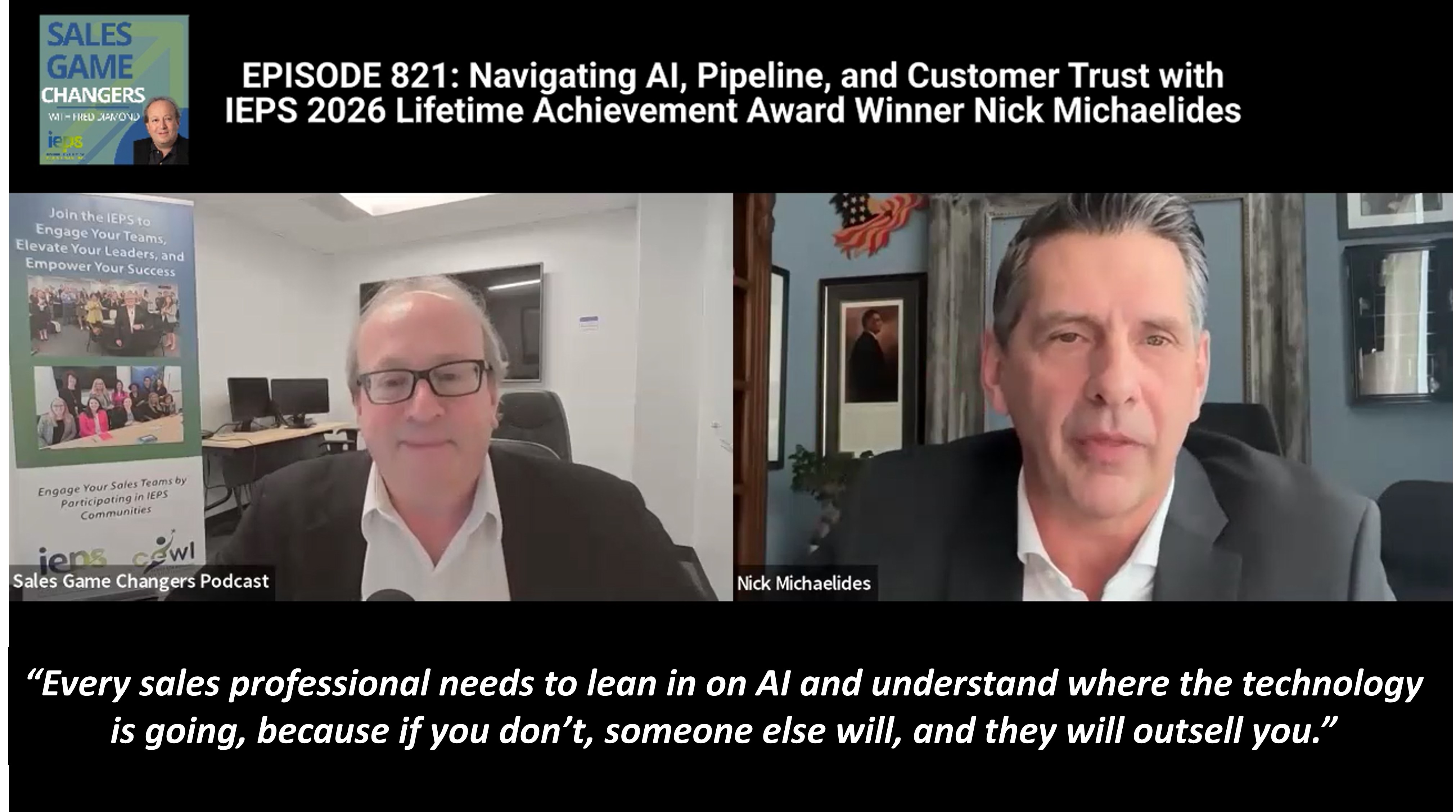
NICK’S TIP: “Every sales professional needs to lean in on AI and understand where the technology is going, because if you don’t, someone else will, and they will outsell you.”
THE PODCAST BEGINS HERE
Fred Diamond: Today we’re talking to Nick Michaelides. He is going to be the Institute for Effective Professional Selling 2026 Lifetime Achievement Award. That award event is going to be on April 29. It’s going to be a great event. This is our 16th. It’s going to be in person at the Marriott Fairview Park. It’s going to be a breakfast event. There’s going to be a lot of great recognition. It’s a celebration of the sales professional. We’re going to have our Women in Sales Leadership Award recipient, Vicki Schmanske from Leidos, our Partner of the Year, the great Kim Napolitano from Hilton. The morning is going to end with your Lifetime Achievement acceptance speech. I know we’re very, very excited about that. Before we get into the questions, it’s great to see. How are you doing today? How are you feeling?
Nick Michaelides: Good to see you. I’m doing great. I got a cup of chai tea here. I’m warming up from the cold weather, and I’m ready to get at it. Just super excited to be here with you and share some of my thoughts on IT sales leadership and equally excited as you touched on to be recognized this year as the Lifetime Achievement Awardee from the institution and share that with some other amazing awardees that you mentioned as well. It’s an honor, and I’m definitely looking forward to our conversation here.
Fred Diamond: When we select the Lifetime Achievement recipients, we talk to a lot of people. We view it as a Hall of Fame, a Mount Rushmore, if you will. One of the fun things about selecting you this year, once we started announcing it, the response that we’ve gotten at the IEPS has been great. Great choice. Right guy. Looking forward to honoring him and celebrating him. Let’s get some of your insights. You run organizations at Cisco, at the highest level. How many sales reps do they have? They have at least a thousand, probably a couple of thousand.
Nick Michaelides: We have thousands globally obviously, but the team that I managed was well over 800 salespeople and probably equally support people around that. It was a very, very large organization and it was very, very rewarding running the Americas there. But spent the majority of my time supporting the US public sector customer there and just the last few years having that opportunity to run the Americas, which includes North America, all of Latin America, and Canada as well too. It was a good journey. It was a good ride.
Fred Diamond: It’s great to recognize you because Cisco has always been one of the premier selling organizations in the history of technology. It’s great to have you there to be recognized and to talk. Let’s get deep into this. We’re doing today’s interview in February of 2026. What are the biggest issues facing selling organizations today?
Nick Michaelides: First off, and I think we all know this, there is unfortunately no shortage of issues facing sales organizations today. We could talk about things like the long-standing impact that DOGE has had on the federal government, and even though that’s been somewhat in my mind ramping down over the last six months or so, I think it’s had a huge and maybe lasting impact. As an example, like government looking like and showing up like and negotiating like a big commercial enterprise or some of the things that I saw when DOGE first came on the scene.
There are other things like memory shortages. We’re all reading the news, we’re all seeing in the press now, you got memory shortages, which is impacting the entire industry that’s out there. You got price increases which create challenges around supply chain and delivery. You also got increased pricing for components. You’ve got reduced profits for OEMs. You’ve got partner profitability potential impact, and you got increased pricing, unfortunately, for our customers.
I think another big one, Fred, if you think about it, is this issue facing software companies today around AI integrations and challenges. AI will be able to replace some of the applications that the customers have out there. Then how will automation and say generative AI impact our customer’s environment? What impact will that have on software applications as those applications are really starting to compete with AI? Because AI can actually do some of the things that the software applications can do today. Trust me, Fred, there is definitely no shortage of challenges for our sales orgs. But for me, it’s all about generating predictable, high-quality pipeline. Period.
Say what you want to say, we all know this industry is all about, what have you done for me lately? In my mind, truly, all seriousness, if you have a strong, predictable, high-quality pipe, like forecasting improves, quotatainment follows, morale increases, growth becomes a reality, we could go on and on on this one, but I’ll pause here just to maybe name a few examples for you.
Fred Diamond: Actually, on your last point about pipeline integrity, I talk to a lot of young sales professionals, people who are entering the sales career, who have been there for a couple of years, and they ask me for advice. I’m sure you’ve gotten tons asking you for advice. That’s one place where I always start. I always say to them, your manager is managing eight people. His manager is managing 10 people. His manager is managing whatever. How you’re doing is going to keep laying up to the organization, which means you need to be as transparent as you can, you need to ask for support when you can, but you need to understand your role in the organization. That obviously gets monitored via the pipe and things along those lines.
We talk a lot in the Sales Game Changers Podcast about B2B, business to business, and B2G, business to government. What are B2G and B2B enterprise customers demanding from sales professionals right now?
Nick Michaelides: I think there’s a ton of similarities between selling to traditional big enterprise and government having spent the last two years now supporting the Americas outside of government. But there’s also differences and I think nuances, Fred, and I know you know this. For me, it was really, really a great experience and a great learning opportunity to cover the Americas versus just US public sector over the last few years.
As an example, for government, they need to know when you show up, you have good working knowledge and an understanding of the agency’s procurement strategy, and that’s pretty diverse. Like the partners that they want to use, the contract vehicles that they want to use, the terms, etc. Does your company understand compliancy, security? Do you know how to sell into regulated industries, and that your offers are compliant? They’re going to need to know that.
Versus say maybe a big commercial enterprise customer, they also care about security and privacy, but they do it in a different way. For them it’s more around SOC and ISO and things like that. But commercial customers also want to ensure that you, the sales rep, that you have an understanding of their business model and that you can articulate how your solutions are going to create real benefits for their business and then help demonstrate strong ROI back to the company and for the shareholders to some extent.
At the end of the day, I think both want reliable, trustworthy salespeople who have a strong understanding of their business or mission and can deliver proven, repeatable, secure solutions. Not albatrosses, not one-off, but proven, repeatable solutions.
Fred Diamond: When you began the conversation, you talked about some of the challenges facing sales professionals. I think more than ever, over the last couple of years through the pandemic, there’s been more of an awareness on what customers are going through. In public sector, again, we’re doing today’s interview in February of 2026, in 2025, it was a very disruptive year, not just for those selling into public sector and other markets, but for public sector. There’s been a huge amount of downsizing. There’s been a lot of layoffs. You mentioned DOGE with “government efficiency”, if you will. A lot of change and also procurement change as well with how they go about it and what the companies that have been selling to the government and public sector have had to go through.
If you were giving some guidance to junior sales professionals, but also sales professionals who’ve been around for a couple of decades, who’ve been there, who’ve done that, who’ve been through things, what would be your advice for them about what customers are going through?
Nick Michaelides: Some of the things you talked about like been doing this for just over 40 years, I’ve never seen anything like it. I think all of us in the industry, when DOGE hit and when government shutdowns hit, when all these things started to come together and create chaos for selling into the government space, I think we were all looking at each other going, “Oh my gosh, we’ve never seen anything like this before.”
But for me, first and foremost, you just need to be patient. We all know that customers are under an immense amount of pressure to deliver outcomes and value for their respective companies or agencies, whether that’s supporting private and/or public sector customers, it doesn’t matter, which within many cases, I think less budget, not in all cases, but in some cases with a lot less budget. I think AI for both OEMs and customers, this is for both sides, are having to deal with one of the largest most strategic IT transformations, in my mind, since the innovation of the internet, maybe more closely like the cloud and things like that. But it is the largest most strategic IT transformation I’ve seen in my career.
From a customer perspective, AI is really driving this shift toward value creation. Customers are leveraging AI to improve IT efficiency with things like AIOps, which is really like AI for their IT operations, or like self-service tools and analytics. For the selling professionals, they really need to understand how their products and their services that they sell are really going to help their customers. This is important because every single customer is implementing AI or planning to leverage this to some extent in the short term and long term.
They are absolutely allocating budget towards this transformation right now as we speak. As such, I think OEMs and salespeople really need to just show up and help our customers really understand how their respective products and solutions have AI capabilities embedded, or not, and then how their solutions can really help customers with things like AI governance and risk management just as an example, and their investments, just like a customer’s investments in talent and skills development around AI. Fred, this reminds me of the days when cyber was the new big transformational IT thing that was happening. All companies and OEMs and partners alike, we were all fighting for this really, really, really small talent pool around cyber. This is the same thing with AI. You’re having to deal with talent shortage and development of your staff. These are just a few of the many things that I think the sellers of today really, really need to be focused on with their customers.
Fred Diamond: We’re doing a lot of work at the IEPS bringing together AI and selling professionalism. As a matter of fact, at the award event on April 29th, we’re going to be giving out our second AI and Selling Effectiveness Awards. These are for companies that aren’t selling AI, but that are using AI in the selling process. It’s definitely disrupted everything, to say the least. People still say it’s the early stage. Well, it’s moving quickly past the early stage into how you need to be using this, because if you’re not, then your competitors are definitely doing it and they’re flushing you out.
Nick, I’m just curious. We’re doing today’s interview at the end of February of 2026. What should be the priorities right now for senior sales leaders? One of the other big changes we’ve seen is that people are pressed to do the right things now. It used to be, what are we going to do for this year and how are we preparing for the next two years? As a senior sales leader, I know you’ve always had quarterly pressure, etc., but now it’s even like today. What do I got to do today to be a successful selling professional? What should tech or B2B sales leaders be focusing on right now?
Nick Michaelides: Top priority for senior sales leaders today should start with making sure your people have a clear understanding of what’s expected of them. Expectations, like how do you deliver appropriately if you don’t know what’s important? There’s just so much coming at the sales reps and the sales organizations, you need to help them understand and know what the priorities are. I think another big part of senior leadership right now is to ensure that the company that you work for, no matter who understands what your customer needs are, making sure your company is focused on solutions that meet your customer expectations and needs, whether that’s hardware/software features, functionality, and/or ensuring that the products and the software are certified for use with a public sector customer as an example.
The other thing I’d say is that senior leaders today really need to understand that all of our customers, no matter what customer segment you support, doesn’t matter, commercial, federal, enterprise, SMB, all of them are trying to figure out how they are or should be effectively leveraging AI. For the senior leaders out there, how your company and the products that you make can help your customer’s IT journey be more AI ready or more AI agile.
Then maybe last point, because you said like now, what are you doing this week? I think as it relates to this week, you better hit your forecast, because again, it’s a, what have you done for me lately world. But you know what? If you and your sales teams don’t wake up every single day, focused on short-term, medium-term, long-term, sustainable, profitable growth, you will be challenged, and not in a good way. Because, Fred, you said it, if you’re not getting on board with some of this stuff, your competitors will.
Fred Diamond: What are some of the best activities that you would recommend that the best sales reps are doing right now? Also, similarly, the best sales leaders. I understand, you get to understand AI and understand customer. Tell us specifically, what are you seeing these top sales leaders and professionals do?
Nick Michaelides: I’m going to start off with relationship and trust, and they really do matter with your customers, especially based on some of the challenges they face and some of the things we talked about. Know this, customers will 100% lean in with a vendor and companies that have been there in the past and want to do business with whom they trust. For OEMs, you need to have trusted relationships at all levels of your customer and the organization that you support if you’re going to be successful in this very competitive environment. It’s not okay just to have the relationship with the technical side or the C-suite. You got to have it at all different levels.
The other thing is you’ve got to be transparent with your customers. We talked about this at the beginning a bit. Be transparent about delivery times. Be upfront about price increases and the impact that your supply chain is facing right now. I think this ties back to what we just talked about around being transparent and building trust. As an example, if you can’t deliver product A in a timely fashion for deployment for the customer, do you also present alternative B that can potentially meet their requirements and delivery timelines? Giving them options and flexibility, I think is going to help with that trust that we just talked about.
Then I think showing up with tangible cost savings such as could be license model optimization. It can be optimizing say a customer’s maintenance cost or say consolidating applications that overlap each other, because customers, it’s not may, they do, customers have multiple apps that solve for the same problems. If you can help them reduce the number of applications and the cost associated with those, customers will trust you, they know you’ll have their back, and they’ll know that you’re going to be working in their best interest, not your own interest, but their best interest. I think it’s super important and it’s powerful and helping to build that trust we were talking about.
Fred Diamond: At the IEPS, we’re doing a lot of work with universities that have selling professional programs. We also do our Office Hours – Sales Professors Unplugged podcasts. I went to a competition this past weekend at the University of Toledo. We’re also going to be giving out an award to our first College Sales Educator of the Year. We have Brian Collins from Virginia Tech. You talked about relationships, you talked about trust.
One of the great things about Cisco is you probably have, if not the preeminent, one of the top two or three partner networks globally around the world. If you don’t mind, talk a second or two for the young sales professionals about building relationships. It’s gotten harder because the pandemic, a lot of people were behind screens, a lot of customers make it difficult now to get into their office. There are challenges with getting to them. Of course, with public sector, there’s rules on ways you can engage. Like I mentioned before, the challenge isn’t how do you develop a 10-year relationship? It’s how are you going to develop a relationship this week?
A lot of younger sales professionals are asking me that. They’re saying, “Fred, how do I develop these relationships?” Because it’s not about reading a script. I hate to say the old days, but in the past, getting to events, going to events, meeting, and I know one of the great things that we’ve gotten when we’ve told Cisco partners about the award event on the 29th of April is a lot of them want to be there because they have this long-term relationship with you and with Tim Coogan and Gary DePreta and the other people who are going to be involved. What’s your advice for the young sales professionals on developing relationships?
Nick Michaelides: If you’re a young salesperson, you should have potentially multiple mentors and coaches. I know you support and believe in this as well. It’s typically not one. It’s multiple people. Some people are better at this than some others, but networking is something that I learned from a leader a long, long time ago who was the best that I’d ever seen in the industry at doing this. But their ability to network and stay connected with partners, people in their organization, higher up, peers, etc., and partners and customers as well, was better than anybody I had seen.
For the younger folks out there getting into sales, you got to have the network. The only way you’re going to get that network, you got to get out there. That’s one of my messages to the sales teams out there. When the pandemic hit and COVID happened, we all learned how to do sales from home. Well, it’s over. If you think about relationships, it’s tough to build a trusting relationship if you’re not sitting in front of somebody and they can see the genuine character of you come out, or see how you carry yourself and things. You just can’t do that virtually. You got to get out there. You got to be in front of your partners. You got to be in front of your customers. There’s just no other way to do it, and it takes time. You just don’t get it like that.
Fred Diamond: I agree. It comes up time and time again, is for the young professionals out there, you got to meet people in person. You got to make the effort. When I say build relationships, it’s not about hanging out at the bar every night. Maybe you’ll share a drink here and there. I was talking to a couple of young sales professionals this weekend. It’s about the moments along the way, the help that you brought to a customer. “Do you remember back in 1994 when we were going after Department of Defense, and blah, blah, blah, we offered this solution.” Those wins along the way, helping customers solve their problem and helping your own company get to the next level.
Nick Michaelides: 100%. I think the days of taking your customer out for drinks and dinner, that’s okay, but that’s the way we sold a long time ago. I think people want more than that. I know they want more than that. When I think about some of the great salespeople, sales leaders that are out there, are you showing up at a customer site and joining them in a give-back event? How powerful and how important is that? I’ve seen my sales reps and the engineers and the CX people show up on a weekend when there’s a customer outage, and the customer sees that. Or say there’s a catastrophic event and FEMA’s been deployed and Cisco’s lending its NERV truck to help people light up comms in an area that was just devastated. To me, those are the things that are really going to build that relationship and that customer trust, more so than the dinners. There’s a necessity for those, but that can’t be all it is.
Fred Diamond: Give us a little peek into some of your personal guiding principles. What are some of the things that you’ve been conscious of along the way to achieve your success?
Nick Michaelides: First and foremost, I know this sounds cliche, but it’s got to start with the customer. Customer obsession speaks for itself. In my mind, I was taught this very, very, very early on in my career back in the early ‘80s, if you take care of your customer, everything else will take care of itself. I think the second thing is building a high-performance culture within your teams. The right people in the right roles comes to mind for me, and when you don’t have the right people, that you have that courage and conviction to either move on from those folks in the very most respectable way possible and/or coach them up, but you got to get the right people in the right roles at the right time.
The other guiding principle for me, ethics, integrity, and trust. Without trust, there’s no me and you. I expected every single salesperson that reported into my organization operated with the highest level of integrity. Clean ethical business is a must. I think constant coaching. Our jobs as sales leaders is to help our salespeople be the best they can. Leverage all the wisdom that we’ve all gathered over those multiple decades and really help them not to make the same mistakes that maybe we did, and then help them get to that best outcome maybe sooner than later. Maybe last but not least, team before self, or maybe team versus self, doesn’t matter, but I learned early on, never ever allow success or the great accomplishments you have be about you. For me, it’s always been about the team. I think that’s just good sales leadership. If I could do this, I would make sure that there was a requirement that sales leaders strike the word I from their vocabulary. It’s never about you. It’s about your team.
Fred Diamond: The more selfless you can be and continue to be a professional and show professionalism. I loved your idea of the coaching. One of the things that we’ve heard back from, which has been a shift from earlier days, you used to get your review once a year. You knew, on April 1st is my review and I’m going to get my whatever percentage increase if I keep working hard. A lot of young professionals, I have one guy who wants to get reviewed every week. He constantly reaches out to his leader. Be conscious of that and continue to grow.
Nick, you’ve given us so many great ideas here. Give us one specific action step, something that the sales reps and sales leaders listening to today’s show must do right now to take their sales career to the next level.
Nick Michaelides: This one I think is super important because I know we’re going through a major transformation with IT. This is calling all sales reps, calling all sales reps. By the way, this includes systems engineers as well. But we all, all of us, need to lean in on this one. I’m less worried about the younger IT sales professionals who were raised on IT, born with an iPad in their hand. It’s folks that have been selling in this field for some time that may attempt to take the position of like, “Hey, look, I’ve been wildly successful selling the same way over the last few decades and I’m going to just keep on doing what I do.” In my mind, that’s a recipe for failure.
Every sales professional needs to understand the AI journey from the days of deep learning in the 2000s, which was around image and speech recognition, to say generative AI. For IT companies, even like Cisco, like help me write code, help me use generative AI to do reports or briefing documents. To say agentic AI where we have agents talking to agents, not just providing valuable information and insights, but now having agents reach out to other agents who have information that may be beyond your own enterprise, to then actually having those agents action things.
As an example, you and me want to go on a great vacation. Who doesn’t want to when it’s cold like this? We can use AI to research the best vacation place to go. But then I want that agent to reach out to the airline and book my tickets. I want then to schedule travel from the airport to the hotel. Then I also want to set up a one-day excursion like hiking and have that all done for me. That’s where we’re going. In short, we all need to lean in, you need to lean in, you need to leverage it to your advantage, because if not, you will 100% be outsold by somebody who does.
Fred Diamond: Once again, Nick Michaelides, congratulations again on the IEPS 2026 Lifetime Achievement Award. We look forward to seeing everybody at the Marriott Fairview Park on that day. My name is Fred Diamond. This is the Sales Game Changers Podcast.
Transcribed by Mariana Badillo