
Watch the video of this podcast on YouTube here.
The Sales Game Changers Podcast was recognized by YesWare as the top sales podcast. Read the announcement here.
FeedSpot named the Sales Game Changers Podcast at a top 20 Sales Podcast and top 8 Sales Leadership Podcast!
Subscribe to the Sales Game Changers Podcast now on Apple Podcasts!
Purchase Fred Diamond’s best-sellers Love, Hope, Lyme: What Family Members, Partners, and Friends Who Love a Chronic Lyme Survivor Need to Know and Insights for Sales Game Changers now!
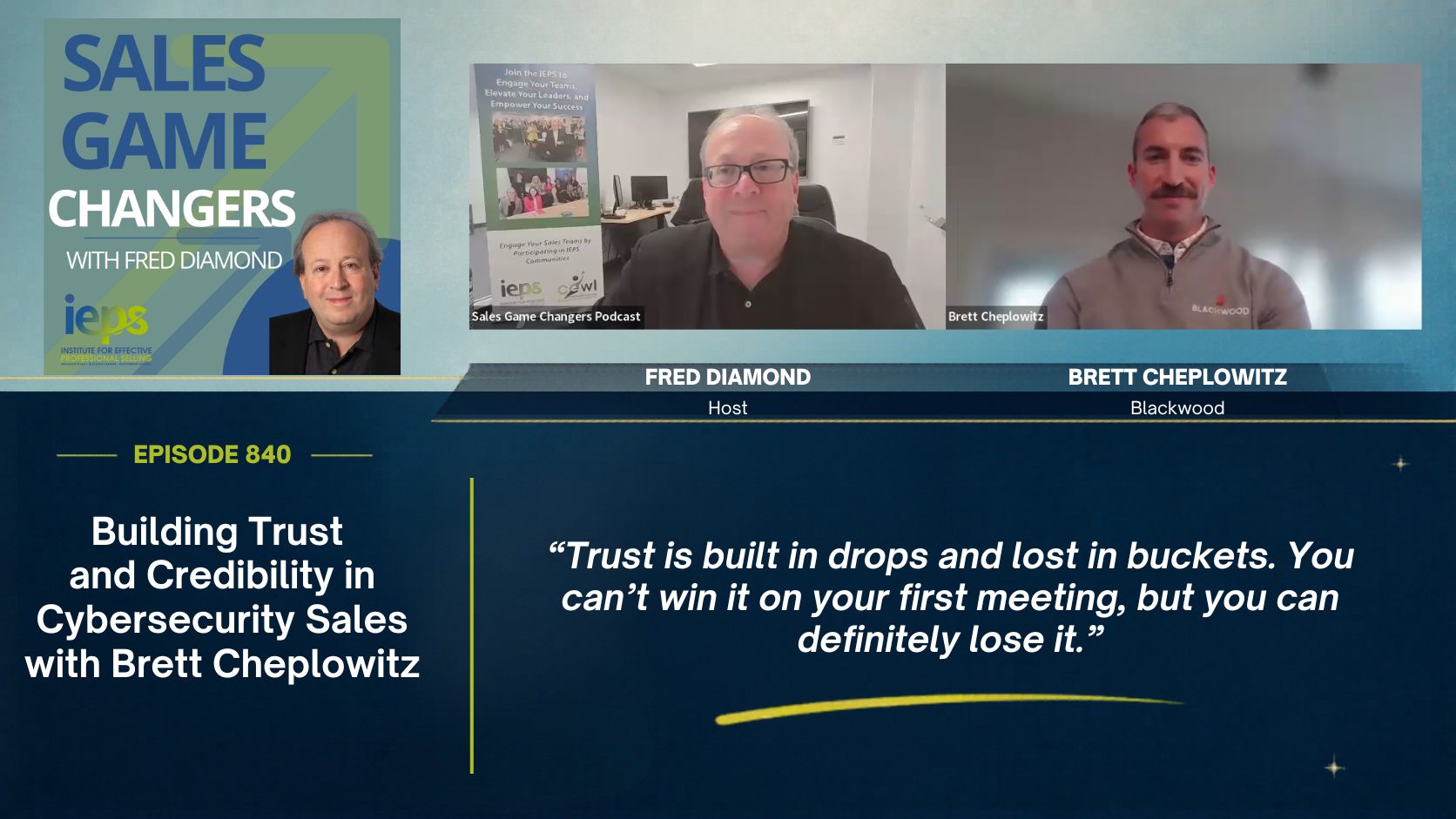
Today’s show featured an interview with Brett Cheplowitz, Vice President, Commercial at Blackwood.
Find Brett on LinkedIn.
BRETT’S TIP: “Trust is built in drops and lost in buckets. You can’t win it on your first meeting, but you can definitely lose it.”
THE PODCAST BEGINS HERE
Fred Diamond: Brett, it’s great to have you here. I’ve learned some stories about how Blackwood has grown and how it’s become such a force in the IT space. I’m interested in getting some of your perspective. I know you’ve been there for a while. I know that you started at Blackwood when the company was primarily focused on the federal marketplace. Give us a little bit of an introduction to yourself and then tell us, what did you learn when you were asked to take the company into commercial and enterprise markets? First, give us a little bit of an introduction to yourself and a little bit of an introduction to Blackwood.
Brett Cheplowitz: I’ve been with Blackwood now for 15 years. I grew up in the space, and to your credit, doing your research and knowing some of the folks that I grew up in this industry with. When I started years ago, we were almost 100% federal business. I was employee number four sitting in a cube in the middle of the office and really had to learn the ropes on my own, given the, “Hey, this is what we do here. Go to work.” I had a couple of federal agencies that I was responsible for. When I started getting to work, I realized like, “Hey, there’s a rhythm to this. You can pick up on some of the things that you need to do to ingratiate yourself with the customers and figure what they need and what their pain was.”
After a little bit, we made the decision like, “We need to diversify.” I think it’s a lot easier to say what I didn’t learn. I was able to learn a lot of things the hard way. It was a very different time for us back in those days. To Blackwood’s credit, to Ryan Morris’s credit, they gave me the keys and said, “Hey, go figure it out,” and I was able to make every mistake in the book. I’m a person who was learning lessons the hard way. I was able to get out there and struck my blades on my own for a while and then realized like, “Hey, we need some help. We need to bring in some people who are much better at sales than I am.”
I was able to go seed territory and backfill with people that are better at sales than I am. I think that’s the number one thing I learned off the bat, is you got to have good people on your team. If you want to succeed in this, and probably any industry, you got to have good people and a team that you can trust that are going to carry your message forward and be just a good brain ambassador at the end of the day. Be obsessed with problems the way that I was obsessed with outcomes, the way that Blackwood’s always been obsessed with outcomes for their customer.
I feel like that’s been learned. Honestly, I got to say, I don’t think that’s changed. If you’re doing anything today, especially as fast-paced as this world is, you got to have A players in your team. That’s probably the number one lesson I’ve learned.
Fred Diamond: Just curious, in one minute or less, what does Blackwood do, so that people can put the rest of the conversation into context?
Brett Cheplowitz: We are a technology broker that is focused solely on cybersecurity. We’re trying to bring the best-of-breed solutions to our customer set, which is basically your entire public sector gambit, massive federal agencies, state and local government, higher education, Fortune 1000 and above on the enterprise side of things. We’re trying to bring this to bear, not just in a product way, but how does this solve a larger problem set for you with all of the problems you’re facing in today’s world? At the end of the day, technology broker focused on 100% cybersecurity solutions.
Fred Diamond: What is the biggest mistake that technology selling professionals make when trying to sell cybersecurity solutions today?
Brett Cheplowitz: There’s all sorts of ways to trip over, especially when you’re getting into the door. I would say the number one mistake I see is symptom chasing. Where it’s like, a customer might come to you and say, “I have a certain problem,” and you want to dive in head long into that specific issue. That might work the first, maybe even the second time, but eventually you got to get to the heart of the issue. You got to find the root cause of these symptoms. If you’re not really doing the proper amount of discovery and trying that conversation up, way left of the problem starting, “Okay, how did we get here?” Just symptom chase, you can fill your pipeline, but you will not be a durable business. You will not be a durable business owner. You have to get to the root of the problem. I think that’s the biggest thing.
There’s so much pressure to go out and take your number, get to your quota, like, “Hey, go to the line.” It’s really easy to make the mistake of, “That door open, I’m going to walk through it,” instead of basically saying, “I’m going to take a step back. Let’s take a breath. What else is going on here? Who else is involved in this conversation? What are we not talking about in this room that might be contributing to this, that’s actually causing these symptoms?” I think that’s a mistake. I got to say that, again, probably not just in this industry, it’s probably all younger sales reps out there in any industry, they want to dive in and sell something. I think sometimes it’s really convenient. The hard answer is to hit the brakes. Let’s step back and figure out what’s going on.
Fred Diamond: A lot of the listeners to today’s Sales Game Changers Podcast sell cybersecurity, or it’s a piece of what they’re selling. Just curious on your thoughts having been doing this for so long, what are the differences between selling into the security organization versus general IT? Or am I wrong there? Are you selling cyber solutions into the IT organization? How does that fit? Do you sell into the security organization? Or do you sell into the IT organization? What do we need to know about that?
Brett Cheplowitz: I think that’s a really good question, because when I first started, there was no security team. It was network and they had some security add-ons and things they needed to accomplish. They got some of the budget for that, but there was no security people. It was just like, “Hey, I’m responsible for this.” Obviously now that entire thing has changed.
I think what we like to do at Blackwood is we like to have big conversations. Like how does this bridge the gap between multiple teams? I think you’re going to need ultimately buy-in on most of these, especially if it’s enterprise-wide deployment of, name your product. You’re going to have to be able to sell to multiple different layers of this organization. You do have to sell to all different teams.
I think from my perspective, if you really break down what the difference is between selling to cybersecurity, and almost everyone else, where it’s like, “Hey, this is what we need,” sometimes you have to help create the need when someone says these are the symptoms. You have to go find the root cause there. For us, it’s like, well, there’s no budget for that. When you’ve got something brand new, when you’ve got something that solves these problems, and it might be a year-old technology, it might not be a box check type of deal for that customer. They might not have a budgeted line on them to say like, “Hey, you know what? I don’t lose insurance if I don’t buy this.” You really have to be able to say, “This is why this solves this problem for you,” and you have to be able to create that need. You got to help them go sell to the broader organization, because a lot of times it’s going to be obscure for right now. People might not know about it today, especially if you’re in there selling to an early adopter, they might not know about that technology for another 8 to 12 months, and you don’t have that kind of time. They need to solve this problem yesterday. How do you like, “Hey, okay, I’m listening to you now. Let me help you with this conversation.”
You do have to create some of that need, and I think that’s probably the biggest difference. But to be honest with you, things have gotten so big now that at a certain point, you’re going to have to be able to sell to the broader organization and help your champions go do that on their own. When you’re not in the room, you got to give them enough ammunition to go back and say like, “Hey, you know what? This is what we’re hearing. I think we can solve it this way.” You got to help them form that kind of messaging internally.
Fred Diamond: A couple of the words that we talk a lot about on the Sales Game Changers Podcast is trust, credibility. Cybersecurity is a pretty important thing. It’s protecting the company against huge amounts of risk. We’ve all heard about fraud and break-ins and all those kinds of things. For the selling professionals listening today, I guess one of the first things you need to do is you need to build credibility right away with the chief security officer, information security officer, the security team, the leaders. These are pretty serious people who are dealing with big challenges. What is some of your advice on building the credibility from Jump Street, from day one?
Brett Cheplowitz: I think the biggest thing is actively listening and being able to say when something’s good enough. A lot of people come in and they want to conquer the world and they want to say like, “Hey, you know what? Everything you’re doing today is wrong. Every piece of competitive technology you have in here is incorrect.” The quickest way to lose credibility is basically say like, “I’ve got an answer for all these questions.”
When you don’t know something, say you don’t know. If you already have a great piece of technology in place, you guys are doing awesome. You can’t just go in and try to wipe the slate clean. I think that’s a really quick way to lose that credibility. I think with so many of these things, trust is built in drops and lost in buckets. I feel like you can lose it on your first meeting. You can’t win it on your first meeting, but you can lose it. These things are built over time. You’re going to learn to trust me over time.
You’re never going to have a conversation with me or anybody at Blackwood, that basically like, “When I walk out of there like, I don’t trust a word that that person said,” that’s just not going to happen. It’s an integral part to what makes us who we are. That comes back to, you got to hire people that are not only A players, but they got to have integrity.
Fred Diamond: I’m going to talk to you about the people who are successful. You’ve hired a lot of people, and you mentioned A players. What makes a good cybersecurity selling professional? If I’m a young selling professional, or if I’m someone who’s been selling IT and I want to move into cyber, what are some of the things that you’ve observed over the years that are characteristics or qualities of people who are successful selling cybersecurity?
Brett Cheplowitz: It’s going to sound extremely cliche. I think the biggest common denominator that I see across not only this industry but all, is just grit. It’s being able to get knocked down and get back up and go back into the fray. No one has to come manage your behavior. You have to manage to a process. You got to have a process, yes, you have to have a brand, and that all has to be there and consistent. But I don’t have to go track any of my guys down and say like, “Hey, are you working?” I think most of the time, your most successful reps, they just have that gritty type of tenacity. They’re going to get up and keep going.
For me, on the management side, it’s fun to watch. You got to realize like, you like the hustle culture and how to push people and how to ultimately engage. A lot of it’s the other side. A lot of it’s having the empathy and having some EQ and understanding when somebody is on the struggle bus, to be able to reach in and help them a little bit because you don’t have to add a lot of fuel to their fire. They’re already just going to get up and go to work.
I also got a long time ago, when I first started in this industry, it’s like, hey, if you get up and you put your shoe on and put in your hours, you’re going to be fine. It’s so true. It’s just getting up and having the resolve to keep going. I think that’s the biggest thing I see in successful sales reps.
Fred Diamond: That’s a great answer there. What are some of the cybersecurity trends that selling professionals need to be paying attention to right now? We’re doing today’s interview in March of 2026 with Brett Cheplowitz of Blackwood. What are things that they need to be thinking about and knowing about today to be successful?
Brett Cheplowitz: I think I can probably hear your little eyes at the back of their head with this eye roll. But unfortunately, the answer is AI. Unfortunately, it is agentic AI, in my opinion, more pointedly. I think if you’re not paying attention to this space, you will absolutely fall behind, yes, but also just a lot of the cloud security conversation from a decade ago, it reminds me a lot of the endpoint conversation from so many years ago. It’s like, say those words to eight different customers, it’s going to mean eight different things.
Everyone has a slightly different definition. Everyone’s attacking the problem in slightly different ways. It’s up to us to have opinions in this space and guide them to where we think this market is going. We aggressively looked at this market for the last several years and started tracking here’s where we’re going to end up. In my opinion, you’re going to see every big brand in the world bake this into their product. You really saw third party players come in and taking over because let’s face it, there’s a massive talent gap, and we’ve been talking about that. How do we reduce the talent gap without taking away jobs? That’s no one’s prerogative here, but I think the tier one analyst, it changes. It actually allows you to analyze, actually look up the stack the way you’re supposed to and set up just triaging all day. I think it’s a massive trend. I don’t think it’s going anywhere and I think every single player in the game today will have some flavor baked into their product.
Fred Diamond: In the cyber world, it’s interesting, when you look at all the vendors out there that are making products, almost everything is AI empowered, cybersecurity, so many things, it used to be very crystal-clear what companies used to do. Now they’re trying to explain and show that they almost do everything. There are so many partnerships that you used to have that you need to have. You need to have relationships with OEMs, got to have relationships with other VARs, other service providers who may have a little more expertise in certain solutions to be able to provide the right service and value add to the customer. What does a great vendor-partner relationship actually look like in practice? What do you want to have as far as your relationships? Give us some insights there, Brett.
Brett Cheplowitz: You hit the nail on the head earlier in this conversation, trust is a big piece of this. It’s like any other relationship you have in your life. If there isn’t a two-way street of trust, there’s nothing. If you don’t trust that when Blackwood is in the room having conversations on your behalf that we’re doing it well, you won’t entrust us with anything. You won’t entrust us to lead any conversations. I think that’s the foundation, like any good relationship, is I trust you, you trust me. We’re going to do the right things together. If we’re in the room together, fantastic. But I also know if we’re not in the room together, we’re going to handle these conversations the right way. You’re going to portray my company message the right way. I’m going to fold you guys in the conversation. It’s built on trust.
I also think if you look at over the years of Blackwood for us, what are the partnerships that have really just taken off? It’s just this all-in attitude that we leave the room with. Like, hey, these reps on the street, on the field level, are on with my reps. They’re talking weekly. They’re on the same page. They’re out there prospecting together. They’re talking about what makes the relationship go with their customers, what outcomes we’re trying to reach, and we’re honest. We feel like that solution is the best fit for these things. It’s all about like if I tell you that, you’re not going to go shatter the rest of the relationship because you don’t like the answer that I gave you.
To me, it really just comes down to that rudimentary thing, is there trust at all levels? Do we have trust? The C-suite all the way down the field. Without that, you truly have nothing. You might win a couple of deals together, but it’s never going to be a real partnership.
Fred Diamond: Tell us something specific about you. You’ve had some great success. You talked about how you were employee number four and the leaders came and said, “Hey, why don’t you take us into these other markets?” What’s one habit or mindset that you have specifically that has made you a more effective sales leader?
Brett Cheplowitz: This habit, I would say, I give this to almost anybody who will listen. I think it’s not only helped me in my career. I think it’s helped me in my life. That’s really taking a step back and mapping out and planning out your day. It’s the simplest thing on earth, that’s making the pen and paper to-do list. It’s sitting down. What are the top five, top six things I need to accomplish today? What didn’t I get done on my list yesterday? That’s the number one thing I got to do right now. As a natural procrastinator, it’s the only thing that I can do to that feeling of like, “I’ll get to that later in the week.” If you ask my wife, she’d tell you, “If it’s not in the list, it’s not going to happen.”
For me, I set out my day the night before. Before I sign off for the day, I’m mapping out tomorrow’s activities. I’m going to add things throughout the day that I need to accomplish either the next day, that week, or whatever. If I need to change priorities, I can do that. It’s not known. I think that’s not helped me in just my career. I think that’s helped in my life. If you look at even a weekend to-do list, it’s there. I’m making a list of some sort. What do I need to go do? It keeps my thoughts organized and it keeps me on track. I would recommend anybody doing that. Period. It doesn’t matter if you’re the world’s top performer in any sport, any profession, you can benefit from having a list in front of you at any time in your life.
Fred Diamond: That’s great advice. Brett Cheplowitz, from Blackwood, thank you so much for being on today’s Sales Game Changers Podcast. You’ve given a lot of great ideas. Give us one specific action step, something specific that people listening to today’s show or reading the transcript must do right now to take their sales career to the next level, something actionable and specific.
Brett Cheplowitz: That’s such an awesome question. For me, go get a mentor. Go find someone, and it does not have to be in your industry. It doesn’t have to be at your company. It could be someone you were neighbors with 10 years ago that you respect what they do and how they carry themselves. It doesn’t matter if they’re in the same industry at all. I would say the things that have helped me most of my career have always been open conversations with people that I just respect what they do.
I had an old boss the first month that I started working at this company. For my first challenge, they’re like, “I want you to go interview the six most successful people you know, not intent to sell them anything. I just want you to find out how they did it. I just want you to find out their story.” I’ve remained in contact with some of those people. Actually, that old boss is still a mentor of mine, where if I’m in a situation where it’s like, “I just don’t know what I’m doing here,” that’s the first person I call. That’s almost 20 years ago. Then for me, getting someone that you respect, and understanding, “Hey, I’m coming to you empty cup. I’m going to come to you, draw out your answers. I want your feedback.” I think that is the most important piece that anybody can add to the puzzle, is just find someone that you can rely on to give you good guidance. That’s huge.
Fred Diamond: That’s great advice. I tell a lot of young professionals who are getting started in sales, or actually any part of their career, if they want to go into sales, I’ll say, “Go find a friend of your parents who is in sales.” They say, “Well, how do I ask them for time?” Just say to them, “I want to talk to you. Can we meet at Starbucks nine o’clock on Saturday?”
My son, when he left college and he had a bunch of friends who were now moving into sales, I must have had half a dozen conversations, and I was thrilled. For people out there, people will be thrilled to share with you. Now, don’t say something like, “Can we go to dinner at Morton’s?” They may not give you three hours, but, “Can I meet you at Starbucks or Panera Bread nine o’clock on Saturday?” and come prepared with the questions. Don’t just say, “What is your advice?”
Brett Cheplowitz: Take notes.
Fred Diamond: Yeah, take notes, bring a notepad. I tell that to people all the time. Take a notepad, not in your phone, on a piece of paper, and then action, and then follow up with gratitude, and things like that. Brett Cheplowitz, thank you so much for being on today’s Sales Game Changers Podcast. My name is Fred Diamond.
Transcribed by Mariana Badillo