
This is a Marketing and Selling Effectiveness sub-brand of the Sales Game Changers Podcast. Regularly, the IEPS posts a new show with Selling Essentials Marketplace partner Julie Murphy from Sage Communications.
Watch the video of this podcast on YouTube here.
The Sales Game Changers Podcast was recognized by YesWare as the top sales podcast. Read the announcement here.
FeedSpot named the Sales Game Changers Podcast at a top 20 Sales Podcast and top 8 Sales Leadership Podcast!
Subscribe to the Sales Game Changers Podcast now on Apple Podcasts!
Purchase Fred Diamond’s best-sellers Love, Hope, Lyme: What Family Members, Partners, and Friends Who Love a Chronic Lyme Survivor Need to Know and Insights for Sales Game Changers now!
Find Rick on LinkedIn. Find Paige on LinkedIn.
RICK’S TIP: “If you’re not getting the results that you want, it’s probably not your people. It’s probably your processes, your governance models, and everything feeding the result of the scoreboard.”
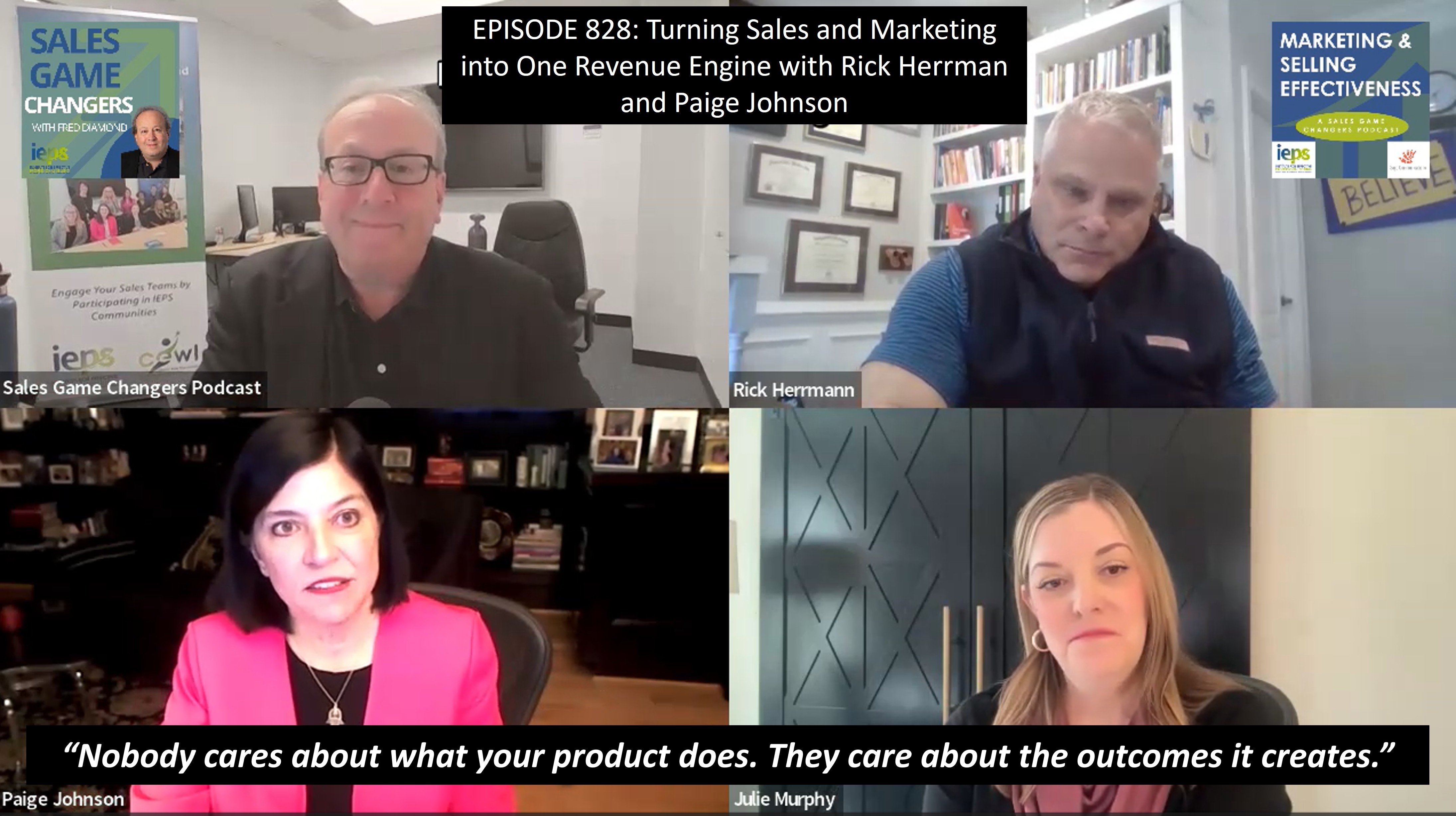
PAIGE’S TIP: “The more you focus on features, the less you sell. Nobody cares about what your product does. They care about the outcomes it creates.”
THE PODCAST BEGINS HERE
Fred Diamond: We have a special show today. It’s our Marketing and Selling Effectiveness show. We’re going to be bringing on Rick Herrmann and Paige Johnson in a few moments here. They both worked at Microsoft and Intel together. We’re doing today’s show in March of 2026, and we want to talk about companies and organizations that understand that sales and marketing need to work together more effectively, especially with things going on in the customer base like AI and how the internet is influencing things. I’m excited to hear what they’re going to be saying together.
Rick has actually been on the show before. He had his own episode back in 2023. Rick Herrmann, when he was at Intel, was one of our early sponsors of the Institute for Effective Professional Selling Center for Elevating Women in Sales Leadership Programs. We may get a little bit of interchange of that as well. Enough of the introductions, Julie. First of all, Julie, it’s great to see you. How are you doing? How are things going? Are you excited for this conversation with Rick and Paige?
Julie Murphy: I’m really excited for this conversation, Fred, because I love it when sales and marketing executives work together at multiple companies, because that means you found a process and alignment that is really repeatable. I’m sure you have a lot of great stories from your time at Intel and Microsoft, and we’re looking forward to hearing all about them. Rick has been at many global companies as a sales leader, and Paige is a real expert in EdTech, and she is currently the CEO of the EdCatalyst Group, and also has significant marketing background. Welcome to you both, and we’re excited to dive in.
Fred Diamond: Before I get to the questions here, Rick, is there anything else that you want to say as far as introduction that you want to let us know before we get into the interview here?
Rick Herrmann: I think we’re going to get into this, but Paige and I have had a really extraordinary, I think we’ve worked together for two decades. Julie, you guys were mentioning, together at Intel and Microsoft. We’re going to get into some of the issues that make a great partnership, but we’ve been more than work colleagues. We’re very close friends as a result of going through some incredible battles at work. I’m really happy to have Paige here, and Paige has been a wonderful partner to me now for two decades in this space.
Fred Diamond: Let’s get deep into that. You mentioned you’ve worked over two decades at two of the most successful companies in the history of technology, Microsoft and Intel. There was a classic article that was written in 2004 by Neil Rackham and Philip Kotler, Ending the War Between Sales and Marketing. Here we are in 2026, and one of the reasons why Julie and I came together for this podcast, is unfortunately we still see siloed organizations. It’s mind blowing that that even exists in 2026.
You alluded to the partnership. What has made such a great and trusted partnership between the two of you and the successful collaboration that you both have had as a sales and marketing leader?
Rick Herrmann: I think it just starts with respect. We each have a different set of skill sets that we were able to bring to the challenges that we were facing, both at Intel and Microsoft. I don’t know anybody that’s as expert in the field of EdTech as Paige in marketing go-to-market professional development. I think our relationship is founded on and built on that respect. That respect also leads to incredible trust. Think about hard decisions that have to be made between sales and marketing. Where are we prioritizing? Where is budget going? You talk about this war between marketing and sales. I think it’s pretty typical for those organizations to try and hide the football, hide the budget. None of that happened.
We had such a great partnership built on respect and trust. That led to incredible transparency, and not just transparency between the two of us. But when you start with transparency, radical candor, radical transparency at the leadership level between two partners, that trickles down through absolutely every part of the organization. Then I think we practiced agree and disagree exceptionally well. You can agree and disagree, you can do it in an agreeable way. You can still walk away with deep respect, even though maybe you didn’t get your way. The ability to make decisions and agree to disagree, but then to go all in on what you agree to. I think those are cultural things that we learned at Intel. It’s things that people talk about but don’t practice well. But actually, I think we put a lot of those things into practice. It’s been an extraordinarily effective relationship.
Paige Johnson: I was at Microsoft for a year before Rick came, and I’m the one that invited him to join our team as a sales leader. We were yin and yang to each other. One of the reasons why I wanted him to come on board was because there was a lot of friction between the sales and marketing team. In his very first week, he had me come onto his first open forum with his team, and my team was like, “Why are you going to the sales open forum?” His team was like, “Why are you inviting marketing?”
He started with, “I just want you to understand there’s going to be radical transparency between our two teams. You can’t play us off each other. We’re here to support you, but we’re going to support you together.” It started the entire tenor of our relationship and our team’s understanding of how we were going to change the culture of collaboration.
Julie Murphy: I love that example, Paige. Both of you have talked about this approach of radical transparency. It’s interesting because I think when sales and marketing organizations aren’t transparent, it comes from a fear, or of a hiding the football, as you put it, that who’s going to get the credit for this, when really obviously you’re both on the same team and that’s why it’s so successful.
Paige, on this podcast, we’ve heard from both sales and marketing leaders alike that often speak to the importance of this structure and alignment between sales and marketing. That when there’s a lack of that, there’s also quite a bit of friction. I’m curious, where do you think that typically arises from and how do you resolve it? It sounds like, based on your last example, you have some real hands-on experience with friction. I would love to hear your thoughts here.
Paige Johnson: I think friction does arise, and it’s a natural part, and it comes from three different places. The first is time horizon. Sales teams better make month close, need to land the quarter, and for god’s sake, hit your year. Rick’s annual and quarterly and monthly targets were mine, but he was more on the hook than I was every single minute for delivering those numbers. I was in support of that. But I had other things that I had to tend to. I was responsible for the entire P&L, so uncovered accounts, partner motions. I was responsible for thought leadership. In public sector, policy influencing is a huge part of what moves the market. That policy influencing often involves significant resources from marketing. Finally, if you own inbound marketing, part of your resources are going to the product team helping to define the roadmaps.
All of those things help sales over time. But when you’re missing on your number, it doesn’t feel like that’s a priority. I understand that, but marketing still is held to those KPIs. Those time horizons and those KPIs are really important. Rick and I have always invested a lot of time in defining what I would describe as a Venn diagram, “Hey, together we share these responsibilities. Sales is going to be primarily responsible for these KPIs. Some of those I’m not even going to worry my pretty little head about because they’re his problem.” There are other KPIs that he’s not going to worry about, because he’s going to be focused on the market and landing his managed accounts, but that doesn’t let me off the hook.
What that means is that you can show the KPIs, but the third thing around that friction is resource allocation. If you interview sales account executives, a lot of times what they would like 99.2% of their marketing resources to go is sales enablement for what they need to have done tomorrow. Marketing doesn’t have the luxury of that. Trading off those resources and being completely transparent, we showed where the resources were going. They didn’t always agree, we had to get them to disagree and commit, but they understood the trade-offs that we were making and they could see it. That does help a lot reduce friction.
Fred Diamond: As we’re doing the show, Julie, we’re not talking about people should have the same job. They’re still sales and they’re still marketing. I run the institute for Effective Professional Selling. Most of our interface is with people like Rick, the VPs of sales, CROs, chief growth officer, whatever it might be. But we’ve come to realize, because of where we are in process right now, that if there isn’t this understanding of teaming properly with marketing, that’s not going to lead to your success.
Rick, let’s get deeper into some of the things that Paige just said as it relates to you. I also want to get your advice for the sales professionals who are listening to today’s show, to the leaders, the emerging sales leaders who want to get to the level where you are leading big sales organizations at companies. Talk a little bit about why did you want this? Why did you realize that this was critical for you to ingrain yourself in the marketing process, for you to empower Paige and her organization to sit in on your meetings, and vice versa? Give some advice for the sales leaders on why maybe that should be part of their mentality as well.
Rick Herrmann: For me, the mindset was we can learn so much from Paige and from the subject experts that were part of the marketing team. It’s that simple, in my mind. I think about one of the things that we did and one of the things that I think Paige and the marketing team did brilliantly. We had this one-to-one blueprint. No salesperson could have come up with this one-to-one blueprint for education. It was about the whole process of transforming an education or school using technology. What that did is it elevated everybody’s game. You talk about game changers. It moved us from a technology sales force to a consultative sales force, to be able to up level everybody’s. We did not have the skill set as a sales organization to do that.
That subject matter expertise, at least in the case of being at Intel and Microsoft, really resided with the individuals that were in marketing. Yes, I had deep technical experts that could design a complete server infrastructure. Paige had these experts, and is one herself, that can go in and talk to a chief academic officer to say, “The outcome that you want isn’t technology. It’s learning outcomes. It’s a change in the trajectory of learning outcomes.”
You started with Neil Rackham and SPIN and we go all the way up that stack from what we’ve learned about selling. It is really moving yourself up into that trusted advisor space, moving yourself into a consultative selling role, moving yourself up in the stack to a value-based role. If there’s one thing that I am incredibly appreciative of, that is what we were able to do in our partnership.
Then I think as a sales leader, and this came from Microsoft, Microsoft has this term around rhythm of business. It’s interesting because we were doing that at Intel, but we never had a label around it. But at Microsoft, this idea of constantly gut-checking your rhythm of business, what is your governance structure? What is your process? Where do you need to collaborate? When I think about it as a sales leader, sometimes you just need to step back and do a gut-check. If you’re not getting the results that you want, it’s probably not your people. It’s probably your processes, your governance models in that entire rhythm. Do you have the right rhythm? Do you have the right collaboration points? Do you have the right processes in place? We spend an awful lot of time as sales leaders and CRM looking at the scoreboard, and I’m like, “Look less at the scoreboard and look at everything that’s feeding the result of the scoreboard.” I think Paige and I together really focused on those areas.
Julie Murphy: Rick, I love what you said around the consultative sale, because that’s actually fundamentally what this whole podcast is about, and how the sales environment has changed so dramatically in recent years. The perfect place for marketing and sales to come together is to help you with that education, with that thought leadership, because Fred and I have looked at stats that even upwards of 80% of customers are doing research online before they’ll even engage a rep to talk about the product. That comes from the white papers, the webinars, the campaigns that help elevate the need for these types of services because it’s directly pointing to those learning outcomes, or whatever your customer’s goals are. I think that’s terrific.
Paige, I’d love to talk to you a little bit about messaging, because especially when we’re talking about technical fields, the two of you worked together at Intel at Microsoft, we’re talking about technical products, and you’re selling into maybe people who aren’t super technical, they’re educators, so they’re focused on learning outcomes in their students. They’re not necessarily deep into understanding the technology, but they will understand if you can explain it to them in outcome terms. When you’re looking at the messaging that really resonates, especially for an audience, like the education community, how have you engaged the sales team to really help in shaping and refining that messaging to make sure that you’re hitting the mark when you go out with your campaigns?
Paige Johnson: That’s a great question. Just riffing on how you set this up, as AI is entering the workforce at a rapid pace, and people are trying to sell AI solutions into their customers, the more they look like the feature creature, the less they’re going to sell. It’s all consultative sales. Nobody cares about what features your AI has. They all care about the outcomes. Honestly, Rick’s organizations, and Rick himself, were my best market sensing network for messaging. It’s interesting because I’ve often had customer advisory groups, and then I go on ride alongs, especially with the best sellers to listen, and I can go to the same customer, have them at a customer advisory, and when they put their advisory hat on, they’re all sorts of bushy tail, bright-eyed, got lots of advice. But when you go into a sales call, they’re poking, they’re pushing, they’re thinking in an entirely different brain model than they are in an advisory call. Frankly, that’s the one that sells.
I have to create messaging that overcomes the concerns that comes up in a sales call that often in advisory, they’re just riffing on, “We could do this, and products could do that, and I would love it if you did this.” But in a sales call, you learn. If you go out with expert sellers like Rick and many of his team members, they’ve already learned how to dance that dance, and sometimes it informs product like, “Wow, that’s a great pitch, but we don’t have a product that does that. I better go feed that back into the product team.”
I really think that you can tell marketing teams that sit in a room and come up with PowerPoints all by themselves. You can see it when their field teams use it. It often leads them over a cliff that they can’t get off of. You can tell marketing teams that spend time really listening to customer pitches and customer conversations. It’s just a very different solution, and it’s a super important part of the partnership.
Rick Herrmann: Julie, you can tell I’m smiling and laughing a little bit on that last comment, because I’ve seen the two as a sales leader. I’ve seen the siloed marketing team that’s just going to spit out PowerPoints versus the marketing team that engages you as a partner at the ground level with a customer. There is such a big, big difference with that. By the way, it’s on the shoulders of sales leaders and salespeople to bring their marketing partners into the process, to bring them into the field. Part of the reason why we knew Paige was so effective was just because of her skill set. My best closer was actually Paige, because of the deep subject matter expertise or credibility in the industry. I always say I was the person that knew the most about EdTech until Paige walked in the room, and then I just handed the mic to her. That is such a big thing.
Fred Diamond: That’s pretty high praise. One thing we talk a lot about on the Sales Game Changers Podcast is the fact that selling professionals need to provide so much more value now than ever before. They’ve always had to create value. That’s been basically what sales is all about. But now, in 2026, if you’re not bringing value for the customer a year, two years down the road, that they haven’t even begun to think about, the customer really has no need for you. You’re not adding any value. They don’t need to work with you. Like Julie mentioned in the beginning of the show, they could just go to the internet or AI and say, “What are the trends?”
You both worked at great companies, Microsoft and Intel. When I worked at Apple, we would do two-day roadmap seminars. You probably did them both as well at Intel and Microsoft. Now the customer can just type in to Claude or Chat or Gemini or whatever it might be, what is Microsoft’s product strategy in blank for the next, and even in EdTech for that matter. You got to come in there with that.
Rick, we’ve talked a lot about great ideas, theory, I want to be integrated with marketing, I want to bring them in, yada, yada, yada. Give us an example. People are probably waiting here with beta breath of an exact example that you can attribute to marketing playing a role, either the marketing with content or brand awareness, whatever it might be, that actually contributed to a deal closing. However you can be public, however you want to disclose that, whatever it is, but give us one example specifically where the marketing side literally cash contributed to the business closing.
Rick Herrmann: I can’t name the account, but I’ll talk about the example. We had one of the biggest school districts in the country moving towards a one-to-one implementation. We had been in there as a sales team working with our ecosystem, helping to refine what that RFP should be. It was the entire EdTech community was doing that. But the real game changer was actually when we brought marketing in, and Paige and her team who are experts in professional development, not just technology deployment, but actually how do you train and enable the teachers in the classroom? Those are things we couldn’t do as a sales organization by ourselves. We really relied on that subject matter expertise that eventually led to a hundred thousand devices being deployed effectively into a classroom. That deep subject matter expertise, which as a sales organization, we just didn’t really possess.
You talked about value. Value at the end of the day is not just bringing a solution to a customer’s problem. It is knowing how to bring your subject matter experts. We’re fortunate at both Intel and Microsoft to have incredibly deep benches of expertise. That is probably one of the greatest assets that a super sales consultative person can identify a problem. Like, “Okay, we want to go deploy all this stuff, but how are we going to get our teachers ready?” Well, I happen to have one of the foremost professional development folks in the country as part of our team. How do you bring that person in to really make a difference? That’s one example, one big school district. But candidly, that was part of our playbook at many school districts.
Paige Johnson: At that particular deal, one of the things was that the RFP specified a publisher product that they had already spent millions of dollars training on. Because we had relationships with that publisher, we could get access to those digital products. We tested it on the ARM-based architecture. We literally brought pictures in that show where the curriculum broke at that time because it was just designed for an x86 architecture. By the end of that RFP presentation, the social science teacher was literally clutching her chest like, “Hey, you can buy this device, or you can buy this device. But if you like the fun crossword puzzle, it doesn’t work on that device.” She was just like, “All the fun things. We don’t want that.” Thinking through the use cases, not on the technology side, but more through the lens of curriculum and instruction, in that case, set up a repeatable pattern that we scale that is still working for Intel today.
Rick Herrmann: I think whether or not you’re in a design of try to modernize a classroom for learning, or whether you’re trying to modernize your infrastructure in a mission-critical war-fighter environment, the playbook is the same. It is your deep subject expertise and how you bring that subject expertise to bear. I still love blueprints. Blueprint is an old terminology, but at the end of the day, blueprints are really about process transformation. It gives a clear roadmap to a customer. We would take the things that we learned in EdTech and we would now take them into state and local government. We would take them into mission agencies in the federal space, because at the end of the day, it’s really that effectiveness around blueprint, subject matter expertise, and bringing that value to your customers.
Julie Murphy: Those are excellent examples. I love, Paige, when you talk about the social sciences teacher, or when you’re talking about the war fighter, Rick. What you’re talking about is really, truly getting into the shoes of who’s actually going to be using the technology, not even the one who’s implementing it, and really getting inside the heads of your audience. Those are great examples, so thank you for that.
We’re going to have fun with this next one because you both have been in this industry for a long time. I’d love to hear from both of you, what’s one marketing or sales buzzword that you’d love to see retired?
Rick Herrmann: I think there’s a lot of cringey one-liners out there today that are about driving productivity out of people, and I just don’t find any of those things to be inspiring in the moment. At the end of the day, I would flip the question a little bit, which is, what do you still think holds? Take all the cringey things like, hey, it’s about more productivity, it’s about higher performance, it’s about more profit. Take all those cringey inside the company stuff. What we really should all be focused on is how do we best serve our customers?
I still really like being customer obsessed. I think that really continues to resonate. I think that’s where you have to start as an organization. But I also think you need to really understand what that means and what customer obsession means. For me, it is really about understanding deeply the problems that you’re trying to solve for your customer. It’s about understanding organizationally the decisions that they have to make and the complexity of those decisions that they have to make. It’s about delivering value in a way that is superior to what your competitor can deliver. I think there’s just a lot of cringey things out there right now floating around. But for me, the one that I remain steadfast on is the idea of customer obsession.
Julie Murphy: Love it. How about you, Paige?
Paige Johnson: I deeply dislike the word disruption. Nobody in public sector wakes up and says, “God, I can’t wait to be disrupted today,” or, “I’d like my mission critical systems to be disrupted,” or, “I’d like my child to be disrupted.” I don’t even know why we use that term. It’s so crazy to me. I’m pretty sure it doesn’t play well in enterprise either, but I just cannot believe the number of sales and marketing people who say, “Well, this is a major disruption,” as if like, “I’m bringing you a birthday present. I love change. I love change.” I do not like the word disruption. It does not make me want to jump out of bed in the morning. That’s the one I would kill.
Fred Diamond: That’s a great point. Actually, one thing I’ve learned a long time ago is for sales professionals and marketing people to realize, their customers don’t really want change. A lot of customers that we’re talking to that are using the technologies, they want to have their job for the next 20, 30 years. They don’t want to be the person who brought in a disruptive technology that cost the company a billion dollars and took down the system for a day. They don’t want that. They want to have systems that are predictable, that are risk averse, that will help them accomplish the job that they need to do.
Before I ask you both for your final action steps, I just want to go back to the comment where Rick said that Paige is one of the best closers, the best closer he’s ever worked with. That really is remarkable, Julie, for a marketing professional to hold that role. Usually it’s an engineer, maybe a service technician or something. But for Rick, who’s held very, very esteemed roles at great companies and has worked on many, many very significant deals across public sector and other markets, and education, as we talked about today, to recognize Paige as his best closer. That’s actually pretty remarkable. What do you think, before I ask for their final action steps?
Julie Murphy: I think it’s because the customer feels like Paige understands them. Paige is getting inside their shoes. They don’t want to be disrupted. They want what’s best for their students. Like Rick said about the customer obsession, that’s where you have to start. I think that’s why she’s the best closer. I agree, that’s really high praise.
Fred Diamond: I want to remind people that our award event is on April 29th. It’s at the Marriott Fairview Park in Falls Church. We’re going to be recognizing Nick Michaelides from Cisco with our Lifetime Achievement Award, and Vicki Schmanske from Leidos with our Women in Sales Leadership Award. I want to thank Sage Communications for being one of our sponsors, as you’ve been many, many times. I want to thank Rick Herrmann and Paige Johnson for being on today’s show. Such great insights.
We like to end our show with a final action step. Tell us one thing specifically that our listeners should do right now to take their sales career to the next level.
Paige Johnson: I’m just going to say that when they’re partnering with marketing, give grace and assume positive intent. A lot of the misunderstandings that happen between sales and marketing start with assumptions, and that rarely leads to positive outcomes. Pick up the phone and assume that they’re doing something good for the shareholder and good for the customer, and then figure out how to come to an agreement.
Fred Diamond: Rick, why don’t you bring us home?
Rick Herrmann: I think for me, maybe two things. The foundation of this conversation has been collaboration with your marketing partner and how important that is. We started the conversation with what makes a great partnership, which is transparency, trust, and respect. My number one advice is if you don’t have that kind of relationship, be intentional about going and building it, because it will pay enormous dividends for your sales organization.
The second one, and I know you’re going to do lots of podcasts on this, is as a sales professional, figure out AI. Paige actually sent me 30 days ago, she had went out and she had built her own agentic AI for a sales training. Agentic AI, similar to the information flow, Julie, you said like 90% of what a decision maker needs to find today is out there in the open. Agentic AI and AI is going to fundamentally change our sales profession. Period. It’s something that everybody needs to really get smart about, really lean into right now.
Fred Diamond: Absolutely. We have a special show where we talk about AI and selling effectiveness. Matter of fact, at the award event, we’re going to be giving out our second annual AI for Selling Effectiveness Award, so that’s sound advice.
Once again, I want to thank Paige. I want to thank Rick. Julie, this was a great show. Look forward to doing more. My name is Fred Diamond. This is the Sales Game Changers Podcast.
Transcribed by Mariana Badillo