
This is a Women in Sales Leadership sub-brand of the Sales Game Changers Podcast.
Watch the video of this podcast on YouTube here.
The Sales Game Changers Podcast was recognized by YesWare as the top sales podcast. Read the announcement here.
FeedSpot named the Sales Game Changers Podcast at a top 20 Sales Podcast and top 8 Sales Leadership Podcast!
Subscribe to the Sales Game Changers Podcast now on Apple Podcasts!
Purchase Fred Diamond’s best-sellers Love, Hope, Lyme: What Family Members, Partners, and Friends Who Love a Chronic Lyme Survivor Need to Know and Insights for Sales Game Changers now!
Find Amanda on LinkedIn.
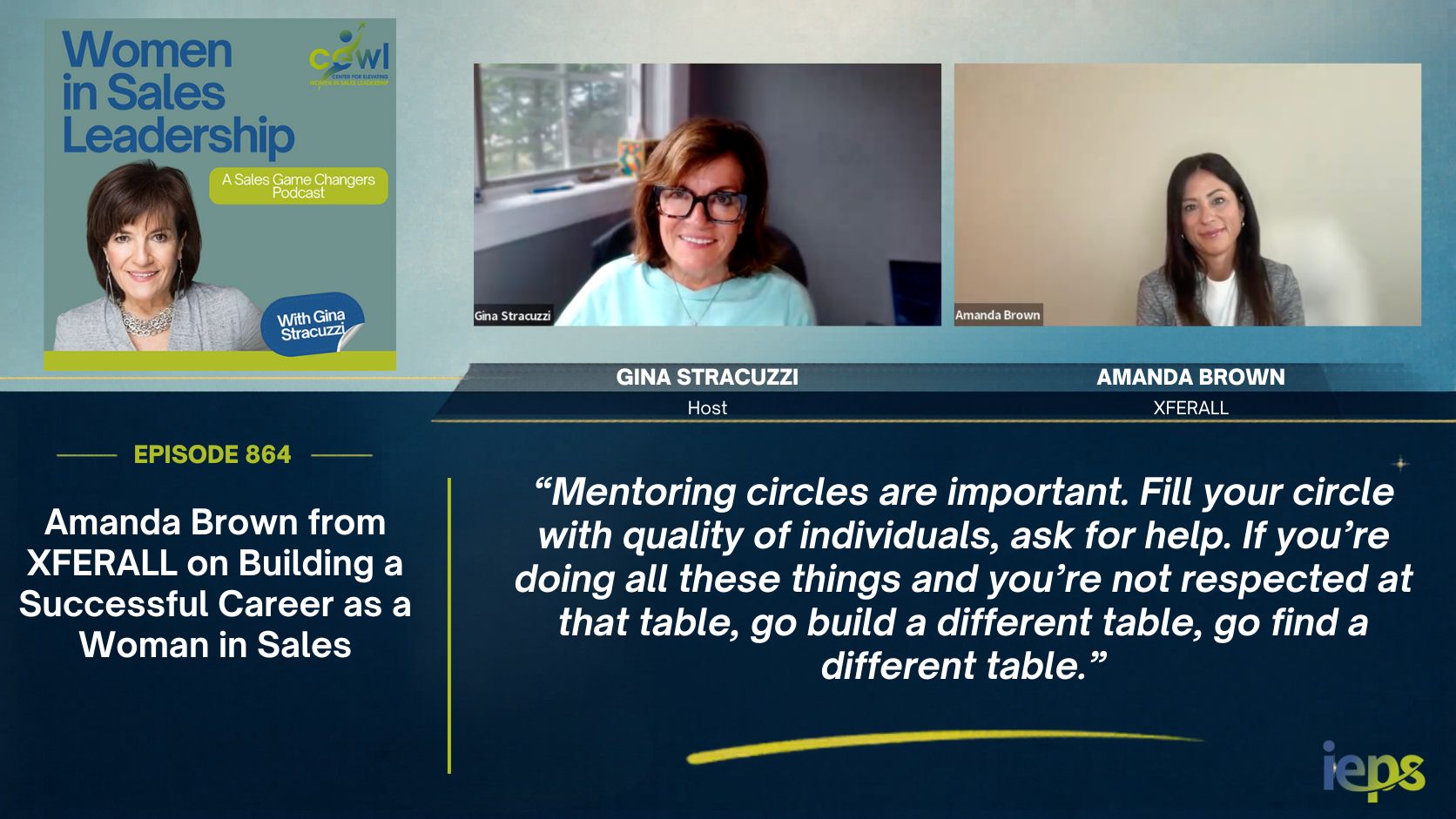
AMANDA’S TIP: “Mentoring circles are important. Fill your circle with quality of individuals, ask for help. If you’re doing all these things and you’re not respected at that table, go build a different table, go find a different table. A lot of times we hold on in roles way too long, and you have a choice.”
THE PODCAST BEGINS HERE
Gina Stracuzzi: My guest today is Amanda Brown. She is senior VP for XFERALL. Welcome, Amanda.
Amanda Brown: Thank you, Gina. It’s a pleasure to be here.
Gina Stracuzzi: I like to have my guests introduce themselves and tell us a little bit about how you got started in sales and if this was your chosen career or something you fell into and just decided this was for you.
Amanda Brown: Interesting enough, out of high school, I thought I wanted to be an interior designer.
Gina Stracuzzi: Me too.
Amanda Brown: Quickly realized that was probably not my path and we all have our own stories and we’re all writing our own stories and chapters. Right before I graduated high school, moved out on my own, thought I could rule the world as a young adult, and started working in corporate America at the age of 18. I did a lot of admin jobs trying to figure out and navigate what I wanted to do. I enrolled myself in community college and went part-time at night. Started working a lot of administrative functions, customer service, order entry for someone who had little to zero experience.
The first company I ended up landing my feet in, we had a female sales leader there and I worked in customer service, completely different department, and I was so inspired by her. She was so strong the way she came in and she just commanded the audience and I wanted to work for her. I had spent several years in another department just doing everything I could to outperform my roles and responsibilities and finally got the opportunity to join her team.
It was an inside sales position. It was a lot of cold calling, a lot of outreach. I was very green and early in my development, but I wanted to prove to her that I could do it because she gave me an opportunity, and then ultimately prove to myself. That’s really how I got started in sales. She gave me that opportunity and I never looked back from there. It’s been quite a journey.
I’m about 25 plus years into sales leadership, operational roles. But from that early on period, in those first few years, I outperformed my team. I was the youngest professional on the team. I made the most amount of calls. I drove engagement. I started cross training my colleagues and peers. They wanted to see what I was doing. By the age of 22, I was promoted into management leadership role of the sales team. It was really about learning and listening and seeing what was working. I’ve carried a lot of those skill sets in my career. But that’s really how I got started in my sales journey.
Gina Stracuzzi: I love that you had someone to look up to and aspire to be, because that’s not always the case. A lot of my background is aligned with yours in that I went to community college, I moved out early, worked for companies, and I was like, “I could do that job. I could do that job,” kind of thing.
Amanda Brown: That’s a rarity too, to have a woman in sales as a leader. Thinking back and reflecting, seeing her, everyone thought she was super tough. I looked at it, I was like, “She’s super disciplined,” and her strength and just watching her navigate. I’ve stayed in touch with her for many, many moons after, but she really was the one, she said, “You know what? I’m going to give you that opportunity.” I didn’t have any experience, but she saw that I was willing to put in the work and learn and really just listen and learn from others. It was a rarity at the time, and now I will do everything I can to encourage everyone, but also rising women who are also looking to enter into sales careers and leadership as well, whatever I can do to support.
Gina Stracuzzi: I love hearing that. My theory about women is if we don’t all rise, nobody rises. You got to bring people along with you. That’s a great story. I love that you stayed in touch with her for such a long time, too.
Amanda Brown: She’s a wonderful human. That’s for sure.
Gina Stracuzzi: That is really great. You’ve spent now more than 20 years leading growth in healthcare technology. Let’s talk about how that field has changed over 20 years, and how you used what I consider some of women’s superpowers like empathy that comes naturally to us. How have you used that to do the growth of yourself and others on your team?
Amanda Brown: Empathy is the perfect word. I use it often. Interesting enough, early in my career, the first six or seven years, it was a completely different industry. Having a family member that had also worked in healthcare, I realized I’d outgrown and didn’t feel as connected to the prior industry I worked in, and so I started looking at healthcare opportunities. I was second pick for an opportunity at a Fortune 500 company to manage an early-career sales team.
Once I joined the company, I really started to look at these were early-career sales professionals, I was building up this sales leadership development program for the company, is being able to connect and really listen and empathize with others the more I learned about healthcare and who you are partnering with on the other side. A lot of times it’s clinical leadership, they are thinking about patient care first and foremost, they’re thinking about their staff that are taking care of patients. There’s a vulnerability and a human connection in that aspect of patient care, that you really have to take a step back and understand, what am I selling to them? If you’re thinking about selling a widget, or you’re thinking about your number, all of these other areas from a metric perspective, then you’re missing the mark.
I started building my teams to really want to understand and connect with the individuals that we were selling to and empathize with them, put yourself in a day in the life of a clinical leader, who’s got patient care, patient escalations, patients dying, patients sick, nurses calling out, nurses with family members that are sick. Empathize with them and understand that they are thinking about a lot of different areas, all while trying to make sure that patient care is being delivered at the highest level of quality.
All of the teams that I’ve had the opportunity to lead and build, I always encourage them, find a connection to the human on the other end, it’s really, really important. Also, find a connection with what you’re selling and the impact it can make. Historically, in the last 20 plus years in healthcare, I have gone to work for companies that I feel are high impact to the work that we do, that I can feel connected to the mission, I can feel connected that we’re actually helping improve the system, versus a widget. There’s a whole role for widgets and selling from that perspective, but for me, being personally connected.
When I hire talent, I’m looking for individuals that also feel personally connected to wanting to make a difference. That empathy becomes really, really important that people can connect to at a human level. It’s something special and all the teams that I’ve had the opportunity to build, and I can speak on behalf of my team now, every individual is connected to our mission. They’ve seen someone that’s been affected in the healthcare setting and they want to be part of making it better. Empathy is really, really important in the healthcare arena, especially really understanding the enormous amount of constraint and pressures these healthcare leaders are on.
Partly why I’ve stayed in healthcare, it’s just so many areas. The healthcare industry has been faced with funding cuts. We have our baby boomers are retiring. We don’t have enough nurses to clinicians to support the care that’s needed. On top of that, we’ve got technology that’s rapidly changing way beyond these organizations can realistically adapt to that change. As partners, we can help them through that journey.
Gina Stracuzzi: What you’re describing in so many ways are traits of a really great salesperson. You step away from what you’re trying to achieve and figure out what your client or potential client needs to achieve. What are their pressures and what’s happening to them? We do so much work with technology companies, a lot of them who deal with the government, and it has been a wild ride for the last 16, 17 months. It made me think like, that patient is on lifelines, some days it feels like that. I can see the parallels there very much.
Something you said when you were talking about how things are changing so rapidly in healthcare technology, do you have a sense of how AI is impacting healthcare technology and how that changes how you sell to the healthcare field?
Amanda Brown: I do. It’s probably one of the hottest topics. I actually just left an event last week, it was a conversation around AI and technology and innovation. We were at the same event the prior year and it was the healthcare ecosystem, it was really focused on, how do we governance? What does it mean? How do we make sure AI is not making decisions and our clinicians are making decisions? How do we make sure it’s used in a way that doesn’t disrupt care, but it supports our clinicians and the work that the teams are doing? It was more on governance and structure and a lot of fear over the last few years AI is going to replace. Now we’ve shifted beyond that.
The conversation is, how do we bring the right change leaders between IT, clinical, and operational together and make sure that the AI that we’re implementing has meaningful impact to our patients and our staff and our organization. Many of them had already finished mini pilots and are widely adopting. Almost every healthcare organization is adopting AI in some form or fashion.
Understanding those shifts, AI is also very expensive for these organizations. They have to be meaningful. They really have to think about where are they using it and the impact that it’s making. As we think, even as far as selling and bringing AI solutions into the healthcare ecosystem, you really have to know the value and the impact that the AI is making. It has to be measurable. It has to be ensuring that it’s not making decisions on behalf of patients, it’s supporting our clinicians, the medical staff and their roles so they can continue to do the great work and do it even faster and better and with more quality.
When we sell AI solutions out, we really have to be thoughtful, because you could go in and say, “This is going to reduce your staff time by X,” and all of the clinical leaders, it was like, “I can’t get rid of my staff,” immediately. You have to be thoughtful in what’s the value and impact. But these organizations that are going through, almost all of them, as I shared, they’ve adopted some form of AI. Even on the vendor and the partner side, every company is using AI. But what does it really mean for patient care? What does it mean for the clinicians? You have to really tie back to the impact that you can bring in all these organizations, because they have so many AI projects that they’re piloting or looking at, they have to also prioritize. Where you can align with what’s important to them and their goals, that’s first and foremost, for sure.
Gina Stracuzzi: This might be a good point in the conversation to tell us a little bit about your products and services. Not a commercial standpoint, but just give us a sense of what you do as a company, because then I really want to get into how do you coach your salespeople in this changing market?
Amanda Brown: The current company that I am, and I’ve had the opportunity to be part of the journey for almost five years, we are a healthcare technology partner. Our platform is really designed on helping patients get from one level of care to the next in this care coordination network. We do a lot of work in behavioral health. In behavioral health, one in eight patients that show up in emergency department front doors is facing a psychiatric crisis. There’s a lot of clinical administrative burden that these individuals are having to, once they determine the patient needs to get to a higher level of care, they’re calling and faxing to try to find an available facility to transfer this patient to. Then on the other side, these receiving psychiatric hospitals, they’re getting all these calls and faxes.
You can just imagine the call, someone sitting there with calls, faxes, walk-ins, patients right there. Our platform provides a real-time care coordination platform that helps them clinically locate and gain acceptance, exchange securely in real time to get that patient transferred so they can get the care that they need. We create these networks that connect everyone together and it’s really helped reduce the ED boarding time, patients getting out of crisis, into appropriate level of care. We’ve seen tremendous growth because it’s been such a high need.
Every patient that comes into a hospital and the four walls of their emergency department is getting care faster by moving the patients that are not in the right clinical setting to the appropriate level of care faster, regardless whether it’s behavioral health and others. We’ve seen a rapid growth from helping patients and helping these health systems and behavioral health providers become connected for better patient access and care.
Behavioral health is a conversation for a different day, but it’s definitely a demand in our country and people need access. They need access to services and care. We need to be helping our clinicians locate so they can get back to the bedside of caring for patients and not spending their time on administrative burden. As we lean into how we partner with these organizations and how we leverage our sales team, it really is about understanding where those bottlenecks, where those impacts are. The more we can understand that, the more we can pathway into helping these organizations help those patients get to where they need to be.
Gina Stracuzzi: I can imagine, it’s a big need, and sadly, growing. Let’s talk a little bit about how you’ve helped the organizations that you have been with achieve significant growth. Really, one of the things we like to talk about on the podcast is how leaders build really successful teams and bring them up and get them ready for leadership or for greater roles. How do you go about it?
Amanda Brown: I’ve actually had the opportunity, several times now, to build net new teams from scratch. One of the first areas when I join a company is I really want to make sure I understand what are we solving and what’s the impact, and who are we selling into and what the dynamics are. I actually like to roll up my sleeves and actually work some opportunities with partners first. I’ve done that at the last few companies. I’ve had the honor to lead and grow teams at where I wanted to go sell the solution first.
It’s not something that can always be done, but I like to really understand, and really understand who the buyers on the other end are and what they care about and start to determine what is the skill set of the teams and the talent of the teams that we need to develop and build that can really understand, empathize, and align with the partners that we’re looking to expand into from a growth perspective.
Even when I joined my current company, I wasn’t quite sure. Building out care-connected networks, there are two different sides of that. It’s an ecosystem. If you go look on a sales resume, you’re not going to find a lot of ecosystem connected networks where they’ve built up in a very complex, and healthcare is very complex, and so it’s not a transactional sale. I started to look at building up a team of individuals that had that relationship. They knew how to connect relationships and found meaning and understanding, well, this CNO makes an impact here. This then impacts the COO from an operational perspective, and how they navigated.
I diversify my team, their experiences. I’ll look and see, do they have a nursing background? Have they worked in this field? Every team member has a different experience and perspective that they’re bringing to the team, and strengths that they’re bringing to the team. When you do that and you bring them together, it’s pretty significant of what you can get accomplished, and everybody is rowing at the same beat. I’ve got individuals that are very, very strong on their communication skills and articulating value and they can go present at a large conference and present to executives. I’ve got individuals that understand the daily life of a nurse and what it means at an in-user level and being able to connect at that level.
I’ve always tried to build out and blend those teams from a strength perspective. The sales leaders and growth leaders, there’s a couple of times I feel like in your career, you hit a special point where everyone is working together, helping each other. You’re in this sweet spot of a company growth that everything is moving at a very healthy pace and the impact that you’re making feels really, really good when you put your head down on the pillow every day. Even if you didn’t accomplish everything today, the next day you are just as excited to wake up and make an impact.
When I look to build teams, I really look at a variety of experiences. I also try to make sure that we’re sharing those experiences and creating opportunities for the team. It’s not my role as a leader to go tell them what to do. They are the experts. I’m there to support them, to help elevate them, to bring strengths when they need strengths, and to help strategize with them and giving them that runway to do that has allowed me to maintain higher attention on all my growth teams and even bring individuals and leaders along with me. That’s been a special part of the journey of just building out growth teams at multiple healthcare technology companies thus far.
Gina Stracuzzi: I like that approach. You are in a unique situation team wise, where having people with lived experience in the medical field is probably crucial to their success and in your success as a company. Whereas quite often in the straight technology sales, it’s on-the-job training and on-the-job learning about how the end user might be using the product. This is really quite fascinating to me.
What advice would you give to women who are especially in their early sales career, and especially if they’re aspiring to leadership roles? What lessons do you wish maybe that you knew before you learned them the hard way?
Amanda Brown: Definitely they were learned the hard way, not having a forged path ahead. Some of the lessons that I would share with rising women who are looking to either go into sales or in leadership, one of them is start to look around and observe the leadership around you. There is so much that you can learn through others. Find those qualities that you’re like, I want to be like them when I grow up in my career, and go meet with them, connect with them, build a mentoring circle around, having a strong support system. I often felt like I was on an island alone. It wasn’t until probably the second half of my career that I realized and really started to take advantage, where I had a strong mentoring circle, and both men and women. Those perspectives are equally important.
Being able to build mentors around you, and you also have a role in that, because you can be a mentor to others. A lot of women think, “Well, I don’t know where to start. I don’t know where to begin,” but you can begin by helping others too around you. I spent a lot of my early years, and that’s how I went into management and then really developed my leadership skills, was through helping others. Instead of saying, “I want to be the top sales performer,” and all I care about is me and my numbers and my financials, I wanted our entire team to be successful. I was willing to sit down and happy to just share what I was doing, and not in an egotistical way, but help them. When people genuinely want to be helped, or they’re like, “I’m not meeting my number. Why don’t we just sit down? Maybe we can brainstorm and come up with some ideas.”
Definitely start to build a mentoring circle. You can also learn from the traits of individuals that don’t make you feel good. You can learn just as much from those individuals, whether they’re leaders of the company or colleagues or you see the tactics, learn what not to do, put that in your toolkit. I have learned just as much from those experts and carried those forward and I’m like, “That is definitely not what I want to be like. What would I do differently?” You have to ask yourself because you can always point out things that you don’t like, but what would you do differently? You start to change your mindset and how you think and you’re like, “Well, I would do this differently.”
I’ve always said, I’m CEO of myself. But if I was running my own company, even to this day, I know things that I will do differently. I’m excited about those opportunities. But mentoring circles are important. Fill your circle with quality of individuals, ask for help. If you’re doing all these things and you’re not respected at that table, go build a different table, go find a different table. A lot of times we hold on in roles way too long, and you have a choice. You can make that choice any time to leave, and there’s a strategy and a process to do that. If you network and you have that strong mentor circle, they can help support you through that transition.
Gina Stracuzzi: Amanda Brown, thank you very much for this conversation. Give us one piece of quick advice that people can put into place who might be listening to the podcast, or something to start thinking about today?
Amanda Brown: One piece of advice is when you sit down every day and you’re thinking about, what did you accomplish? What were the goals that you set? What did you accomplish? Maybe you didn’t accomplish everything you thought. Reset yourself. Don’t get lost in that. Or if you had a deal that went wrong or something that just went away, I have found if you can reset quickly and redirect those moments, it fuels your acceleration in whatever you’re doing. But a lot of times we get stuck because we didn’t accomplish something, or we lost a deal, or something went awry.
I’ve seen talent over the years that have gotten stuck in that moment for way too long. It’s okay to acknowledge it and find your lessons learned, but just find that reset button quickly. Next hour is a new hour. Tomorrow is a new day. When you can reset and use that as fuel, you’ll just accelerate so much quicker and faster and accomplish your goals faster.
Gina Stracuzzi: That’s great advice. Acknowledge what went wrong and move on. I love it. Thank you, Amanda. Thank you, everyone, for listening and we’ll see you next time.
Transcribed by Mariana Badillo