
Watch the video of this podcast on YouTube here.
The Sales Game Changers Podcast was recognized by YesWare as the top sales podcast. Read the announcement here.
FeedSpot named the Sales Game Changers Podcast at a top 20 Sales Podcast and top 8 Sales Leadership Podcast!
Subscribe to the Sales Game Changers Podcast now on Apple Podcasts!
Purchase Fred Diamond’s best-sellers Love, Hope, Lyme: What Family Members, Partners, and Friends Who Love a Chronic Lyme Survivor Need to Know and Insights for Sales Game Changers now!
The Institute for Effective Professional Selling has launched the Partner Revenue Academy for partner account managers who are looking to become more effective active sellers. The next 6-session cohort launches on September 11.
Learn more here.
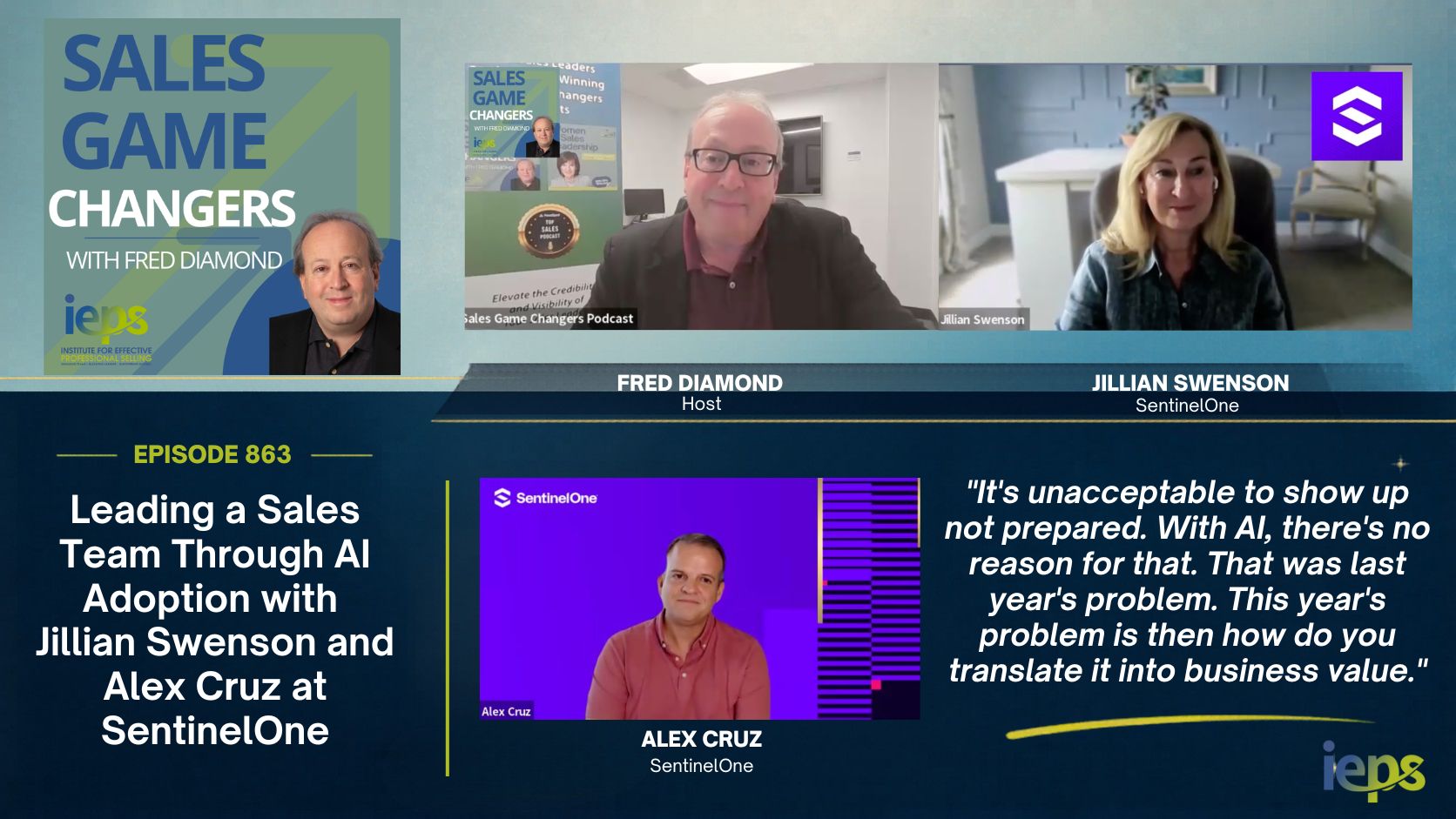
Today’s show featured an interview with Jillian Swenson, Vice President of Federal Sales, and Alex Cruz, Senior Director of Global Field Enablement at SentinelOne.
Find Jillian on LinkedIn. Find Alex on LinkedIn.
JILLIAN’S TIP: “It’s unacceptable to show up not prepared. With AI, there’s no reason for that. That was last year’s problem. This year’s problem is then how do you translate it into business value.”
ALEX’S TIP: “AI is amazing. It does just crazy things for reducing time as a rep. But without guardrails in place, it can get you in some hot water if you send something over that’s generated and you don’t do trust but verify. We’ve all come through that frame of thought. We have to verify AI.”
THE PODCAST BEGINS HERE
Fred Diamond: I’m very excited. We’ve got Jillian Swenson and Alex Cruz with SentinelOne. Jillian and Alex, just give us a brief introduction, what you do with SentinelOne. I’m excited that we’re going to get very deep into how you and your sales organization are using AI tools to be more effective.
Jillian Swenson: I have recently joined SentinelOne as the vice president of federal. When I did this show before, the closing question for me was, what’s your best advice to sales leaders? I said, if you’re not using AI, you’ve got to embrace it. When Fred reached out about me doing the show again, I’m like, well, let’s go deep on AI and talk about that. I’m excited to talk to you today, Fred.
Fred Diamond: That was a great bit of advice. That was close to two years ago. You were ahead of your curve. Good for you. We’re doing today’s interview in July of 2026. It’s a different world as it relates to AI. We’re going to get deep into how you’re directing your selling professionals. Alex Cruz, give us an introduction.
Alex Cruz: Been with the company for five plus years. I’m the senior global director of field enablement at SentinelOne. That means onboarding, field enablement, obviously everything on productivity. AI is close to our heart in making sure that the field has what they need to be successful.
Fred Diamond: I’m glad to have you on the show because we’ve done a lot of shows, we’ve done over 850 Sales Game Changers shows. We actually have a special sub-brand called AI and Sales Brief, where we get into the ties with AI and sales. A lot of it has evolved a lot since we’ve been doing this over the last year. The podcast has been around for nine years, but AI topics, and Jillian was one of the first people to get us started.
Alex, why don’t you get us started here. Every sales leader is talking about AI, thinking about AI. However, many have struggled on how to standardize and manage across the sales process and with the sales organizations. What made SentinelOne decide that this wasn’t something to watch, but something that your sales organization needed to embrace?
Alex Cruz: This is something that when Jillian came on board, she said exactly that. She is just firsthand all AI. How can I use it to be a better leader, but also how can I really unlock productivity within the sales org? For us specifically, at enablement, it’s all about how can we really enable the teams on the right workflows? What are the repetitive tasks that you’re just drowning day in, day out that AI can automate? It honestly goes to our DNA as a company. If you look at SentinelOne’s history, way back when we were founded 13 plus years ago, Tomer Weingarten really looked at all these threats coming in, and we were a signature-based antivirus, how can I use AI and ML to stop attacks at machine speed?
When we’re thinking that and flipping that on the sales productivity side, how can I look at a sales person’s day and see what’s taking so much time? There’s just so many areas of account research, proposal building, RFIs, RFPs that are just drowning a sales, and even account team when you think about a sales engineer, and all the other folks that are involved in that process that are just eating up time. For us, it’s how do we really provide the tools necessary that an account team has to automate a lot of those tasks and get some more time back in their day?
Fred Diamond: We’re going to be talking about the tools in a second here. I’m going to ask you to take us through some of the tools. A follow-up question, Jillian, I’m going to have for you is, we talk a lot now about workflow and how AI needs to compliment the selling professional’s workflow. I’m excited to ask you that question, but first, Alex, give us a little bit of an orientation. You mentioned several different AI platforms. Walk us through some of the different tools your team uses. More importantly, why would someone use Gemini versus Claude versus maybe a tool like Actively. I’m sure you’ve gotten deep into them in the sales process. Which performs best at the various levels?
Alex Cruz: This is honestly one of the very first questions we got when we were starting to go heavy on productivity for AI. There are so many different tools and a lot of times there’s overlap. We are a Google shop. I think definitely on Gemini, NotebookLM is an amazing tool, which can do amazing things for account planning and really just building together really good notebooks for all of your accounts. We recently got Claude this year. That is still a learning journey. I won’t say that we are experts in it, but we’re making a lot of great strides in it.
Then as we’re thinking about really the agentic form, because a lot of the enablement that we’ve had was more of using these tools to be more efficient. But how can we leverage a tool that is going to go out and be an agent working for you 24/7, where it’s looking at signals, buying signals, looking at a recent podcast like this and saying, hey, there is an account that is matching the ICP and matching these buying signals that you should engage and reach out. This is where we’re really taking it to the next level of leveraging AI to be more proactive and more engaged in those early sales cycles.
Fred Diamond: I love that because there are so many tools and what a lot of people get wrong, we think, is that they focus on the tool. Especially in enablement, there are thousands of tools at this point, if not tens of thousands. You could spend all the time working on tools and it’s really about the workflow.
Jillian, why don’t you walk us through the typical sales day with AI? Where does AI show up for the first customer interaction until the opportunity closes?
Jillian Swenson: We’re actually seeing a big shift there. Even just five, six months ago when I joined, got with Alex’s team, started looking at it, and my team had not embraced AI much. I was a power user, really experienced on Claude. My first thought was, well, how do we start doing that basic research? That is where we started. Then we started to get more focused on what Alex touched on, which is how do you take the work out of routine activities? If you’re putting together a presentation, you can leverage Gemini to create your Google PowerPoint, for example. Or if you’re putting together a communication, what does that look like?
Then I had my team doing things like their account planning, using a tool that Alex’s team built that’s like, our account plan is going to look like this, going to leverage everything underneath. We started doing more of that prep and research. But now with the implementation of Actively, we’re starting to switch into the more proactive, strategic focus on a daily basis. My team is just getting up to speed on that. It’s a new implementation for us. We’ll have to do this again in a year, because I’m sure it’s going to have completely changed at that point, but it really is about starting to just look at your workflow and figure out where it is not a high value, high experience task and shift that work over to an AI tool.
Fred Diamond: Most people probably know about Gemini and Claude and ChatGPT. Could you tell us a little more specifically about Actively, about what actually it does, how it’s used? To be frank with you, it’s not a tool that I’m particularly familiar with.
Alex Cruz: Actively is really an agent that’s trained on the vast majority of our systems internally. That’s also hooked into LinkedIn, into ZoomInfo, into Demandbase, which is our buyer intent tool. What it’ll do is crawl the internet. It crawls basically all of the signals on LinkedIn and then basically compares it against all of our internal systems that will essentially Slack a rep, an SDR, an account team as soon as there’s intent. As soon as it identifies there are some signals going on with this account, that marks an engagement. That’s not just a signal of, hey, go reach out. It provides buyer from LinkedIn. It also will provide a customized email. It’s basically doing a lot of this guesswork of, okay, which accounts do I need to really start engaging with?
I think this is the one thing that gets me most excited about AI. It’s like, when you have this account base and you were hunting, and we all were there before when we didn’t have AI, and you were looking for something, you were looking for some diamonds in the rough, a tool like Actively will literally eliminate a lot of that, just that time space of here’s someone in the market that right now is searching for a problem that we can solve. It does a lot more, but that’s really the intent behind it, a 24/7 agent that’s working for you to find those ripe accounts.
Fred Diamond: Jillian, I’m going to ask you in a second about some of the biggest promises with AI and what some of the things are that you’re seeing from an improvement perspective. I’m going to ask you a very basic question. Alex, you just mentioned LinkedIn, maybe Jillian, you can chime in, again, most basic tool that there is right now, probably one of the biggest tools in B2B and B2G, etc. How are you instructing your sales organizations to use LinkedIn? Very basic question, very basic tool, but I’m curious, we’re getting deep into the AI, what’s your advice and strategy for them on using LinkedIn?
Alex Cruz: LinkedIn for us, it’s critical. We have LinkedIn Navigator and that’s something that we use to really understand where the contacts are. Again, just understanding their profile, matching up honestly with us, understanding who we have relationships with within SentinelOne that could actually broker a meeting. That’s something that we use very heavily here within SentinelOne, and then just understanding that profile of do we have really good buying intent also with openings of job boards?
AI security is top of mind. If they’re actually going and hiring a lot of AI data scientists, a lot of web developers, AI right now, we’re looking for those job roles on LinkedIn, which are mostly posted, and using that as buyer signals. Jillian, go ahead and share more.
Jillian Swenson: We’re doing all the typical things, social amplification, driving people to our events that you’ve historically seen. Where I’ve personally used it and seen my team using it more recently is having that outreach very customized. Having the research done across their public profiles, not just LinkedIn, but where they’ve spoken publicly, articles someone might have published, and really getting a sense of what that person is trying to drive at their organization before you do the outreach. Doing the background research and then actually customizing it.
I was sharing with Alex recently, I was doing a cold outreach to three different C levels at the same company, and I wanted to make sure that the messaging was consistent, but was completely customized to their particular role. Having Claude just rapidly do that, it would have taken me maybe two hours to craft a great response, and I was able to take that, do it pretty quickly, but the only thing I changed was the first responses didn’t sound like me. They were flowery, they were long, I’m like, oh no, that’s not me. Let’s just get to the point, make the ask, use the data, and go.
I was able to work with Claude and send it to my previously written emails so they could have more of my voice and tone. I think that’s important. We talked a lot about AI slop. I get stuff in LinkedIn every day, just delete, delete, delete, because it’s just spam at this point, and I don’t want to show up that way to our customers.
Fred Diamond: Jillian, let’s get back to some of the biggest promises of AI, and of course, one of them is speed, and hopefully speed being more productive. What are you seeing as some of the biggest gains with your sales organization? You mentioned prospect research, account planning, writing emails, writing LinkedIn requests. You just talked about collaboration amongst groups. Are your sales reps getting faster? Are you seeing improvements from them by better utilization of all the tools we’re talking about?
Jillian Swenson: A thousand percent. Just looking at typical sales cycles like, how to do annual planning, how to prep for account reviews with a customer, they’re leveraging the tools and it’s making it better, more effective. What I will say, particularly with Claude, is that as you move up the maturity level and working with AI and you stop using it just as like a super Google, and you really start refining things and having it as a conversation with Claude, you get a much, much higher quality product out of it.
I’ve had results come back initially that aren’t quite right, and my experience allows me to say, that’s not quite right. Let’s tweak it a little bit. We found that if you are working iteratively with Claude in particular, that it gets very good at actually recommending approaches to take, it will often give you three options based on the research that you provided it and things like that, and help you really hone your messaging.
Fred Diamond: AI, Alex, becomes more powerful when it’s connected. You’ve already begun to talk about some of the ways that it gets connected here to various other applications, but talk about how you’re integrating AI with platforms such as Salesforce and maybe Highspot. How does that change the seller experience? Because everything we’re talking about here is designed to make your sellers more effective. I run the Institute for Effective Professional Selling. The reason, in May of 2025, we changed our name from the Institute for Excellence in Sales to the Institute for Effective Professional Selling, because Jillian, we talked to 200 people like you, senior sales leaders, who said, coming out of the pandemic, our people just need to be more effective at 30 different things.
Alex, I’m getting from you that you really enjoy this, that you really enjoy community solutions.
Alex Cruz: You got to be passionate about it. Yes, exactly. I love what I do. As any good enabler, I definitely held a bag for many years, had a passion for mentoring, and here I am. That’s what I love. Seeing other people really get successful is something that I crave.
For the integration piece, and I think this is what’s critical, and it might parlay into another question you have just around areas that we’ve seen as concerns or issues that we’re seeing across the Salesforce, but it’s critical that we connect into Salesforce, just making sure that all the data is hooked in there. If you want to query your account base, if you want to query an account, the next steps to win have to be we’re really diligent on having that deal and the opportunity at the next step level, so getting into those areas.
Highspot for us is really our source of truth when it comes to content, when it comes to sales plays. Leveraging that content when we’re querying Claude and making sure that there’s guardrails in place. AI is amazing. You can definitely spend just any amount of times building great content, but if you don’t have guardrails that are really making sure that we’re staying on brand, that we’ve got really our key value messaging, then it’s going to have a tendency to hallucinate. There’s no way that you can just eliminate hallucinations unless you put some guardrails in place.
Another example is really big on value quantifying value. We’re solving a lot of big pain points, a lot of time back into these security teams. If we just trust AI without any checks and balances, who’s to know that that calculation is right? We do have a business value assessment tool, which we’re now working on integrating within all of our AI stack, so that when you say, hey, I want to create a value assessment, a cost ROI analysis, it actually is using guardrails to eliminate a lot of the hopeful calculations and content that’s built without some guardrails. That’s a little bit of things that we’re dealing with now, which I think the folks on the call would appreciate.
Fred Diamond: I want to follow up on the guardrails. How do you encourage experimentation while making sure that customer data, messaging, compliance and quality stay protected? I know that SentinelOne has a tool related to that. Would you mind addressing that now, the whole concept of guardrails?
Alex Cruz: The guardrail piece, and this is something that when we rolled out Claude, we saw just a lot of amazing innovation, where specifically the SEs, the engineers, were first that bad of creating these amazing skills and just these things that other people could use. What we did is very quickly established an SE innovation center to just go and make sure and see, okay, is this something that we can leverage internally? Is it customer-facing it needs definitely a lot more checks and balances and governance? We have a good process of inorganically trying to surface up some really good talent and just skills that an SE may be using in Vancouver, that could be something that could be applied globally. That’s something that we’ve had really good success in.
Also, as a company, for engineering and support, we also have an area of review for skills and then making those publicly available. Speaking about the human piece that Jillian was saying, we’ve all seen those AI-generated emails. We actually have a humanizer skill that will go in and crawl your emails and look to see your voice of tone, your inflection. How are you speaking on Zoom and making sure that your AI-generated communications out to the customer are in a human nature and they’re not AI with all the hyphens everywhere. But going back to essentially the solution, I think this is something that’s really one of the fastest growing lines within SentinelOne, is prompt security.
Shadow AI is rampant everywhere. Before we had a lot of these guardrails in place, you can imagine employees just want to leverage AI. They’ll go on to their own personal instance of ChatGPT, of Gemini, of Perplexity, and start loading up possibly some sensitive data, like account information. You want to build an account deck, but you’re using your account information on these personal websites. This is a severe risk, which obviously a lot of companies are grappling with. We have one of the best solutions here that cannot eliminate the use of shadow AI, but enable safe use of it.
This is imperative that companies shouldn’t stifle innovation, but you have to have some guardrails in place. If there’s sensitive information, we can either redact it, stop it, and then actually give a bit of information back to that employee of this is why we can’t have you loading this instance of information, and then also making sure that we’re staying within separate governance and guardrails. Obviously, data compliance is massive as well.
Fred Diamond: Alex, one of the things we’ve talked about as social media got big was how do your people represent the company on places like LinkedIn and Facebook and Instagram or other types of social media? That may or may not have been a huge challenge. But you also mentioned developing SentinelOne-specific AI skills. What does that mean? Your employees represent SentinelOne. Yes, they’re human beings. Yes, they have hobbies, hopefully, and maybe kids in Little League and maybe political views and whatever it is that they want to get out there, but they’re representing SentinelOne in the work environment. It’s a little bit blurry. How do you make sure that their usage of the AI reflects SentinelOne positioning, competitive differentiation, and best practices? Tell me if that’s a big challenge and how do you do that?
Alex Cruz: Internally, for sure, hooking into Highspot, number one, enables us to make sure they’re on brand. These are things when they’re developing custom content, we want them to tailor content. You don’t want boilerplate decks going over and just assuming these are the challenges you’re dealing with. We want them to customize until the content, but we also want the main narrative to be involved there.
Going back to social media, we have a really good social and brand team, which will build out LinkedIn posts on key announcements, on key thought leadership pieces. Ensuring that they’ve got a good baseline, we encourage a little bit of flexibility. To Jillian’s point, we want to make sure that it’s supporting her federal DoD and CIF teams. But at the minimum, as a company, we should be supplying that overarching narrative, that key areas of differentiation, and then from there, we’ll tailor it. But yes, that’s the key thing of hooking into a lot of our systems and also working closely with our social and brand team so that sales teams are leveraging the approved content that should be going out.
Jillian Swenson: We actually have a resource spread that specifically focuses on taking that core messaging and then making it appropriate for the public sector, particularly federal customers, because some of the words are different, some of the way you talk to those kinds of customers are different. We want to make sure that we have the appropriate wording approach with our federal customers that are slightly different than what you’re going to see in the commercial space.
Fred Diamond: Jillian, you told me that adoption happens when leaders model the behavior. Talk a little bit more about that. What are you directing your management level people, your sales managers, what are you directing them to do differently that encourages sellers to embrace all these great tools? Obviously, we’re bringing on Alex. He’s obviously doing a lot of things. The company’s investing a lot. You wanted to come on the show to talk about some of these great things. How are you directing your leaders to make sure that it happens?
Jillian Swenson: My poor team, they probably hate me at this point, but I found Alex’s team in my first week at SentinelOne and just started asking them all kinds of questions and using all the tools and probably asking them for things like, we hadn’t thought about that, and really leaning in. That’s why Alex and I are both so excited to be here today.
I started with just getting an evaluation. Where was the team using any of the tools? I honestly did not see that much adoption. I started to make it non-negotiable. We said, we’ve got this meeting coming up and we’re going to talk about this topic. I want you to use this tool. One of the things Alex’s team created was a strategic deal coach almost. It would say, I’ve got this opportunity. You could actually put in very little about it. It was surprising how much you could get out of the tool. I’ve got this customer. Here’s what I’m trying to talk to them about. Fairly minimal requirements to enter. It would come back with an entire play.
We use Command of the Message as our sales training. It was completely aligned with Command of the Message. It would give you a way. We were in the process of adopting AI and adopting Command of the Message, and this tool really brought it together and made it impossible for the account executive to not comply with both requests. It made them much more productive and it got the adoption level up very quickly.
Then it went into the second phase where it was like, oh, I’m asking you a question. If you come back to me with an answer and I can’t tell that there was some deep AI work in here, I would go ask the question. I’d say, oh, what you gave me was okay, but look what I was able to get in 30 seconds. Then they’re like, oh, no, now we need to get serious. You’re going to check. Then it was more proactive on their part. Now I think we’ve come out with Claude in particular, it’s a much stronger tool. With the investment in Actively, now I’m seeing my reps starting to across the board just embrace it.
Fred Diamond: Jillian, I want to ask you a general sales leadership question. We talk about the fact now, we’re doing today’s interview in July of 2026, sales professionals have always had to bring value, now, more so than ever. One of the great things about the AI tool that you’ve touched on, it can do a lot of research into what your customer’s direction is. Especially with public sector, there’s never been a problem with knowing where government agencies are going, because it’s public information. Of course, you had to read a lot of things and you had to research. Now at the flick of a button, you could figure those things out. How are you leading your teams to help them bring or at least show the customer value?
The customers don’t need to be talking to salespeople because they can go on AI as well and type in, what is SentinelOne’s direction, or what are the tools that you fit in with your competition’s direction? They don’t need you to sit for a day and go through a product roadmap. How are you instructing your reps? Alex, if you want to talk about non-public sector, or your thoughts, how are you helping them use AI, not just for the productivity sub, which we touched on, but to bring more value to the customer?
Jillian Swenson: One of the things that Alex mentioned earlier on was our business value analysis tool. I have one sales rep that has just been all in on that tool from day one. We actually hold her up as the model for how that tool works. It is not just, oh, plug in some numbers on some ROI spreadsheet that a lot of people have historically put in front of customers. It is a very structured analysis that shows if you move to this platform, here are the various areas we can bring value back to your business, and to have that business-based discussion. I think it’s one of the primary areas.
It’s unacceptable to show up not prepared. With AI, there’s no reason for that. That was last year’s problem. This year’s problem is then how do you translate it into business value? It’s particularly challenging in the federal space where you’re not looking at an annual report and going in and saying how I can increase your earnings per share. It’s a very different discussion. Being able to not just take that business value analysis from a financial perspective, but then being able to translate that into a mission impact, is something where I still think the experience and the human touch is highly additive to AI.
Fred Diamond: Alex, what are your thoughts on that?
Alex Cruz: I couldn’t agree more. I think everyone right now is selling an AI-powered solution. How do you separate yourself from all the noise? It’s literally quantifying what we can actually drive and providing a proof point of how we’ve done it. Going back to Command of the Message, it’s all about business outcomes. Here’s what we’ve seen. Here is an example of hypothesized value. Then helping your champion actually provide this and sell it internally to the economic buyer. These economic buyers need to see clear line of impact to their business. Same on the enterprise and commercial space. You need to show how we’re attaching to business problems and how we can actually influence the business.
AI is tremendous there, and latching on to regulations if they don’t adhere to. The AI EU Act is huge in Europe, even for US companies that are doing business in Europe, you have to adhere to it or else you’re at risk for 7% of revenues. Quantifying that and making sure that they can build the case internally, paramount to getting these six-figure deals across the finish line.
Fred Diamond: You guys have implemented a ton of things. There had to have been some mistakes, some lessons learned along the way, especially Jillian, you leading such an important organization. Jillian, what’s a mistake that you learned that in retrospect, you wish you didn’t go through?
Jillian Swenson: I edit everything. I actually read it. Fortunately, I didn’t get too far down the path with some slop that came out that wasn’t usable, but I have seen people present things to me that have obvious errors. It’s a very basic mistake, but there’s a disclaimer at the bottom of everything, this is AI. It can make mistakes. Guess what? That’s true. Also, not just the glaringly obvious errors, but things that are just not strategically where you want to go. You can’t just rely on AI to do your job.
Fred Diamond: That’s something that we all hate, is when we see something that’s obviously AI generated. I like what you said before, Jillian, you talked about how you had to train it to be humanized to you. We constantly know that needs to happen. Alex, what’s a mistake that you’d like to focus on?
Alex Cruz: I’ll piggyback on Jillian’s comment. Just putting guardrails in place so that we can minimize the amount of inaccuracies. AI is amazing. It does just crazy things or just reducing time as a rep. But without guardrails in place, it can get you in some hot water if you send something over that’s generated and you don’t do trust but verify. We’ve all came through that frame of thought. We have to verify AI. We’ve got to make sure that before we send out anything to a customer, we’re reviewing it with a subject matter expert. Is this, in fact, legit? Are there things here that we don’t know we need to make sure that we’re validating before we send out to a customer?
Fred Diamond: I want to thank Alex Cruz and Jillian Swenson with SentinelOne. This has been great. As a matter of fact, we’ve done over 850 shows. I think this might be the first one I ever did with an in-the-field VP and sales enablement leader. I’m going to be doing more of these. I love the way that you both worked on each other, bouncing ideas and getting the key message across. I want to thank you both with that.
As a wrap up, final thoughts. If you want to talk to something, maybe give some advice, Jillian, to a peer who’s maybe six months to a year behind you and wants to get going. Alex, maybe the same thing with enablement leader. One of the great things about what you’re doing, Alex, and what you’re talking about, is you’re literally helping the field become more effective. Jillian, one of her challenges, is making her selling professionals more effective. I love to see the synergy and the working together. Alex, why don’t you give us advice, maybe for your peers on what they should be doing, and then Jillian, you’ll bring us home.
Alex Cruz: There’s nothing more than really spending time with the field to understand what the problems and where the time savings could be. I think this is where we got it right, was as soon as AI came out and we had just like we’ve got to get this jump on board, we very quickly span the field globally and said, what are the major use cases that are spending the most time? RFIs, RFPs, account research, proposal building, how can we help build out really good thorough prompts, use cases, and provide those for the field to quickly manage? I think that’s one thing staying close. Then honestly, for me, speaking with Jillian and understanding what she’s dealing with and constantly iterating, because as AI is moving at lightning speed space, those use cases have now changed. I think the constant iteration, making sure that the field has what they need, for us is the number one thing, for us as enablement, or ensuring that we’re close to the field.
Fred Diamond: Jillian, bring us home.
Jillian Swenson: You stole my answer because my answer was going to be go out and find your Alex. Having that partnership between sales leadership and sales enablement is completely game changer, to steal from your title. That’s important. Also, you have to do the work. Your people will only do what they see you doing. I think one of the reasons I have credibility with my team is I was in sales for a long time, and Alex carried a bag, I carried a bag. Well, now I’m using the tools. I’m not asking them to do anything that I’m not willing to do myself. I make time for myself every week, even if it’s just one small thing to do that I haven’t done with AI before. I’m actually surprised myself. It’s like, oh, I wonder if Claude can do this. I just ask it and like, oh, this is amazing. Just challenging yourself every week to just get a little bit better, and that way you don’t get so far behind you’re not going to catch up.
Alex Cruz: I will piggyback also on that. The leaders have to lead from the front. You can’t go and say learn AI and you as a leader don’t know it yourself. This is something that Jillian, when she came on, just was passionate about show me what we can do with AI, show me the stack. I’m going to really get my team to the next level. You have to lead from the front.
Fred Diamond: Absolutely, and you have to be doing it. Once again, I want to thank Jillian Swenson and Alex Cruz with SentinelOne for sharing these great insights today. My name is Fred Diamond. This is the Sales Game Changers Podcast.
Transcribed by Mariana Badillo