
This is an Office Hours: Sales Professors Unplugged sub-brand of the Sales Game Changers Podcast.
Watch the video of this podcast on YouTube here.
The Sales Game Changers Podcast was recognized by YesWare as the top sales podcast. Read the announcement here.
FeedSpot named the Sales Game Changers Podcast at a top 20 Sales Podcast and top 8 Sales Leadership Podcast!
Subscribe to the Sales Game Changers Podcast now on Apple Podcasts!
Purchase Fred Diamond’s best-sellers Love, Hope, Lyme: What Family Members, Partners, and Friends Who Love a Chronic Lyme Survivor Need to Know and Insights for Sales Game Changers now!
Today’s show featured an interview with Robert Peterson, Clinical Professor of Sales at Indiana University – Kelley School of Business.
Find Robert on LinkedIn.
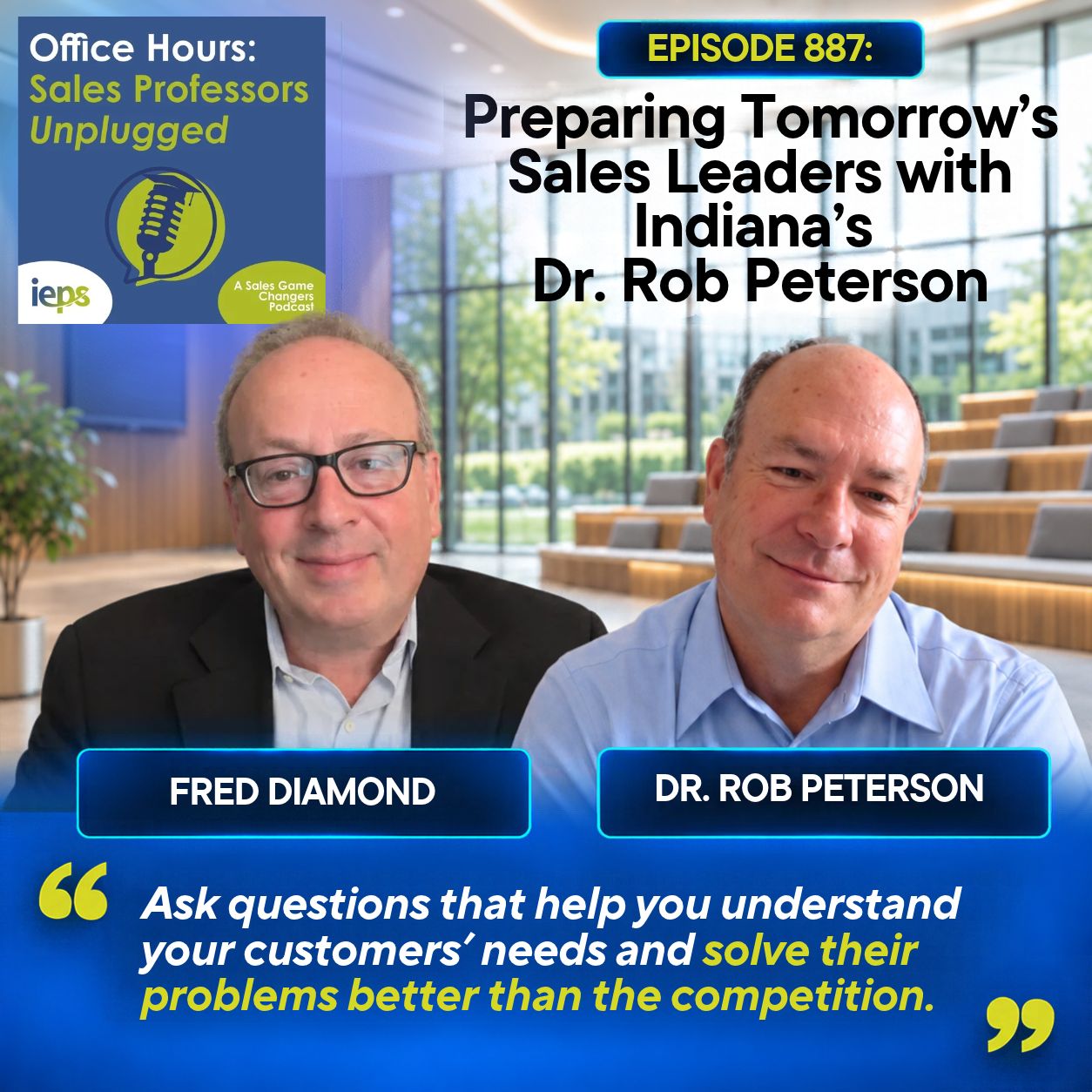
ROB’S TIP: “Ask questions that help you understand your customers’ needs and solve their problems better than the competition.”
THE PODCAST BEGINS HERE
Fred Diamond: Dr. Peterson, we’ve done close to 25 Office Hours – Sales Professors Unplugged with a lot of your peers. Many of them are associated with the University Sales Center Alliance. One of the great things about doing these shows is that when I then post it up on LinkedIn, it’s amazing to see three to five people comment, “Fred, I didn’t realize that there were programs at universities teaching people to go into professional sales.” I’m excited to talk to you and get some of your insights on what you’re teaching. You’re doing some interesting and unique things as well. We’re going to be talking about that as well.
Why don’t you do this? Before I get into the questions, just give us a little bit of a background. Tell us who you are, what you do. We got some really good, exciting meeting questions to get into here.
Robert Peterson: Fred, it’s an absolute pleasure to be here, but also have you come to the office hour because students don’t come to office hours anymore. They get the content down, and we’re really good to get the content down, and then there’s a lot of LMS, the more content will reside, which didn’t happen. I went to Indiana, that didn’t happen. You walked out of the classroom and whatever textbook you had was what you had until you walked back in the classroom. Now the information is everywhere.
When I have people come to the office hours, which they don’t, but I did have a kid just yesterday in class, negotiation class, is, “Dr. P, when’s your office hours?”
I said, “No one ever comes. When do you want to talk?” I said, “Do you want to talk about jobs?” He’s a senior.
He’s like, “Yeah, I want to talk.”
That’s what they talk about. They want to talk about strategy, want to ask about comparing different offers, or the next step that they might have. This student was in negotiation. It wasn’t, hey, better explain the ZOPA, or how do I anchor better? They get that, or that’s available to them, so you’ll see that information is available, but judgment and wisdom, which we’ll probably come back to because I saw a question on AI, that’s what they’re starving for. It’s good to have somebody in my office hour.
Fred Diamond: For people who are listening to an Office Hours show, it’s a sub-brand of the Sales Game Changers Podcast. When I talk to young adults who are still in college, I tell them, get to know your professors, especially in a profession like sales. One of the great things that we’ve learned by doing all these interviews is that you’re preparing these young adults to go to the companies that are associated with the Institute for Effective Professional Selling. One of the great things is you’re preparing the young adults to hit the ground running.
We estimate that the companies who are hiring your young adults, they’re saving three to four years of training, of teaching, because the young adults come out prepared. They have to know your product, your industry, and your markets. Let’s get into this. I’m excited to talk to you. What originally attracted you to teaching sales? What have you discovered about developing successful selling professionals that maybe you didn’t appreciate when you got started?
Robert Peterson: What attracted me was I’m the offspring of a career salesman, in my dad, and my mom was a high school business teacher. She taught general business, shorthand Pitman, I don’t even remember. Maybe somebody listening might know what that is. I was in that nice confluence of both of those. I was in sales. I graduated, got my sales territory, took a job in DC pounding the pavement, learning the business, talking to my dad a lot about various things and why don’t people do this and what about that?
I remember calling him one time and asking him, “Dad, what’s the deal? Some people can’t make a decision. I’m sitting here holding a pail of water in the desert and this buyer can’t make a decision.”
He’s like, “Yep, that’s going to happen.”
I’m like, “It’s insane.”
What attracted me to sales was everything is different. You get rewarded for your outcomes and mostly based on your merit or capabilities. Then after years of doing that, we have a long history of education in the family, so I made a pivot, earned the PhD, did a dissertation in negotiation, and have never looked back.
Fred Diamond: What did your dad sell?
Robert Peterson: He was in software sales before anything was software-y. He explained it, we didn’t understand it. This is in the ‘70s. No one understood what he was doing. But if you’re in the business, you’ll know that some of the early things was, if Fred, the CEO, is going to print something, we need a software program that allows his print request to go to the top of the queue. People are thinking, “What are you talking about?” It’s like, yes, because Fred, the CEO, might have to wait 30 minutes or an hour and a half for his print job to show up. That shows you the coolness of that and the dynamic of the industry. There’s always something on the cutting edge. You got to learn more, you got to innovate more in order to service the customer, because the landscape’s always changing.
Fred Diamond: I can picture what your dad did because I marketed mainframe software in the mid ‘90s. For people who are relatively new to technology, there were mainframes, these big computers, they weren’t like your phone or your laptop or your computer is now. You had all these inane type processes and there were little things that people like your father would sell to make the mainframe more productive.
I also loved your analogy, a lot of selling professionals, especially who are new, they’re so enamored with their product. They know it makes so much sense for the customer. I love that analogy of a glass of water in the desert, yet someone’s going to take a week to decide. It’s something that young selling professionals need to understand, process, budgeting, decision-making, who’s involved with the buying decision, etc. It’s great that you’re teaching that.
I saw a post that you had done about using comedic improv to teach sales, negotiation, maybe some other skills on the process. Talk a little bit about that. Where does that play? How does that help the young adults who are going through your classes?
Robert Peterson: Absolutely love it. When I was in Chicago, I got to study at The Second City Training Center. I was there for a couple of years taking classes, stand up, writing, the improv set. I had always been doing stuff in the classroom along those lines, but I finally got it formalized. I was like, “Ah, this is a better way for me to convey this capability.”
I teach LACE, and that’s my own creation, LACE, listen, adapt, collaborate, engage. That’s what makes for a good improv. You don’t go to Second City, or anybody, you don’t go anywhere and pay money to go in the door and have people argue. I can get that at home for free. But what people want is to be entertained, and you’ll see the same skillsets that are great for improv up on the stage, people coming to see you, are the same skills that would be phenomenal if you use them as a salesperson.
Are you listening? Are you adapting? Are you collaborating? Not only collaborating with your customer or your prospect, but a lot of young people will learn, hey, you got to collaborate internally. I just did a training this past week with a company and I asked them, and they said about 50%, 50% is selling on the street. The other 50% is selling internally to get whatever we’re doing, and they’re a manufacturer, so getting things done.
The last one is engage, up and down the line. Maybe engagement on the improv stage means excitement and physical comedy. But in the sales, things like you have to keep this person engaged, your customer, or they’ll wander off. They’ll wander off to another priority. They’ll wander off to a competitor or whatnot, especially in today’s market. I’ve been teaching this for several years now, I have them go through a bunch of different steps.
You mentioned improv as comedic. We absolutely laugh and have fun, like a setup. In fact, let me just give you the verbal setup. I’m teaching this section on voicemail. Most of them have never left a voicemail. In fact, most people don’t know how to leave an effective voicemail. It started out fun. It’s like, “Hey, get a partner. You’ve got 30 seconds, and I got my timer. Leave a 30-second breakup voicemail.” They’re going, “Oh, it’s not you. It’s me,” and blah, blah, blah. The other person goes, and now the laughter’s gone.
I build on that, I build one more, and then I hit them with the role play. “Hey, you’re you, sales rep in the role play, calling on this buyer. You get their voicemail. Get ready. Go.” They’re not ready. I said, “Okay, who’s ready to sit down and learn the finer points of leaving an effective voicemail?” Boom. We did the fun and then they crashed and burned and were like, “Yes, I don’t want to do that again. Help me.” We do a lot of that, and I’ve got a plan for the whole semester.
One thing that has really changed in the last year or two, and I just started working on this, so you’re my first audience. What happens when information is no longer scarce or an advantage? That is when your judgment and your ability to bring value explodes, because information is everywhere. There’s a lot of noise because of that. But the salesperson, the human being, anybody who wants to help another person make an informed decision, that capability to look at all, everybody has all the information now, how do we use our professional judgment and move the decision down the funnel or down the line in order for that customer to feel like, “Ah, yes.”
That raises the bar for human judgment in the conversation, and that’s improv. If you got this RFP, everybody comes and makes a presentation, for the most part, you have very similar information. Well, you win it in the Q&A and you win it through listening, adapting, and collaborating with your client. How do we do that? For me, I just keep on repeatedly putting them in situations where they have to think on their feet. They can go get their answer, AI will help you with that, within parameters of hygiene, garbage in, garbage out. But what I need to do is listen to Fred, make sure I understand what he’s doing, what he wants, and then, boom, put it into some value terms that he can chomp on and find use for. It’s what I do a lot, flip the classroom. I give them a lot to do on their own. When they come in, it’s like, “Let’s practice this.” Hopefully we’re getting less deer in the headlights.
Fred Diamond: I see the value in what you’re doing. I’m remembering back about four or five years ago, we had a professional comedian on the Sales Game Changers Podcast. During the heyday of the pandemic, we used to do a show every Friday called Creativity in Sales. This was a guy who actually performed at Second City TV. As a matter of fact, one of his tutors was actually Tina Fey for a number of years, Tina Fey from Saturday Night Live. He said the main thing that he learned from her, and this was very applicable to sales, he said when she was coaching him, she said, “Stop trying to be funny. Stop trying to be funny.”
The same thing, you hear this a lot in sales, stop selling. We teach young professionals, you need to listen, you need to be ready because you got to know of preparation so that you’re creative. Obviously, improv, people think you just get up there and just make things up. A lot of the great improvisers, they’ve practiced their shtick for 50 times.
Robert Peterson: Totally agree with you. Totally. It’s like any skill, playing the piano, you know your skills, or any instrument, this and that. I’m an old dog, so trying to beat the Chicago Bulls in the 1990s, you were never going to beat them in seven games. You could beat them, yes, but they played so well together, they knew where they each were going to be. When you’re on stage with a professional ensemble of improv people, they know what to say and what to do. Not because there’s any script, there is no script. Somebody from the audience just yelled out something. But the rules of engagement are known. It’s like, don’t say no, yes and them, and the improvisers will make it funny. But in sales, we’ll build until we get an answer. But absolutely, the engagement and just getting the mindset ready for that human interaction.
What you and I are going to get to do, as information becomes not only available, but it becomes readily available and you can get answers immediately. Back in the day, if you wanted to know, hey, who did have the highest earn-run average? Or who did play that first concert at blah, blah? It’s now seconds away. Back then, it was like, are we really going to go to the library and go figure, no. That part of it is done. Now the listening, the trust building, the adapting, knowing that I’ve got your back when things go sideways, and they will go sideways, that you can’t necessarily get from a great bot.
Fred Diamond: Let’s touch on AI. You alluded to it before. Obviously, it’s the topic that’s ubiquitous in everything, almost every engagement that we have. Everybody here who’s listening to today’s Sales Game Changers Podcast with Dr. Robert Peterson, they know AI. They know the tools. Out of the 870 plus shows that we’ve done, we’ve probably done at least 100 just on AI. I’m just interested, as a professor, as someone who’s teaching young adults, is AI helping them become better sellers or are you concerned that they’re becoming too dependent on quick answers, they haven’t prepared, so they’ll jump up on AI. Or they’ll look at AI maybe two minutes before they get to do a phone call. Give us some insights into what you’re seeing. What are your concerns?
Robert Peterson: You’ve hit it there. I’m lucky that I tell my students, use AI. Hey, here’s the role play. You’re calling on a company this size in the southern part of the US and you’re calling on the IT manager. What are the top three things that he or she’s generally concerned about, how the budget might play? Boom. Then let us say, okay, that’s the pressure on this person. This is a fictitious role play, or semi-fictitious, and you’re starting to get into the grass. I’m like, that’s perfect. I want you to do that.
Now, if I was teaching American history and I was talking about how did Lincoln handle disappointment during the Civil War with his generals, fortunately or unfortunately, that thing could spit us out the answer right now. We’d read it like, wow, this is really informational. For the prof who’s trying to grade that, you got to pivot. I do the same thing with some of the short quizzes that I’ve used in the past.
Up until two years ago, I’ve had to pivot. I was like, “Okay, they’re just going to take these SPIN questions, put it in the AI. Here’s the answer.” Like 12 Angry Men, I use that in the negotiation class. I came up with this great, put it into AI, they answer this. I said, well, how do I switch it? It told me. My Spidey sense said, ah, so I dropped it into another AI platform. It came out with the most amazing answer in about 90 seconds, and I’m like, “This would have taken me like 90 minutes at least,” and I know the movie.
What we need to do from a teaching standpoint is then incorporate some of their own personal things. On that 12 Angry Men, I do a flashback to a previous negotiation they had done and ask them to draw that forward and explain. That will make them think. But going to your overarching question, yeah, it’s not even anecdotal, it was right in front of our eyes, where a couple of students who were not doing everything that they could. They were put in the same group and they made their presentation. AI helped them put together a beautiful presentation.
First Q&A question, they did not know what the hell they were talking about, and it showed. For me, I tell them, use it. Then you got to own it. If you don’t own it, I’m going to own it and I’m going to take your customer. Gen Z are quiet, at least the sales students we get to deal with, are quietly competitive. I get the Gen Z stare. I’m like, “What’s going on in your brain?” But when I give them a situation where they can compete without killing anyone, oh my God, they are all in. You can’t teach that level of energy and that competitiveness. You either have it or you don’t have it. Lurking under that exterior, and an exterior of now being influenced by the ability to have AI do a lot of things for them and us, it’s a matter of putting them in situations where they have to think on their feet.
The objections that a customer might push back and say, “Hey, they’re looking for more information,” or, “You didn’t explain it well enough,” or, “Their competitors said this and now they want to double check to see if it-” You’ve got to think on your feet. We do a lot of practicing of thinking on your feet. AI is also applied improv. It’s also artificial intelligence. We do a lot of that in the classroom, because when they leave, I can’t make them bulletproof, but I can tell them or show them exactly what it’s going to take for other people to do business with them.
Fred Diamond: Let’s talk about that. Obviously, AI has all the tools, etc. There’s so much value in getting the information, etc. But a lot of selling is human interaction. A lot of it, as you know, is long-term relationships and showing value and getting the opportunity to show someone that you understand, but not like in an AI way where you’re spewing back what the AI tool has produced for you. A lot of the professors that we’ve interviewed on the Office Hours – Sales Professors Unplugged, when I ask for a final action step or something, they’ll say develop relationships, build those relationships. Is that playing into your curriculum? Those types of concepts? Or is everybody just AI, AI, AI, automation? There’ll be questions I need to ask. Why may they have balked at this offer for a glass of water in the desert? Whatever it might be.
Robert Peterson: You and I grew up in a different time than the people that I get to teach. In fact, somehow, every year, they stay the same age and I just keep ticking up. I don’t know how that happens. I think all human beings care about, the ones that are going to succeed, other human beings. To make them successful allows you to be successful, getting truly in their shoes and helping them.
As we’re recording this, I just finished lunch and I was catching up on a couple of old Wall Street Journals. I came across two articles and one was they talked about the new Goldman Sachs CEO. I’m like, okay. I got a student who just accepted his first job there. I read it. I understand what we’re doing. Highlight, boom. Put it in my back. I’m bringing that to him tomorrow. I’ll show it, it’s like, “I know that you’re interested and you joined this amazing organization. You’re starting your career. Here’s how this guy started his career.” The article said that he got rejected from them and he went to Bear Stearns because he didn’t have enough experience, whatever it was. Now he’s going to back-run the whole thing. Never burn your bridges and building the trust and the belief.
Here’s the crazy thing, Fred, that I’ve seen that I am always all in. I am holding their feet to the fire. I’m supporting them, but not accepting any excuses, because no one downstream, when they start getting a paycheck, is going to be interested in their litany of reasons why, why, why, why not? Supporting them or holding their feet to the fire, when they get done, I’ll see them, they’ll graduate, maybe they’ll come back at homecoming that fall, they’re not the same people. They start to understand. What I’m trying to do is trying to move them faster than they’re accustomed to, as are all the sales programs. Getting them ready for the streets so when they interview, they know the best place for them to match up with. But when they get there, the marketplace does a really good job of cutting out the things that are not acceptable, and supporting things that we want to see out of you.
Fred Diamond: Speaking of that, I keep coming back, in my head, to that glass of water in the desert analogy, about why someone wouldn’t accept it. Most of the great sales professionals, they’re passionate about their selling. They believe it. You have to. You have to show the energy. You have to show the commitment why this is so great. But as you and I know, it’s hard to get to prospects. They’re not sitting around waiting, “Gee, it’s 3:00 o’clock. I hope five salespeople call me right now,” especially a young sales professional who doesn’t know my industry, etc., who doesn’t know what my goals are, blah, blah, blah. We know it’s very emotionally-demanding. A lot of rejection.
The great young adults who are making it forward have dealt with that. Is it part of your curriculum or do you coach them on, hey, FYI, not everybody is going to get in line to buy your stuff? We’ll talk about your corporate sponsors in a minute, but a lot of them compete, and to really be successful at sales, in a lot of cases, a lot of the companies that you and I deal with, those are companies that they’re all competing hard. They’re all going after customers. You got to be pros to be really successful in sales. Talk about the emotional challenges and how do you impart that upon your students, if you do?
Robert Peterson: We talk about Hunter Farmer and the level of rejections you’re going to get. It’s always there, just the percentage is going to be slightly different. If you’re a hunter, you’re going to get a larger percentage of your day is beginning with no, no, no, no. Obviously, there’s a payoff to taking that type of job. But there’s space for everybody. Don’t get excited and show up. Probably the best thing that a couple of companies did for me decades ago when I interviewed, I got rejected and I was pissed. I was like, “What do you mean?” I went on a visit, they flew me to the place, and I wanted a little bit too much of a hunter job, and they couldn’t offer that to me.
It took me maybe a year or two before I realized, before I started in business and whatnot, I’m like, “Wow, you did me a favor, because I would have been there years later.” Matching your skills, abilities, and trait to what the job opportunity is, is definitely job one. If you don’t have a great career services or a great relationship with your sales professor, you need to make that happen, because you don’t want a bunch of false starts. You pick the wrong industry or company or whatnot, and then you go to another one, then all of a sudden that boss turns out to be a nightmare from hell. By year two, you’re looking at your third job and you’re not trending up, you’re trending down. Making an informed decision and judgment is key.
Getting back to the question at hand, being resilient and picking yourself off the ground after you fail. We do some improv exercises where they’re getting a hell no, then what would they do? A lot of them haven’t had a lot of nos or a hell no. We just grew up in a different time where if you and I wanted to go play with Bobby down the street, we’d go down there, ring the doorbell, interface with Bobby’s mom or dad, ask some questions, talked one out. Now, because of technology, my mom would just text down there and do this, and boom, and off I would go. The coolness and their resilience, and think about the world that these young people are coming out, it wasn’t my world. We didn’t have as many of, at least we didn’t know about the level of risk and badness in the world. It certainly existed back in the day. These kids are resilient.
Fred Diamond: I want to ask you a different question. We have a lot of corporate sponsors. One of the great things about this podcast is a lot of the companies that are looking to hire, and that’s who we’re associated with at the Institute for Effective Professional Selling, companies that are looking to hire young adults out of these great programs. We’ve helped make them aware of it, and also mid-course and senior career as well. If you were to talk to a corporate sponsor to get them aware of why they want to be associated with your program at Indiana University, give some of the key things that they need to be aware of.
Robert Peterson: There’s plenty. There’s a history. There’s the dedication of the students, which dovetails into probably the number one thing, is risk mitigation. We just take the risk out of people coming and not staying because, “Huh, sales. I guess that’s what people are hiring for. Let me try that,” as a well-intended history major, or whatever major you are. You come to a sales program like ours and you’ve got four classes. I asked just the other day, it’s like, “Can you imagine taking a sales job without this class?” They’re like, “No.” Just all the mistakes that you would make in the marketplace and how tough the marketplace is, and they don’t teach you. They just don’t return your call. You get no feedback. You get plenty of feedback if you’re at the IU sales program or any of the other great sales programs. Risk mitigation, without a doubt, is the biggest thing.
Then the chance to help or influence the curriculum, like, “Hey, we did this great thing,” and blah, blah, “You did that in your training program? Perfect. Come be a guest speaker. We’ll talk about this.” The ability to be involved, get to meet the students, see who matches up for their culture, amongst the laundry list of other things, but the ability to figure out who’s the best that would not only come would be good, but they would stick and stay, that is the cool thing about the sales program.
Fred Diamond: The retention that we’ve heard from the corporate sponsors that sponsor your programs and other programs at the University Sales Center Alliance, they just get it. One of the hardest things in sales is keeping good people. You’re training them for a career in sales the right way. All the things that you’re going through your curriculum is critical. Dr. Rob Peterson with Indiana University, I’m just curious, this has just occurred to me. I was talking to someone about this this morning. What changes when a firm treats revenue ops and enablement as a strategic capability? What is your advice for leadership to build upon that?
Robert Peterson: Wow. That’s a deep conversation. Let’s go with RevOps is thought, a lot of people don’t even know what’s the difference, think of RevOps, and you can correct me with this analogy, or any of the listeners. RevOps is like going to the doctor and just getting, “Hey, this is your blood pressure. This is your pulse. This is your weight. Hey, we ran the test. This is your sugar, your salt,” blah, blah. Like, okay, now what are we going to do? Well, that’s your enablement. I was like, all right, we need to exercise more or cut down from four beers to no beer at dinner, whatever, let’s get this body back on the right road. Why it’s so key, you’ve got handoffs, and you got to get these people working across the company, and none of these silos. How do we make this repeatable and not a number that we hit? Well, we don’t even know why.
I think what is an important strategy, or why it’s so important, is because you’ve got to deal with repeatable measures. Anytime you think, “We’ll just use a KPI,” KPI will change behaviors. I teach a class in rev enablement to the grads. Anytime you change that KPI, you think, “We’re going to get this,” man, people are squirrely. Long time ago, this tech company said, “We need an input from every customer that we sell above X,” it was a government thing, “X millions of dollars. You need to go there and they have to fill out this.” They weren’t going to do that. The sales rep said, “I’ll come down.” They logged it in on their own computer. He answered the questions for them, and their customer’s like, “Yeah, that’s fine. I don’t give a damn.” Obviously, word got around and corporate changed that. It was just the wrong KPI to measure.
Imagine all this going on. That’s a vomit test I just gave you, but there’s a lot going on strategically, incredibly important, and enablement is not just training, and RevOps is a moving target, depending on how you measure it.
Fred Diamond: Dr. Rob Peterson, thank you so much for being on today’s Office Hours – Sales Professors Unplugged. You’ve given us a lot of great thoughts, a lot of great things for companies that sponsor these programs that are looking to hire selling professionals that are going to stay that are ready to go, hit the ground running, if you will. Give us your final thought, just something to leave the show on, that will help our audience become better at the art and science of selling.
Robert Peterson: I used this yesterday in class and it’ll be good for the folks who are early in their career and a reminder to those who have been there for a while, is questions will set you free. Be curious. Ask good questions. Ask penetrating questions, because if your customer doesn’t know it up, because this is what you do all day, figure out what questions to ask to get the information you need to help them solve their problem better than the competitor. Yes, there are such things as stupid questions. Stupid questions are things that you should have known easily by looking it up, or maybe not stupid, but don’t ask a question here when we’re already at step 17. You’re like, “Well, how many people do you have in that?” Oh my God, that takes away.
But I’m telling you, be naturally curious to figure out why things are the way they go. It’s not, “I’m a good listener. A lot of people tell me I’m a great listener.” You can listen to static air and get nothing out of it. Be a great questioner. Ask things. Ponder what you want to ask, refine it, I think that’ll help anybody, especially people who are starting out.
Fred Diamond: The great selling professionals that we’ve come across, they’re curious. When you’re curious, it’s not about you. When you’re curious, it becomes about the customer, the prospect. What a lot of people need to understand in sales is most of the time your customers, their spouses don’t want to discuss these things at home. If you’re in IT or finance or operations or logistics, any of the customer bases that are buying a lot of the stuff that’s being sold by the companies, their spouses don’t want to hear about it. Their kids don’t want to hear about it. Their friends have no idea what they do.
If you genuinely show interest, but not from a perspective, I’m going to show you interest so that you’re going to ask me how to help solve your problems, but genuinely, which goes back to the relationship question. People who work in some of the most successful sales enterprises have been working with their customers for a long time.
Now, we’re doing today’s interview in October of 2026, where there’s been retirement and layoffs, and certain industries have retrenched, government, for example. A lot of the people that you’re going to be working with, you’re going to be working with for a while, especially if you’re going to be in a position to be successful. They want to talk to you about real things. They don’t want to talk to you about why your product’s so great if it’s not going to help them. They want you to show them that you’re thinking about how they’re going to solve their mission, where they want to go. If you’re not curious, that ain’t going to happen.
Robert Peterson: Can I plug one more thing? How to Win Friends and Influence People. If you haven’t read the book, read the book. You can either read the old one, which I love, a lot of his story, or the new updated one, normally it’s not as good. It’s outstanding. How to Win Friends and Influence People is to be naturally curious, but actually care about who you are. Because in the end, throwing back to RevOps, is hard skills get measured, but human skills will get promoted.
Fred Diamond: I love that. Once again, thank you to Dr. Rob Peterson for being on today’s Office Hours – Sales Professors Unplugged. My name is Fred Diamond.
Transcribed by Mariana Badillo