
Watch the video of this podcast on YouTube here.
The Sales Game Changers Podcast was recognized by YesWare as the top sales podcast. Read the announcement here.
FeedSpot named the Sales Game Changers Podcast at a top 20 Sales Podcast and top 8 Sales Leadership Podcast!
Subscribe to the Sales Game Changers Podcast now on Apple Podcasts!
Purchase Fred Diamond’s best-sellers Love, Hope, Lyme: What Family Members, Partners, and Friends Who Love a Chronic Lyme Survivor Need to Know and Insights for Sales Game Changers now!
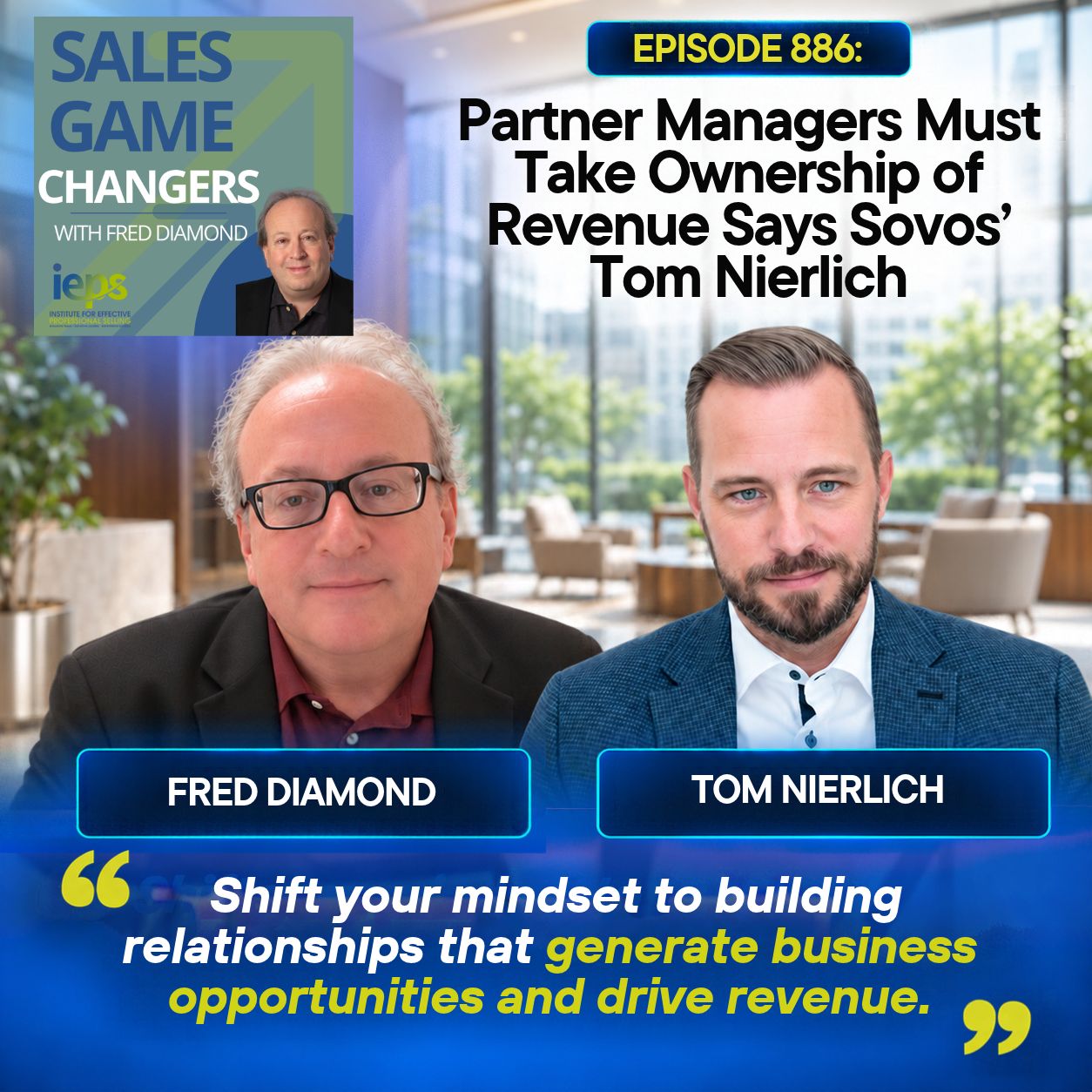
Today’s show featured an interview with Tom Nierlich, Vice President of Strategic Alliances at Sovos.
Find Tom on LinkedIn.
TOM’S TIP: “Shift your mindset to building relationships that generate business opportunities and drive revenue.”
THE PODCAST BEGINS HERE
Fred Diamond: We’re doing today’s show in October of 2026. A lot of our frequent listeners know that we’ve been doing a lot of shows with VPs of channel, VP of strategic alliances, because the IEPS has launched our Partner Manager Revenue Academy. It’s a six-session cohort. The next one begins January 8th. It’s for partner account managers, channel account managers. We’re going to take about 12 to 15 through an intense six-session program. We’ve been reaching out to a lot of the senior strategic and channel alliance leaders.
Tom, we discovered you. You were recognized by CRN as one of their channel leaders for 2026 and reached out, engaged with you and got to know you a little bit. I’m excited to have you on today’s show, Tom Nierlich with Sovos. It’s great to see you. Before we get into the world of alliances and your company specifically, tell us a little bit about your journey. How did you end up in partnerships? What was the moment when you realized that this is where you really wanted to build your career?
Tom Nierlich: It’s been an interesting journey for me for sure. I left Germany in my mid-20s and I started my career in finance and operations in the United Kingdom, not in sales, before eventually moving into partner enablement, alliances management, and ultimately alliances leadership here in the US. My goal at the beginning of the career was really to become a COO of a mid-sized company, believe it or not. At the time, and actually throughout my career, I was really blessed with a great mentor who said to me once, “If you want to become an average COO, pursue a back-office career in operations. It’ll get you there. But if you want to become a great COO, you need field experience.” Sales, alliances, services, it really doesn’t matter what it is, but you need to be on the front lines.
For me, alliances was the logical stepping stone at the time because I noticed that the biggest enterprise deals we did back then, 15, 16, 17 years ago, already had a partner attached to it, Accenture, Deloitte, IBM and others. It was really the one thing that all of these different deals had in common. Even at a company like SAP where I started my career, customers really seemed to trust the SI’s recommendation more than they trusted the vendor in some instances. Probably because SIs are more agnostic, vendors are obviously not. That’s when I understood that there was a real leverage in partnerships and alliances.
Today, I’m VP of alliances for North and Latin America here at Sovos. Fred, I can tell you, I’m no longer thinking about becoming a COO at this point. Alliances is really it for me because I think that this is where I can make the biggest difference.
Fred Diamond: I like the advice about getting the field experience. At the Institute for Effective Professional Selling, we’ve been working with a lot of companies and there’s some estimates that 70 to 75% of business goes through China partners. Some as big as a lot of the SIs that you refer to, many through standard tech companies, and some that are very, very focused. We’ll get into that.
Tom, you built a career in the world of partnerships and alliances. We’re doing today’s interview in October of 2026. How has the role of the alliance manager changed over the years? What do you think it takes to be successful in that role today?
Tom Nierlich: It has certainly evolved significantly over the last few years. I still remember the times at the beginning of my career where the partner function was mainly focused on, let’s say relationship management. Lunches, dinners, quarterly business reviews, keeping partners happy. I jokingly refer to them as the good old days. But all joking aside, over the last few years, the partner function has certainly evolved into a revenue-generating function in its own right, with targets, pipeline accountability, and really a seat at the go-to-market table.
You mentioned 70% just now, we’re not quite there yet at Sovos, but let me put it into perspective of where we are. This year, about 15 to 20% of all closed business will come from partners, purely incremental. Referrals, reseller deals, managed services deals, and so business that simply would not exist if it wasn’t for our partner.
Then a further 15 or so percent of our business will be impacted by partners. This is where we are proactively bringing partners into our opportunities because we know that we either couldn’t close them without the partner or because the partner adds significant value. For example, helps accelerate the sales cycle, gets us into the boardroom, or helps us increase the deal size. There really is an underlying shift here that changed everything, which is partners are no longer just a route to market, they’re really a route to trust. That’s what it’s all about.
We’re in a regulated industry. Buyers in regulated industries go to the SAP implementation partner, they go to the big four advisor, they go to the system integrator of choice before they go to the vendor. As a result, alliances leaders really must speak two languages fluently. One is they need to understand and speak the partners business model. The other one is obviously the internal business model. The seller’s quota pressure and really translating and navigating between these two worlds, that’s really the essence of our roles.
With that in mind, success today means being much more commercially rigorous. We’re talking about attach rates, influence pipeline, partner contribution to close revenue and so on, and not just relationship depth.
Fred Diamond: Let’s get specific about your company, Sovos, and the role that alliances play. What makes partnerships particularly important in the field where you are, tax compliance and regulatory technology?
Tom Nierlich: That’s a great question, Fred. I think it’s important to understand that we solve one of the most complex problems in enterprise software, which is tax compliance and regulatory reporting. We do it across more than 70 countries worldwide. There is not a single company in the world that navigates that alone. Partners are how we scale the expertise. In this market, a partner’s recommendation really is often the first sales call that we never have to make.
In our world, especially, you’re talking about indirect tax, tax determination, electronic invoicing mandates, the buying decision almost always involves an SI, an ERP vendor, or a compliance advisor. If you’re not present in those partner conversations, then you’re not in the deal.
At Sovos, our ecosystem spans three types, and it’s very typical for the industry. We have our technology partners, your SAPs, Oracles, NetSuites, and so on. We have our consulting and SI partners. Those are big four, global system integrators, regional implementation firms, and then referral partners. Each plays a different role in how the customer ultimately buys. The key point here is that partners are structural and not optional. What I mean by that is that a tax compliance purchase is never made by the tax team alone. It’s the ERP vendor that owns the system of record. It’s the systems integrator that designs the process and it’s the compliance advisor that interprets the rules. We plug into that architecture.
When we are part of the partner standard solution, for example, we get recommended by default instead of being evaluated from scratch. Regulation here is really our catalyst. E-invoicing, real-time reporting mandates keep spreading, from Latin America where they originated, to Europe and beyond. Every mandate comes with a deadline. Deadlines create urgency and that urgency really pulls the partners and Sovos together into the same customer conversations really. Partners would obviously much rather bring in a compliance answer they trust than build and maintain one themselves.
For us, scale here is really the growth story. 70 countries, it means rules are changing all the time and a partner with hundreds of consultants in front of customers can really extend our reach. We could never hire that many people, and that’s why roughly 30 to 40% of our business this year is either going to be sourced or influenced by partners.
Fred Diamond: Let’s get to where the rubber meets the road here. We’re doing today’s interview in October 2026, Tom. A number of leaders came to us at the Institute for Effective Professional Selling and said, “Here’s a problem. My partner account managers, my channel account managers, people at the OEM and ISVs, they’re not helping our partners generate revenue.” They’re focusing sometimes on the wrong things, but because of the status of the world with the AI influence, a lot of leaders at companies have said, “I need my PAMs and CAMs to work with their partners to generate revenue,” and companies proudly announce new partnerships and, “Hey, we’re excited with this new relationship,” but as we know, not all of them generate revenue. They’re nice to have, a press release or a LinkedIn post, whatever it might be, it’s a challenge now to generate revenue through the partnerships. What separates the partnerships that generate true business successful results and those that never live up to their potential?
Tom Nierlich: I think we all love a good press release, don’t we? But I think the number one killer here is really misaligned incentives. If the partner sales team is not motivated to bring you into deals and if my own sales team is not motivated to bring the partner into my deals, then there is no amount of executive relationship building that can fix that. No number of press releases, it doesn’t matter how great the partnership agreement is that you may have signed on paper. My answer to this is very basic, but joint business planning really matters. But unfortunately, a lot of the time, partnerships, it is being skipped, and it’s being treated as a formality. I’ll give you an example here.
When I first joined Sovos, I inherited a partner ecosystem with a few hundred partners. It was pretty much an overgrown referral partner ecosystem. There was no repeatable business. There were a lot of tactical pursuits. In my first week, I asked my team at the time, so who are our most important partners? They gave me the answer that I had expected. It’s the big four, Deloitte, KPMG, EY, PWC. Why? Well, because we’re on tax compliance and they do all the tax advisory work. My next question was, how much business did we do together with these four partners? It turned out it was less than 1% of new bookings, less than 1%, Fred. It turned out that not only did we not have partner agreements in place in some cases, but we had no business plans with any of them, no joint targets, no joint value proposition, no quarterly business reviews, no regular cadences and so on, you get the picture. Even where we had agreements in place at sea level, nothing moved because the field alignment and the field enablement was missing.
I really want my team of alliance managers to sound like broken records, really, in front of our partners and in front of our own sales teams. It’s about continuously reminding them of the key value proposition of our partnership and how we drive results together. In a nutshell, Fred, field activation is everything.
Fred Diamond: Let’s get specific. We have a lot of individual contributor, partner account manager, channel account manager, strategic alliance manager who manages a cadre, maybe just one. But what would be your advice for them on how to become someone who proactively influences pipeline, accelerates deals, drives revenue? I guess the main thing here is, and this is a big emphasis we’re doing at the Institute for Effective Professional Selling, is shifting relationship managers to partner revenue, what we call architects. Give us some of your insights there, Tom.
Tom Nierlich: You alluded to it, there’s a lot of online courses already out there. LinkedIn Learning, the whole nine yards, where you get a lot of the theoretical advice on how to build partnerships, basics of modern alliance management. I mentioned a few of them, how to do partner agreements, how to do business plans, joint targets, enablement and so on. Those are the fundamentals, obviously. All of that stuff is really teachable and quite easily learnable. But like with everything in life, tools are useless if they’re placed in the wrong hands. I think what is most important here is the mindset shift from, “I’m an alliances manager, I manage relationships,” to, “I’m an alliances manager, I own a pipeline.”
Owning a pipeline means knowing your partner’s open opportunities, knowing where your company, in my case, Sovos, can add value, and really inserting yourself proactively in the conversation and not waiting to be called. I hold my team accountable to build pipeline and to close business. If my pipeline is not growing, then that’s primarily on me and my team and not the partner. That’s always a bit of a balancing act, because one of the big challenges is that we obviously need to influence without authority. We don’t control our partner sales team or their client account leads or their consultants.
You have to really build that credibility, be genuinely useful, resourceful, and make them want to bring you into a deal. That’s a very, very different skill set than direct sales. Of course, it does not mean that relationship management is going away. It’s still important, it will always be important. I’m still having lunches and dinners with my partners, of course, because at the end of the day, partnership is a people business. But the distinction here really is that it’s a means to an end. Pipeline creation and bookings is what ultimately matters to the business.
I want to be specific, my team maintains regular cadences with our partners, of course. It’s our job to always have pipeline development top of mind. But it really also helps to institutionalize it. For example, we run a monthly partner Blitz Day. We actually ran one just earlier this week on Tuesday. Not rocket science, good old fashioned, I know, but on this day, once a month, we call all our partners and specifically ask for business, what are the accounts you’re currently calling on? Have you come across an RFI or an RFP recently that might be a good fit for us? Are there new AEs or new client partners or new consultants that recently started in your company who you could introduce us to? Because at the end of the day, it’s the metrics that drive that evolution. If you can’t show a partner a pipeline contribution, if you can’t show deal acceleration or closed revenue, then you will still be perceived as a relationship manager, irrespective of what it is that you’re actually doing.
Fred Diamond: I like that tactic that you described with just coming out and saying, “Hey, partners, this is what we need to be doing right now,” as compared to beating around the bush or whatever it might be, getting direct on, “Hey, we need to physically sit down and talk about deals so that we can move the business forward.”
I’m just curious, you work with a lot of different types of companies, different types of partners in your ecosystem, consulting firms, technology providers. You mentioned the big four SIs, if you will, just a variety of different types of partners. As the leader for all strategic alliances, how do you work with your teams to develop specific go-to-market strategies when your partners have different drivers? A lot of times when you bring in the SI, they have a requirement. You’re not really influencing them to bring in you. It’s more they have a requirement to fill as compared to maybe proactively with some of the technology partners that have the relationships that are trying to find new things to bring to their customers.
Tom Nierlich: I think the first thing that I would say here is that there is no one strategy that fits everybody, of course. You already alluded to that. A technology partner like an SAP, we will have a completely different go-to-market motion than, for example, with a Deloitte or a KPMG, and that’s different from a referral partner. You really have to segment that and build distinct go-to-market place for each, because all of these partners care about different things.
A technology partner, for example, cares about integration depth. They care about certifications. They care about co-marketing. SIs care more about implementation, methodology, billable hours. Referral partners care about simplicity and commission. We’re really talking different currencies, different conversations.
For me, that’s the reason why I start every partner conversation with their P&L in mind and not mine. What I mean by that is with a technology partner, you ask, what makes their customers more successful on their platform? With a systems integrator, you ask, where is the services revenue? With a referral partner, you ask, what is it that makes this worth your time? If I cannot answer the what’s in it for them question in one sentence, then the go-to-market is not ready.
With their size in particular, if I can just zone in on them a little bit, the key is really to make the money. They’re not threatened by us when we create implementation work for them. We bring them in early, we give them a clear scope, and we make sure that our product creates billable work for them instead of replacing it. That’s a very different pitch from the one that I would make to a technology partner or to a referral partner. Let me give you an example.
I was in New York a couple of weeks ago where I met with a prospective partner. They’re a technology company, so ISV, and we were talking about integrating our products. They have a strong client base that they are going to introduce us to. I did not lead with the good old, “Hey, here’s our partner program. Here are our routes to market that we offer ISVs.” I asked the P&L question and their response was that they’re not interested in a standard referral partnership. They wanted a revenue share agreement. They will open up their entire client base to us and recommend us. They will build the integrations and maintain them. They will go far beyond just sharing their leads with us. They will be fully invested in the sales cycle.
Doing a revenue share with them, which allows them to compensate their account executives in year one and then pays for them to maintain the integrations that they’ve built in subsequent years, made the most sense. Of course, their head of alliances was compensated on top line recurring revenue. Hence the interest on his side in the revenue share. Now, are we giving up more money in a revenue share than a standard referral agreement? Yeah, sure. It’s a client base that I cannot get into otherwise. With that revenue share, for example, I might be giving up, say, 20% of recurring revenue, but now I’m partnering with an ISV who is 100% invested in winning me new business that otherwise I cannot win.
Fred Diamond: That’s a great answer. I’m just curious, do you have any examples of a relationship or a partnership that failed that you had to learn from? I used to ask this question a lot before the pandemic. It was a big question. Tell us about a loss that happened that shifted you as a salesman. I’m just curious, I haven’t asked this question in a while, but was there a big failure maybe or an incident in your career that you learned from that maybe shifted how you became an alliance leader?
Tom Nierlich: I would be lying if I sat here and told you, “Hey, partnership failure, what is that? I have no idea.” I think we’ve all seen partnerships fail and there’s a multitude of causes that can contribute to that. The one I touched on earlier, I want to talk about a little bit more, and that’s a trap that I fell into a little bit earlier in my career, and that was, I would say, confusing executive alignment with field activation really. They feel like the same thing, but they’re completely different problems. That’s a very common mistake that I’ve seen execs make over and over again.
Early in my career, I had a partnership that really looked great on paper. We had strong executive sponsors on both sides. I’ve been working in ISVs all of my career, so it was between two ISV companies. We had strong exec sponsors. We had a signed partner agreement, a joint press release, and then almost no joint pipeline followed, and that’s because we did not build the seller-to-seller relationships. The partner didn’t really know what we did or why they should call us, or when they should call us and how, and we did not really know what the partner did and why we should call them. You see this a lot. A lot of partnerships start out at the exact level, and then there is a bit of a disconnect after the initial signing of the agreement. The celebratory handshake and see you in three months’ time at the QBR, what happens in between?
I changed a couple of things. I started measuring my team’s time more on how much time do they spend with field-level people, partner AEs, partner SEs, regional managers, not with the VP or the sales directors. Then second, we started to ask a different question, not do we have a good relationship, but does the partner sales team really think of us when they are in front of a customer? The lesson learned for me was that today we build our field activation plans into really every alliance from day one, because the exact deal, that’s the starting line for the alliance. It’s never the finish line. Having the exact alignment is obviously great, always. But I believe you can have very, very successful partnerships without executive alignment, but you can never have successful partnerships without field activation.
Fred Diamond: That is a great story, and I’m thinking of dozens of examples where maybe the marketing team or the alliances team is challenged with, “Hey, we need a relationship with Company X.” The alliance team does the work, flies to New York, flies to San Francisco, whatever it might be, and maybe it takes a year or whatever it might be to make that connection happen, because everybody has busy times, etc. Then you sign the deal, it’s great and everyone’s happy, it’s checked off of your KPI, whatever it might be if you’re in the alliances team. But then at the field level, no one knows about it, they don’t understand, they don’t know the value. They haven’t been tasked with anything. Then, like you just said, I love the way you said it, three months later, we meet at the QBR and, well, gee, how come there’s no deals in the pipeline?
Well, because typically the CEO isn’t the one who really makes deals happen at the field level. It is the territory reps, or it is the industry reps, or whatever it might be. As we’re talking right now, I’m actually thinking right now of examples through my career where that happened, where a team established its goals, but it didn’t lead to anything because the rubber hits the road at the field and at the account, etc. Great story there.
Once again, I mentioned that we originally met you when you were designated as a 2026 CRN Channel Chief. Congratulations on that. Share some of your leadership principles that have helped you build successful alliance teams. What advice would you give someone aspiring to become a 2027 CRN Channel Chief, or to reach the level where you’re recognized in industry at that level?
Tom Nierlich: Thank you, Fred. I think that was the second or third time that you gave me kudos here for that award. I got to pass it on to my team real quick, because it’s a great honor for me, but it’s a recognition of the work that the entire team has done over the last year, not just me, obviously. I think it reflects what happens when you hire really commercially-minded alliance managers and you give them the seat at the revenue table. Instead of treating alliances as a back-office relationship function, as we talked about a little bit earlier on. I really can’t tell you how proud I am of the team that I’ve built here at Sovos. It’s amazing to work with these guys day in and day out.
If I look at some of the leadership principles behind that, then the first one is certainly to hire curiosity over experience. We are still in build mode here at Sovos. We are breaking glass almost every day because we explore new business models with partners, we explore new markets, we explore new technologies. We really need intellectually-curious people who can adapt to that, whereas narrow subject matter experts often don’t. Don’t get me wrong, they have their place obviously. But in this specific context, definitely curiosity over experience, because you can teach someone details of a product or a partner program, but you can never teach curiosity.
The second principle that I would highlight here is you always want to have a culture of accountability without bureaucracy really. I don’t want my team getting buried in reports and process. I always push them to answer that one question, what did we close this month because of a partner? If we can’t answer that, then something is off, whether that’s pipeline, partner relationship, or how we’re spending our time.
Finally, to anybody aspiring to lead an alliances organization, my advice would be get either direct sales experience or partner sales experience and get it early in your career. Because if you’ve never carried a quota, you will really struggle to coach your team on pipeline development, you’ll struggle to earn the respect of your sellers you depend on and so on. Having a seller’s perspective in alliances is just not negotiable. It goes back to what my mentor told me earlier on in my career, if you remember, “Tom, you need to be on the front lines.”
Fred Diamond: That is great advice. We’re working with our Partner Manager Revenue Academy, it’s something that the partner managers need to know, partner account managers, CAMs need to know, that your success, at the end of the day, moving forward, more than ever, is on your ability to generate and inspire revenue. It’s just critical right now because, let’s get to AI, we briefly alluded to AI, but looking at one year, let’s just say, 12 months from now, where do you see AI? Where do you see it changing customer expectations? Where do you see it shaping the alliances’ profession? What is your urgent advice for alliance and partnership leaders to make sure that they continue to be valid at their companies because they’re doing the right things?
Tom Nierlich: My general thesis is that AI is really going to act like rocket fuel to the alliances’ growth engine. Let me tell you why. First of all, I don’t think that AI is going to replace us all, or as some of the doomsday folks say, kill us all. My advice is to take all of these prophecies with a huge pinch of salt. You referenced the pandemic earlier on in our conversation. I recall distinctly listening to some futurists early on in the pandemic who were telling us life will never be the same again, we will never travel again, we will remain confined to our homes and so on. Compare that to how we’re living now, pretty much the same as pre-pandemic. Definitely first advice, let’s not buy into all of the fear mongering. But AI is obviously going to fundamentally change the way we work.
It’s a seismic shift, no doubt about it. For me, it’s another Industrial Revolution and the single biggest productivity enhancement tool of my lifetime. I want to offer three different perspectives here. I want to answer it from a partner perspective, from an alliances’ leader perspective, and then what does it mean for alliance professionals.
From a partner perspective, their business models are going to change significantly, Fred. ISV partner focus investments on agentic AI, which is going to draw investments away from more traditional collaborations. Most importantly, the way system integrators and big four make money will change. AI will significantly reduce the number of project hours across the board. The model of billing by the hour is going to evolve towards something else, probably something billing based on client outcome, client ROI, or something like that, but that’s going to be a completely different business model for those partners and we need to adapt to that.
From an alliances’ leader perspective, I’m seeing massive productivity gains. QBRs, weekly reviews, meeting preps, post meeting follow-ups, all of this is going to take a lot less time. Companies can look at that from two different perspectives. First of all, great. Now I can save some personnel cost. I will need less alliance managers going forward. Or the other one would be, hey, my existing alliances team can now be a lot more productive and cover a lot more partnerships. What’s right for the company obviously depends on the industry they’re in, margin pressures, do I prioritize margin over top-line revenue growth, and how they view the alliances’ function in general? Fred, I work in the software space. I’m lucky to be in a high margin industry. I’ve bet my career on partners and alliances being a growth engine. I mentioned earlier, AI is like rocket fuel to my growth engine. The same team that used to be able to cover say 20 in depth focus strategic partnerships can now cover twice that number. The single biggest reason why in the past we’ve always said, we need to have focus partnerships, we cannot boil the ocean, and so on, is that we’re operating with limited resources and AI can help us overcome that at least to an extent.
Then finally for alliance professionals, my advice is to really embrace AI. Guys, take AI prompting classes, incorporate it into your daily work. I use AI every hour of every day. If you’re applying for a role on my team, expect several interview questions probing you on your AI proficiency. If you cannot demonstrate that you lead with AI, there’s no way that I would hire you these days. But my advice also goes both ways. If you’re applying for an alliances’ role in the software industry and the hiring manager does not ask you about your AI proficiency at all during the interview process, then your alarm bells should really go off as well, because it might indicate that that particular company does not lead with AI and then risks being left behind. Just as much as employers are evaluating candidates around AI, candidates should do the same to their employers.
Fred Diamond: Once again, I want to thank Tom Nierlich from Sovos for being on today’s Sales Game Changers Podcast and for sharing your wisdom. My name is Fred Diamond.
Transcribed by Mariana Badillo