
This is a Women in Sales Leadership sub-brand of the Sales Game Changers Podcast.
Watch the video of this podcast on YouTube here.
The Sales Game Changers Podcast was recognized by YesWare as the top sales podcast. Read the announcement here.
FeedSpot named the Sales Game Changers Podcast at a top 20 Sales Podcast and top 8 Sales Leadership Podcast!
Subscribe to the Sales Game Changers Podcast now on Apple Podcasts!
Purchase Fred Diamond’s best-sellers Love, Hope, Lyme: What Family Members, Partners, and Friends Who Love a Chronic Lyme Survivor Need to Know and Insights for Sales Game Changers now!
Find Kristy on LinkedIn. Find Carli on LinkedIn.
KRISTY’S TIP: “There was a gap in how we were delivering our cyber services, so went to leadership and said, ‘The cyber leadership role doesn’t exist, and it should. I’m the one to run it.’”
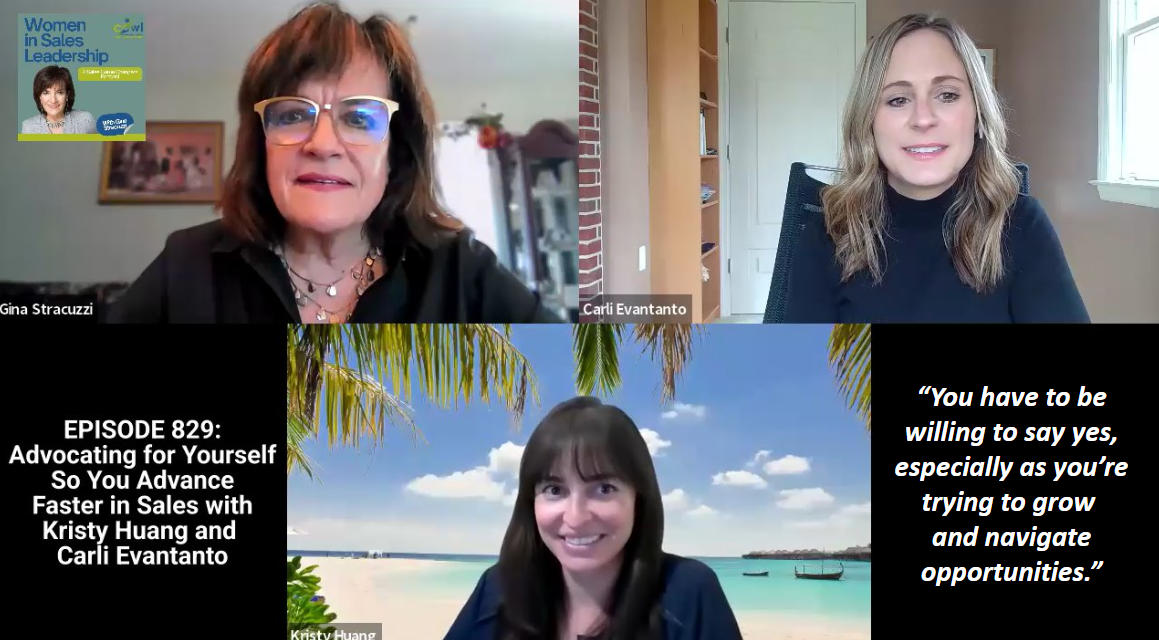
CARLI’S TIP: “You have to be willing to say yes, especially as you’re trying to grow and navigate opportunities. Unless it’s detrimental to you or your family, there’s no reason to say no.”
THE PODCAST BEGINS HERE
Gina Stracuzzi: Today, I have two guests, so that’ll make it even more fun. Carli Evantanto, who is the director of business development for the government consulting arm of ABS, and Kristy Huang, who is the global director of cybersecurity at ABS. Welcome. I gave them your titles, but let’s get down to who you are and how you work and how you came to be the team that you are. Kristy, do you want to go first and tell us a little bit about how you got to where you are?
Kristy Huang: I’m the Director of Global Cybersecurity Business Development for ABS Consulting. I’ve been in this role for about six months now, something like that. Prior to that, I led our government growth practice, and prior to that was specific to DOT. I’ve been in sales the entire time while I’ve been here at ABS doing that hybrid capture business development role. Prior to ABS, I was at a lot of different organizations, some large systems integrators, some small whether it’s digital transformation, but really have lived in the government space for a majority of my career.
In my current role, I do both commercial and federal. That has certainly been a learning experience for me, but really exciting to be able to support both sides of the organization. Then I bullied Carli into joining ABS a little over a year ago at this point, so excited. Carli now leads our government practice. Carli, if you want to tell us a little bit about how you got here and why you chose me after I bullied you into it.
Carli Evantanto: I’m Director of Business Development for the Government Sales Sector here at ABS. I previously was brought into ABS to be a capture manager or sales representative to grow out our FEMA and Department of Homeland Security portfolios under Kristy. Then a little bit over six months ago, Kristy was extended the offer to go lead our cyber sales. As a result, she pulled me up alongside of her to lead the government sales team. It’s really cool because she brought me in and then she continued to advocate for me and bring me up.
Previous to coming to ABS, I worked for a small government contractor doing government sales. Before that, I was in B2B traditional sales roles as a BDR, as an account executive doing that very standard cold call software sales process. But my career started in higher education. I made a career pivot after about two and a half years when I had a female mentor at the university that I worked for sit me down and share with me that she appreciated my energy. She thought I had great ambition and talked to me about different ways that I can utilize the strengths I have and helped me discover what the sales world is all about.
It was interesting because that was a mentor and a supervisor who said, “I think you’re great here, but I think you’re going to be greater somewhere else.” That kickstarted my whole sales journey and led me to here where, yes, Kristy, she sold me to come to ABS and it was a pressure that was highly welcomed and her leadership was really what brought me here.
Gina Stracuzzi: I love that somebody saw something. We hear that more often than you might think, for how people started in sales, it was like, “Yeah, I know this is your interest, but you really should be looking at this.” That gives you, I think, that extra courage that you need to be resilient in those first years of sales, because it’s not for the weak of heart. I often kid that if I was coming into sales now in the current environment where a lot of people are working from home, if I didn’t have the energy of a sales department around me, I don’t know that I would have stuck with it, because it’s really the energy that keeps you going. I like that you two are a team and that you hold each other up and that you’re accomplishing great things. This is great.
Let’s get into some of what you all do. Especially now, what does it look like to sell government consulting and cybersecurity services to this administration? How is that different from other roles that you might find yourself in, sales roles anyway?
Kristy Huang: It’s funny because prior to this, I sold more software type of solutions where there was a hard solution to sell. I think it is a completely different world now to do just services because we’re a vendor-agnostic company. While we can work with any platform, we don’t sell a platform. Quite honestly, I find it to be a lot more challenging to do the consulting side because it’s really more about partnering with your customer to really understanding what they need and what that end goal is, and then figuring out a way to say, “Okay, here are the services you need on top of it.”
I think right now we’ve seen a shift in how the organization or how the administration is buying services. A lot of it really is like, what is actually needed here? What is the critical path forward? I think when you hear consulting, you think, “That’s extra. We don’t need that. We can just buy this solution and that’ll solve all our problems.” But historically and more so now than ever, I think that’s just not the case. The consulting is what’s needed because you can have the best tools in the world, but you need to understand how to apply them, how to use them, and how to make them work for your workforce.
We’re seeing a lot more engagement from our customers in that aspect of their willingness to have the conversation about their end goals. Whereas before a lot of times, I think we had to fight it out of them, or really I’ll say talk it out of them over multiple conversations trying to get to that. Now I think there’s a lot more emphasis on, here’s the goal, how do we get there, and openness in those conversations. I don’t know if it’s made it harder or easier because almost everybody’s remote, or at least in a hybrid schedule. When you’re talking with customers or they finally respond to that 10th email of yours, I’m like, “All right, let’s do this.” It makes those few times that you do meet with them in person that much more critical of, “Okay, this is my one shot. I have 60 minutes to explain why they need us, how we can help them.”
I don’t know that things have been a little bit more challenging from getting in front of people, because I can just ignore you because you’re not walking the halls like we used to when you reference what it used to be like. We used to be able just to have an office, have a desk within Department of Transportation or wherever else, and you could go by and say hello to everybody.
Now you can still go in, but you’re not sure who’s going to be in there that day. That makes it a little bit more challenging, but it’s certainly, I think for me personally, just the consulting side, it’s more of a challenge to me to figure out that, “Okay, here’s their end goal. We could do 50 different things for them to help them out, but what makes the most sense for their specific challenge?” I know Carli is really high energy as well, but there’s that brain function that just clicks, where you’re like, “I know exactly what you need. Here’s this, we’ve had a similar client.” I don’t know, Carli, for you, if you’re experiencing the same. Again, products are products, but the services side has certainly been interesting, especially when you put the word consulting into the mix when we’re talking to our clients now.
Carli Evantanto: I think our game has become much more strategic and collaborative than ever before, because as Kristy said, you get maybe one person who can go walk the halls and you don’t know who’s going to be there that day. Instead of Carli being in charge of my portfolio and looking at myself and going and doing my work, I now have to communicate with Kristy and the other team members who also have the ability to talk to clients. We all have to be on the same page because it might not be me that gets to talk to my client. It might be Kristy who gets there first and it’s not in a way of beating each other, but in a way of how do we leverage the team of resources that we have to best support and serve our clients and really work on getting this win together. That’s the environment that I feel like I’ve noticed in a shift this past year, is that it takes really way more than one or two people now, especially as we’re growing within the government and in the commercial sector.
It’s super collaborative. It’s highly strategic. You can’t just cold call as much anymore. It’s really what’s the game plan. As Kristy said, getting the clients what they need, and in today’s environment, they don’t often know what they need because they’re moving so fast. We’re all learning together and establishing what is the need at the same time. Really it is difficult, but in a really exciting and positive way.
Gina Stracuzzi: I like that there’s an overall tone of positivity that yes, it’s complicated dealing with the government, but there are opportunities there and it really is all about a team effort, as you say, because otherwise it would be so hit and miss if it was just one person trying to connect with one person who might be there next week or might not be. I like that approach very much.
How have you two advocated for yourselves to move into these director level roles? These are important questions for women in sales. I’m just finishing up a book that we’re about to publish, which is all about stories of women who have bucked the trend or had that wakeup call that, “Okay, I need to be advocating for myself and not waiting for someone else.” Talk to us a little bit about how you have advocated for yourselves and each other. What advice do you have for the women listening, how they can handle things?
Kristy Huang: I think one, we are lucky that there are a lot of women in positions of power at ABS in a way that is very encouraging and in a way that we have people who are both our equals and above us who are always advocating for other women. I do really appreciate that about the culture here of just having people who, especially coming from our government group, a lot of the people who started as consultants in our government space are now leading their own P&Ls and have moved over to commercial, or instead of being a project manager, they are now leading government operations. We certainly have a lot of women who we’ve seen them move through the organization. I think that gives you that comfortability and confidence you need to advocate for yourself because you’ve seen other women do it. I do think that that is important to surround yourself and be aware and have relationships with other women within the organization.
But for our specific roles that we’re in now, it’s interesting but challenging environment within the government space. I saw that there was a gap in how we were delivering our cyber services. I went to our senior VP and I said, “Hey, this role doesn’t exist. I think it should. I think I’m the one to run it.” I’ll be honest, I think I surprised him in this conversation. I called Carli the next day and I was like, “I did something.”
Gina Stracuzzi: Good. I like hearing this.
Carli Evantanto: No, because I was like, “Oh, no, you’re quitting. I can’t do this without you.” My heart sank because we’re already in an extreme environment and Kristy is like, “I just have news for you.” I was like, “Okay, I’m ready to brace myself.”
Kristy Huang: I just paused for a second and Carli is like, “You’re quitting.” I was like, “No, no, no, opposite, actually.” Ultimately, we don’t necessarily have a ton of control in large organizations. Where you see the moments, my best advice would be, take it. If the answer was no, then I’d continue in my last role and I would have found ways to get creative. It was a surprise to me, honestly. It wasn’t one of those like I’ve been thinking about this for months and months. I think I was just really excited about a couple of very specific cyber opportunities that we were growing. I was just looking like, who can I turn to for advice on this? I was like, “Hey, I actually think that person’s me,” and that’s how this thought came to me.
With that, having that conversation with Carli of, “I think you’re ready, Carli,” I was out for a couple of weeks last year and Carli had stepped into the role and I had that conversation with her of, “Hey, I know you haven’t been here for that long. I know I brought you in to work with me and I was really excited about it, but I think you’re the right person for this role. I’m going to tell them that.” I didn’t want to throw Carli into it if she didn’t think she was ready and she didn’t want that and really was like, “No, I just want DHS.” That’s perfectly fine. You got to know yourself and what you want. I do think that that was a, and I’m sure, Carli, I’d love to hear your reactions to how and what level of nervousness you were when I was like, “I think you’re ready, you should do it.”
Carli Evantanto: Well, I had no thought. I just said, “Yeah, of course,” because as Kristy said, you just have to be willing to say yes, especially as you’re trying to figure out and navigate any opportunity, unless it’s detrimental to myself or my family, there’s no reason to say no. You just say yes, if the opportunity presented itself to you.
Gina Stracuzzi: Clearly, Kristy is a hell of a salesperson.
Carli Evantanto: Yes, that’s a trick in it, because I said yes, and it moved very quickly. Both of our equal transitions moved very quickly. There was, I will be honest, a moment, because as anybody who watched the news in 2025 learned, the government landscape shifted a lot. There were dramatic changes, better, worse, net neutral. There was a moment a week or so after I said yes that I was like, “What did I get myself into? Did Kristy trick me? This is crazy.” I very quickly got over that and saying, “Yes, this is challenging. Kristy is walking into something challenging. She’s giving me something challenging. We’re both gifted with this opportunity to be a part of really positive and impactful change.” Challenge is not inherently bad when you have a team of people around you. It wasn’t easy, yes.
As Kristy said, there’s a lot of women in leadership here at our company, which does make it easy to say yes, to step up and do hard things. In fact, when I was interviewing with this company and going through my options and what I wanted to do, I remember one of the last conversations with Kristy, I said, “I’m just so nervous because I’m so determined and I’m really passionate about my career and my growth. But I’m also a mom and can I do both?” It was if she timed it, if she planned this, her daughter barges in to our interview and was like, “Mom, mom, mom,” and Kristy was like, “This is literally my daughter. This is how we operate here.”
Other women in leadership, they’re not necessarily in sales, but they’re still in leadership here, we’re all walking a similar path together. Being offered a chance to stand next to the women here was a no brainer because we’re all juggling, whether we’re moms or not, our own families, our own personal lives, our own personal aspirations that it’s hard to do what we do every day, but it’s easier when you’re doing it in a team.
Gina Stracuzzi: There’s so much there to unpack. One, you hit on something really important, the idea that if you see it, you can be it. If you’re in a company as a woman where there’s no women at the top, or there’s just one and she’s hanging on for dear life, it makes it really hard to imagine that there’s opportunity for you. That’s really demoralizing and it leads to the why am I here feeling. When you do have rough days, it’s only that much more profound.
For both of you, Kristy, I think when you went into your boss, the sentiment, the emotion, the idea was so genuine and so authentic that there was no way to say no, because it wasn’t a theory. It’s like, “This is what we need and I’m the person for the job.” Honestly, I could retire tomorrow if every woman that I come across would do that. Just believe enough in yourself to make statements that there’s no denying them. Rather than, “Maybe this is a good idea,” or, “I’ve been thinking, I don’t know what you’ll think,” that hesitation is what gives people an opening to say no. But when you, “This is what we need, I’m here, I’m ready, let’s do it.” Who’s going to say no to that?
Carli, I love that you jumped head first, too. It’s always good when things make you a little nervous because that’s when you’re going to grow. If it all felt really comfortable, then it’s not a lot of growth.
Carli Evantanto: In the sales division, Kristy and I are the two women within leadership, but we are surrounded by men who also equally let us be ourselves. Kristy and I are often the loudest voices in the room by nature. You always know what Kristy and Carli think, but also surrounding yourself with people and finding a culture of everybody who listens to each other, regardless of your positionings, I think is really important in making sure that we all have an equal chance to advance, and particularly in sales, which is generally a male-dominated field. Then Kristy and I have the ability to work with the women who are on the sales team or on the sales floor who are entry level or beginning their career. They can look to us and we can help them navigate what we navigated before.
Gina Stracuzzi: It sounds like a perfect scenario, or as close to perfect as you can get, when you’re also dealing with a lot of volatility and uncertainty. What routines or boundaries help you manage the demands of global and government sales? There are long cycles, there’s travel, time zones, kids, as you pointed out, other demands on your time. How do you do this without burning out?
Carli Evantanto: For me, it’s about recognizing and knowing myself enough to say, “Hey, I’m going to burn out.” Even just yesterday, somebody requested to have a quick conversation with me, which never happens, they’re never quick, and I had to say, “Hey, no, I feel like I’m really at my end of the rope and I need to take a little bit of time and just step away. Can I call you first thing tomorrow morning?” If you have that awareness of who you are, it helps you advocate for yourself. Then if you’ve already built really strong rapport with the people around you, this individual, I work with them frequently enough that they can say, “Okay, if Carli’s saying this, she means it and I respect that.” Being able to know who you are, say no, and know what my priorities are. We both travel frequently. Kristy travels far more than I do, but being able to recognize like, “I’ve been gone X number of days and I can’t do another one,” and just knowing when the right time to say yes versus no, is really important.
Kristy Huang: I think boundaries, knowing yourself and the personal boundaries are really important just so that you don’t get burned out. Honestly, I think the best thing that I did, and this is a very tactical response, but I got a work phone. I have a work phone and I have a personal phone. I think COVID really challenged that notion of where does work end and life start? I think it happened in a rough way. I live in D.C. proper, so my house is tiny. It’s going from my desk and then five feet away is my couch and my kitchen. There was no separation. I do think that literally separating that is good so that when I leave the house, I don’t even have the option to respond to my work emails or to people from work.
Obviously, people have my personal phone number as well. If there’s something real serious going down, you can call me. But in the end, sales to sales. The people that we’re selling to are likely going to be working in the same time frames that you are. I’m not expecting a call of like, “I really need to buy X, Y, Z at 2 a.m.” I think it’s not a real fun response, but I do think that that helped me personally to make sure I was compartmentalizing this is the work day and this is where it bleeds over.
I do think too, it’s good when you appreciate the people that you work with and you have that rapport with other people, because you can say things like what Carli said, “Tomorrow’s going to be better.” For me, similar situation of people understand that when I need time, they give me time and they can respect that. Similar, you’re on PTO, give people that time to actually take PTO. They need a break, give them that break. We’re salespeople though, so if we need to be on that one call, if that’s how we close the deal, I’m never going to say no to that. That’s the slippery slope of where do you decide to say no, like which ones? But I think boundaries are important. I think it’s being flexible on those, but also making sure that people understand when they’ve crossed that line or when they’re asking for too much, to make sure that you maintain that balance.
Carli Evantanto: I think the boundary internal is easier to protect with clients. Typically, I will answer the phone for my client, maybe not at 2 a.m., but if the deal is there, know when to prioritize and who to prioritize with. Client calls always come first, unless there’s a situation that I can’t talk for whatever reason, that’s the call I always answer. Kristy’s calling to talk to me for five minutes, that might not be the call I need to take right now. Actually, I answer 99% of the time, but knowing the prioritization of what it is that you need to get across the finish line and what your goals of the day are, and managing those also helps protect your own boundaries as well.
Gina Stracuzzi: That’s great advice, ladies. We do like to leave our listeners with pieces of advice they can put into place today to help their sales career or sell better, whatever the case is, or hit up that client. What do you have for us?
Carli Evantanto: I actually was just thinking like, what advice would I have given to myself? There was a question I got asked not too long ago, and I think it’s of similar vein. For me, it’s intentionally do hard things, intentionally put yourself in challenging situations so that when real-life hard things come up, they don’t feel as challenging, and you won’t be as scared to make that phone call. For me, that’s in working out in the mornings and doing the hard run, or trying something different, and the safe environments where you safely can try hard things. When the difficult conversation comes up in real life, it doesn’t feel as intimidating because you know that you have the strength to do it.
Gina Stracuzzi: I love that. That is really great advice. Try to top that one, Kristy.
Kristy Huang: I think it’s different for everybody, but for me, the thing that has helped me out most in my career is being your authentic self. I think at the beginning of my career, I felt the need to look at other people and say like, “That’s what I need to look like. That’s how I need to go to this networking event,” and try to emulate the success that I’ve seen. Then that showed in how I was selling. That showed in how I was interacting with clients, where I was nervous, I wasn’t sure of myself because I was trying to copy somebody else’s delivery.
Now, maybe I’m a little bit too much myself in meetings, so I could probably find a balance there. But I think that’s how you gain your customer’s trust. That’s how you gain people you work with trust, by being yourself and saying like, “Yeah, here is my limitation,” or, “I don’t know the answer to that, but I know somebody who does and I can get back to you.” Instead of saying, “Yes, we can do that,” and making something up on the fly, or just trying to be more robotic because you feel like it’s more professional. I think you can be a professional version of yourself.
It shows you’re more comfortable, people are more willing to open up to you as a result. I’d say look to others for guidance in terms of what’s worked for them, but try to maintain that version of yourself that shows, because that will feed into your confidence. Selling is impossible if you don’t have the confidence and you don’t stand behind what you’re saying and how you’re saying it.
Gina Stracuzzi: Great advice. Thank you both. It was such a pleasure having you and a great conversation. I look forward to hearing more about what you’re doing.
Transcribed by Mariana Badillo