
Watch the video of this podcast on YouTube here.
The Sales Game Changers Podcast was recognized by YesWare as the top sales podcast. Read the announcement here.
FeedSpot named the Sales Game Changers Podcast at a top 20 Sales Podcast and top 8 Sales Leadership Podcast!
Subscribe to the Sales Game Changers Podcast now on Apple Podcasts!
Purchase Fred Diamond’s best-sellers Love, Hope, Lyme: What Family Members, Partners, and Friends Who Love a Chronic Lyme Survivor Need to Know and Insights for Sales Game Changers now!
Find Eric on LinkedIn. Find Dean on LinkedIn.
ERIC’S TIP: “Life rewards action. Always be moving forward, moving sideways, just be moving. Attacking accounts, learning about your customers, and discovering what’s important to them only happens when you’re active.”
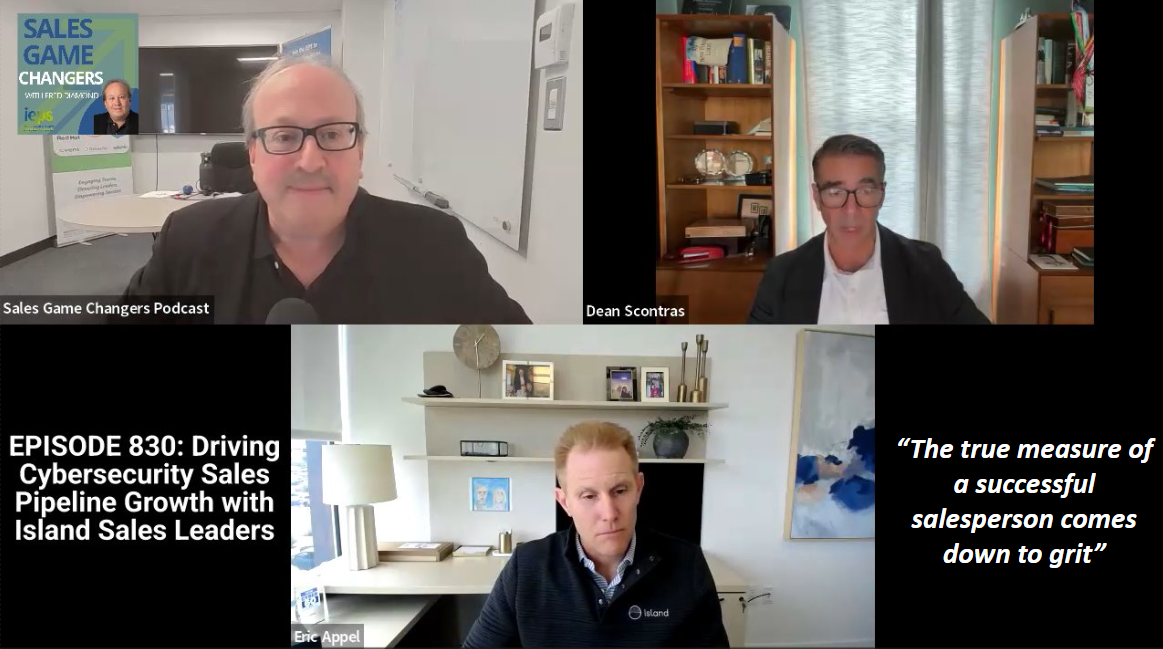
DEAN’S TIP: “The true measure of a successful salesperson comes down to grit, and how they create qualified pipeline in a short amount of time. I do think grit directly transforms into how effectively you generate pipeline.”
THE PODCAST BEGINS HERE
Fred Diamond: We have two leaders here from Island. We have Eric Appel and Dean Scontras. Eric, you’re the CRO, so you’re just not working on public sector. Dean leads state and local and education, SLED. We’ll get a little more specific with him about some of that. I’m excited to talk to you both, and it looks like Island is doing some pretty remarkable and interesting things on a lot of the topics that we talk about, not just on the public sector side of the Sales Game Changers, but in the Sales Game Changers in general.
Eric, why don’t you get us started here? Tell us a little more about Island, for people who don’t know. Then I’m curious. Island has grown quickly in a marketplace that doesn’t really tolerate hype. You can’t really hype too much because customers have very, very demanding requirements. What did you do right early to really begin to develop the trust with your customer base?
Eric Appel: I tell people all the time, Island has been the most rewarding professional journey/professional experience in my life. It has truly been incredible. We took a concept five and a half years ago of the most widely used application. The application that people use for everything, that it’s accessing my email, accessing things like Salesforce, Slack, Teams, Zooms, just what do I do to work? Well, you work in the browser, but the browser was never an integrated part of an organization’s architecture. We saw a great opportunity to drive efficiency, because if the browser, think Chrome, Edge, those things, was not an integrated part of the architecture, what we’ve had to do in cybersecurity and IT over the past 25 years is surround it with all these tools. Things like VPN, virtual desktop infrastructures, web filtering, privileged access, data loss prevention, all these things, because you don’t control that browser.
Island said, “Well, what if the browser was an integrated part of the architecture? What if it was something that was integrated into your identity stack? What if it was how you now access applications?” It’s allowed organizations to rethink everything, if the browser is now the way at which you work. The vision, which seemed corny five and a half years ago, was, if you change one thing, you can change everything. From an IT and work perspective, we have seen that that can indeed be the case.
It’s been an amazing journey. Almost every large financial institution now works with Island, most of the large healthcare, retail, high tech. We’re now serving over 18 countries, growing fast in the US market, federal market, SLED market, and internationally as well. Now with the advent of AI a couple of years ago, when you think about how does AI get accessed, provision, it all happens in the browser. But yet do you trust something like a consumer AI browser to work in your environment? Probably not. You want the goodness of it, but you want to be able to put controls and be able to leverage it as you would an enterprise stack of tools. That’s what we’ve been able to also do for AI. Been an amazing journey. Feel very, very fortunate.
To your question on how do you actually deliver, when you think about cybersecurity and IT, something that’s not going to just tolerate hype? I tell people all the time that our product and platform makes us look good. As salespeople, it overcomes a lot of sins. The platform that we have built and continue to build is absolutely world class. We think about three things when we deliver. We think about how do we improve user experience, how do we improve security posture, and how do we deliver an ROI? So far, when you look across our 950 customers, I think all of them would tell you that we’ve for sure delivered a better user experience because you’re not trying to use a consumer browser now in the enterprise. But we’re able to deliver a superior security experience as well as a great ROI. We’ve really, really leaned into that. Given that our product is doing so well, it’s allowed us to take advantage of the success that we’ve had up this point.
Fred Diamond: I’m very interested in talking about the sales side of this, and how you sell to customers. It’s interesting, when I was first introduced to you guys, I saw a browser company. Then as I got deeper into what you offer and why you offer it, and how there’s more value for customers, particularly the customers at a lot of the companies that are involved with the Institute for Effective Professional Selling deal with, there’s a lot of criticality in what you’re bringing to the marketplace.
Dean Scontras, tell us a little bit about yourself. I’m just curious, what’s most misunderstood about selling security solutions today? Like Eric had mentioned, a lot of the regulated industries that you’re selling into, and government. You lead SLED, state and local and education. What are your thoughts on that?
Dean Scontras: I’ve been with companies like Duo, which was acquired by Cisco, and then Auth0. That’s how I got to Okta. Then most recently Wiz and now Island. A little bit of a trend of highly successful companies that have been highly successful in public sector. As Eric suggested, I think this has all the traits of all those companies of being equally successful.
I think the biggest misconception, and I talk to a lot of companies at the startup phase or the acceleration phase, when they’re thinking about getting into public sector and SLED. I think the thing I hear most commonly is that SLED tends to be a technology laggard, they’re behind the curve. But in reality, they do want the modern security solutions just as much as the private sector. It’s really not about resistance to innovation, but the different realities that the public sector consumer has to deal in. Those are budgeting, budgeting timelines, how you get money for projects, the various compliance requirements, StateRAMP, FedRAMP, all of those that apply. Of course, the procurement process is different, and even the protracted sometimes legal review of deals.
Those can add additional friction, but I think the biggest myth is that SLED or public sector is a technology laggard or resistant, but that’s what makes it fundamentally different and we’re the biggest misunderstanding about getting into the SLED business. Yes, it takes time, but it’s not because the companies or the agencies don’t want technology. It’s because a lot of the inherent systems that surround it make it a little bit a longer time to market. But we don’t have to convince them the value of things like the Island technology.
Fred Diamond: For people who don’t understand SLED, just give us a brief introduction. What does SLED mean? What type of entities do you sell into?
Dean Scontras: We just got through the territory planning process and SLED is enormous. It’s not only 50 different states, but it’s every town, city, and county K-12 education, as well as private education. If you look at a SLED map, there’s between 250,000 to 300,000 separate accounts. You look at 50 different states and you have 50 different states, no one buyer is like the other. It’s a very diverse customer set. But state is largely the state and the state agencies, and that can fluctuate between centrally-controlled IT and distributed IT. There’s even variations on that. Higher ed, universities, research institutions, R1s, R2s, those are targets, and certainly K-12. Don’t forget local law enforcement and first responders, publicly-paid utilities at hospitals. It’s a very expansive space and that makes it sometimes tough to capture. How do you find the highest propensity to buy customers in the shortest amount of time? It’s a very sprawling space. It’s 200,000 to 300,000 individual accounts among so many sellers. It’s tough to get to.
Fred Diamond: Eric, you mentioned the scale and how the company has scaled over the last five years or so. What’s had to change as you led the sales organization? Startup, it’s usually the owners, the founders, people like that. Maybe they’ll bring in a techie who’s doing some sales. Before the show, we talked about how you’re actually recruiting into universities. We also do a show, our Office Hours – Sales Professors Unplugged. Talk a little bit about you as a leader and how the company has had to scale.
Eric Appel: That’s a hard one because, I’ll tell you, and Dean can probably appreciate this, at Island, we really tried, especially early on, and still, to lean in with all of our resources. We as a CRO, Mike Fey, our CEO, Dan Amiga, our co-founder and CTO, and then so many others in the organization, just wanted to put our arms around every single opportunity to ensure, one, we understood what was important to them. Two, they understood our platform works going, and three, they had a great experience when they did a POC and then moved into buying. It was so hard. We all wanted to touch and feel and be a part of every single transaction. I’ll tell you, for about the first a hundred customers, we did. We even lean in very differently for deployments and that our sales engineers are actually responsible for that deployment as well, because we just want that intimacy. We want the intimacy that we built pre-sales to continue post-sale, and it’s worked out really, really well.
Now, as we’ve scaled, and we approached a thousand customers and more, and we’ve got 25% of the Fortune 100, yes, we’ve had to think about things differently. Over the past 12, 15 months, we’ve put an enormous focus on enablement. We are scaling to hundreds of salespeople across all segments and verticals. It’s really, really important that they get immersed in a couple of ways, immersed into the product, immersed into the culture, the Island way, how to prospect effectively, how to run an effective sales campaign. We’ve had to think about it as runbooks. We’ve had to develop runbooks that give them the recipe for success really across all parts of the sales process while we try like hell to not lose that intimacy, where it makes sense, where we can still go build executive relationships pre-sale, but also be present post-sale. That’s the part of our culture that we really never want to change.
Fred Diamond: What are some of the characteristics that someone would have that would make them successful in selling for a company like Island? You mentioned you’re scaling, you’re bringing on a lot more people. It’s not Microsoft that’s been around for 50 years with a process everybody understands. You’re selling something that’s a relatively new concept. You need to know things. Dean, what kind of person would be successful selling at Island or a company like Island?
Dean Scontras: It’s a great question, and it’s one I actually have with my peers, had this one in the industry when you’re going through an AE excellence profile, what does excellence look like? You have the ABCs and one, two, threes fundamentals of being able to play the game and forecast and do those other things. But I think it’s a big function of the intangible qualities. I’m a big fan of the Duckworth book Grit because I think that’s the biggest future indicator of success for a salesperson. But it’s like the famous Supreme Court case, I don’t know how to define it, but I know it when I see it. Thankfully, we do have track records of people being successful in previous capacities.
I think grit translates to, especially at Island, which is we put a lot of emphasis on pipe generation. Through the rest of the sales process, the demos and the POVs take care of themselves at an alarming high rate. They convert from stage to stage to stage. I think the true measure of a successful salesperson at Island, or anywhere really, it does come down to grit. When it comes down to individual contributors, as I have in my AE excellence profile, that grit directly transforms to how can they create qualified pipeline in the short amount of time. That gives myself and Eric the best indicator of future success.
I’m all about grit. That’s why, being a former football player myself, I tend to lean towards athletes because I think athletes, at least sales athletes that show the propensity to get out there and really use the channel to do that, to use marketing to do that. Of course, in SLED, we use government relations and lobbyists to do that as well. But I think that overlaps not only being good in process and being good in grit, but also being good in execution. The other place we need people to be tremendously sharp are the details when it comes time to close. Once the POV is done, how do we execute there? It’s a lot like what they talk about in football now, where you got to have the process, but you also have to have the motor. I think those are the two skills that I look for.
Fred Diamond: Eric, you’ve managed and led many sales leaders and professionals in your career, and I know for a fact you’ve seen some that have failed and some that have succeeded immeasurably. What are two or three of the things that you look for in a sales professional? It could be what Dean just said, but what are maybe two things that you look for that you think will lead to that person being successful?
Eric Appel: How I’m going to answer this is potentially different in Island than it is at other places. Island actually demands sellers to be probably the best versions of themselves. Island is not always a simple, “Hey, here is a problem, here is a product that solves it. Go.” Island now changes the way you work. Island, we think, is the future of work. It demands you to think beyond just, “I got to get to this economic buyer, convince that economic buyer, and I win.” You actually have to sell broadly. I like talking to people that possess grit. That’s huge, what Dean said, because that’s your motor. That gets you up and gets you going no matter the circumstance.
But I also look for people that are curious, that are curious into the accounts they’re going to sell into. They’re curious that, “Hey, I don’t know that I’m going to absolutely need to go build a relationship or sell to that line of business, but it can’t hurt with me building a relationship there.” We have a saying at Island called Selling Past Yes. Seems weird. Typically, when you get a yes, “Yep, shut up. Let’s get the order and move out.” Island, we like to say, sell past yes. When somebody says yes, go build other relationships. Go find out what other problems that we can solve, because if you think about the browser’s now expanded into this huge platform where we can help with so many different things in an organization, that for us, I like the grit, I like the tenacity, but I also like the curiosity, the desire to go find the complex and perhaps bring it back to a simple solution like Island.
Fred Diamond: Dean, I want to talk about SLED for a second here. SLED is an interesting marketplace. As a matter of fact, a lot of our listeners know, when I was at Apple Computer, I was a director of channel marketing for SLED. I remember going on calls in Sacramento and understanding that the State of California is the seventh biggest, it was at the time, seventh biggest entity on the planet. I also remember once I was talking to the chief procurement officer for the City of Philadelphia who said to me, “Citizens see fire trucks. They don’t necessarily see security software that’s being used in an office, per se.” I’m just curious, for you, what are some of the biggest mistakes that companies make when they try to enter SLED as a new marketplace?
Dean Scontras: That’s a great question. I think the biggest mistake is, and it alludes to a little bit what I said before, I think the first thing you have to have is product alignment. Sometimes companies think because a product’s been successful on the commercial side, it immediately applies equally to the SLED side. That’s not always the case. There are good technologies that don’t equally apply. I think product alignment, product fit is a big one. I do think the average time to close, which I’ve had over the course of my 25-year career, tends to be a little bit longer just because of what I alluded to earlier, is that the decision process can be a little bit more protracted.
As Eric just alluded to, there’s a variety of different stakeholders in SLED opportunities, and the bigger the opportunity, the more stakeholders that are involved. Those can range from not only practitioners and CIOs, but all the way up to legislative staff and budget staff. You’ve really got a wide variety. What Eric said about curiosity applies a lot as well. You have a market, as I said before, they’re not laggards, but the time to get there is generally a little bit longer. I also think product market fit, that was a real large reason I chose Island, which is when I saw the problem that Island fixes for state and local, especially in the budget environment we’re talking about, I think those are a couple things that you need to really gauge upfront.
Like, is there product alignment? Do we have a signal? Is there a fit? What problem do we solve? As you said, it’s not always apparent to the taxpayer. Again, I think we’ll probably get into it a little bit later, but the thing that’s apparent to the taxpayer right now is that budgets are cut and a lot of these folks, all the practitioners, the legislators, the budget staff are all looking for cost savings and software sprawl. I think there’s a few things to take into consideration for companies that are considering it.
Fred Diamond: Eric, you alluded to this in your previous answer here, but let’s talk about the right activities. We’re selling into markets that have a lot of requirements, there’s a lot of risk because they don’t want the risk. They’re trying to eliminate risk, obviously. We hear about cyberattacks and we hear about all these things consistently happening. What are some of the activities that truly help to move deals forward at Island? First, what are some of the activities that your reps do that just at the end of the day, they’re really not worth the time, but they’re still maybe being done?
Eric Appel: Interesting. Well, I was actually thinking a different direction now. I’ll answer what I think moves the needle and then give you maybe some advice and maybe some things that don’t. I’ll give you an example. When you think about enabling a merger or an acquisition, typically today when a company does that, they have an M&A budget, they ship laptops to the acquired entity. They put all these systems and all that, and it takes 6, 8, 12 weeks just to get assets out. That for a large acquisition can cost millions if not hundreds of millions of dollars. I’m just giving an example. Island simplifies that because you don’t have to ship a laptop. All you have to do is have them download a browser, they authenticate now to access the application. You take a 12 to 15-week period down to about 30 seconds, and you shrink the cost from hundreds of millions to massively less.
There’s so many other examples that revolve around just understanding what’s happening in that business. Let’s say, yes, you’re going through an M&A event. Well, Island can massively impact that thing in a great way. What if I’ve decided to outsource my IT staff? Well, now all of a sudden, Island can be a great way to enable that access. What if I’ve just told the board that I need to reduce IT expense by a hundred million dollars? Well, Island can do that. The best sellers use tools like AI and other things to understand what’s happening in the accounts all the time, and then use that current data that’s happening in their accounts and map it back to our value proposition. Now when we go target those people, we’re targeting with something that’s very real to them and is also going to drive immediate value. That’s what the best folks are doing.
There’s this concept of a drip campaign, where you’re just dripping out emails, and I’m hoping for a 0.01 conversion. You might get that, but even the one that engages, is it really the right one? There are so many great tools that allow you to now be very intentional about what’s happening to an organization and even happen to specific people, leverage that to map back to what your product does best. Where we do that systematically and from a process and from a personnel perspective, we strike gold.
Fred Diamond: You’re absolutely right. For the sales reps who say, “Hey, I just sent out 50 emails,” there’s so much more that needs to be done for a sale to happen. You touched on AI. For both of you, I’m just curious, where does AI actually help your sales team or sales teams in general today? Maybe where is it being oversold, but how do you want to see your sales reps using AI?
Eric Appel: This is a top-down thing for us. This starts with our CEO and on down. If we are not leveraging AI, we are behind. Period. He pushes us hard, I push the team hard, because there are just too many efficiencies to be gained to not do it. As I was mentioning, where we can leverage it to help with our intent, where we can leverage what’s happening in an organization, and there’s so many wonderful off-the-shelf tools that are leveraging AI, there’s just the large language models that we can go use from a consumer perspective, that help us map current events to Island.
We’re also always thinking about ways that we can do it in our browser. I’ll give you an example. In the Island browser, if I’m in Salesforce, I am scrolling over a record. From an AI perspective, I can inject some knowledge to say, “You should reach out to this person based on what just happened to this account,” just by scrolling over that record when I’m in Salesforce. That’s something that the rep may not have known, but we’re now injecting to help that person be very, very successful. Then, by the way, when you click yes, let’s have AI generate that email based on what we think is important to that person in that account from you. Now, as a rep, I have an opportunity to personalize that. I might know that, “Hey, it’s this guy’s birthday in two weeks, so I want to personalize it,” but it’s those types of things where it’s recommending what you should be doing based on information that it had, just like that. Those things work really, really well.
Now, as a sales leader, I will tell you, relying on AI to do your forecast, to be able to represent to the board, all that stuff, excuse my French, bullshit. There is no replacement for digging into what’s really happening in the business, understanding not just what AI says your pipeline conversion is going to be, but why is your pipeline conversion going to be like that? How do you understand from historicals why it’s going to do that? Relying on AI to manage your sales organization is false hope. Leveraging AI to help you be much, much more efficient, intentional, and intelligent, absolutely, we’re all in on it.
Fred Diamond: Dean, as I follow up with you on Eric’s great answer there, historically there’s an expression that all politics is local and all IT is local. The people who are most successful selling into SLED markets lived in town, they knew the universities, the kids played softball together. Obviously, that’s changed a lot because of the nature of how organizations are set up. But give us some of your insights on using AI, but also the personal side.
Dean Scontras: I think AI for top of funnel, especially for SLED, if you look at generally where we try to capture top of funnel in SLED, it’s at events, which is not like my commercial and private sector enterprise leaders. It’s not a great return. In fact, I think it’s like 5% conversion on event leads is good. There are several great data enrichment tools that are now combining an AI component into it that can do FOIA requests to really reduce the size of the haystack on the top of funnel side that I’m really excited about. Furthermore, a lot of the data that we get from Zoom and LinkedIn is not always as fresh as what a public sector or SLED tool specifically is.
Now, getting back to what you said, I wouldn’t want a highly-paid sales rep doing emails with 1% conversion rates. But now if you can actually customize an email and automate an email that’s going to that persona based upon something you heard in a committee meeting or at a public event, or at a state where a CISO said something, and actually customize that with no touch, that takes my acceleration top of funnel from largely what you said before, you got to be at a table at an event and hope somebody comes by and swipes their badge.
I think the biggest gamechanger for us in SLED is how do we use AI at top of funnel to automate a lot of the things that you just talked about? Because as I said, how am I going to cover 300,000 accounts with 10, 15, 20 AEs? It’s impossible. They got to pick their poison. But now with AI, I think we can do a lot more customized emails directly to those personas. That’s where I’m most excited about at Island, and especially I think for us in our space. I’m not going to name the vendors we’re using, because I don’t want to tip off any of my competitors, but the tools are out there.
Fred Diamond: This has been great. A lot of great ground that we covered here. We’ll end the show where I’ll ask you both for an action step. You’ve both given us a lot of great ideas, something specific that sales professionals must do right now to be successful. Eric, give us a final action step, something specific sales professionals must do right now to take their sales career to the next level.
Eric Appel: For me it’s easy. My favorite saying is a very simple saying, and it’s just that, life rewards action. The advice that I give to somebody that’s on day one or day 761 is to always be moving. Always be moving forward, be moving sideways, just be moving. When you think about attacking accounts or learning about your customers, or educating them on what we can do, or discovering what’s important to them, that only happens when you’re active. I love the thought of never eat alone. I tell people all the time, if you have an open lunch, go take a channel partner, go take a peer, go do something, go learn. Just be active. Be active high, be active low, be active wide. Good things come to those that are active.
Fred Diamond: I actually have a little quote here on my wall. It’s, movement, not motion. Like, “Yeah, I just sent 500 emails.” Well, nothing happened, we talked about the 0.01%, but if I’m moving the deal forward by talking to a channel partner, talking to a customer, talking with a peer, whatever it might be, who’s someone who understands where I’m trying to go with the business, that’s where movement is going to happen. Great answer. Dean, why don’t you bring us home here?
Dean Scontras: I’ll riff off a little bit the last conversation we just had. I think usually AEs and good salespeople fall on a spectrum of being really process-oriented or just all grit. I do think a lot of the process and a lot of things we do for inspection, typically manually done, consumed a lot of time, I do think with AI, it gives you great promise to put into a dynamic territory plan with real feeds into it that can give you a dashboard on how to operate. I’m big on the process. I love Coach Cignetti from Indiana University talking about process. But I think also, you got to compliment that with a lot of the things Eric talked about, those intangible qualities and those things that are not just activity, but are producing results, and I think being able to manage that, to enable, to have that input. I think there’s this great opportunity for people who used to be process adverse to really implement a good process, a repeatable, predictable process in real time through modern tools. They should be able to do that easier. You combine that with all those intangible qualities of curiosity and grit, I think that’s the recipe for success.
Fred Diamond: That’s great. I want to thank Eric Appel and Dean Scontras from Island for being on today’s Sales Game Changers Podcast. My name is Fred Diamond.
Transcribed by Mariana Badillo