
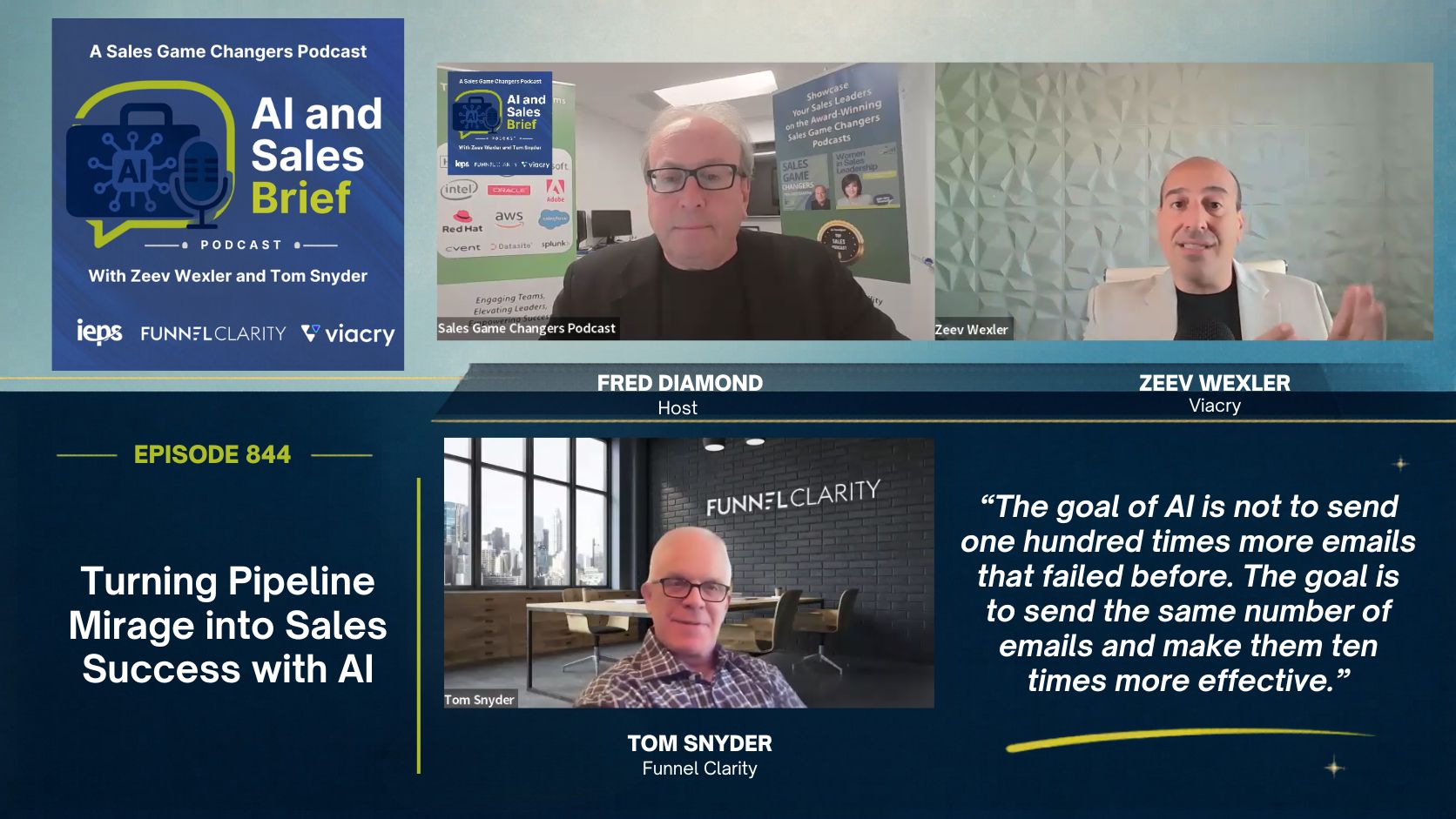
This is the second episode of AI and Sales Brief, a new sub-brand of the Sales Game Changers Podcast.
Watch the video of this podcast on YouTube here.
The Sales Game Changers Podcast was recognized by YesWare as the top sales podcast. Read the announcement here.
FeedSpot named the Sales Game Changers Podcast at a top 20 Sales Podcast and top 8 Sales Leadership Podcast!
Subscribe to the Sales Game Changers Podcast now on Apple Podcasts!
Purchase Fred Diamond’s best-sellers Love, Hope, Lyme: What Family Members, Partners, and Friends Who Love a Chronic Lyme Survivor Need to Know and Insights for Sales Game Changers now!
Today’s show featured an interview with AI expert Zeev Wexler CEO at Wexler, and sales expert Tom Snyder, Founder of Funnel Clarity.
Find Zeev on LinkedIn. Find Tom on LinkedIn.
ZEEV’S TIP: “The goal of AI is not to send one hundred times more emails that failed before. The goal is to send the same number of emails and make them ten times more effective.”
TOM’S TIP: “Before something enters the top of my funnel, it should have at least the initial evidence needed to qualify it. The standard should not be that someone answered the phone for the BDR, agreed to see a demo, and then did not show up.”
THE PODCAST BEGINS HERE
Fred Diamond: Every Monday morning, we release a special episode called the AI and Sales Brief. We will post the show and tackle one question. Tom Snyder and Zeev Wexler have a strong solution for companies that want to use AI more effectively in sales.
This is the second episode. Today’s topic is “The Top-Heavy Mirage: Why Is Our Pipeline Full of Leads That Never Convert to Opportunities?”
Tom Snyder: I love that we called it leads that never convert. Why do we not refer to those as wishes, dreams, hopes, and aspirations, and call leads only the few things that are real potential opportunities? When you talk to sales leaders, they will tell you that their funnel feels full. It is, but most of it is filled with things that do not belong there.
How does something get into the funnel? First, there is pressure on SDRs, BDRs, and account executives to continue adding to the top of the funnel. Often, we reward BDRs and SDRs for doing that. They make dozens of calls, send emails and InMails, and when someone agrees to a call, it is immediately added to the funnel. It should not be.
First, if we are not trained to do it, we have no way of determining whether we can structure a hypothesis of need before reaching out to anyone. What information can we gather before making contact that indicates there are relevant characteristics about the company’s position, performance, management, or other factors? Those indicators tell us whether they may be interested in exploring a decision we care about. That is different from saying they may be interested in buying from me. They may be interested in exploring an alternative to what they are doing now. The second piece is understanding how to get the attention of the individuals I plan to contact at that company.
I receive around one hundred unsolicited emails a day. They promise all kinds of results, such as five times the performance, ten times the ROI, or a happier world. If someone could tell me how to be six inches taller, I would be interested. Other than that, I am not. We need to craft something that creates a pattern interrupt in the mind of the person we are contacting. It must cause them to pay attention, even when they are busy. A pattern interrupt is easy to find when you know how.
Finding that information takes time. If I can be armed with information that allows me to write a subject line that encourages you to open my email, or say something when you first answer the phone that makes you pause, think, and become curious, I have a better chance of getting your attention. I can use that same information in the subject line of an InMail. Then, with the information I have gathered, I can establish a hypothesis of need. Why might there be a willingness to explore, or a seed of opportunity?
Before something enters the top of my funnel, it should have at least the initial evidence needed to qualify it. The standard should not be that someone answered the phone for the BDR, agreed to see a demo, and then did not show up. It also should not be there because a salesperson is convinced that a particular client must be pursued because of the company’s size or potential revenue. It does not work that way. When that happens, the funnel becomes full, the forecast deteriorates, and deal reviews become a stream of questions followed by self-forgiving excuses. Everything slows down because there are only so many calories you can spend in a day. If you are wasting time chasing ghosts, you may feel comfortable because the funnel looks full, but the numbers will not match up.
I will say this in every episode: I have learned that Zeev Wexler, the person I admire most in this industry, can accelerate what I just described beyond belief. What might take hours can now be done in a few moments, maybe even seconds. Zeev, tell them about the magic.
Zeev Wexler: Thank you, Tom. I want to bring something in. It is not only AI, and it is not only sales acumen. It is the combination of both. If you have an AI operator, or an agent, that understands exactly what Tom just described, it can function as your manager, assistant, and sales trainer in one place. It guides you through the steps and helps you understand what works. As salespeople, we get excited. Someone wants to talk to us or do something, so we want to put them into the funnel. Through my work with Tom, I personally learned that sometimes I move too fast and do not clarify enough.
I have learned so much from you, Tom. Bringing your knowledge, expertise, and insight into what truly works, and putting that into AI, allows the process to move step by step. It helps you clarify who you are dealing with, whether that person is a contact, a prospect, or a real opportunity that belongs in the funnel.
Artificial intelligence can work for you to clarify these things. It is not there to slow you down, but to make the process clearer. I have told many sales forces that the goal of AI is not to send one hundred times more emails that failed before. That is not the goal. The goal is to send the same number of emails and make them ten times more effective. The goal is to clearly understand who you are dealing with, what you should say, what they want to hear, their past behavior, and what matters to them. Something that could take a week for each prospect can now, with the right AI process, become a matter of a minute and a half per prospect.
That is the true magic: understanding what works, understanding the sales experience and acumen, and automating that knowledge into your process. True value comes from bringing sales and AI together, not relying on one or the other. This is the moment when every sales organization needs to ask: how do we bring what actually works, and what is scientifically proven, into our process? How do we make it shorter, stronger, and more useful so our salespeople are equipped and able to close more deals? Then the pipeline is no longer a mirage; it becomes an actual pipeline.
Tom Snyder: Zeev, could you take one minute and describe the fact that many salespeople are using AI, but corporations have not yet figured out how to do it correctly?
Zeev Wexler: Absolutely. Many corporations bring in AI tools such as Copilot, Claude, Gemini, ChatGPT, or another platform. Then they allow salespeople to experiment, prompt, and send different things. As a result, every answer is different.
Instead, companies should process AI properly by teaching the system exactly what works. It should understand the hypothesis of need, what it is working on, how to put the pieces together, how to test them, and how to deploy them to the team. The process should reflect what leadership wants, what the client wants, what works in sales, and what is supported by evidence.
Then you have an agent that truly understands your company, your client, and what works in sales. That is the triad. If you understand those three elements and provide a process, AI does not just shorten timelines; it creates sales success.
Tom Snyder: Awesome. That was awesome.
Fred Diamond: Good stuff, Tom and Zeev. Once again, this is the Institute for Effective Professional Selling. We have a new solution brought to you with the expertise of Tom Snyder, Zeev Wexler, Funnel Clarity, and Wexler. Reach out to me, Zeev, or Tom, and we will help you get started.
Every Monday morning at 7:30 Eastern Time, we will tackle a topic that is top of mind for sales professionals and sales leaders. This is the AI and Sales Brief. My name is Fred Diamond.