
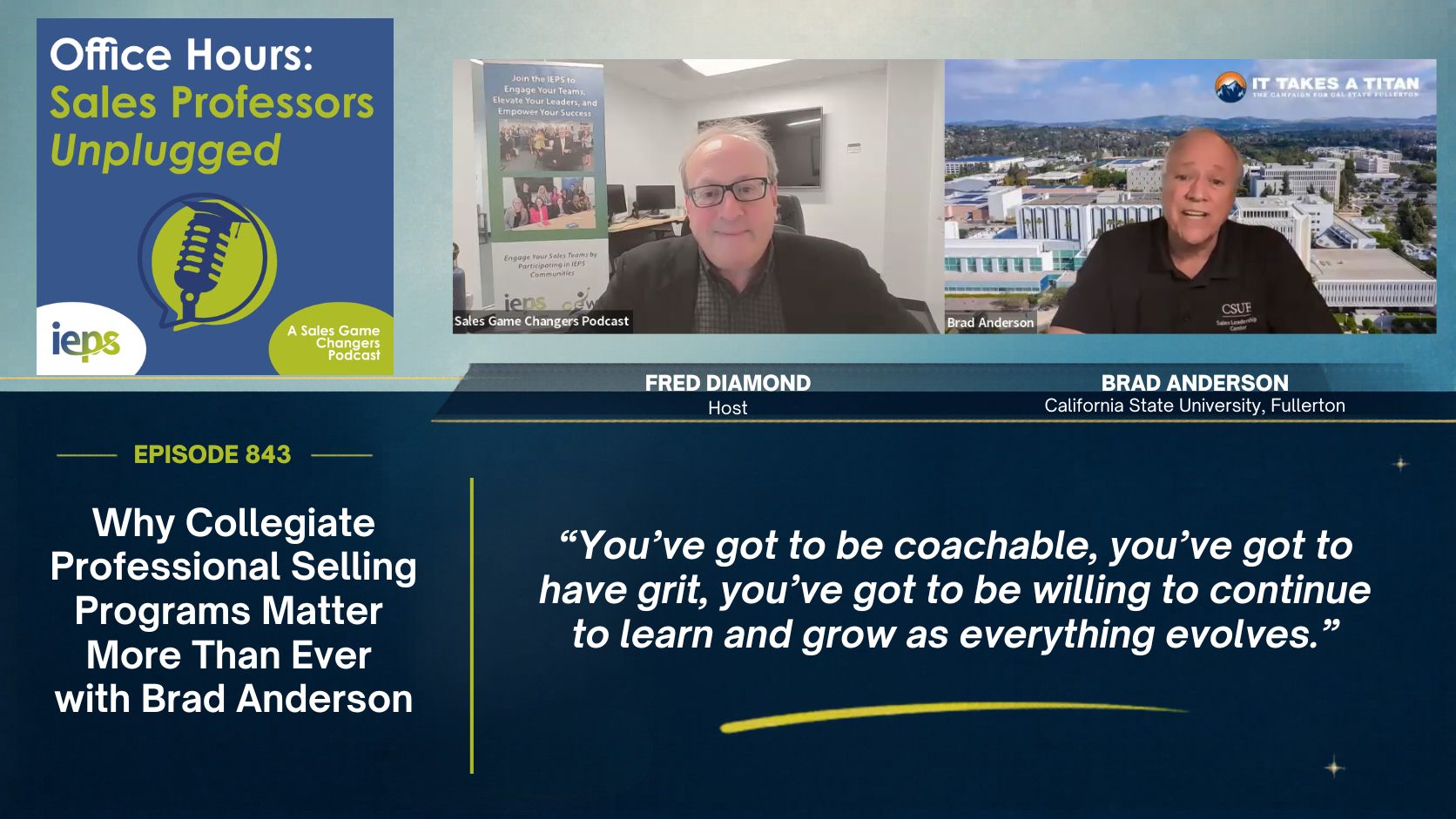
This is an Office Hours: Sales Professors Unplugged sub-brand of the Sales Game Changers Podcast.
Watch the video of this podcast on YouTube here.
The Sales Game Changers Podcast was recognized by YesWare as the top sales podcast. Read the announcement here.
FeedSpot named the Sales Game Changers Podcast at a top 20 Sales Podcast and top 8 Sales Leadership Podcast!
Subscribe to the Sales Game Changers Podcast now on Apple Podcasts!
Purchase Fred Diamond’s best-sellers Love, Hope, Lyme: What Family Members, Partners, and Friends Who Love a Chronic Lyme Survivor Need to Know and Insights for Sales Game Changers now!
Find Brad on LinkedIn.
BRAD’S TIP: “You’ve got to be coachable, you’ve got to have grit, you’ve got to be willing to continue to learn and grow as everything evolves.”
THE PODCAST BEGINS HERE
Fred Diamond: Today’s show is a special Office Hours – Sales Professors Unplugged. Brad Anderson with Cal State Fullerton, we’ve done probably close to two dozen shows where we’ve interviewed directors of professional selling organizations at universities. A lot of these universities are part of the University Sales Center Alliance, and they’ve been great shows. We typically talk about how you’re teaching the students, what the curriculum is, how you’re working with sponsors, and anything else that would be appropriate. It’s great to have you on the show.
It’s interesting, you had mentioned to me that you’re one of the only schools on the Western side of the United States. I went back and I checked and yeah, you are the first professional sales leader at a university that we’re interviewing on the West side of the United States. I know we’re going to be talking about that as part of the context today, but it’s great to see you here. Thanks for being on the show.
Tell us a little bit about your journey to running the selling program at Cal State Fullerton. Tell us a little bit about your sales career before you got into academia.
Brad Anderson: I didn’t actually want to go into sales. I actually thought I wanted to be a teacher and then learned how much they didn’t make to start their salaries and went into business instead and changed my degree. I got a degree in economics from the University of Redlands. It’s actually management science. I changed that also my senior year. Then started my career with Carnation Company, which was purchased by Nestlé right after I started with them.
It was really my 30 years at Nestlé, I started carrying a bag in this Riverside-San Bernardino sales area, similar to some of our sponsors like Gallo, Southern Glazer’s, and Kellogg’s. Basically worked my way up through the management there. I became a trainer, then a manager, then an account manager, then I ran the LA region. Then I went to our headquarters. I was one of the first people at Nestlé in the sales side to have a personal computer, which got me into what was called sales technology at the time. I basically went to our headquarters. I was a director of sales planning, got into our order entry system and forecasting for salespeople, things like that.
Then this new thing called category management started in CPG. I got hooked up with Brian Harris, who started Apollo and started the category management, basically vernacular for CPG. That became my road to more management and more experiences at Nestlé where we worked with our retailers. I got very involved with Nielsen, with IRI, and with Intactix on their space management, the category management, managed a whole team, started the team at Nestlé for category management.
Then when we purchased Purina in 2001, I transferred over to Purina, started actually training people how to sell pet food in a grocery store and also how our salespeople could sell pet food, because a lot of them came from Nestlé and didn’t sell as much pet food. We had a learning center. We brought people in, talked about consumer, and so it really started my teaching.
At the same time, I was also teaching at a junior college here in California, got my teaching credentials, worked there for about four years, but it got to be too much. Because of travel, I couldn’t teach and travel, we didn’t have Zoom at the time. Then I started working with Purina on tools and automating all of the sales tools. Basically, we created some things for automated assortment planning, space management, we used the tools that were available from Intactix, IRI, and Nielsen. We also did an automated sales presentation. Basically, an account manager could come in, put in their account, the product, and a few other pieces of information and it would spit out presentations that they could then automate, edit, use, whatever.
Then I came to Cal State Fullerton, because I took early retirement, came to Fullerton and replaced a former Nestlé co-worker as the director of the Sales Leadership Center. I’ve been here almost nine years now.
Fred Diamond: I’m based in Northern Virginia. Nestlé, one of their headquarters is based not too far from me in Rosslyn. As I mentioned to you before, part of the pandemic, we had one of your peers, Dominic Strada, who was on the Sales Game Changers Podcast. Before the pandemic, I used to do the interviews in-person. We actually did his interview at Nestlé’s headquarters down in Rosslyn, Virginia, which is right across the river from Georgetown, Washington, D.C., and had a big, beautiful vista of the D.C. area from that.
It’s interesting you’re talking about sales technology and tools. A lot of the great big brands were first in the game with sales automation tools and some of the things that you had alluded to. Now with AI, a lot of things are becoming more spread. It was pretty interesting to see that you were way early in the game.
Cal State Fullerton, first of all, tell people where exactly that is. We have listeners around the globe. It’s interesting that your student population, maybe compared to some of the other universities that are part of the University Sales Center Alliance, might be more diverse. Give us a perspective on the school and why that might be.
Brad Anderson: Cal State Fullerton is relatively new compared to a lot of colleges. We didn’t start until 1957. That’s when it started. It basically is a state school. The Cal State system works as a university, then the Cal State University, and then Cal State colleges. It has a three-tiered program. We’re in the middle of that. We’re one of the largest business colleges on the West Coast. We have 40,000 students in the university. Of that, over 27% of it is with our business college, which is where I report.
We basically do have a lot of first-generation undergraduates. In fact, about 40% are first-generation, their parents have never gone to college, but they push them. As far as undergraduates, we have almost 10,000 of that. About 4,000 are transfer students. We have a lot of transfers as well as a lot of first-generation. This makes us a little unique because California is basically flooded with universities. We have probably 16 or 17 universities in the LA Orange County area. High competition, everything from private universities like Chapman, University of Redlands, to the colleges like Irvine, which is in the UC system, Cal State like us, then Cal State Los Angeles is also nearby.
With our college, we actually have 13 centers of excellence, which basically the Sales Leadership Center is one of those 13. We have things like women’s leadership, regular leadership management, things like that, entrepreneurial. Then we were also very big and worldwide-known for accounting.
Fred Diamond: I feel a little bit of affinity because I got my master’s in business at San Jose State University. I was very, very proud of that way back in the day. You mentioned that California is a hub for a lot of universities. There’s a lot of them. There are great ones, a lot of great community type colleges, but you’re one of only two University Sales Center Alliance recognized programs in California. Why do you think there are so few professional selling programs out West?
Brad Anderson: I don’t really understand it other than I think a lot of the people that started the USCA, which is a great program. We love it. I’ve learned a lot from them. They helped me onboard when I came here. But I think because a lot of them started more in the Midwest and East, that they’ve concentrated more there. You’re right, it’s us and Chico State here in California. I do know that San Diego State is looking at trying to create a program, but there are a lot of requirements. That’s why the USCA is very good at accrediting, very similar to like Western States or anything else. There are a lot of requirements and I think that’s what protrudes them, is you have to have a center, you have to have a budget, you have to have dedicated personnel. Then you have to have the right academic and integration of nonacademic skill sets.
Fred Diamond: Tell us a little more about your curriculum. Tell us about some of the classes. Do you offer a degree, either a major, minor, or certificate? What are some of the trends that are shaping this curriculum?
Brad Anderson: We do not offer a major, we offer a minor in sales. Since most of our students in the business college are marketing majors, and it would be duplication, they cannot get a sales minor and a marketing major. Instead, we have the certificate, which is also accredited by the USCA. We offer the credentials for the certificate. They have to take three classes. If they take the minor, it’s five classes. It’s all set so that we do augmentation beyond just what’s in the classroom. In our classrooms, we have a sales class, we have a sales management class, so specific to sales, we have consumer products, we have negotiations, and then we have ISDS, which is more info systems.
Fred Diamond: Tells us a little bit about how your program fits in with the rest of the universities. One of our big friends at the Institute likes to say that even as late as 1980, in the US census, if you were in sales, you had to check the box, it said peddler. One of the interesting things that have happened with our Office Hours – Sales Professors Unplugged is a lot of people have been surprised that there are programs that teach professional selling. Yet the irony, I think, is I’ve worked for some of the best technology companies in the world, and some of those important employees are the sales professionals, and it’s a science. There’s so much to it. It’s not just like a nice handshake anymore, or even relationships, especially with technology and AI. Especially when you’re selling complex technology, it really is a thoughtful endeavor, we believe. Obviously, everyone listening to the show probably believes that as well. Give us some insights into how your program is fitting into the rest of the university.
Brad Anderson: Part of it is because we have a diverse background of students as well, or ethnicities. We’re high Asian, high Hispanic, low Caucasian, low everything else. We cater to that. The school, basically, we just funnel the same type. What helps us here is a lot of people don’t understand that sales is part of everybody’s life. In fact, one of the exercises I do my first day of sales class is have a little role play where I get two students to come up and they just read my role play. It’s basically them, they were going to go to lunch, so they know they have a need. They already know each other. They don’t have to be prospecting. But now, they start negotiating about, do they want Del Taco or McDonald’s, In-N-Out Burger, and how and why. It takes about two minutes and then they see how this is really how everybody goes through their life.
How we fit with the university is the mission statement for our college and university is to be nationally recognized and also service all of these different ethnic backgrounds. We do exactly that by providing them all of the skill sets and the soft skills that go with the academics they get in the classroom. Then we also reach out to developing those programs that help them develop those skills. We do sales competitions. We do role plays. We are starting to use some AI with some of the role plays as well, which is becoming very interesting. We have a lot of the students that when they have experiential learning to go with the academic learning, it makes them a better product for the companies that then want to hire them.
Fred Diamond: With your student mix, what do they want to learn? You’re saying a lot of them probably are getting newly exposed to what professional selling is and the science behind it, and how you need to interact with the customer. There’s a lot of thought that needs to go into a complex sale. What are some of the things that they’re excited to learn about? What do they want to learn about?
Brad Anderson: The first thing they want to learn is why should they even be in sales? We take them through the fact that it’s just part of your life and that B2B sales, which is the bulk of what we prepare them for, is not the same as B2C sales. Most of their experience is about B2C. They go and buy something. That’s their experience, which is why sales has a bad rep. But the bulk of the business is done B2B. We start showing them how you start using the methodology to sell the process, you do the information, you have to do research, and there’s a lot of academics, a lot of research that goes behind building a science for making a sale.
They want to learn how to do that. What’s that process? How do I get successful at that? How do I get the skills so that I’m going to be better than someone else at doing that? That’s where some of our sales competitions, our role plays, the academics, all of that fits together because we help them build those soft skills that then help our sponsors when they hire them. The onboarding is much faster. The training, because they’re coachable, they’re ready, is much easier. Their training programs are much more effective and they’re more productive faster.
Fred Diamond: One thing that we’ve learned from a lot of the companies that do sponsor programs similar to yours is the fact that the students that they’re hiring are so well prepared that they’re three years down the road. It’s not like they’re hiring a young adult right out of college who needs to understand. The ones who are coming from programs at the USCA, and yours at Cal State Fullerton, these young adults, they’re three years down the road. They know a lot of the things, however, they need to be trained on the product and the market and the nuance of what they sell.
One of the cool things for me that I really enjoyed is seeing how much the students who are going through programs like yours are enthusiastic about the professional selling process. They learn that it’s not the ridiculous, what do I got to do to get you to buy this pen type of a thing, or what people might think about selling is. B2B sales, you’re selling for some of the best companies in the world. You have to have shown that you have earned the right to be a sales professional at companies like these.
Talk about some of the corporate sponsorships. Tell us about your relationships. What do they know? What do they expect? What would you tell a business that may not know about this, but has learned about it and would like to get involved?
Brad Anderson: One of the things with our sponsors, like you were saying with onboarding, we have success stories from our students. Our platinum sponsors, Enterprise Mobility, which is the car rental company, they get many of our students every year. They have a two-year training program to get into management. A lot of our students basically go through that in about 14 to 15 months instead of the 24 months. Some of them have gone a lot faster. Daikin, which is another one of our sponsors, has a student right now that has gone through their management training program in two years and he’s already running full divisions. They get far ahead and that’s what our sponsors like. They like the fact that we prepare them for coachability, for soft skills, for getting ready to make good presentations, and how to get the information so that their training programs are more effective, their management training programs are then faster and better.
CED have a very good program for training their management development people. Maybe they’re very strict on who they hire and they only hire a couple each year, but then they hire some of our students just to be regular employees and can still make some of the same head roads into management. Yes, our sponsors look for the soft skills. They come to our competitions as our judges to actually see the students in action and watching them do a role play, which is a real role play.
We’re coming up on a sales presentation right now with a competition on April 10th where Enterprise will do the role play and they’re going to use their fleet management, so it’s B2B. The students will be selling the fleet management services to other companies. But then we have many of our sponsors like Samsara, they’re in technology. Like you mentioned, technology is something where a lot of the technologists are very good at programming things like that, but then they don’t have good people skills to go sell their own good products. Samsara has an excellent culture behind their company.
We’ve got all kinds of companies, and we thank our sponsors because we need them to basically come and sponsor us so we can host these events to help the students. But then as much as we want their money, we also want their participation. Because if they’re not on campus with the students, the students aren’t going to know the connections, they’re not going to network. Some of these companies, I just mentioned CED and Samsara, the students don’t even know who that is. Enterprise, they understand. Gallo, they understand. Kellogg’s, they understand, because those are all companies that are consumer products. But when you start talking about these background Ryerson, Patterson Dental, or Amcor, students have no idea who these people are. We’ve got UKG does a great job of putting together programs for internships.
Anything we can do to help them get students in front of them so that they can then recruit them and hire them, that’s what they’re looking for. They do look for ROI, because I deal mostly with recruiters, but they’re looking for those soft skills, they’re looking for networking, and they’re looking for students that are hungry to win.
Fred Diamond: The students, a lot of them, they get educated as they matriculate. Then they learn about the offerings that are there and they learn more about what type of job potential they can get from something like this. Tell us about some of the expectations that your students have. How much of them will go into sales, the ones with the minors, and how many will be in professional selling? I know your program is relatively new, but how long will they be in? Will they be in sales leadership and management for their entire careers? Is that what they’re expecting to move into from this?
Brad Anderson: That’s a great question. Actually, no, they don’t expect to always be in sales. Some of them do stay in sales. I stayed in sales in the sales department most of my career. But no, they don’t expect necessarily that, but they’re open to that that could happen. Some of them, like the one I mentioned with Daikin, he’s been there since 2021. He’s already in second level management and he did not think he would be selling more than a couple of years. Now he’s in sales management, loves it, wants to stay in that for his whole career. He even got his MBA so that he could actually be more participatory in management and strategy in the management department.
They want careers, they want good jobs, and so we offer that. I do vet our sponsors as well. As much as they vet us, I vet them to make sure that they have good training programs, that they have longevity, that they offer development. The students look for that. They want to know that they can grow. They want to know that there’s good training programs. I mentioned Enterprise, they have one of the best training programs in the country for any entry level sales person. But they also look for growth and solid competitive benefits. They’re not always looking for the highest salary, and we actually try to guide them to looking at total benefit packages, not just income.
Fred Diamond: Congratulations on the success of your program. Like I said, one of only two USCA-recognized programs in the State of California. I did a similar interview with a guy named Plamen Peev who runs the program at Towson State, which is in Maryland, just to the east of Baltimore, similar type of a thing. A lot of his students are first generation. They don’t know that B2B and complex selling exists. They work with a lot of great sponsors who are looking for hardworking, who have grit, who want to prove things. They’re the first generation in college, so they want to take their careers to the next level, and they have that support. It sounds like some similarities there. I applaud you for the great work that you’re doing for them.
Give us a final action step. You’ve given us a lot of great ideas, but give us something specific that you would recommend sales professionals do to take their sales career to the next level. For someone listening to the show, for a student, what would you give them for advice? What would be your one thing you would tell them to do?
Brad Anderson: You need to continually learn, because our environment in business is changing radically every day. Everything from AI to data. Big data is a big problem. At Nestlé, that was one of the reasons we were ahead of the AI curve and doing automated presentations. You’ve got to be coachable, you’ve got to have grit, you’ve got to be willing to continue to learn and grow as everything evolves. I don’t think AI is going to replace sales. It will change how we sell. It will change how we get some of the research done. It will change how we interact. But there is always going to be a need for people to be selling one to one, because AI can’t tell you what it doesn’t know. It picks up from what’s the past, what’s existing. It doesn’t try to go to the creative and it can’t, at this point in time anyway.
I would say definitely reach out. If you’re going to be a good sales professional, you’re going to need to learn more. You’re going to need to adapt. You’re going to continue to network. Network with people beyond just where you are. Find mentors, things like that. For companies that come to us, we want your money because that’s how we stay in business to do and produce things, but we want your participation as well because the only way you’re going to get our students is to interact with them.
Fred Diamond: Once again, I want to thank Brad Anderson with Cal State Fullerton. Congratulations on your success and for being on today’s Sales Game Changers Podcast. My name is Fred Diamond.
Transcribed by Mariana Badillo