
Watch the video of this podcast on YouTube here.
The Sales Game Changers Podcast was recognized by YesWare as the top sales podcast. Read the announcement here.
FeedSpot named the Sales Game Changers Podcast at a top 20 Sales Podcast and top 8 Sales Leadership Podcast!
Subscribe to the Sales Game Changers Podcast now on Apple Podcasts!
Purchase Fred Diamond’s best-sellers Love, Hope, Lyme: What Family Members, Partners, and Friends Who Love a Chronic Lyme Survivor Need to Know and Insights for Sales Game Changers now!
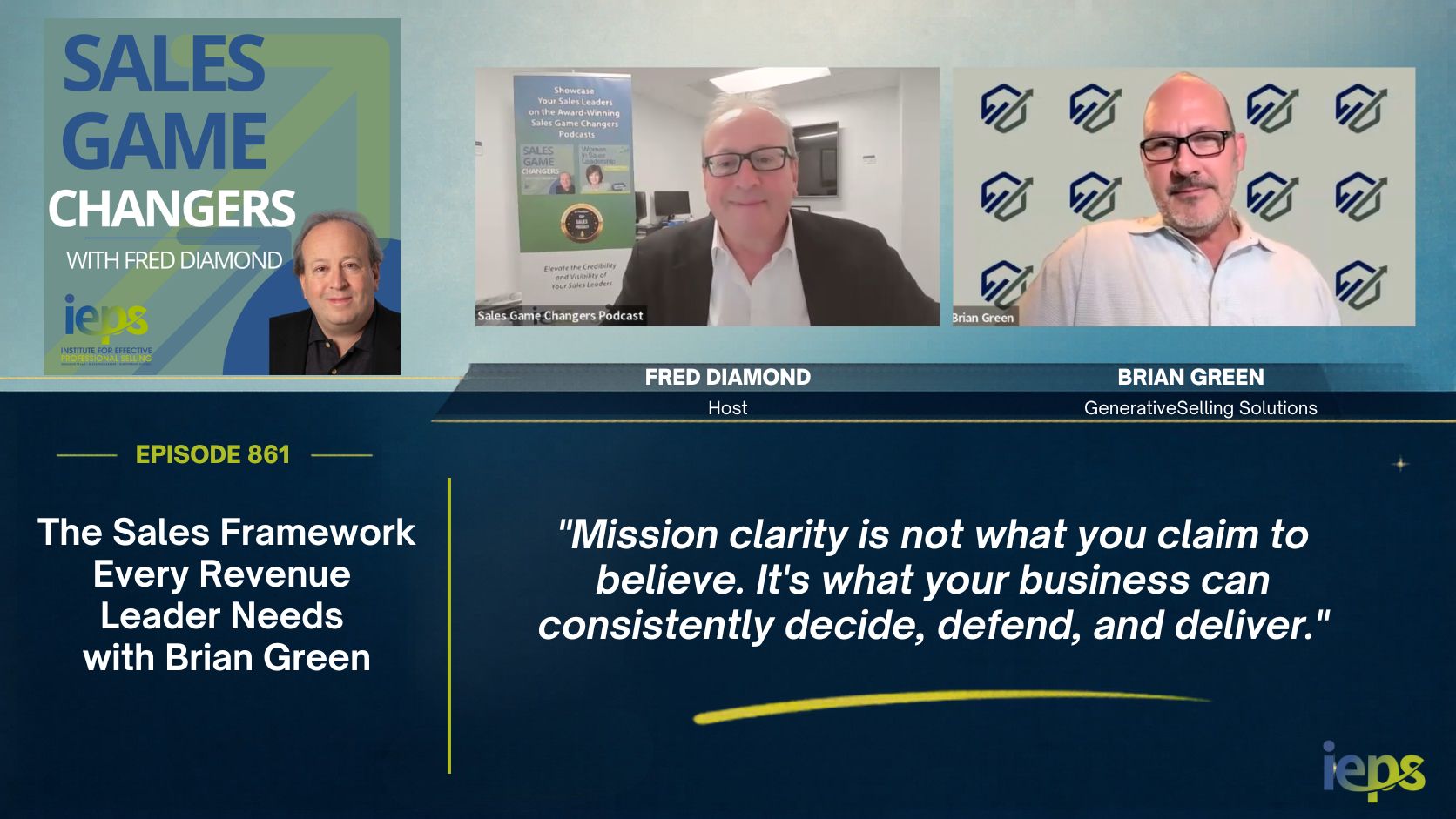
Today’s show featured an interview with Brian Green, Advisor at CodeSignal and Founder of GenerativeSelling Solutions.
Find Brian on LinkedIn.
BRIAN’S TIP: “Mission clarity is not what you claim to believe. It’s what your business can consistently decide, defend, and deliver.”
THE PODCAST BEGINS HERE
Fred Diamond: Brian, it’s critical right now because there’s more pressure than ever on selling professionals and companies that are in ecosystems and the channel to be generating revenue. It’s not a time of niceties anymore. It’s a time of what are you doing for me now? Brian, give us a little bit of a catch-up on where you are today, what you’re doing. I’m excited to get into the six critical steps for generating predictable revenue that you generated.
Brian Green: Thank you, Fred. A big honor. We started this process together. You were so kind to invite me to be the first guest of what now is over 800 shows, rapidly approaching 1000. I’ve been a big supporter of you, your organization, the amazing annual event that you have every year bringing sales and marketing professionals together under one roof to celebrate a very difficult profession, a very challenging profession. Every year I come to see you, you get bigger and bigger in the names and the brands, which ironically, we’re going to be talking about today, get more and more impressive. You’re not just serving local, regional organizations, you’re serving national and, in many cases, international brands. This hopeful conversation is going to be helpful and informative for all organizations, small, medium, and large. Happy to join you and get into this very productive conversation.
Fred Diamond: What triggered scheduling this particular show is you said that predictable revenue is not accidental, it’s designed. What do you mean by that? I’m excited to get deep into this conversation.
Brian Green: Just for your listeners’ clarification, I’ve been a professional who’s carried a bag. I’ve been a senior vice president, overseeing a large team of international sellers. I’ve been partnered with marketing, I’ve been partnered with our program and operational staff. I have a good perspective in serving large organizations, large federal departments, large systems integrators, large defense contractors, as well as spanning into state and local governments and nonprofits and small businesses as subcontractors, SDVOSBs to my contracts that I had with say like the Department of Veterans Affairs.
My lens really cuts across a wide swath of organizations and how they serve the customers that they serve. I’ve also been the benefactor of working for some organizations and leaders of those organizations that really got it, and got it really well, and taught me, and I learned a lot from them, and then certainly contributed back.
What started this journey for me, when I founded GenerativeSelling Solutions, which is an organization that really is designed for providing service, support, training, process, development for organizations that are doing sales and marketing and operational support of their customers. As a successful seller myself, I recognize that talent has a lot to do with being successful, capability, competence. All of that has a lot to do with being successful in sales. But one of the most important benefits that I had in working with the organizations that I did is the total scope of how we looked at that customer journey.
Those six factors that we’re going to talk about, I’ll just preview, is mission clarity. Why should the market trust your organization? That also compounds to why should they trust you. What value are you bringing as an individual? We’ll talk about brand ambassadors in a little bit, but value articulation is why should the market have confidence in our ability to solve their problems, which is different. Trust and confidence are two totally different things. I love you, I trust you, I like your organization, I like what they’re doing, but you don’t have a product or solution that solves my problem, so I don’t have a need to do business with you. Trust and confidence are two totally different dynamics.
Customer alignment, so the ideal customer profile, if you would, is who are the customers that we’re best aligned to serve long-term? I say that specifically because usually the best customer growth happens after the first sale, not the first sale itself. Who are those customers that we should be serving long-term? How are our products and our services maturing to serve those particular customers that we want to serve long-term? Demand generation is how do we make ourselves impossible to ignore by the customers that we’re aligned to serve best. In so many cases, I serve and support clients that are going after .mil clients, going after small businesses, going after local governments, and they’re all over the map, basically chasing revenue, not really targeting those customers uniquely. We’ll talk a little bit about that as well.
Then the final two is discipline selling, which I’m a proponent of, but how do we convert that trust, confidence, and deal momentum into revenue? How do we align that really well with the buyer journey? The buyer only cares about their lens and their roadmap and if you’re aligned with them, and if you are, good things happen. If you’re not, you’re going to hit one of the exit ramps pretty quickly.
Then the last one, which I just teed up, was the expansion strategy. How do we compound that earned trust into a deeper, more durable partnership? We’ve got a couple of different stories that we’ll get into now, describing how organizations that do this really well, how they’re doing it, why they’re doing it, and what the net result is.
Fred Diamond: You used a couple of words there that we talk about all the time. The word trust comes up almost every time. Some of the most popular words that we’ve heard on the over 850 Sales Game Changers Podcast episodes, trust, value, etc. Mission clarity. Basically, the question there is, why should the market trust us? I know you have an example here of Southwest Airlines. Why is Southwest such a strong example of a company whose mission became more than just words on a website?
Brian Green: Southwest is a really good example for a variety of reasons. If you look at Southwest and their core message, their core mission clarity is the freedom to fly. That’s their anchor statement. That’s because they never really wanted to be the cheapest airline. Their larger purpose was to make sure that air travel was accessible to ordinary Americans, being obviously a Dallas-based company, but also, all citizens in general.
Travel at the time was obviously very expensive, and still remains that way today, and Southwest had this model of, how do we create freedom to fly? That mission clarity gave the business a very clear operating filter, not just for ticket agents and pilots and everybody else behind the scenes, but that low fares was not just a pricing tactic. Fast turnarounds was not just like an operating metric. Ironically, their stock symbol is LUV. Their employee culture was just not a branding choice, but it was really this holistic approach of ensuring that the marketplace trusted their organization to continue to be focused on this mission clarity of offering people the freedom to fly at the lowest price possible, with the quickest turnarounds, with the least disruptions. I just think it’s one of the best statements for an organization. As an employee, as a pilot, as a customer, as a traveler, you just hear that and immediately you get gravitated towards Southwest as an airline to travel with versus some of the other players in the market.
Fred Diamond: For the semi-professionals listening today, connect this to them, how should the sellers show up in the marketplace with mission clarity?
Brian Green: I would say that the single most important part of the relationship, as you just said, is trust. That initial first impression that a selling professional or a marketing professional can create is a moment of trust in the organization, trust in the team, trust in the leadership. Mission clarity is not what you claim to believe. It’s more what your business can consistently decide, defend, and deliver. The faster that we can get that messaging out begins to break down that wall. If you think about it through a buyer’s lens, they’re possibly evaluating 20, 30 different companies to solve a problem, 10, 15 companies, 3 or 4 companies, whatever that might be, there is always competition. How do you begin to bring down that veil of resistance, if you will?
The first way of doing that is to create that trusting relationship with the organization, what we stand for, how we deliver, who we serve, how we serve. Mission clarity is, I think, in my impression through the 30 years of work that I’ve done in this profession, it is the single most important part of the conversation, is to create trust in that initial first impression.
Fred Diamond: A word we just used a little bit of go, value. Once you build the trust, or as you’re building the trust, I guess it’s a great opportunity to communicate value. You call it value articulation. FedEx is a company that you and I have talked about who does a very good job of doing that. Tell us a little bit about that, your angle on that. Why do so many selling professionals struggle with the ability to communicate the value? Having done 850 Sales Game Changers Podcasts, having spoken to thousands of selling professionals, the ability to communicate it is something people still struggle with.
Brian Green: I agree. The reason why I think is because we’re always taught that value is in the features and functions of our capabilities. Just in that first example alone, the freedom to fly has nothing to do about feature or function. It is really putting the customer in that focus first and then figuring out what the customer wants and then how do we speak to that customer, resolving that risk, avoiding that pressure point, or removing that pressure point. I think so many times we get lost in the value of something. It really is, how are we delivering value to the individual?
The FedEx example, their slogan is when it absolutely, positively has to be there overnight. FedEx created this, one of the clearest examples of value articulation. The power of that line is that it does not just simply describe the service as an overnight service. It captures the buyer’s pressure, or what I like to call the sense of urgency, which John Kotter in his famous book, Leading Change, says that the number one way of invoking change in organizations, find the sense of urgency, address that, and that’s how change occurs.
When you think about a buyer’s sense of urgency, they’re trying to get something off of their table. They’re trying to get their boss off their back. They’re trying to get this risk resolved. They’re trying to get the network secure, or whatever those things might be. That value is also speaking to that sense of urgency, the pain, the pressure that someone feels, and it’s a lot squishier and it takes a lot more time and energy and effort. But again, if you go back to that mission clarity piece and you really describe and define who we are as an organization, how we serve, who we serve, why we serve, all of a sudden that value story just becomes incredibly easier to put your finger on.
FedEx wasn’t saying that we’re a logistics company. It says basically, when failure is not acceptable, we’re the ones who you trust. If the buyer is feeling that same way, that’s a great opportunity for any seller, any marketer to express the service capabilities that you have through that value articulation of removing problems and solving problems, or removing risks and solving risks.
Fred Diamond: That goes into the third one, customer alignment. There’s a couple of myths that we’ve been uncovering as AI continues to grow. As we talked about AI and selling effectiveness, which we spend a lot of time with, one of the things that people are saying is, “Well, gee, you could use AI to get your message to a plenitude of companies now.” Well, the problem is even the biggest companies in the world don’t serve everybody. Talk a little bit about customer alignment. Why is it so difficult for companies to admit that they’re not really built for every single customer? Then what’s your message to the selling professionals who don’t realize that yet or need to be slapped over the face and told not everybody’s a prospect. Focus on the most important ones.
Brian Green: I think the best example of this is a company that I think most everyone knows about Patagonia. They had a campaign one time that said, Don’t Buy This Jacket. It was so odd and everyone was like, “That’s a huge failure.” But if you thought about what Patagonia’s ideal customer profile was, it was that they’re telling people not to buy something unless they really needed it, because that was who their customer was. It was someone who valued durability. Most of their buyers or customers are environmentally-responsible. They prefer long-term use over disposable consumption. They knew specifically who their customer segment was and down to the level of detail so much that it was safe to say, Don’t Buy This Jacket. Immediately it was like, “Well, okay, now why don’t I want to buy this jacket?” It almost created the reverse effect, which is why it was such an incredible campaign.
Customer alignment is the discipline in your organization when it’s not chasing every wallet. I think that’s what selling professionals and marketers sometimes get bogged down in, which is everybody’s a customer, and that’s not true. That’s why pipelines in many cases look full but revenue stays fragile, because they’re just chasing, chasing, chasing, and that buyer journey lacks that intimacy, that trusted, high-confident relationship that we established at the very beginning, which puts two organizations together hand in glove, and that’s how a pipeline becomes real. That’s how a pipeline becomes revenue.
Versus we’re chasing every deal just for the numbers and we don’t know who those customers are or are not that are those that are best aligned with our ability of solving problems, removing risks, whatever that might be. I would say that in this, understand who your customers are, and the faster that the organization can tell those customer stories through testimonials, through use cases, through all the audible and video capabilities that we now have to distribute that message, the faster that you’re going to open up that market to really understand who that customer is, where they’re at, what their needs are, and how you can serve it.
Fred Diamond: One of the biggest challenges, as we’re talking to Brian Green here and moving through his six factors of revenue generation, generating revenue, etc., that are critical to happen, you could see how these things all come together. Which lands us to number four, which is demand generation. Every selling professional on the planet is striving to get prospects and existing customers to pay attention to them, to want to spend time with them. The way you do that is by showing value, etc., but how do we make ourselves impossible for the customers to ignore that we know that we can serve?
In B2B and B2G here, Brian, I know you’re an expert in both, every sales professional who’s successful believes what he’s going to do is going to help, but the customers are thinking about 5,000 other things. The great selling professionals have their attention. It’s not just the biggest companies on the planet, the Amazons, Microsofts, etc., in tech. There are smaller companies who figured out a way and the selling professionals have figured out a way to get that attention.
Brian Green: That’s right. DemandGen is probably one of the most challenging roles that any organization has. Email is getting more and more filtered and, in many cases, not even used. Now you’ve got AEO, GEO agentic searches going on where we’re trying to figure out how to get AI to recognize and understand our company. But at the end of the day, DemandGen is about getting relevant attention on your core mission. You’re seeing a thread here, why this entire arc is so important, because when you’re able to create demand by the people who are seeking your products and services and are core to your mission and their mission, magical things happen.
Not to say that DemandGen isn’t a numbers game, because it is. You touch as many people as you can with relevant messaging, but it’s become so saturated. One of the examples that I use is the Red Bull Stratos story, where they didn’t run an ad. They created gravity. Back in October of 2012, Red Bull sponsored Felix Baumgartner’s jump from the edge of space. Millions viewed it, over a billion watched it. It just immediately drew the attention of the Red Bull ICP, their ideal client profile Who was it? It was enthusiasts. It was A Type personalities. It was outdoors. It was X-game type enthusiasts. They knew exactly who their customer was and they knew exactly the campaign that they needed to tie their brand to.
It got probably one of the most attention-getting campaigns probably in our history, which is when Baumgartner jumped off from 24 miles high in the sky, and we’ve all seen it, first human being to break Mach 1 travel as a human. It’s just incredible. You go, “Okay, well, we can’t all be Red Bull.” But the relevancy of how Red Bull understood who their customers were and what the core desires of that community that drink Red Bull, that are looking for that surge of adrenaline, they knew that that was the answer. It was an amazing ad. It got a billion views. Let’s shoot for 50,000 or 100,000 views, but the key is understanding mission, understanding value, understanding your customer. When you tie those things together, DemandGen becomes increasingly much easier.
Fred Diamond: Let’s get specific here for selling professionals. Number five is discipline selling. The things that we’re talking about here, building trust, mission clarity, communicating value properly, give some specific advice here for the selling professionals. We’ve estimated that 60% of our listeners are B2B or B2G selling professionals. Then another 20% above that are leaders, director and above. Let’s get specific in what selling organizations need to be doing to create better performance.
Brian Green: This is one that’s obviously near and dear to my heart. I’ve got workshops on this. I speak to this in most of my customer interactions. What I would say on the discipline selling front is if in fact you’re willing to sweat the details as a professional, not everyone’s going to be a rainmaker. Not everyone is going to be number one. But in most cases, leaders don’t want a room full of number ones. They want a room full of A minus, B plus, because that’s consistent. A room full of number ones come and go. You want consistency across your sales teams. You want everybody operating at a consistent operating standard with messaging, with engagement, with negotiations, with effectiveness.
The example that I like to share on discipline selling is not an organization, but the British Cycling Organization. For 76 years, they were a train wreck. Then Sir Dave Brailsford basically came in and applied a discipline called the aggregation of marginal gains. What the philosophy was, was to break down performance into every contributing factor on the team as a racer, as well as the support teams. Each one he looked at, they looked at nutrition, they looked at the bikes, they looked at the equipment, they looked at everything.
After this process that they went through, having 76 years of abysmal failure, all of a sudden this aggregation of marginal gains was applied and they made 1% to 3% corrections in nutrition and training and psychology. Then from 2007 to 2017, they won 65 or 66 gold medals, 5 Tour de France wins, it was incredible. It was that concept of looking at where selling is occurring across the buyer journey, and the reason why I call it discipline selling is because I don’t think that you can just take talent and apply it anywhere. It’s got to be a process. That process has to follow a disciplined journey where the buyer is and where they ultimately want to be.
I had a rep one time who was an amazing man, I won’t say his name publicly, but he was an amazing young man, a great rep for me, was killing it every year, year over year. All of a sudden something went south in his life and he was literally at the bottom of my team. I went to him and said, “What is going on. What happened?” I figured out a way of just building him back up and I created what’s called a Silky Sullivan Award. Silky Sullivan, if you’re familiar with horse racing, he was known as the California Comet. This horse, of all the great closers, was the one that usually came from the furthest back. He was down like 41 lengths one time and came back and won it in three.
All we did at that time, Fred, is we looked at every single part of our methodology, from his initial outreach to his initial messaging, to his proposal design and development, to the conversations that he was having, to his forecasting capability. We looked at every single element of his plan, of the methodology, of his engagement, of his writing, of his presentations. The same thing, we fixed the little elements across his entire approach, just to get him back up into a high-performing selling rep for our company. Ultimately, he won the Silky Sullivan Award. He came from the back of the pack the previous year and returned to the number one spot on my team. I’m a big believer that discipline selling is not just looking at great talent and putting them in a direction and saying go. Discipline selling is really taking great talent, putting them in a system, and allowing that system to create aggregate level results across the entire team, not just for one individual.
Fred Diamond: It also sounds like there was great coaching there too. As a sales leader, you recognized some things were happening and obviously they were talented because they were able to get back to where they were, and things happen sometimes.
Brian Green: I’d almost say also, just to share one more analogy, the great Bill Belichick, his famous line of, Do Your Job, with the New England Patriots, was Do Your Job. Understand your job, figure out those stones that you’re walking on to do your job effectively, and do that to the best of your ability, and wherever those stones are missing, let’s rebuild those stones and keep going.
Fred Diamond: The final of the six is expansion strategy. Every selling professional, you want to get that first deal if it’s a new client, but then you want to have the client for 5, 10, 7 years. Just give us some insights into expansion strategy and what selling professionals can and should be thinking about to have that as part of their six-pronged approach.
Brian Green: Love it. Probably the single most important part of any company going from startup to growth is how you create long-term relationships with organizations. I would just have your listeners walk away with thinking about Disney and how they go from creating a character to merchandise. Merchandise becomes a theme park. That experience becomes a memory. The memory becomes loyalty. Just think about Disney as an example of how and where we can leverage the trust and confidence in our mission alignment and customer clarity on paper and how do we put thoughts and energy into expanding that, partnering more closely, having an expansion and a broadening strategy.
Expansion means other services and solutions that we can offer. Broadening means taking what we did here and leveraging that into another organization, and we constantly, constantly, constantly have to be thinking about sales, marketing, and operations being at the center of that conversation, because program managers, operational expertise, marketing expertise, selling expertise, all of those customer interactions are creating that trust and confidence moment for your organization. So long as there’s tight alignment between those three teams who are uniformly touching that client, your expansion strategy will take care of itself.
Fred Diamond: Congratulations on bringing these six strategies together. They’re all critical. It’s great seeing you. Best of luck here in the future development as you bring these solutions out to more companies. My name is Fred Diamond. This is the Sales Game Changers Podcast.
Transcribed by Mariana Badillo