
Watch the video of this podcast on YouTube here.
The Sales Game Changers Podcast was recognized by YesWare as the top sales podcast. Read the announcement here.
FeedSpot named the Sales Game Changers Podcast at a top 20 Sales Podcast and top 8 Sales Leadership Podcast!
Subscribe to the Sales Game Changers Podcast now on Apple Podcasts!
Purchase Fred Diamond’s best-sellers Love, Hope, Lyme: What Family Members, Partners, and Friends Who Love a Chronic Lyme Survivor Need to Know and Insights for Sales Game Changers now!
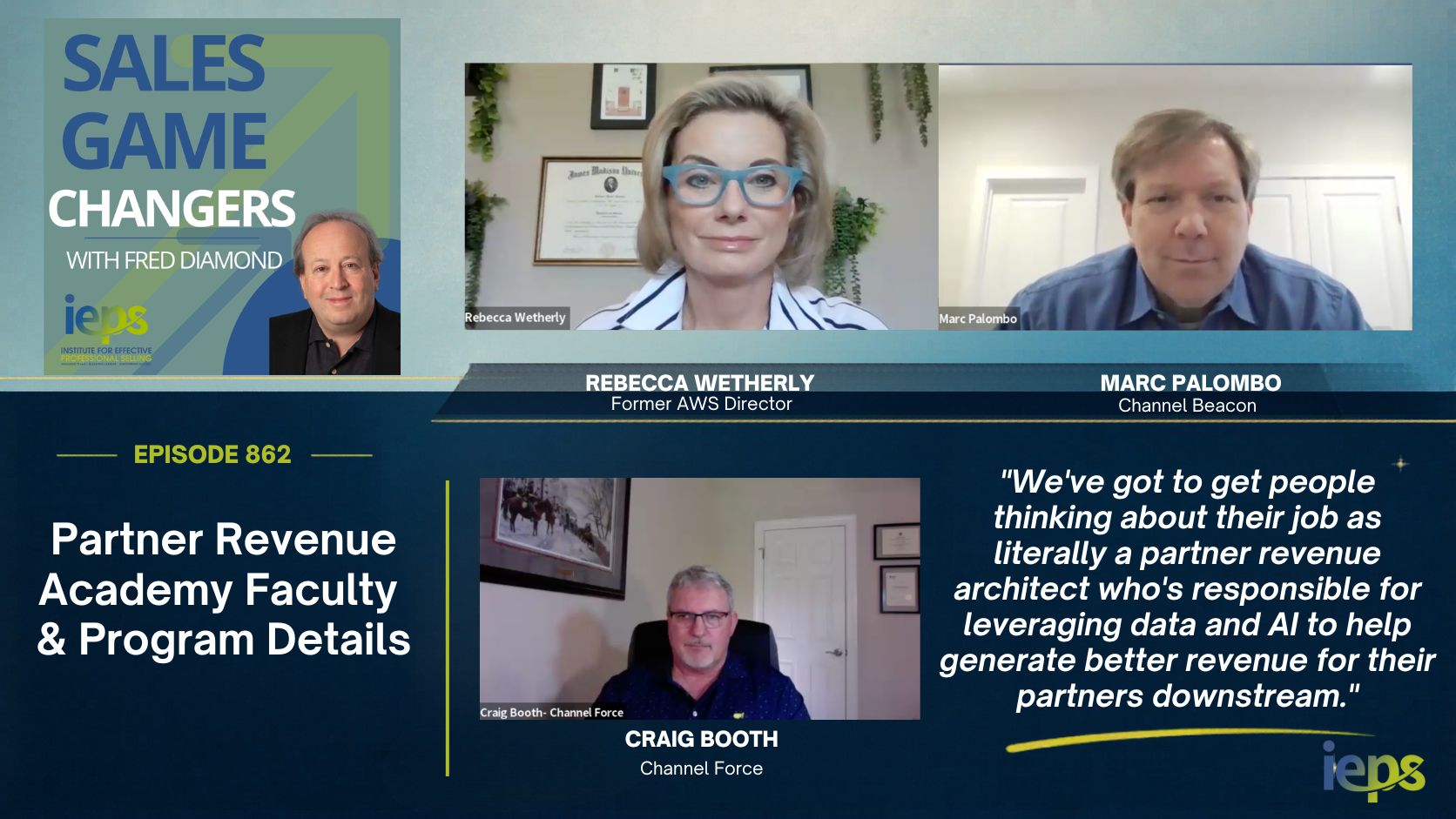
In this special episode of the Sales Game Changers Podcast, host Fred Diamond is joined by industry leaders Rebecca Wetherly, Craig Booth, and Marc Palombo to introduce the Partner Revenue Academy, a new leadership development program designed to prepare partner account managers for the next generation of channel sales.
Learn more here.
Find Rebecca on LinkedIn. Find Craig on LinkedIn. Find Marc on LinkedIn.
REBECCA’S TIP: “Partner sales roles are super complicated. You have to be a jack of many trades. You’re critical to the sales process and need to always be demonstrating value to partners and colleagues. Driving revenue and creating meaningful pipeline growth has never been more important.”
CRAIG’S TIP: “We’ve got to get people thinking about their job as literally a partner revenue architect who’s responsible for leveraging data and AI to help generate better revenue for their partners downstream.”
MARC’S TIP: “Once you actually get in the trenches, no plan survives five minutes with the enemy. It’s about being able to take the initial plan, make adjustments, and rinse and repeat what’s working and what’s not working over time.”
THE PODCAST BEGINS HERE
Fred Diamond: I’m very excited. I have the faculty with us today for the first ever Partner Revenue Academy cohort. It’s going to be a six-session program kicking off on September 11th. It’s going to be virtual, but we’re also going to be having a live portion for people in the Washington, DC metropolitan area.
The faculty, Rebecca Wetherly, Marc Palombo, Craig Booth, and Rebecca, you’ve been on the Sales Game Changers Podcast a couple of times. Craig Booth, you were on recently with Pam Johansen. Marc, even though I’ve known you the longest out of everybody here, this is your first appearance on the Sales Game Changers Podcast.
Before we get into details about the program, let’s talk about the state of the partner account manager. We’re doing today’s interview in August of 2026, and the program, the Partner Revenue Academy, is kicking off September 11th. Rebecca Wetherly, you had a great career. You, by the way, were a IEPS Partner of the Year in 2024. You’re a tremendous supporter of many of our programs, including our Women in Sales Leadership Program. You’ve led partnership relations at AWS and Dell, and you’re extremely well known in the industry. Where are we today? August 2026, what’s the state of partnering?
Rebecca Wetherly: Great to be with you guys today, and we’re excited about this Partner Revenue Academy with Marc, Craig, and yourself. What’s super exciting is that this role of the partner account manager is both pivotal and critical, and certainly complex. Not only do you need to understand your partner, your customer, and your company, but you have to understand programs that help create value for partners, investments to leverage sales, as well as lots of complicated customer industries. You need to decipher which partners to work with in specific accounts, what partner-to-partner mechanisms exist for mission outcomes, and you also need to know what partners are committed to you and your company.
With all of this complexity, Fred, there’s just little to no training offered. There’s on-the-job training, there’s mentoring, and that’s what most partner professionals have to lean into. Today, many companies are shifting partner roles from partner development to partner account management. Along with that come sales targets, quota responsibility, and the real responsibility to generate new revenue.
Something to consider. Canalys projected that partner delivered IT will account for roughly 70% of worldwide IT spending at last year. In 2025, 70% of worldwide IT comes through a partner. That makes the channel the primary go-to motion across enterprise technology. They also project continued double-digit growth in partner-delivered managed services and the rapid expansion of software supporting channel operations through 2028. This is super critical to consider, as your partners will drive consumption of software, hardware, and cloud, but they’re also going to reap the benefits of managed services, AI services, consulting services, security services, which are all core to their P&L. You’re going to need to understand what behaviors drive your partners and their willingness to engage and lead a deal.
Fred Diamond: You’re going to be kicking off the session on September 11th. We’re going to swing back to you in a second to talk a little more about what you’re going to be focused on. Now, Craig Booth, Channel Force, a couple of months ago, back in early 2026, one of our IEPS great partners said partner account managers are way off right now. They’re doing the wrong things, they’re not focused on what their companies, the OEMs, need them to be doing. Fortuitously, we’ve known Pam Johansen for a long time. She’s been a good friend of the IEPS and she reached out and said, “You need to meet this guy, Craig Booth, who’s doing a lot of really smart thinking on shifting partner account managers to,” your term, “partner revenue architect.” I’m excited that you’re going to be a big part of the curriculum and the instruction moving forward. Where are we and what led you to shift your thinking or to make your thinking more well known about this transformation that needs to occur?
Craig Booth: I’m really excited about being part of the academy here, obviously working with amazing people like Rebecca, who you just heard. I don’t even know how to follow up after that. Rebecca and Marc, I’ve learned a lot from Marc as well. I think you’ve got a really good cast to help create the vision for this program and to carry it forward.
Answering your question, what is it that drove me to think through how things are operating? I came from a sales background. I never understood why some of the metrics that we see in partnering, why we accept those metrics, like the 80/20 rule. Why is it that 20% of our partners or less are driving a majority of the revenue? Why is it we have all these long-tail partners? Less than 5% of the partner ecosystem of sellers will actually do anything to proactively position our products and services. This is what’s really killing the channel. It’s killing what we’re actually doing from a performance standpoint. As it relates to the potential of the partner program, you have a lot of underperforming partner programs.
The shift for me is all about how do we create 5X more active sellers? How do we literally take and move the metric of production from the partnering, and measuring at the partnering level, and move it down to active sellers and account engagement? Then how do we resource and structure that active seller to be efficient and effective at positioning and selling both a joint sale strategy?
What I’ll be covering and what we’ll be going through quite a bit is this shift from partnering to creating active sellers. Then how do we equip those active sellers to be highly productive and efficient, because we all know, profitable, efficient growth is what is the key metric that every CFO is looking at, and our channels and our partner programs have to start aligning to efficiency and efficiency metrics.
Fred Diamond: We’ll get into the details here about part of the curriculum that you’re going to be involved with and instructing. Marc Palombo, I’ve known you for probably close to 20 years now. What do you see right now? You’ve worked in the manufacturing side, the OEM side. You also have worked with many partners around the globe. You’re one of the guys that I call when I have a question. I’m excited to have you part of this curriculum. Where do you see the partner community right now?
Marc Palombo: Just reiterating what both Rebecca and Craig said, thanks so much, Fred, for putting this on. I think this has really been a long time coming. As Rebecca said, I agree with her, there’s a lot of inexperience. Unfortunately, the next generation of partner managers and leaders coming out of the woodwork, they don’t have enough folks mentoring and coaching and training them, and enough formal training programs like we’re doing with the IEPS here for the Partner Revenue Academy, to really get people knowledgeable about what works and what doesn’t work.
I also love Craig’s methodology on KPIs and measured performance metrics, deliverables, targets, revenue targets. All of these things are critical. What you see today in the partner channel, what I see day in and day out, is a lot of confusion. In addition to the folks that are inexperienced, not really knowing what to do, as the old saying of fake it till you make it, sorry, you can’t do that anymore, especially in the age of AI. If you’re going to train your AI models, be sure you know the things you’re training them on, if they’re accurate, and getting the results you need.
I didn’t hear too much of what’s been happening in the market around hyperscalers. You’re seeing a lot of push towards AWS, towards Azure Marketplace, towards GCP. What I tell a lot of folks that I work with is either you’re in the stadium or you’re tailgating the parking lots. I think having these partner managers understand that over 800 billion dollars are being sold now in the marketplace today, and if you’re not actively engaging those marketplaces and you know how to co-sell for the market effectively, you’re going to fail. We need to talk about some of that.
I also look at there’s so much confusion. There are just more and more technology vendors coming to the market. There are thousands of vendors. Whether you’re on the ISV side of the equation or the partner side of the equation, who’s managing that? Who is saying, “Hey, this new partner we just signed up, what are the key metric for success?” We’re at a point 12 months from now, was this a good partnership? Was it a bad partnership? Was it a partnership we should never have signed in the first place? We have to really analyze and understand that.
Last but not least, I’ll talk about this when you come back to me about things I’ll be covering in the course, but partner marketing is a huge area that has fallen by the wayside. I know as a former marketer yourself, I see thousands, if not millions of dollars, being spent on direct marketing with maybe a two to three percent direct conversion revenue. then you look at partner marketing and you can get conversions of 30 to 40 percent because these are the people that are the trusted advisors to a very large customer base. Why would you not spend more money on partner marketing? Those are some of the things that I think about from a planning perspective, things I see that are lacking in the marketplace today.
Fred Diamond: As people who are listening to this will definitely attest to, we’re going to get deep into what really needs to happen. We’re going to be kicking off September 11th. We’re going to go through six sessions that are going to culminate on November 20th. Each session is going to be virtual, so you can be participating from anywhere in the world for that matter. If you’re in the local DC, Reston, Virginia area, Northern Virginia, we’re going to have some type of in-person as well.
Rebecca, I’m very excited that you’re going to be kicking this off on September 11th. We’ll introduce people and then we’re going to get right to it. By the way, for the people who are going to be participating, we’re going to have a bunch of online support, meaning that we’ll ask you, tell us what you do, where do you work, so that our faculty members will know about you. We’re not going to be spending a half an hour every session introducing yourself to our participants and the faculty. We’re going to get that all handled, so we’re going to get right to it when we start at 11:00 o’clock Eastern Time.
Rebecca, you’re going to be kicking off session number one. I’m very excited. Give us a little bit of a peek into some of the things that you’re planning on covering.
Rebecca Wetherly: I’m excited to kick things off, Fred. I love, by the way, Marc, what you just said about marketplace and brand-new avenues that folks may not have considered, because they’re massive opportunities, and channel-lite in terms of friction, which all partners love. I’m thrilled you’re covering that.
I’m hopefully going to be the hype girl that gets everybody totally psyched and feeling like you’re part of a cohort. I want to create openness and camaraderie that you’re going to expect to have with your cohort colleagues. I have worked in the trenches, from partner marketing, to partner development, to partner sales, account management, and executive leadership. As Fred mentioned, I’ve been at Dell. I was at a company called Silicon Graphics way long ago. I most recently left AWS after 13 and a half years leading a large part of the consulting partner business. I’ve done it. I’ve been there with you. I am going to plan to share my top tips for partner sales and encourage you to think about working with a customer-first mindset.
This is going to include considering your partner as a customer, as well as their end customers. I’m going to lean into the why, which stems from are you making sure that you’re not just selling products and solutions, that you clearly understand the mission that you’re serving. Speeds, feeds, product offerings are not good enough to position. You have to know what the mission is for your customer and why and how your offering is important.
As I shared earlier, partner sales roles is super complicated. I think it’s the most complicated out there. You have to be a jack of many trades. You’re critical to the sales process and need to always be demonstrating value to partners and colleagues. That’s the difference. Driving revenue and creating meaningful pipeline growth has never been more important. Shifting your mental models and how you are leveraging AI to create real business value on lessons from the experiences we all share is what you’re going to learn in the program. You have the opportunity and the responsibility to put these lessons into action during the program. I’m going to get us started, lay the foundation, and get you guys totally ready for the next five sessions that will go from there, and really helping prepare you for great success in your career.
Fred Diamond: That is great, and that’s the attitude. I love the idea that you’re talking about, which is our cohort. At the IEPS, we’ve been doing cohorts for nearly a decade right now. For people who are looking forward to participating, we’re going to have people from multiple companies, and complementary companies. One of the great things is you build those relationships as well. May suit you today, may suit you in two to three or five years, whatever it might be, but that’s going to be one of the things. Eventually, we’re going to be building a strong community.
Craig Booth, Rebecca is going to be teeing up what you’re going to be getting down and dirty into, the whole concept of shifting from what we used to think partner account managers were, that is no longer valid, as Rebecca very well said, to the concept of being a partner revenue architect to help design predictable revenue systems, to create repeatable revenue systems that will help your company achieve its goal, be able to forecast where it’s going. Like you mentioned before, and as Marc touched on, identifying the partners who really have the skills to help your company grow and to help them grow. You’re going to be handling sessions two and three. Why don’t you give us a little bit of a peek into what you’re going to be talking about?
Craig Booth: The concept here is really shifting thinking. We’ve all learned one way to run our partner programs. We’ve run with, I call it sprinting through the 50-meter mark, when the real race is running all the way through the 100-meter mark. We’ve learned how to recruit partners, on board, enable partners, get partners compliant to our partner program. Where the struggle has always been is how do I take those partners and activate those partners at the seller and account level to actually drive push into the market in a structured way and in a repeatable way that’s scalable.
What we’re going to talk about first is how do we shift the mindset from where you are as a traditional partner account manager, which I think is really important. We still need trust. We still need the foundational principles that a partner account manager will traditionally operate in, but we’ve got to add to that. We’ve got to get people thinking about their job as literally a partner revenue architect who’s responsible for leveraging data and AI to help generate better revenue for their partners downstream. We’re going to talk about the principles that shift around that.
The first session, we’re going to go into something called structured performance partnering, and structured performance partnering is essentially we’re going to teach you how to plan revenue, build a production process, with a coverage model associated with that. We’re going to teach you how to execute a strategy and how to enable partners using a MEDIC-based process to create active sellers. Then we’re going to use AI to optimize that. We’re going to show people a complete process there as we walk through.
The second session that we get into, we’re going to get into the weeds where we’re going to take the foundational principles that we learned in the first session, and we’re going to start applying this into a methodology we have called Connected Probability scoring, where we’re scoring the solution strength, partner impact, seller impact, ICP scores, relationship scores, and the corresponding strategies that wrap around that. We’re going to go into territory management. We’re going to teach people how to plan territories, how to effectively predict revenue based on this. We’ve got a lot to cover in a very short period of time.
We’re also going to teach people how to build effective sales playbooks, how to leverage AI to do that. We’ve got a lot to cover, but I think that essentially what this is all about is we’re going to teach people how to produce revenue out of partners. That’s really what it’s going to come down to.
Fred Diamond: Those are going to be two very, very meaty and exciting sessions. Marc Palombo, you’re going to come on and you’re going to help us basically operationalize all the stuff that we’ve spoken about in the previous couple of sessions. Give us a peek into what you’re going to be talking about.
Marc Palombo: I like to think that everything that Rebecca and Craig is talking about really gets you from the ecosystem to the operations, the KPIs, all those things. I look at what I’m covering really as practical applications. Once you actually get in the trenches, as the old joke goes, no plan survives five minutes with the enemy, it’s about being able to take the initial plan, make adjustments, and rinse and repeat what’s working and what’s not working over time, double down the things that are working, get rid of things that are not working.
Every partner ecosystem is different. I’ve run things for ERP channels, FinTech, LegalTech, EdTech, and every buyer persona and ideal partner profile, which we’ll cover as well, is different. You may be in a mature program. You may say, “Hey, we have a thousand partners, but honestly, 50% don’t really fit the ideal partner profile. Why are they partners?” You may question yourself. Or you may be starting from scratch. You’re a scale up or a startup, which is typically companies that I work with, and you’re trying to build that program from scratch. Who are the right people you want to talk to?
I talked about executive buy-in, because all the things that Craig and Rebecca cover, if you don’t have either the chief revenue officer, the CEO, or the VP of sales, whatever that role happens to be, high enough up the food chain to say, “Hey, we need to treat your company as a strategic partner and we’re going to do these things,” it just falls in deaf ears. Then that leads into one of my favorite things, which is the partner business plan. Do you have partner business plans for all of your partners that talk about all these deliverables and KPIs? What are you being measured on? What does success look like from 12 months?
Now, I would add to what Rebecca said about treating your partners as customers. I tend to treat my partners as an extension of my sales team, my marketing team, my services team. To that end, imagine if you hired a salesperson and you said, “Hey, Fred, your quota is a million dollars. Go sell and I’ll see you in a year.” That’s unfortunately what we do. We sign up a partner, we give them a quota, we don’t talk to them for a year, and we say, “You didn’t hit your numbers. We’re going to demote you now. We’re going to fire you from the program.” It’s just silly.
What are the processes? Are you going to do target account mapping? Are you going to do monthly pipeline calls? Are you going to have quarterly business reviews with executive leadership to understand if sales are doing what they need to be doing, marketing is doing what they’re doing, and service is doing what they’re doing from a delivery perspective? All those, what I call the three-legged stool, all those pieces of stool working, because if one leg of the stool breaks, the stool falls over. These are going to be the practical applications of things that I’ll be covering.
At the end of the day, it’s really about how do we create a win-win. You always hear about better together stories. You want to be sure that both you and the partner are aligned, that you’re working together, and you’re on the same team driving towards building each other’s company’s revenues. Again, dovetailing on Craig’s point about those active sellers, because they’re the ones, I hate to say they’re coin-operated, but we’re all coin-operated. We’re trying to drive business and revenue and we want this to be successful. That’s why successful partner strategies work so well.
Fred Diamond: Then session five, we’re going to be getting deep into the operations at the partner. We’re going to be talking to executives on what drives them, what drives their revenue models, what optimization they’re looking for. Then in session six, we’re going to bring it all together with final questions, ways to work together, ways to implement the programs and the lessons that we just learned from. It’s very, very exciting, if you’re interested. By the way, after just listening to Rebecca, Craig, and Marc, if you’re a partner account manager and you ain’t interested in this, you’re going to be halting your career. I can tell you that right now. Our whole mission at the IEPS, Institute for Effective Professional Selling, is to help companies engage with customers and their sales professionals. Rebecca, you and I have talked about this before, I view the channel professional as sales, it’s all sales role, working on the same thing, bringing a revenue to our company, helping them elevate their leaders and helping them empower revenue success.
Go to theieps.com, you’ll find the link on how to register. We’re going to be starting the session on September 11th. It will sell out, so if you’re listening to this podcast now, if you have any questions, reach out to me, Fred Diamond, or any of the faculty members will answer them for you, and we’ll get you to participate.
Rebecca, Craig, and Marc, I’m excited to have you on this next endeavor with the IEPS. For all the listeners today, I’m excited for you, for your investment, and taking your career to the next level. My name is Fred Diamond. This is the Sales Game Changers Podcast.
Transcribed by Mariana Badillo