
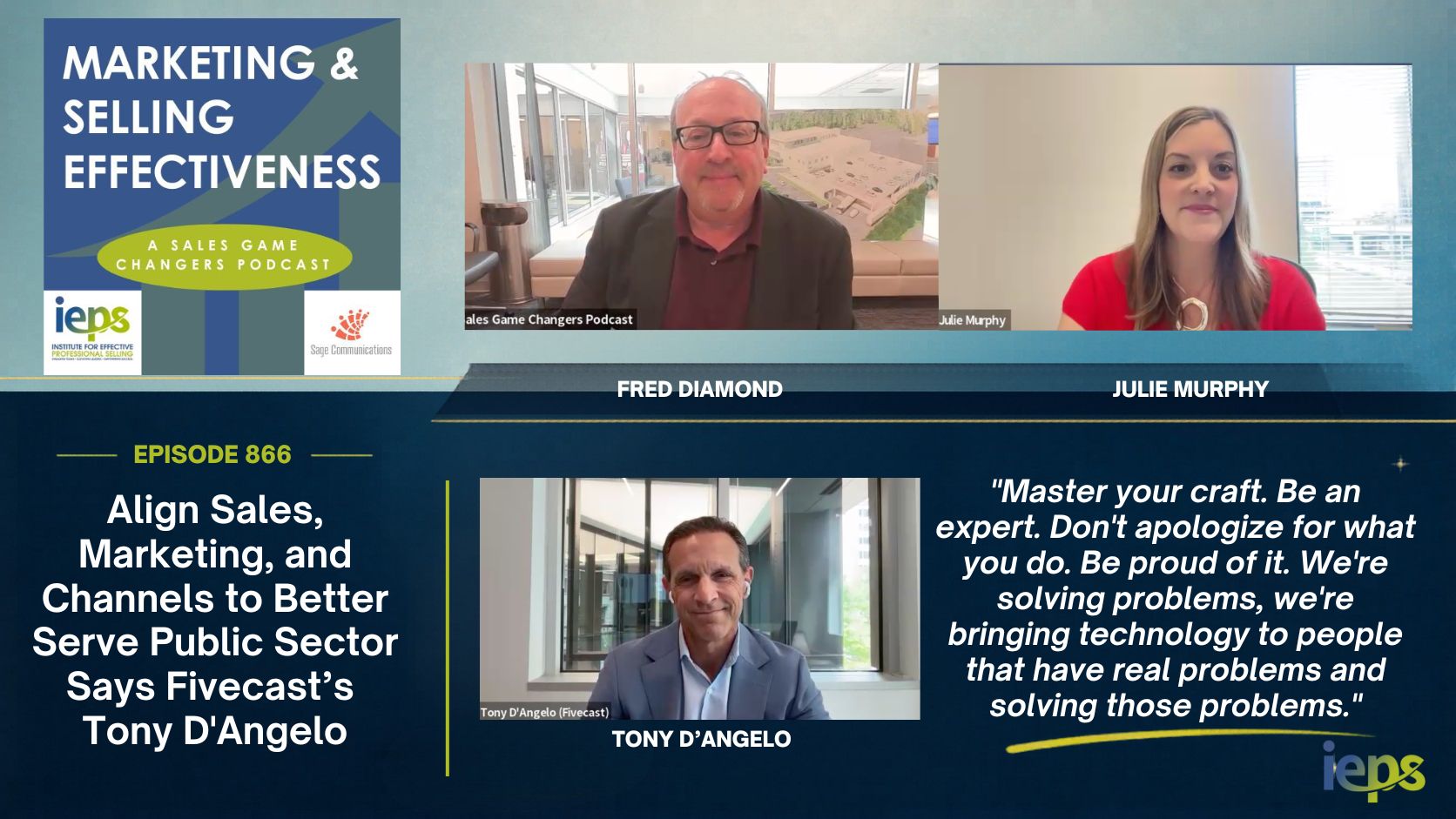
This is a Marketing and Selling Effectiveness sub-brand of the Sales Game Changers Podcast.
Watch the video of this podcast on YouTube here.
The Sales Game Changers Podcast was recognized by YesWare as the top sales podcast. Read the announcement here.
FeedSpot named the Sales Game Changers Podcast at a top 20 Sales Podcast and top 8 Sales Leadership Podcast!
Subscribe to the Sales Game Changers Podcast now on Apple Podcasts!
Purchase Fred Diamond’s best-sellers Love, Hope, Lyme: What Family Members, Partners, and Friends Who Love a Chronic Lyme Survivor Need to Know and Insights for Sales Game Changers now!
On today’s show, Fred Diamond and Julie Murphy meet with Tony D’Angelo, Vice President of Public Sector at Fivecast.
Find Tony on LinkedIn.
TONY’S TIP: “Master your craft. Be an expert. Don’t apologize for what you do. Be proud of it. We’re solving problems, we’re bringing technology to people that have real problems and solving those problems.”
THE PODCAST BEGINS HERE
Fred Diamond: Julie, I’m very excited. We’re going to be talking to Tony D’Angelo with Fivecast. I really enjoyed the prep call that we had with Tony and his team. I’m excited for what we’re going to be talking about here.
Julie Murphy: Yeah, me too. We’ve got a lot of questions for Tony. Tony is a longtime sales leader in this space. I first met Tony when he was vice president of public sector at Lookout, where we did a lot of thought leadership together around mobile security and the sales team and marketing. PR team worked really tightly there.
I also met Tony because his daughter was the lacrosse coach for my daughter, which was really nice, when she was in fourth grade and his daughter was in high school. Now she is a D1 lacrosse star. This town is small, so you can meet people in a lot of different ways. Tony, we’re really excited to hear about your advice and the trends that you’re seeing in the market. Welcome to our podcast.
Tony D’Angelo: That was great. Thank you for having me.
Fred Diamond: Tony, I’m excited to have you here. I forgot about the lacrosse tie. As I told you, I have a son who is a hockey professional. He played a little bit of lacrosse. I know you’re mostly on the girls’ side. Maybe we could tie in some of the lessons from what you’ve learned from coaching.
Tony, tell us briefly about yourself and then let’s get started. We’re doing today’s interview in July of 2026. What’s the biggest shift you’ve seen in enterprise buying over the past couple of years and how should sales and marketing leaders be responding?
Tony D’Angelo: It’s a good question. I think predominantly it’s the access to information. That’s changed dramatically over the years. The buyers are far more educated than they used to be. Now with AI tools, it’s gotten even better for the consumer. They can look at you, your competitors. They can create a capabilities matrix with just a couple of keystrokes and have everything at their fingertips.
The trick for marketing leaders is to take back control of that messaging. I’m a big fan of ABM, account-based marketing, highly targeted marketing campaigns. If you know your client base, who’s going to resonate best with your message and your product, it’s pretty easy to come up with that target list of accounts. Then within those target accounts, really identify the target individuals that you want to market to and create custom content for them. It’s a lot of work, it’s hard, but nothing is easy in this business.
The ones that put the time in, put that extra energy into it and control the marketing, you may not be able to do it before they actually do their own research, but you might be able to at least give yourself more of a fighting chance because they could make up their mind before they even meet you. But if you have that opportunity to try to control some of that messaging and some of that custom content, you’re going to be in a much better position.
Julie Murphy: I absolutely agree with you on ABM and really targeted marketing and thought leadership because marketing is really getting as close to one-to-one as possible, because your customers expect when you’re talking to them that it’s customized. You’re not going to walk into a federal agency and start talking about profit margins. It’s an immediate turnoff. The more customized you can be toward your customer, I think the better.
You had also mentioned AI. What do you think organizations are getting right and getting wrong when they apply AI to marketing and sales? What have you seen?
Tony D’Angelo: In the last year is probably the first time I’ve really used it and I’ve seen the team really use it as a key tool within the business. If I look at the sales professionals, I think they’re doing a really good job at building business plans with it, doing the research, trying to identify the right target customers. Even if you’re talking about government, which is what my team focuses on, really identifying even the sub-agencies and sub-organizations that we may not have known that much about, even though most of us have many years of experience, there’s always going to be new corners, whether it’s reorganization, a different sub-agency pops up or a mission moves from one to the next. These AI tools are providing tremendous lift and helping us to just really narrow our focus.
The other thing, on the marketing side, where organizations are getting it wrong, I would say it’s tempting to let AI do most of the work. I think it’s a good tool to do a lot of the busy work, but it still requires human hands and that human touch. I think there’s a temptation to generate too much content. I think there’s a temptation to let AI generate all of the content, again, without that human intervention. I think, at times, we have so much bombarded at us through social media, LinkedIn postings, all different types of media coming at us that oftentimes can feel cold and lifeless. I think just making sure that we don’t stray too far away from the human element, but use tools like you might use a traditional set of tools in a toolbox. You’re not going to hammer a nail without a hammer. You’re not going to do it with a block of wood or your bare hand, but there’s those other elements that just really matter when it comes to making sure that content looks and feels right.
Fred Diamond: Just give the audience, if you don’t mind, just a brief introduction to yourself and what you do.
Tony D’Angelo: I’ve been in the industry over 30 years now. I’ve spent my entire career in the Washington area. Worked for private sector technology companies the entire time. I’ve led not only public sector organizations, but commercial as well. It’s hard to not attach yourself to government business living in the Washington area. The thing I just love most about it is the mission and the client base. It’s also the largest enterprise in the world. There are many unique things going on.
The team I lead today is focused on public sector for the Americas. Fivecast is an open-source intelligence software platform. We collect off of open web, across social media, and a variety of different data sources and generate risk profiles for things like law enforcement, defense, intelligence, other use cases around fraud, different things like that. We’ve got customers across state and local government and then all sectors of U.S. Federal, and that’s globally as well, across the international governments too.
Fred Diamond: One of the challenges, and we talked about AI and all the access to content and information, is that buyers, customers have access to all the information that they want. As a matter of fact, if an IT professional working in a government agency wants to know whatever he needs to know about Fivecast’s product strategy, he can probably go into any of the AI tools and within a minute, he can get your plans that have already been communicated somewhere. What does that mean for today’s modern sales professional? It used to be 15, 20 years ago, sales professionals were walking brochures, and that’s not pertinent anymore. What does that mean for the sales professional? What are you looking for? How are you leading them to be effective today? We’re doing today’s interview in July of 2026.
Tony D’Angelo: It’s a very interesting question because we have this conversation a lot. Customers used to use a sales call to educate themselves. It’s no longer the case. You’re lucky if you can even get in front of them face to face. Oftentimes it’s over a call like this and they don’t even turn their cameras on. There are so many other challenges, and so that’s a much longer conversation.
I think the way that I coach the team, and even what I try to do myself, is to be agile. We want to learn as much as we possibly can, ideally from that prospective client, before you get in front of them, whether it’s an initial phone call or even it’s an email exchange about what this meeting agenda and what the meeting flow is going to be like. But oftentimes you just don’t know or you could be caught a little bit off guard. Being agile and just being prepared to jump into a later stage of the sales motion than you might normally expect.
Customer might be highly educated on your platform and they’ll say, “Hey, I’ve already done all my homework. I got 20 minutes. I just want to see a demo.” You need to decide if that’s what you’re going to do and if that’s how you’re going to allow the call to flow. Are you going to let them control the call and is that the way that it’s going to go? Generally, you might have to go that route if that’s the only airtime that you have. You might want to make your best impression.
As best you can, also do your homework on the client. They’re doing research on us. We can do the research on them, particularly if it’s a government agency, I can learn a lot. Is it a defense agency? Is it a weapons systems program? What do I know about the budget? Have they been in the news? Has somebody been hauled in front of Congress? Are they having problems? Is the program going really well? There’s a lot that I can glean from this. I can virtually map out the leadership just doing my own research. Then ideally, show value and try to map capabilities to the mission, understand the mission as best you can, because then you’ll have some credibility. If you’re just going to show up and let them completely lead the call and assume that they know everything because they’ve done the research, you’re probably not going to get a second call back.
Julie Murphy: Tony, it’s not even just your customers that have access to all this data. Fred and I have talked about previous podcasts that sometimes customers are researching up to 80% closer to their decision before they actually even talk to the sales team. But you have data as well, both marketing and sales teams. There are lots of different ways that you can track your prospects, whether it’s through click through rates, leads that you’re getting from trade shows. Really now, because there are so many different channels to reach these prospective buyers, you have more data than ever.
What metrics really matter to you when you’re looking at the data, because there’s a lot of activity that you can do, but what are you tracking? What numbers do you think are really contributing to the revenue?
Tony D’Angelo: Yeah, lots of activity, which can be confused with productivity, as I like to say. The sales numbers are pretty easy to measure. Even the contribution from marketing or channels, things like that, it’s the amount of qualified pipeline that’s been created. Then in addition to that, if sales and marketing and channels are helping to create qualified pipeline, are we closing that pipeline? We can even measure that in different sectors. What’s the percentage of opportunities that we’re closing that are generated by sales versus marketing versus channels?
Virtually every company I’ve ever been in, marketing will say, we’ve created thousands of leads for sales. What does sales say? I have no leads. The truth lies somewhere in the middle. There could be a lot of reasons for that. It could be, not to get overly technical on marketing, but MQL to SQL conversion rates, so marketing qualified to sales qualified leads. Who’s generating the leads? Are they properly qualified? All of those things. It requires a bit of digging, but the data typically doesn’t lie.
Fred Diamond: Tony, we’re over 850 Sales Game Changers Podcast episodes. One of the keywords that sales leaders like you bring up frequently, value comes up all the time and effectiveness, but preparation is a word that comes up all the times. The sales leaders that we typically present on the show and at the Institute for Effective Professional Selling understand that and are excellent at that. What is some of your advice for the selling professionals listening, and the ones that you manage, about preparation? What do you expect of them? What are some of your tips and guidance for them to be more effective?
I like what you said before. If you get the opportunity to be in front of the customer, no matter how they want to be presenting themselves, it’s gold. Every time you hear back from a customer, you get a chance to speak to a customer or a prospect, it’s gold, but you got to be talking to them of things that are of purport and of value. They don’t want to talk about the World Cup, but they want to talk about how is your technology going to affect them as they’re trying to achieve this mission or this goal, whatever it might be. Just curiously, since this is the Marketing and Selling Effectiveness Podcast, what might be your advice for the marketing professionals out there to help the sales professionals be more prepared when the opportunity arises?
Tony D’Angelo: You think about job interviews and what people go through with that type of preparation. If somebody wants a sales role at Fivecast and they spend a few minutes looking at the website for the interview, it’s probably not going to cut it. That’s probably the bare minimum, because if I or anyone else says, “Well, tell me what you know about Fivecast,” and it’s very little or nothing at all, clearly they haven’t done the preparation.
Same thing goes with meeting with a prospective customer. It’s doing that work. The data is generally there, unless it’s a classified environment, classified program, you can learn a lot about your client. This goes along the ABM route as well. Doing your homework on what’s the message that might resonate with this client? What is the particular use case? What problem are they trying to solve? Do we have a solution that solves that problem? Who are the individuals that are probably going to be most interested in what we’re doing? This is where I like to take ABM to the next level, I jokingly say almost like a stalker-ish level, because I want to know the individuals that are interested in our type of technology who might be speaking at trade shows, who might be posting online.
If you put the time in and do that level of research, you’re probably going to find out, because if someone comes back and tells me that, “Hey, we’re going to meet with these three individuals, and these are the people that I’ve targeted,” I’m going to ask why, why the CIO or why the CISO. They might have no interest in this technology. It might be somebody else, but until you actually do that homework, because you could literally, just based on titles alone, you could probably come up with 50 people that sound like they could be the right person. But until you do your homework, you could narrow that down to four or five people. Without belaboring the point, I think it’s that deep preparation and just understanding the potential client and the mission outcomes.
I think the other point is be a master in some sales methodology like MEDDPICC or something like that, because training your brain, when you have a very short amount of time in front of the client, you tend not to miss things. You’re going to look for an economic buyer, you’re going to understand the evaluation criteria, you’re going to try to implicate pain, if you will, what problems are they trying to solve, and then be able to help them. Because you can be a relationship sales person, you can be a very technical sales person, but the ones that are going to be the most successful, the ones that are solving problems, that’s what customers want. Understand what I do, understand my mission, understand my problems, bring me a solution that solves my problems. If you can do that, you’re going to be very successful.
Julie Murphy: That’s very smart, Tony. What you’re talking about when asking why, it’s what are the motivations, what’s the buyer behavior, and what’s motivating them to be interested in this particular product or service, which is why the messaging and collaboration between sales and marketing. You’re helping each other, you’re speaking the same language. I know that’s something that you’ve always been a champion of. I know that during my time when I worked with Lookout and you were there, you were very open and collaborative with the thought leadership team and getting that messaging right and getting the right talking points out there and awareness in the marketplace. From what I’ve seen, you’ve been doing that at Fivecast as well.
Everyone talks about sales and marketing alignment, not everyone really does it. In organizations that you’ve ever been a part of or that you’ve seen that really do it well, what consistent behaviors are you seeing?
Tony D’Angelo: I would add channels to that as well. I look at it as a three-legged stool, so sales, marketing, and channels. I expect that the pipeline contribution is going to be a third, a third, a third from each. We talked a little bit about that before. The way that that is best managed, my opinion, is when marketing and channels are completely part of the sales go-to-market business plan, down to the rep level. Each rep, each sales individual, sales professional needs to have a marketing plan, needs to have a channel plan, needs to be very actively engaged with their peers in those organizations. Because if you’ve got a marketing organization that is off doing their thing and they’re creating content and mass-emailing it across a number of different verticals, government and commercial, it’s going to generally fall flat, in my opinion. It’s that close alignment.
The marketing leader and the sales leader, as well as the marketing individual and sales individual contributors need to be complete partners, as well as the channel leaders, and just all do that together. Because if we’re building marketing plans for a specific ABM, we can see that and measure that and then tweak it. As I’ve told people, when we’re doing these ABMs, we’ve already decided who are the target accounts. We’ve decided who the target individuals are. We’re not going to try it and then stop. We’re going to try it until we get it right. If we’ve got the messaging wrong, we’re just going to keep going.
If we’ve identified our target accounts and our target individuals, we’re just going to keep going. Maybe we get in through a channel partner. Maybe we get in through this great marketing content. Maybe we meet somebody at a trade show, but it’s going to be that persistence and the close collaboration across that three-legged stool of sales channel and marketing that will win the day.
Fred Diamond: Knowing who those companies are, or in your case, the government agencies and who the people are, will definitely save a lot of time, make your marketing more effective. It may not lead to a quicker sale, hopefully it will, but it definitely makes the efforts of everybody involved.
Tony, I’m going to ask you to give us your first thing that comes to mind to the next couple of questions here. What do you see sales reps doing wrong? If you could just pick out one thing, you’ve managed hundreds of sales professionals, maybe thousands in your career. Again, we’re doing today’s interview in July of 2026. What’s the one thing that you’re constantly seeing selling professionals do wrong today?
Tony D’Angelo: I would say not focusing enough on the growth and retention aspects. We’re a SaaS company. GRR and NRR, as the terminology goes, it’s the renewals and the expansion of that existing client base. If you’re a company that’s growing 35% to 40% a year, roughly 75% to 80% of your annual revenue is going to come from your renewal base, and then if you can grow that renewal base, roughly 20%. But yet most sales leaders and sales individuals will spend the majority of their time chasing the logo business, which might represent 20% of the growth.
Those are important, don’t get me wrong. It’s super important to have new logo and continue to expand that footprint, but the gold standard, if you can hit a 95% renewal rate and then retain your existing clients and grow them 20%, you’re going to solve a lot of problems. The sales cycle is shorter and the cost of sales is a lot shorter. It’s a lot easier to retain and expand your existing client base than it is to go find new clients.
Julie Murphy: We’re going to have some fun with this next one, Tony. If there’s one marketing or sales buzzword that you’d like to see retired, and I know you’ve heard a lot over the course of your career, what would you be okay if you never heard it?
Tony D’Angelo: There’s a lot of them. Just one. Synergy maybe. There’s a lot of corny, tacky ones, circle back, there are so many, but yeah, Synergy probably. It’s just vague and it sounds good, but there’s not really much meat behind it.
Julie Murphy: A little empty. I agree with you on that one.
Fred Diamond: That’s funny. I have a daughter who’s a sales manager at the Hershey’s Corporation and she just got promoted to manager and we were talking about words, like Julie’s reflecting on here, and buzzwords, etc., and I said one of my favorites is circle back. Anyway, I want to thank Tony D’Angelo. Julie, thank you for bringing Tony on the show. This was the Marketing and Selling Effectiveness Podcast, a sub-brand of the Sales Game Changers Podcast. Thank you, Tony, for the great insights. The whole notion of ABM, I’ve been saying this my whole career, knowing who your prospects are, knowing who’s most likely to buy, and it ain’t thousands of companies.
I used to work for a guy who worked at IBM, who was a senior VP of sales at IBM. This was when IBM was the technology company, the hugest one. Even he said that not every company was a target of theirs. They couldn’t satisfy every single customer. My daughter, that I just mentioned, sells Hershey’s candies, same thing. I said, “Well, I guess everyone buys Reese’s Peanut Butter Cups because it’s the biggest candy.” She said, “Well, peanut butter is not very big with Hispanic audiences.” It’s a lesser product in some neighborhood convenience stores, for example. I love what you brought up with your team and directing them, makes marketing efforts a lot more effective, etc.
You’ve given us so many great ideas here. Give us one specific action that people listening to the show or reading the transcript should do right now to take their sales career to the next level.
Tony D’Angelo: Master your craft. Be an expert. There’s this notion of 10,000 hours to be an expert. I don’t think that’s enough for sales. Maybe it’s enough to play the piano or to do something else, but put the time in. Don’t apologize for what you do. Be proud of it. We’re solving problems, we’re bringing technology to people that have real problems and solving those problems. Do the hard stuff. Put the time in. Read books. Listen to podcasts like this one. Just continue to get better and hone your craft. Like I said, 10,000 hours, I think, equates to less than five years in the workforce. That’s not enough. Just keep at it and you’ll get better.
Fred Diamond: As we’ve said many times, if you’re a professional, be a professional. What are the things that professionals will be doing? Julie, any final thoughts before we wind down here?
Julie Murphy: I think you’re right. I think the 10,000 hours is a good starting point, but it’s also never stop learning. Our industry is changing too much.
Tony D’Angelo: Changing really fast.
Julie Murphy: If you took a back for five years and came back, we probably wouldn’t even recognize it. I think it’s a continual over the course of your career, is to try to keep up. That’s what we do as well.
Fred Diamond: Once again, thank you, Julie Murphy. Thank you, Tony D’Angelo. My name is Fred Diamond. This is the Sales Game Changers Podcast.
Transcribed by Mariana Badillo