
Watch the video of this podcast on YouTube here.
The Sales Game Changers Podcast was recognized by YesWare as the top sales podcast. Read the announcement here.
FeedSpot named the Sales Game Changers Podcast at a top 20 Sales Podcast and top 8 Sales Leadership Podcast!
Subscribe to the Sales Game Changers Podcast now on Apple Podcasts!
Purchase Fred Diamond’s best-sellers Love, Hope, Lyme: What Family Members, Partners, and Friends Who Love a Chronic Lyme Survivor Need to Know and Insights for Sales Game Changers now!
The Institute for Effective Professional Selling has launched the Partner Revenue Academy for partner account managers who are looking to become more effective active sellers. The next 6-session cohort launches on October 16.
Learn more here.
Today’s show featured an interview with Joel Jackson, Senior Vice President of Worldwide Technology Sales and Client Adoption at Red Hat.
Find Joel on LinkedIn.
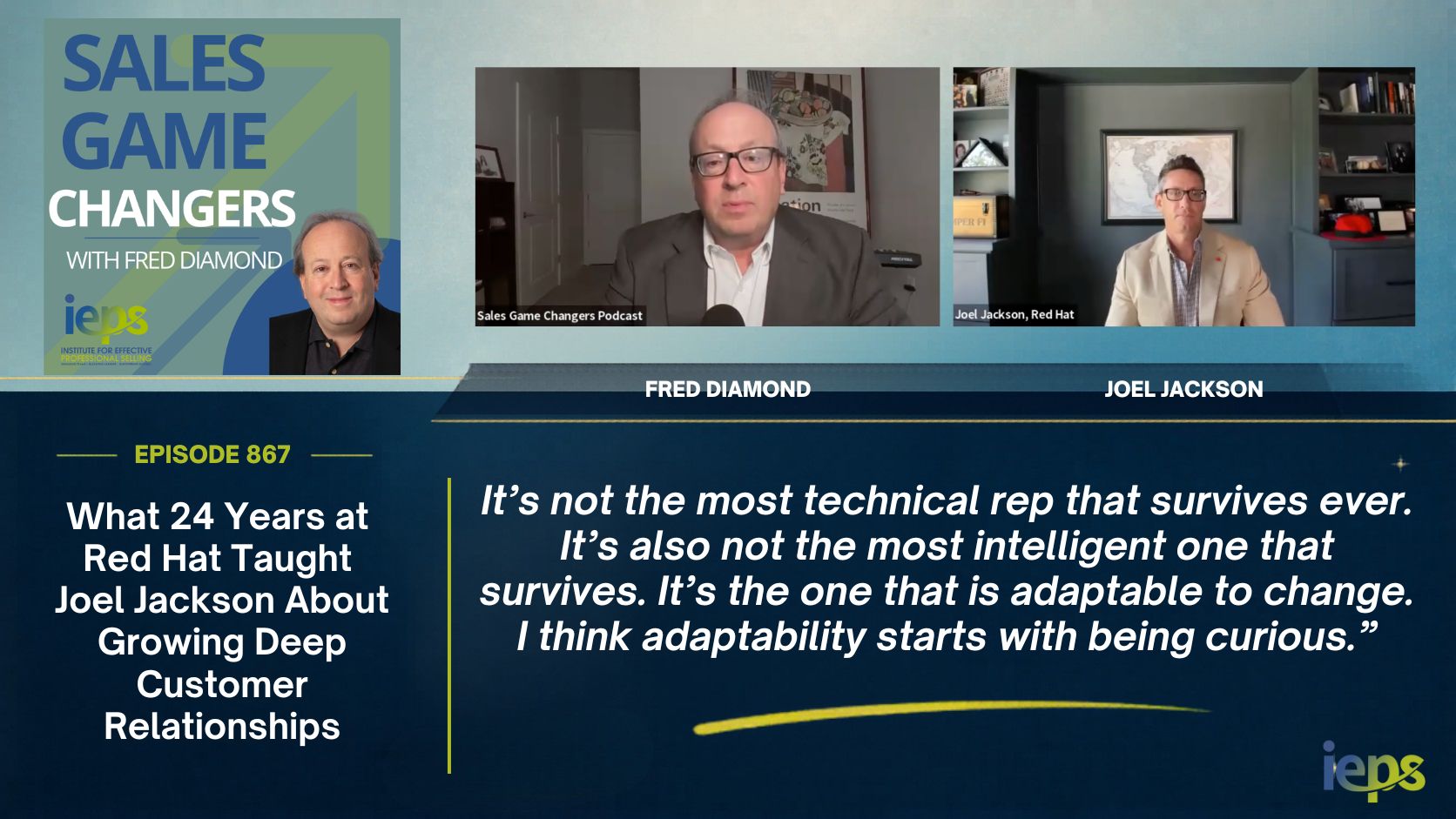
JOEL’S TIP: “It’s not the most technical rep that survives ever. It’s also not the most intelligent one that survives. It’s the one that is adaptable to change. I think adaptability starts with being curious.”
THE PODCAST BEGINS HERE
Fred Diamond: Joel Jackson, I’m excited to talk to you. Give us an introduction. Tell us what you do. I got some great questions teed up here.
Joel Jackson: I work for Red Hat. I run the global technology sales and client adoption team. It’s about 1,700 people that are all in the technology business, whether you’re a subject matter expert, you’re an SA, black belts, then we have an entire adoption team that fits on to that team as well. I’ve been at Red Hat 24 years last week. A good part of that was with public sector and Paul Smith over a decade there. This is my third software company, but by far the longest. You don’t catch too many Red Hats in a row, but this has been a great ride for us.
Fred Diamond: Good for you. 24 years, that’s a long run. Matter of fact, I just had a child who just had their 24th birthday. You’ve been at Red Hat longer than them.
Joel Jackson: I got married here. I had three kids here. Paul’s seen actually all of that. It’s been a great place to work.
Fred Diamond: Very good. I’m excited to get deeper into what you do. It’s a really interesting time for companies like Red Hat and IBM. There’s so much transformation. We’re doing today’s interview in July of 2026. We talk to a lot of great sales leaders and a lot of things are changing. Speaking of change, you’ve led sales through open source, hybrid, cloud, digital transformation, and of course, now AI is the big topic and the big technology that supports almost everything that’s happening. Looking back, what’s the biggest leadership lesson you’ve learned from leading through so many ways of technology change? In 24 years, they’re flying into my head right now, in addition to the ones that I just listed. Give us some of your thoughts about what you’ve learned.
Joel Jackson: Especially pertaining to the world that I’ve lived in, which is the open-source world, for a quarter of a century now, I think every wave looks like a technology story. Underneath it is really an adoption story, and I don’t think that pattern changes too much. Linux was extremely powerful, but it was fragmented. Enterprises couldn’t run it until someone operationalized it into a thing that we called RHEL, Red Hat Enterprise Linux. Containers, the same way. I’m just going to walk through the path and the journey that I’ve seen here.
You had RHEL, you had open source, you had containers, those were revolutionary until we productized that as well and made it consumable for the enterprise. You had Kubernetes come online around 2012, I think, and that was super transformative, but intimidating. I think AI is probably the same movie, the gap between demo and production, security and governance, operational rigor. Look, that’s where the real business lives every single time.
As far as the leadership lessons, I think your job is to lead people through the ambiguity. Sometimes that’s naming the hard part out upfront so your team doesn’t mistake difficulty for personal failure. We deal with that quite a bit. Some of these technologies are extremely hard in the beginning stages. Direction first, then you add velocity.
Another big lesson that I learned was the money is always one wave behind the headlines. I think when everybody was talking about cloud, on-premise was still paying the bills. Today, everyone’s talking about AI, while for us, there’s other places that pay the bills, but you have to have a team, you have to close them off from the main part of your company, get them to disrupt and do what they do best. When that product gets product market fit, then you bring it back into the whole part of the company. You can’t have everybody chasing the shiny object at once. You need to pay those bills.
Fred Diamond: You just said something very interesting I want to follow up on. You said difficulty versus personal failure. That’s actually very insightful. Sales is hard, man. We talk about sales being hard and you may be having a great year and then all of a sudden, boom, things go down and you question everything that you’ve ever done in sales, or things, of course, can go the other way. The prospect that you haven’t heard from in three months, you get an email, Friday at 4:00, “I want to talk on Monday,” and then boom, everything’s great.
Go back to that for a second. As a leader, how do you help your people, either your direct reports and maybe people down the chain as well? That’s just an insightful comment.
Joel Jackson: I’ve watched leaders, I think everybody has, you watch leaders in every one of these cycles pretend the transition is easy, it’s clean, and the playbook is there. It never is. The sellers and the leaders who thrive are the ones who literally lead them through the truth early. The rules are being rewritten under your feet. You close the gap with judgment, not necessarily a playbook, in the beginning. That’s the job. It’s not a defect in the job.
When we hire disruptors for an early or emerging technology, we don’t pretend that we have all the answers. Your job is go figure out what the right pattern is that we can repeat and get this cleaner, but you’re going to fail. I think if you bring that upfront, especially in the emerging technology space, I think that gives people and associates and sellers a little bit of leeway. They’re not afraid to fail. We don’t think of that as a bad thing at all. It lets you move on. I think the worst-case scenario is mediocrity. You don’t move on. You don’t learn anything. Failure isn’t terrible. In emerging technology, I think you really do have to make sure that they don’t take that personally. They’re moving forward. As long as they’re moving forward, we’re good.
Fred Diamond: That’s a great point. I’ll harken back to, I was with a software company in the late ‘90s and our team was tasked with bringing a particular new product to the marketplace. It was very difficult. It was very competitive. Our company was five years behind. I remember I was meeting with our VP of sales and I said, “What are we going to do?” He said, “I have no idea.” I was like, “Okay.”
Joel Jackson: It’s like that direction first, then velocity. A lot of folks will take a new technology, apply velocity to it. That’s not the right process. It’s the old, I forget who said this, but if you’re an inch off of landing on the moon, no problem. But if you’re an inch off of taking off to the moon, you miss it by a thousand miles. We use that all the time, especially with the newer technologies, just let’s get the direction. Companies, they don’t disrupt. People do. Make sure you get the right people onboard.
Companies think they like to be disruptive, but it’s the people in that company that really are. I think we learned that really quickly with open source. Just because you think you want to go after some giants in the proprietary world, you better have some people that can take failure and can disrupt the status quo.
Fred Diamond: I think you’re back on the history of Red Hat, when you guys came out with open source. No one else was doing it. It was brand new. Essentially, it was free. We don’t need to debate that or anything, but now you’re out there trying to sell this. We don’t need to go into the history of Red Hat, we could probably talk about that for hours.
Joel Jackson: It’s hard selling free software. That has not changed at all. But yeah, you’re right.
Fred Diamond: Obviously, you manage a lot of people who bring a lot more to the table, and that’s been the case. Just curious, we’re talking about AI here, are there other big things happening? AI is a huge one, and not just AI from the customer, but we spend a lot of time on the Sales Game Changers Podcast talking about AI and the sales process and what leaders like you are doing. What are some of the other big monster shifts that are happening?
Joel Jackson: Depending on the customer or the segment that you’re talking to, AI is certainly the loudest. But you have robotics, you have drones, you have edge networks. Those are growing as fast from a real dollar perspective for companies, especially companies like us. All this stuff is getting closer to the field. They’re putting edge networks closer. Your phone, this thing, it’s just all coming closer and closer to where the action lives.
AI is certainly the loudest. It’s not the only one, and it may not even be the most immediately consequential, which some people might disagree with that, it certainly will be consequential in the future. There are definitely other shifts that are happening where AI is going to participate in, but those other markets are moving just as fast.
The other thing I would say on this topic is probably the economics is something to pay attention to. Now, you’ve seen this over the last decade, probably, where the industries are moving from acquisition economics to consumption economics. You don’t necessarily earn the revenue at a signature anymore. You earn it at usage and adoption. That can invert a lot of your sales organization around compensation, around coverage, and even what a win means.
You can sign a nine-figure deal, I think a lot of the cloud companies do this as well, but your commit to consume, you still have to go in there and get them to consume it. That’s another shift that is just going to get exacerbated by all the AI talk and even the edge and the robotics. All that stuff is going to be very relevant.
Fred Diamond: I agree. You lead one of the world’s premier technology sales organizations. Again, we’re doing today’s interview in July of 2026. What separates great technology sellers from those who simply know the technology? Just as a follow on, you’ve been leading global teams for over two decades now. What characteristics consistently define maybe the top 5% of your sales professionals?
Joel Jackson: I’ll take that first question. It’s not the most technical rep that survives ever. It’s also not the most intelligent one that survives. It’s the one that is adaptable to change. I think adaptability starts with being curious. I’m a Marine Corps guy. The motto there is adapt and overcome. I think it’s the same motto in sales. You have to be curious. You have to be adaptable to change. If you’re not, you’re just going to have a bad time with some of these paradigm shifts. If you just take a look at AI, knowledge is simply table stakes now. It’s honestly depreciating fast. I think an AI model is going to know your product specs better than your best SA will ever know, and it probably already knows today.
I think what doesn’t depreciate is what you want to focus on in the future. I think that’s translation. It’s conviction. A great technical seller can hold a deep conversation with an architect in the morning and have a commercial conversation with a business leader or a CRO in the afternoon, the same day, the same deal. I think connecting, though, too. I was talking about the economic conditions, understanding the revenue metrics under the deal, multi-year structures, consumption, ACV, what renewal looks like in year three, those are the big things. It’s operators, not order takers. I think we’ve seen this move for a long time.
I do like to go back to Red Hat’s early days. We were the first company to ever offer a subscription model to software. Nobody ever had done that. The subscription where every year for us was an election year, I think that model is just now down at the micro level. Every hour you have a compute GPU burning, you better be using that. It’s just going all the way down to a micro level there.
Fred Diamond: Joel, first off, thanks for your service. Second of all, I’m just going to go off script here a little bit. I’m going to give you an opportunity, obviously, as a great sales leader, top sales leader, you’re always recruiting. Give us a pitch to someone to get them to come to work in sales at Red Hat. For two people, maybe somebody who’s mid-career, maybe 10, 15, 20 years in, maybe working for a partner or a competitor that you think would be a good acquisition for the team. Then also, I don’t know if you do much recruiting at colleges or for young adults, if you will, but I’m going to give you the opportunity to give the pitch to both of those audiences.
Joel Jackson: I’ll give you a Marine Corps analogy. If everybody could get in the Marines, it wouldn’t be the Marines. That’s the mentality we take on recruiting. We’re looking for those folks that want to be part of something big. Open source is still a big part of that. If you look at where robotics, drones, AI, what is the one thing that is not going to change? It’s probably open source. It’s been a constant for a while, and I think it’s leading those markets. If you want to be a part of something and a part of a community, that’s what we look for. We look for that at Red Hat and IBM combined.
IBM has been a great partner for us over the last couple of decades. They bought us, some might not know that, they bought us nine years ago, and they’ve been an extremely good partner. They’ve left Red Hat alone. They know that the open-source culture and that DNA is very different from a lot of companies, especially over at IBM. But we have got a great future around open source, AI, quantum. I think Jeff Bezos said that, “Instead of asking what’s going to change every year, what’s not going to change every decade?” I think it’s very insightful.
I don’t think Linux is going to change. I don’t think open source is going to change. I don’t think the innovation engine of open source is going to change. I think what other company do you want to work for that’s going to take advantage of that? For me, I look for three things at a company, role, company, and culture. There’s been plenty of opportunities to leave Red Hat for a cool role or a cool company, but nobody could ever match the culture. That still is here. Come knock on our door. We’re looking for a few good men and women.
Fred Diamond: As a matter of fact, speaking of women, Red Hat has been a big supporter of the Institute for Effective Professional Selling. A lot of it started with Paul. You’ve sent close to a dozen of your women in sales leaders through our Women in Sales Leadership Forum program. Red Hat was a big participant when we got that off the ground. The people that you hire are world-class.
You mentioned before client adoption. I saw that in your title, in addition to sales. Why is customer adoption becoming just as important as customer acquisition? What does that mean for modern sales organizations?
Joel Jackson: In a subscription and a consumption world, an unadopted sale is deferred churn. Shelfware isn’t revenue like we talked about before. It’s actually a liability with a renewal date attached. In our world, that renewal date comes every year. Red Hat learned this very early. You saw a lot of companies bolt on what they called customer success as an organization. They bolted it on as a peer to the CRO or even some of these other sales organizations. We went the other way. I think everybody is coming towards our way where it’s under the technical team. The blurring of the line between post sales and pre sales, it’s just too blurry. Everyone should have an adoption mindset on that.
Open source definitely forced us with that. Our customers can use that technology without paying us. We have to earn that subscription every year through the value of adoption, whether that’s support, security, lifecycle outcomes. The renewal is never automatic. It’s always rewon.
The software industry has now converged on the model where adoption arguably precedes revenue and the retention rate is your growth engine. It’s very logical to have that. Where it sits in the organization, you might get some debate. I think we’ve had a lot of good success putting under the technical team, because at the end of the day, it’s a technical person usually that’s going on there and doing something around getting the products deployed and giving you that true inertia where the customer is using that.
Fred Diamond: You spent a lot of years selling into the federal government before moving into the worldwide leadership role. I’m just curious, what are some of the lessons from federal selling that still shape how you think about enterprise selling today that you may pass on to your teams?
Joel Jackson: The mission is so incredible in federal. I actually miss it. I love it. Being a marine obviously impacts that as well, but mission over quota, you learn that really quickly. You learn that the customer’s mission is the only thing in the room that matters. Now, you get that when you’re selling to automotive and banks for sure. It’s a different level of urgency. Your job is to serve or get out of the way. A lot of federal customers that are more on a lot of mission critical DOD networks, IC networks, civilian networks, and I think internalizing that mission over quota, you can’t ignore it in federal. You can ignore it in the enterprise a little bit, but you’re crazy to ignore it, but there’s just no way around that.
The other one is patience and multi-threading. Federal cycles are very long. Stakeholders are many. No single champion can sometimes carry you there. We have to build that muscle memory for the large platform deals that define your career. I’ve had a few of those nine-figure lifetime-value multi-year arcs. Those are very suited for enterprise platform deals that make it over into the commercial world.
Fred Diamond: We’ve mentioned the name Paul Smith probably half a dozen times on today’s show. Paul is, for people who don’t know, he was the 2017 IEPS, Institute for Effective Professional Selling, Lifetime Achievement Award winner. He’s one of those guys we use the Bill Parcells analogy that a bunch of assistant coaches then went on to become head coaches, etc. We talked about Paul and his impact on you. When people look back on your career, what do you hope they’ll say about you? If I were to do a show with someone who reported to you for 10 years and we’re doing this interview a year or two, three years from now and I brought up your name, what do you hope they would say? What would you want some of your legacy to be?
Joel Jackson: I love Bill Parcells. I love everything about that guy. I think he had a quote like, “In football, there’s only winning and misery. That’s it.” We all keep coming back to it because it’s the ultimate proving ground. It’s the same thing with sales as a competitor. You keep coming back for it. It’s very binary. You either win or lose in a lot of deals.
I hope they say about me, I think it would be around leadership. I did not learn leadership in a business school. I learned about it when I was 18 years old, introduced to the United States Marine Corps, where leadership, it’s not necessarily taught by some favorite professor in a three-credit course. It’s taught by every officer and NCO in every minute and every hour of the day. Not to make it sound like we’re military over here, but we listen to the front lines, and it’s one of the biggest leadership things they teach you in the Marines. You don’t sit there and plan for a war and then not listen to your front lines. I think sales is very similar to that.
Leadership is this responsibility, not a rank. Great books on leaders last about the Marine Corps on that, but I hope they say that. I hope they say we listened to the front line. This is why I give Paul so much credit. He’s one of the few leaders that did do that. Then also you’ve got this confidence to stand alone and the courage to make tough decisions, and then the compassion to listen to the needs of your front line. I hope they say that. We’ll see what they say behind closed doors when I get out of here at some point, but it’s been an honor to serve for the teams that I’ve been able to run.
Fred Diamond: A little bit of a twist. I used to ask the question to sales leaders such as yourself on the early days of the podcast, what is your, not superpower, because I hate that word, but what is the thing about you that makes you so successful? A lot of times, 66% of the time, the answer was, “I’m a great listener.” I always attributed that to listening to the customer. When you’re meeting with the customer, fighting the urge to speak, but listening to them for clues, where are they going? What’s the direction? You just gave us a great insight into how leaders need to listen, not just to the customer, but to the team. You’re absolutely right. What’s going on in the field is usually where things are going to be going. It’s a foreshadow for things and you need to be a student. You can’t just be looking forward and what’s being said above you.
Joel Jackson, thanks for the great insights. I appreciate it. In the early days of the podcast, we had a bunch of Red Hat people on. Paul’s been on a couple of times and it’s nice to get a sense of what’s going on in Red Hat and further evidence of why the company is such a superstar company in the history of technology, and presently. Give us a final action step. You’ve given us a lot of great ideas about leadership and listening and direction. Give us something specific that selling professionals and leaders must do right now, after listening to the show or reading the transcript, to take their sales career to the next level.
Joel Jackson: For leaders, I’ll hit on that adoption side. You have to fund adoption like you fund an acquisition. Companies are really starting to figure that out. If you’re a senior leader, I would start that this quarter. The cheapest revenue for you over the next 12 to 18 months is probably already sitting inside your install base. Most likely in an under-consumed, under-attended line item in your customer’s budget. Go after that.
For frontline leaders and maybe on the middle, when you’re starting something new, because I also have all the emerging technology over here, scaling an organization, whether it’s a new tech or even an old tech, requires instituting this uniformity without compromising your commitment to excellence. It is hard to do, but if you can keep that in the back of your mind, have your bar for your commitment to excellence, but you’ve got to hire 200 people, I still think it’s one of the hardest things to do in sales.
Who you let in the door, like I was talking about before, people disrupt, not companies, it’s the most important piece. It’s still something that I learned a long time ago that if you don’t scale that organization with uniformity without compromising excellence, you’re going to have a bad day. I wish someone told me that when I was first starting out. If someone’s listening, that is in that position, it’s worth its weight.
Fred Diamond: Well, we got a lot of people who listen to the Sales Game Changers Podcast. I’m sure people will reach out to you after listening to today’s show. Once again, I want to thank Joel Jackson for being on today’s Sales Game Changers Podcast. My name is Fred Diamond.
Transcribed by Mariana Badillo