
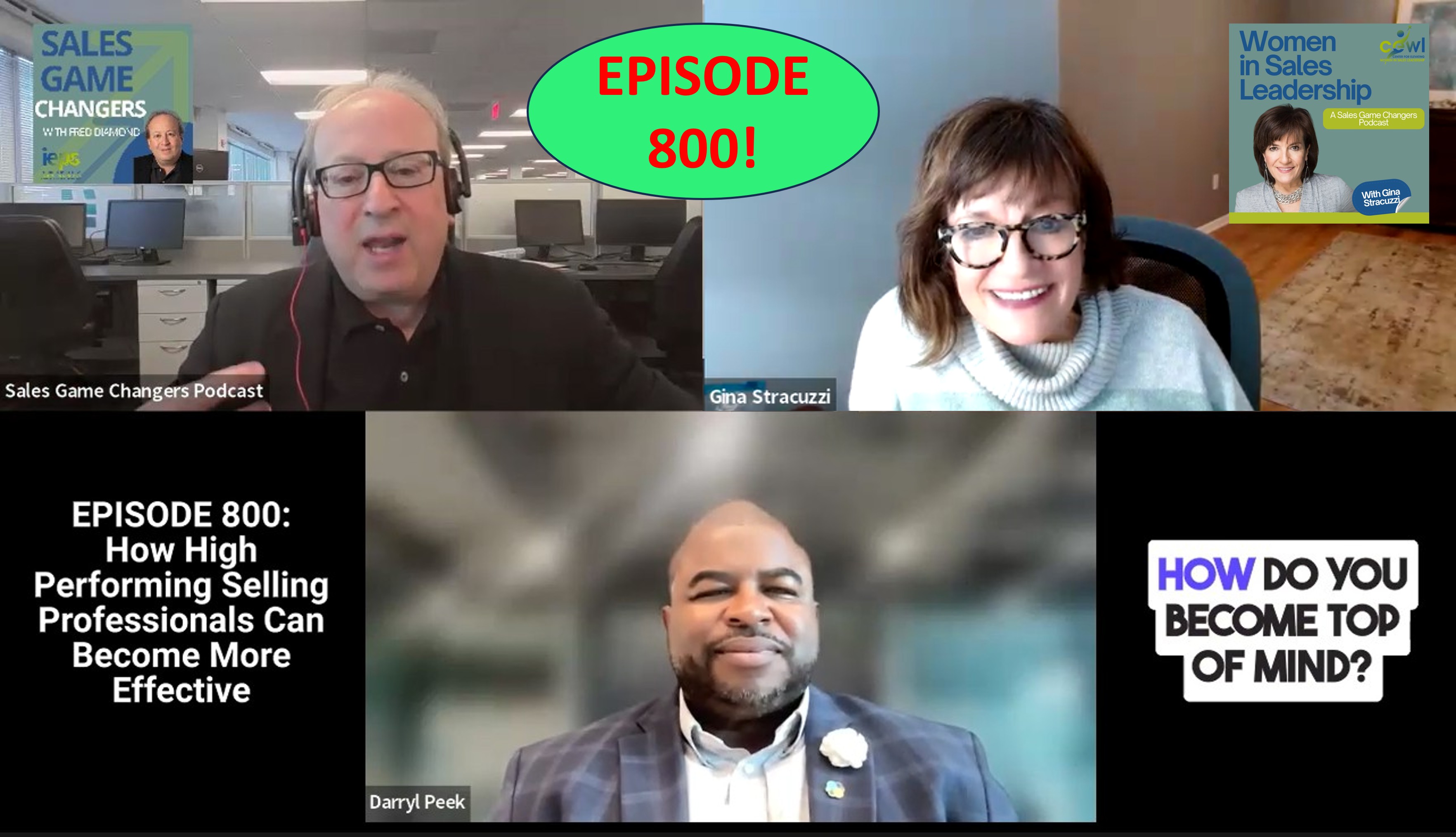
This is the 800th episode of the award-winning Sales Game Changers Podcast! If you’re here, send Fred a congratulations message on LinkedIn and he’ll send you a special gift.
Thanks for everyone who listened to at least one listed of the show!
Watch the video of this podcast on YouTube here.
The Sales Game Changers Podcast was recognized by YesWare as the top sales podcast. Read the announcement here.
FeedSpot named the Sales Game Changers Podcast at a top 20 Sales Podcast and top 8 Sales Leadership Podcast!
Subscribe to the Sales Game Changers Podcast now on Apple Podcasts!
Purchase Fred Diamond’s best-sellers Love, Hope, Lyme: What Family Members, Partners, and Friends Who Love a Chronic Lyme Survivor Need to Know and Insights for Sales Game Changers now!
On today’s show, Fred and Gina, host of the Women in Sales Leadership sub-brand of the podcast are interviewed by Darryl Peek. VP of Public Sector partnerships at Elastic.
Find Gina on LinkedIn. Find Darryl on LinkedIn.
FRED’S TIP: “If you want to be successful in sales, you have to be known for something. Sales is hard, and that’s why professional selling matters.”
GINA’S TIP: “If people don’t know your aspirations, they can’t help you grow. You have to raise your hand.”
DARRYL’S TIP: “Business is a contact sport. Every handshake, every meeting, every follow-up. That’s on you.”
THE PODCAST BEGINS HERE
Fred Diamond: Welcome to another episode of the award-winning Sales Game Changers Podcast. Gina, we’re here. This is our 800th episode of the award-winning Sales Game Changers Podcast. My name is Fred Diamond. I’m the Cofounder of the Institute for Effective Professional Selling, and Gina Stracuzzi, the President of the Center for Elevating Women in Sales Leadership, and also the host of the Women in Sales Leadership sub-brand of the Sales Game Changers Podcast. Gina, this is our 800th episode.
Gina Stracuzzi: I know. Amazing. Really amazing. I can remember when you started it.
Fred Diamond: Yeah, and I used to have hair. Actually, the people can judge what episode by the length and color of my hair. But seriously, I just want to remind people, we’ve transcribed, believe it or not, every single episode of the Sales Game Changers Podcast, from episode number one. Go to salesgamechangerspodcast.com and you could read all the transcripts, listen to all the shows. Gina, we’ve posted about the last 70 shows on YouTube. We didn’t do it originally because we did audio the first 200 episodes. Then during the pandemic, we shifted to the online, but it’s been the last 60 or so shows that are on YouTube. We’re getting a lot of traction with the YouTube channel. I know a couple shows that we’ve posted recently have had a couple hundred views and it’s great. We’ve won a couple of awards, Gina, along the way.
As we were thinking like, what can we do special about the 800th episode? We both said we need Darryl Peek to come on and interview us. We’re thrilled. We have Darryl Peek. He was one of our panelists at a recent Institute for Effective Professional Selling, we call them the Mainstage Live programs. Darryl, I know you’ve been at a couple places and you have such a huge following. I saw you on the panel at our good friend Vince Menzione’s Ultimate Partner Summit. We had known of you a little bit from LinkedIn and various things. Then when we had you on the panel, it was in November of 2025. We’re doing today’s interview in middle of December 2025. You had so many nuggets of wisdom. I said, “Darryl’s got to get some exposure here.” You have a great exposure, you have a great following on LinkedIn particularly, and probably other places as well. Thank you so much for being our guest host today.
Darryl Peek: Thank you so much for having me, Fred. I’m so glad to be here. This is an amazing accomplishment, 800 episodes, which is absolutely incredible. I’m so happy to be here with you and Gina today. You two are two powerhouses in the sales ecosystem, and just really leaders in the space, not only from a B2B, but also business to government perspective. I thank you for your consistency, your contribution, and your thought leadership throughout this process. I’m just glad to be here to interview you both, to ask a few questions, to give the listeners some insights on things that you are seeing, what it takes to get to 800 episodes, as well as, are you still having fun? We want to make sure we cover that.
Fred Diamond: Introduce yourself, tell people who you are if they don’t know who you are.
Darryl Peek: My name’s Darryl Peek. I’m the Vice President for Partner Sales for US Public Sector here at Elastic. I’ve been at Elastic around three years now. Really excited about what we’ve been able to accomplish over three years. I am responsible for our partnerships across our federal as well as state, local, and education space. I work with a lot of the system integrators, the value-added resellers, the cloud service providers, as well as our distribution partner and our technology alliance partner. What does that mean? It boils down to a few things.
One is going to market with our partners within the government space, as well as working on developing opportunities with those partners and looking at enablement opportunities to teach them more about Elastic and what Elastic does, as well as creating a plan. My grandfather used to tell me, “You have to plan your work and work your plan. If you fail to plan, you plan to fail.” That’s one of those nuggets, Fred, that we talked about in some of our previous panels.
Really what Elastic does is we are a search platform but we also do something called observability, which is looking at your environment as well as we handle security. Those are things that we do very well in the space, and definitely excited about what we’re able to do in support of some great missions throughout the US public sector.
Fred Diamond: We’ve covered a lot of partner relationships on the Sales Game Changers Podcast over the years. The partnership world, the ecosystem is going to be so critical in 2026, particularly in the federal marketplace and other public sector because of the changing nature of the customer. 2025, everybody knows, who’s listened, has been a very transitional year, for lack of a better word, transformational year. For some people, it’s been a traumatic year, but the partnership ecosystem with the various players is going to be so critical for companies to optimize and to discover. Good luck for you and the team at Elastic and actually all the companies who are serving the federal customer.
Darryl Peek: Absolutely. I really appreciate that, Fred. Once again, I’m just really glad to be here and really taking cues from you because you’re seeing the pulse of what’s going on in the industry and making sure that we are leaning forward, is really important. With that, let’s ask a few questions and kick this off. Fred, I want to start with you, because this is 800 episodes. I’m sure over those 800 episodes, the podcast has evolved. Can you talk about that evolution and what it takes to get to 800 episodes?
Fred Diamond: The reason I started the podcast was for two reasons. One is I used to be a DJ, so I enjoy speaking into a microphone, and I enjoy interviewing people. I thought I was going to go into journalism. I’ve been thinking about how have we gotten to 800 episodes. There’s a word that we use a lot on the podcast, it’s curiosity. I’m interested in what a sales leader is doing, how they’re working with customers, how they’re leading teams. But we started the podcast originally in 2018. Perfectly frank, I needed to meet more sales VPs who are my customers at the Institute for Effective Professional Selling. I needed to figure out a way to get into their office to spend time with them.
Originally, I created the podcast to interview sales VPs about their career, their big wins. I had my ATR2100 mics. I had a bunch of filters, some lights that really didn’t do anything. But I just engaged in these conversations and it gave me a chance to be in their office. As I’m setting up the mics, “How many salespeople do you have? What are some of your goals? Okay, good. Now let’s do the podcast.” If it weren’t for starting the podcast, there wouldn’t be an Institute for Effective Professional Selling. One of the key things in sales is you need to be where your customer is.
Then the pandemic happened, and Gina and I started doing webinars every single day. Every day, Monday through Friday, we did a webinar and we were getting hundreds of people because we made a quick pivot, as they say. We took those webinars and transferred them in the podcast. Then eventually we’ve created a couple of sub-brands, which I’ll talk about, including Gina’s show. But it’s given us exposure to sales leaders all over the world. With the IEPS, we focus on not just B2G but B2B enterprise selling, and we’ve been fortunate to talk to so many great leaders.
Darryl Peek: How have the stories evolved? Because I’m sure after 800 episodes, the environment has changed, the conversation has changed. What are some of the evolutions that you’ve seen over those episodes?
Fred Diamond: Obviously, a lot has changed. Again, 2018, AI has become big. The pandemic. The reality is, the pandemic changed everything. Not just how do we communicate online, but how do we get to customers now? One of the results of the pandemic, and Gina has become one of the leading thought leaders on working from home versus the office, and the challenges that it’s brought women that she’s worked with at the Center for Elevating Women in Sales Leadership, but getting to customers has been hard.
One of the things that the pandemic has led to is everybody’s had the same challenges. We’ve all had to figure out what do we do now? How do we evolve? How do we work with our customers? Now, how do we get back to an effective way to communicate with customers, to interact with them, to show them that we can bring them value? There’s been a lot of challenges.
Real briefly to one quick thing. Before the pandemic, we would just talk about stories. Tell me about your great sales success. Tell me about a mentor. Tell me about a deal that you turned around. Then when the pandemic kicked in, and this has continued to this day, the communications have been, what are you doing today? How do I be successful today? How do I get a deal closed this week? As compared to, tell us some stories from the beginning of your career. It’s, I’m a sales professional, I’m struggling, or I’m working on an opportunity. Sales Game Changers Podcast, give me some ideas that I can implement today.
Darryl Peek: Gina, let’s pivot to you. Opportunities for growth and improvement is really important. You work with a lot of women in sales. Could you talk a little bit about the opportunities for growth and how do some organizations fall short of achieving that outcome?
Gina Stracuzzi: It’s been interesting over the 700 episodes and where we are today. There are a lot of opportunities for women, and AI being front and center, and that we focused our entire conference on it earlier this year in that, as women, we have to be in that conversation. We have to be part of the planning, part of the process, adoption of AI, and really for women who start to embrace it, we can really lead, because it’s been proven already that women are actually better with AI because we look at a totality of a situation, and perhaps even over prompt, telling AI what we need from them. How are we going to use this information? Who’s going to benefit from it? We give a bigger picture rather than, how can I improve sales?
That’s where the biggest opportunities lie for women. We still have a lot of ground to cover in things that should have been further along than they are, say, leadership. But all the women I talk to, while they have frustrations on certain levels, they are super optimistic for the future. IT sales in particular, they’re really excited about and where AI is taking us. What I see a lot of women doing is finding their niche inside of these opportunities. Each company looks a little bit different. There has been a little bit of, how do I get myself into that? It’s like, raise your hand and join a committee. Think what you want to do with it. It’s really got women excited. I think there’s going to be a lot of AI related positions that are held by women, the women that raise their hand and dive in head first.
Darryl Peek: What are some of the signals that a woman should look for when they are ready to take it to the next level or go for a promotion?
Gina Stracuzzi: Darryl, that is something that really still is very difficult for women. Because there are double standards, let’s put it that way, because it’s very obvious to see quite often what a man’s doing, because men are just different. I always joke like, Joe comes in and he’ll say, “Darryl, don’t get too comfortable in that seat. I’m gunning for your job.” They make a game of it, where women will sit and I’m going to work as hard as I can and someone’s going to notice and I’m going to get my opportunity. It is really about raising your hand, making your aspirations known. That’s why it’s so important for women to get on any AI board within their company, planning, strategizing, anything, even if you don’t know it. Nobody knows more than somebody else at this point. We’re all making our way through.
Like always, it’s the ones that make the most noise that get the opportunities. Women are just by nature a little more relaxed in their approach. It is making sure that the people that can help you know what you’re interested in. If I worked for somebody like you, Darryl, I would be knocking on your door all the time. You’d be like, “Shoot, here she comes again.” But it is that kind of thing, you have to let people know of your excitement and your interests and raise your hand for those stretch projects and, “We’re putting together a committee to figure out what we’re going to do about this.” Take it on, and make sure you get in the office, too.
Darryl Peek: That’s really important, and hopefully for the listeners, that is a value bomb that just got dropped. Please take key to that. Make sure you engage early if you are looking to take it to the next level.
One of the things we talked about, Fred, on the panel was the three Es, and we talked about the engage, enable, and execute, but effectiveness is really big on your mind and entire conversation. What are some of the things that folks should think about when they talk about effectiveness in sales, and what does that mean for you, and what should the listeners listen out for?
Fred Diamond: That’s a great question. We used to be known as the Institute for Excellence in Sales. At the end of 2024, we interviewed over 200 sales leaders, B2B, business to business, and business to government. What are the biggest challenges you’re facing? What is going on in your organization? The word that kept coming up time and time again was, “I need my sales professionals to be more effective,” at the leadership level, the mid leadership level, and people entering the sales force, at the SDR or BDR level. Need to be more effective in account development and communications, and relationship building, and using technology, and figuring out how to partner. Just effectiveness just coming up time and time again. We actually changed the name of our company to the Institute for Effective Professional Selling, and there were three Es that we talk around it.
One is engage. Sales leaders said, “I need my people to engage their customers.” They need to engage their partners more readily, and I, as a sales leader, need to engage my team. I need to bring my people more into the leadership roles and more into how are we going to grow the business coming out of a challenging time? The second word was elevate. A lot of people, it’s like, how do we elevate our leaders? How do we train our people?
One of the challenges that happened at the beginning of the pandemic is a lot of people were promoted in 2022. We always say the hardest job in sales is first time sales manager. There’s very few classes, there’s few people in a company who get promoted, so there’s usually nothing internally. It’s kind of, “Go figure it out.” Here we are working from home, it was very challenging for these new managers to get advice and mentorship from those above them, because they were also struggling with, “How do I help my organization at my particular time?”
We’re all about helping them elevate their leaders. At the end of the day, it’s all about empowering success. The reason that we’re in professional sales is because our company is depending upon us to grow revenue, to grow revenue into new markets, to cross sell our new products, to grow relationships with partners that can get us into new customers and expand. The big three that we like to say is we help organizations engage their teams and their customers, elevate their leaders, and empower revenue success.
Darryl Peek: Based on that, and really great insights, what one of the Es are our leaders struggling with the most that you’ve seen over the years?
Fred Diamond: It’s obviously effectiveness. We’ve talked to so many sales leaders at great companies. We’re very fortunate at the IEPS that we have blue chip companies like Amazon Web Services, Hilton, Salesforce, Cvent Software, Oracle, Microsoft, and even these companies that have been well established with world-class organizations, times change, customers change.
Gina mentioned AI. Obviously, AI is throwing a big monkey wrench into the selling process as customers are getting their information before they even need to talk to a sales professional. The challenge is you have to be effective at so many ways as a sales professional. You have to make that first meeting go really, really well, and not just the first meeting, but the follow up.
One of the moments on the Sales Game Changers, I think this was episode 120 or something, I had a guest on whose company records sales calls, and his company had recorded 10 million sales calls. I asked him, I said, “What is the number one thing that you discovered from all these sales calls?” He said, “70% of the calls didn’t have a follow up.” Not, “Hey, can we meet next Tuesday with your CIO?” Or, “Gee, I’d like to schedule a meeting in a week to talk in a little more detail about that question.” Follow up, being effective in that. It’s great to have a great meeting, but as you know, you’ve been in millions of them, you got to get to number two. Sales is always about getting to the next conversation.
Darryl Peek: When we talk about getting to the next conversation, Gina, you mentioned at the end of your answer to the previous question, that being in the office and being visible. However, Fred also mentioned COVID and us being in remote situation. How do you balance the difference between being virtual and making sure that you’re effective remotely, as well as making sure you’re showing up in person and making the most of that moment?
Gina Stracuzzi: I’m going to tie it into some of what Fred was just talking about, because from my standpoint, what I took away from some of the conversations Fred talked about earlier with sales leaders is the effectiveness or lack of it is because people aren’t as engaged as they once were. This is the underlying current of what we talked about with these sales leaders. What comes up in the forum, the Women in Sales Leadership Forum, all the time is women talk about the people they’re leading. I’m sure you find this true. There isn’t the level of engagement that there used to be. Something got left on the road after the pandemic, this fire that we all had. We were going to burn out if we kept going at that rate, but now, we just don’t have that rhythm that we used to.
Part of it is because we’re here, we’re there, we’re way too often on screen, even if somebody’s in the office, somebody else is not. For me, you lose the juice of selling when you’re not around other sellers. There’s an energy, and honestly, if I had to come into sales at this point, and I was working from home, I wouldn’t stay in sales. It is hard when you get started. You are trying to get your own energy going. It’s just different. What gets left behind, especially for women, is when you are in your house all the time, your mind’s on, “Oh my gosh, I got to pick up the kids. I got to take the dog for a walk. What am I going to make for dinner?” that kind of thing.
That’s mostly for women with families. But when we get to a certain age, we all have families, or most of us. It is something that I am seeing a lot where women are struggling with the convenience of being at home, because it does make life a lot more convenient. But you lose that engagement, that level of engagement that you get when you’re in the office. You also lose visibility. I hear women all the time talk about, “It’s so much easier. I just don’t want to go in the office.” I’m like, “Let me get this straight. You leave the house to take your kids to school and pick them up and go to the grocery store. That was my mother.” We have to be very careful that we don’t slide backwards. The growth that women had appreciated over the last 20 years, they reckon that after the pandemic, we’d lost like a decade. If we are not careful and we keep choosing to not be present in the office, we are going to continue to get passed over for promotions. It’s just different.
Darryl Peek: You just talked about proximity. How does that impact opportunities? Because we talked about growth in the previous question. Now, how does proximity and being visible impact that? As well as what are some of the things that are created from a perception perspective for those who are not in the office versus those leaders who are in the office?
Gina Stracuzzi: You pretty much answered your own question in your question, because it really is, if I’m sitting 20 feet from you, and you see me working and talking to people and doing things, and we go to get coffee together and it’s like, “Hey, Darryl, what’s going on?” I’m going to be top of mind if an opportunity comes by. The people that are on camera, and you only see at very predictable times, half those people don’t even want to be on camera. There is no way your career is going to grow. If we go with what we see, we go with what we know, especially there’s constant reorgs and people inherit teams. I work with people who have never physically met the people on their teams. You cannot expect your career to grow if your boss doesn’t know who you are. You’ve got to be there.
I know it’s a pain in the butt a lot of times. Back in the DC area after being a while, I’m like, “Oh my God, how do people do this?” It’s just so much, but it is so necessary if you have aspirations for growth. If you are fine where you are, and your life is humming along, and it works for you, no fault, no blame. There’s no shame in that. But if you have aspirations for more, you’ve got to show up.
Darryl Peek: Really, it comes down to the mindset of the person, of the individual. That really does drive those outcomes and the awareness. Sometimes we talk about the emotional intelligence, sometimes we talk about executive presence and what that means, but mindset is a major thing, Fred. What does that mean and why is it foundational to how successful sales leaders come to market?
Fred Diamond: That’s a great question. There are a couple words that have permeated the 800 episodes, value. You need to bring value to the customer. Passion is one that comes up a lot. Listening is one that comes up a lot. We put a lot of these in our book Insights for Sales Game Changers. But the reality is this, especially in some of the markets, the B2B markets. I remember I had a guest on one of the early podcasts who said that selling to the federal government is like being in the NFL. It’s the top performers. You’re selling to one of the most important customers. Not just the federal government, but major financial institutions and healthcare institutions, and huge retail operations, and huge online operations as well.
Sales is professional selling where you need to be optimistic, you need to be positive, you need to remember that you’re bringing value. It’s wrought with challenges along the way. Everything could be going great and then there could be a major macro event, like a pandemic or a terrorist attack or something along those lines, and a lot of micro things. Gina had mentioned before, your customer retired, or your customer was laid off, your customer was just purchased by another entity. You’ve been working with them for 10 years, then they got purchased by a larger organization with their own infrastructure, so, “Gee, do we really need your product anymore?” and a lot of things that are out of your control.
But what’s in your control is preparing, it’s being of customer service. You and I are both quote guys. Two of my favorite quotes, which go to mindset, is the Henry Ford quote, “If you think you can or think you can’t, you’re right.” I used to think that was just about accomplishing something. That permeates everything in your being. Am I going to be successful? Well, yes. Okay. Now, what do I have to do to be successful? What are the action steps I need to do? As a leader, how do I need to lead my teams?
The other quote that I’ve gravitated towards in the last couple years is the Einstein quote, “Only a life lived in the service of others is a life worth living.” Sales is about service. The customer needs you if you’re going to help them achieve their mission. You need to be really smart. You need to be a couple steps ahead of them. You need to understand where they’re going. It’s no longer about, “Hey, I got these three things. I got a discount. What do you want?” It’s about, “Gee, I know that your agency or your company is looking to do this in the next two years. Here’s some ways that we can help with some partnership relationships that can help you grow.” The mindset of being of service, of being of value to your customer, and of being someone who’s going to help your company achieve what it’s bringing to the marketplace.
Darryl Peek: Within that mindset, it’s always easy when you’re hitting your quota and you’re getting those win wires, you’re getting sufficient pipeline. You got the workshops going with your customers, you got an effective plan, your MQLs are off the meter. But there’s time when there’s pressure and conflict. How does mindset show up in those moments when you’re not getting the pipeline, you’re not booking the deals, you’re not meeting quota, you’re not getting enablement, you’re not prospecting well?
Fred Diamond: It’s interesting. I remember at the end of almost every episode, I’ll thank my guest for giving us such great ideas and giving us 10 things we can do. Then I say at the end, “Give us one action step that sales professionals should do right now, after listening to the show or reading the transcript.” Darryl, and Gina knows this, you’d be surprised at how many sales leaders have said, and these are people who are 20, 30 years of success, “I meditate every day,” or, “I take time off,” or, “I spend time talking to a mentor,” or, “I have those types of relationships,” or, “I have a group of three other sales leaders that I call if I have a challenge.”
One of the great things that’s happened over the seven, eight years that we’ve been doing the podcast is that there’s been an openness to that. We’ve done a couple shows on breathing. Just breathing and how that can help you stay grounded. I remember one show that we did, it was with a sales leader from LinkedIn. Her name is Alyssa Merwin. She actually won our Women in Sales Leadership Award. This was before the pandemic. She is the Senior Sales Leader for LinkedIn. She talked about how she’s vulnerable and how she’ll tell her people, “Things aren’t going great right now. Here’s what we need to do.” A lot of times sales leaders or professionals think that everything’s got to be rosy. It’s like, “Gee, everything’s going great. We’re doing great. A hundred percent. We’re going to get our a hundred percent quota,” when your biggest customer just announced that they’re cutting all budgets. There’s ways that you need to be mindful, you need to be grounded, and you need to bring in the support network of people who will help you get through those challenging times. Great question, by the way.
Darryl Peek: Thank you so much. In regards to that moment, and Gina, you’re a subject matter expert when it comes to women in sales, what are some of the things that women wish employers understood about them being in the office and being in the role that maybe they should consider going forward?
Gina Stracuzzi: It’s an interesting question, Darryl. Even the women who work from home, women tend to take on a lot of extra tasks. They will quietly say, “Just give that to me. I’ll take it. Just give it to me. I’ll make sure it happens.” I think because women still are not really great at saying, “Did you know I’m handling this, this, and this, as well as this?” That’s just not in our DNA. A lot of women that I speak with wish that their bosses knew without them telling them. I think what I would say to people who lead sales teams is be aware of what all of your team is doing. You don’t have bottlenecks for a reason. What is that reason? Who is that reason?
Because there’s been studies done on the value of the quiet work that women do that they don’t even talk about. It’s staggering. If every woman just started following her job to the tee, we would be in a world of hurt, because there’d be a lot of things that don’t get done. It’s a different kind of visibility. It’s being aware of who is doing what and to what degree. When you have your one-on-ones, ask. “Tell me what you’re working on, the totality of it, not just the things I know about.” There’s that piece.
It’s making sure that women have the same opportunities for visibility as well, and that they’re not held to different standards. In other words, if I’m doing everything that I need to do, and then some, but my role is hybrid, let’s say. I don’t come into the office, and then I try to come into the office and I spend more time there, and you have more visibility, make sure that I am still getting the same opportunities for promotion. Women are looked at with the same potential meter that men are. Like, “I can see where Darryl can go. He could go here.” Women, it’s like, “Well, they may need to take off to take care of kids, and they may need to take off to take care of aging parents. We’re not sure about her potential.” It’s in the back of minds, even if it’s not a conscious thought. I think what women would like is to be measured by the same potential meters as men.
Darryl Peek: What does a woman risk when she does not speak up and when she does not represent herself and her brand in the organization? What is that risk? Is that something that you’ve experienced as well in your conversations with women?
Gina Stracuzzi: All the time. The reasons that women don’t speak up are myriad. Sometimes they get talked over, sometimes they even get scoffed. Like, “Really? You think that’s a good idea?” Sometimes there’s just stunned silence, but you have to find your moment and find your bravery. Maybe you enlist other women to help you, kick you under the table. Like, “Hey, you just talked about this. You have an idea.” It comes down to that visibility. If there are guys who are always speaking in meetings and the women that are there are staying quiet, maybe because Bob’s always going on and on and on, and Bob never lets anybody else talk. It’s when you say, “Excuse me, Bob, I’d like to get a word in here. Your ideas are always great.” But what that does is it puts you on the map, but you got to keep doing it because you’ve got to let people know your ideas. If you have stunned silence, so be it.
Sometimes you can even address that. You and I have that kind of smart-ass energy. If I met it with stunned silence, I would say, “Have I blown your mind? Is that it?” You have to figure out your time. But if you don’t do that, people don’t know that you have ideas and they don’t know that you have a sense of what could be done. Like, “I have a solution for this,” or, “I believe that this is the way we should be going. I think this is a mistake.”
We had one woman in the forum who she’s like, “I knew this wasn’t the right way for us to go. I knew it. I knew it, but I just couldn’t find my entrance to say something, and the whole thing blew up, and we lost the deal.” She said, “I have been kicking myself ever since, because that could have been my moment. Maybe they wouldn’t have listened to me anyway, but now I’ll never know.” It’s kind of that if you see something, say something. If you know something, say somethin
Darryl Peek: That’s very interesting. Fred, what are the listeners looking for? Because Gina talked about speaking up and really articulating the challenges and also the opportunities, but what are the listeners looking for?
Fred Diamond: We’ve done some surveys. 60% of our audience are sales professionals, B2B or B2G. That’s what they do for a living. There’s no doubt. 20%, 25% are sales leaders, people who are director or above, typically B2B, B2G, or enterprise selling. About 25% of our listeners are maybe small business owners, consultants who know they need to sell better. But what’s happened over time is people just like to listen for the stories and for the examples. Now, people need ideas. I tell people this, I tell my guests, this isn’t a class, it’s a podcast. People are typically listening as they drive, as they mow their lawn, as they walk the dog, as they’re out for a run or on the treadmill. Very few people are sitting in front of their computer watching and taking notes. But they will stop if they hear something and they will listen for an idea or something that’s going to spur them.
Like I told you, people are looking for solutions for today. They’re looking for more information too. Every single show that we’ve ever done has had a guest, some cases, two guests. Every Women in Sales show, every Sales Game Changers show where I interview a VP. A lot of times, one of the great things about the podcast is I’ll bring on a VP of sales at Amazon or Salesforce or Hilton, and people will listen for what that person is saying. Maybe they’re a partner. I always tell my guests, the prospects who I’m looking to have appear on the show, being a guest on my podcast is a great way for you to be shown as someone people want to work for or work with. They’re looking for an idea or two or some information.
Darryl Peek: Now that we’re about to wrap up, there’s so much value that came out of this conversation. We got a chance to talk about effectiveness, opportunities for growth, mindset, being able to really talk about how to show up authentically, which is definitely important as well as how to manage virtual and in-office works. Definitely a lot of value in this conversation. I hope the listeners got a lot to gain. But as we close out, what are some of the takeaways that a leader should use as a result of this conversation of the 800th episode? What would you like to share with the listeners?
Gina Stracuzzi: For the listeners, if you are a woman, make sure that people know what you’re capable of, what you want. People can’t help you grow in your career if they don’t know your aspirations. Don’t keep them to yourselves. Make them known. I know it’s a little scary sometimes, but it’s like your vision board. Let people help you.
Fred Diamond: One of the tips I give people who ask me for advice on how to be more successful in their sales career, I say be known as someone. Be known as the guy who is the AI expert for defense agencies, or be known as the woman who is the insurance leader in Northern Virginia, whatever it might be. You got to be known for something. A podcast is a great way to do it, or a video series or something. How do you become top of mind? How do you get people to want to pay attention to you? It’s really hard. One of the key things I’ve learned over the years is sales is hard, being a professional seller, but that’s why you get paid if you do well, that’s why your company will achieve, you’ll get industry recognition, but it’s really, really hard.
It’s like one of that guests that I mentioned before, you’re a professional athlete. That’s why we changed our name to professional selling. Think about ways that you can distinguish yourself. You could be shown as the leader. You’re one of the go-to guys in the industry for partnerships, and you’ve worked at some great places, and you’re out there hosting events and being on panels and talking about excellence. The way that you have communicated your body of knowledge is great. You pick a letter and you have three things that apply to the letter and people gravitate towards you. People listening, how could you be someone that people gravitate to because they want to work with you?
Darryl Peek: One of the things I would like to say, and my major takeaway here, is business is a contact sport. Every handshake, every meeting, every follow up, every opportunity, that is something that you’re responsible for in really having a successful career in sales. Thank you so much, Fred, thank you, Gina, for the great conversation. I’m just looking forward to episode 801 and 900 and 1,000. Thank you so much for having me today.
Fred Diamond: I want to thank you, Darryl Peek, for being our guest host today. Gina Stracuzzi, I want to congratulate you on being part of all the 800 episodes that we’ve produced. My name is Fred Diamond and this is the Sales Game Changers Podcast.
Transcribed by Mariana Badillo