
Watch the video of this podcast on YouTube here.
The Sales Game Changers Podcast was recognized by YesWare as the top sales podcast. Read the announcement here.
FeedSpot named the Sales Game Changers Podcast at a top 20 Sales Podcast and top 8 Sales Leadership Podcast!
Subscribe to the Sales Game Changers Podcast now on Apple Podcasts!
Purchase Fred Diamond’s best-sellers Love, Hope, Lyme: What Family Members, Partners, and Friends Who Love a Chronic Lyme Survivor Need to Know and Insights for Sales Game Changers now!
On today’s show, Fred interviewed Trellix SVP of Sales Craig Bowman about his new book “CRAFT: CIA Tradecraft Meets AI: The New Rules of Elite Selling. Craig shares how lessons learned from his years at the CIA should be applied by selling professionals. It was a remarkable interview.
Find the book on Amazon here.
CRAFT stands for: ✔️ Conduct Research – Identify where real change, urgency, and opportunity exist ✔️ Refine & Target – Map the true sphere of influence inside complex organizations ✔️ Activate – Engage partners and stakeholders as allies, not tools ✔️ Find the Value & Pain – Uncover what truly motivates your buyer beyond the surface ✔️ Tailor & Validate – Prove success using mutually agreed-upon metrics that reduce risk
Find Craig on LinkedIn.
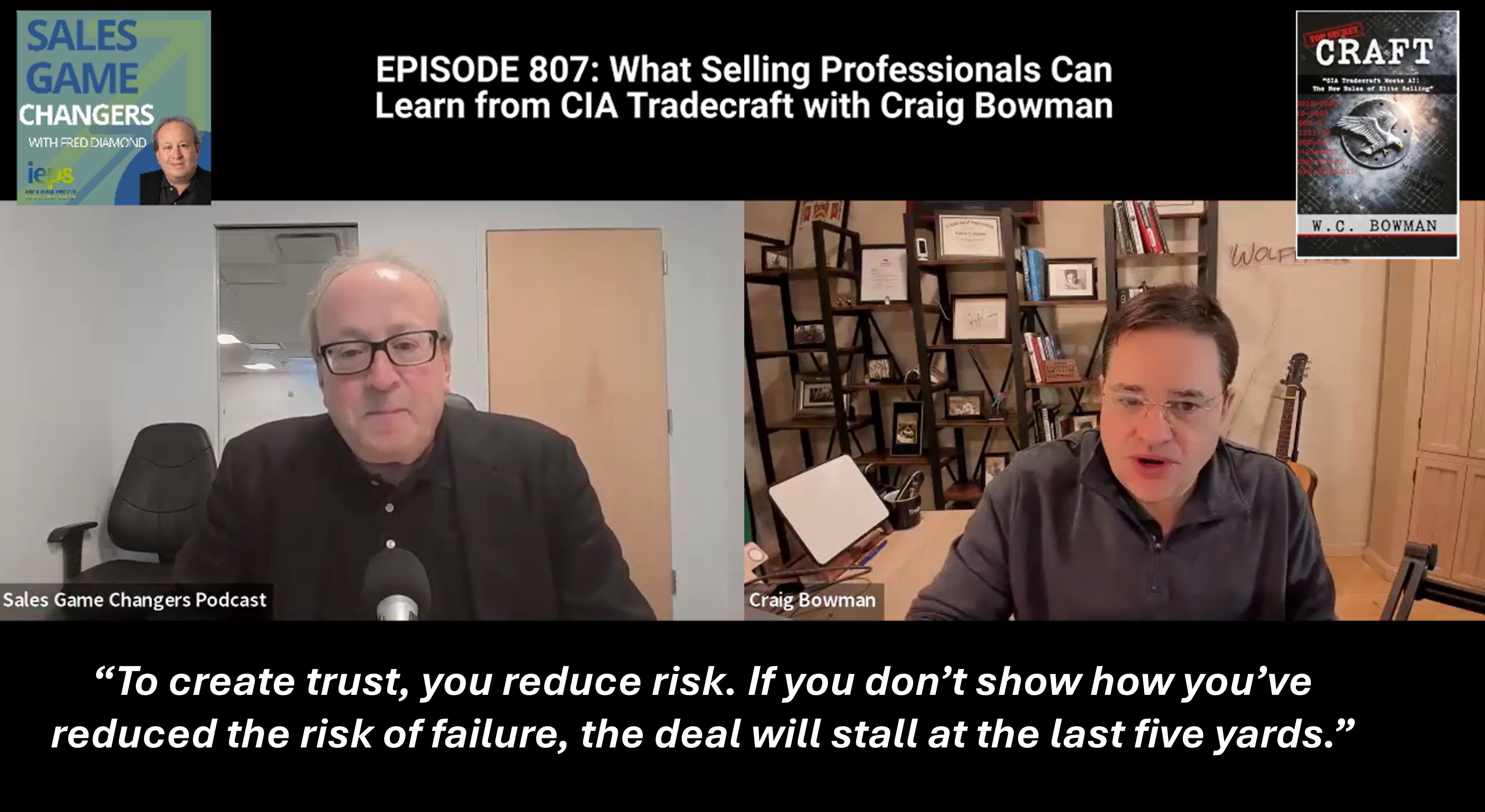
CRAIG’S TIP: “To create trust, you reduce risk. If you don’t show how you’ve reduced the risk of failure, the deal will stall at the last five yards.”
THE PODCAST BEGINS HERE
Fred Diamond: I’m very excited today. We have Craig Bowman. He’s the author of the book CRAFT: CIA Tradecraft Meets AI: The New Rules of Elite Selling. Craig, you start off the book with a quote here, which says, “There is no harder sale in history than asking someone to give you classified information that will put them and their families at risk.”
For people who don’t know you, you spent a good portion of your career in the CIA, the Central Intelligence Agency. For people listening in the future, we’re doing today’s interview in December 2025. You wrote this great book, and it’s interesting, Craig, because I’ve had people from the sports world who talked about lessons they learned being an elite basketball coach, and people who learn things from football, and people who learn things from other industries. I’ve had chemists on the show, politicians on the show, who moved into enterprise selling, and they talk about the lessons.
You’re the first person I’ve had who worked at the CIA, and you actually go very deep in the book. It’s a nice allegory with an agent named Nash. Then you tie his process into selling processes for enterprise sales. You cover a bunch of topics, which you call CRAFT, and it’s conduct research, refine and target, activate, find the value/pain, and then tailor and validate. What I loved about the book is you go into really good detail on how to prepare and how to identify if the customer is the right target, and are you speaking to the right people, tying it back to lessons you learned at the CIA.
First off, introduce yourself. Tell us a little bit about your career that you want us to know. Tell us what you’re doing now. We discovered you also because you’re a VP of sales in technology. Tell us about your journey and then let’s get deep into the book.
Craig Bowman: Until the book came out, I really didn’t talk about working for the intelligence community. I had to get their approval. For the people who are listening saying, “How can Craig talk about this?” I actually did submit everything to the CIA, got their feedback. They asked me to remove things from the book. Everything I’m saying today has been approved. There’s also that caveat in the book as well.
It started off right out of college, was asked to join the agency in the director of operations. It was in the technology industry, where it was in a technology area. Very lucky to do it. They reached me in a kind of a roundabout sort of way. At the time, this was early 1990s, there was no internet because the internet didn’t start until 1996. That was when the act was put forward to commercialize DARPA. Before that, there was CompuServe and there was America Online. I was on a bulletin board, and I was posting about some of the technology capabilities that were coming out.
One was a hypertext linking technology that was going to unify data across the globe. I got a hit from somebody on one of the bulletin boards that asked me to go to an interview. Being somebody who’s leaving college and looking for a job, I set off for this interview in Northern Virginia. It was a commercial company, and we met at a hotel, and then the interview conducted in a facility that was not a government facility. It was a very cloak-and-dagger interview process.
I didn’t know who they were when I interviewed with them, but I remember at the end, the person that ended up being a very dear friend of mine, I write about her in the beginning of the book, said, “He’s going to have to go to The Farm.” Again, this has all been approved, but I said, “What’s The Farm?” I had no idea what it was. I remember they said, “It’s a place where we grow potatoes.” That was my introduction into the clandestine world, was that interview.
From that, I fell into the mission. Everything that I did, I went everywhere, doing training in training facilities to working in the director of operations. Eventually ended up with the CIO’s office and then working for the director of intelligence for the CTO over there, phenomenal individual. But it was right at the end of that period of time that I was approached by Adobe to help them figure out how to leverage their technology in the intelligence community. Being a fan of their technology, I thought, “There’s got to be a way that we can use their technology for doing things out of the box.”
I joined my first real sales gig, even though I had started and sold two companies affiliated with intelligence community, that was my first real sales gig. They handed me a relatively small quota at the time. I was a team of one, and years later, we were doing tens of millions of dollars in the intelligence community, had a team of nine full-time sellers, a bunch of engineers underneath me. That was the moment that I realized that all of the training that I had received at the training facility, at The Farm, at the agency, that it translated to sales.
I write about that in the book, that nothing that they ever do is by chance. They don’t have people going out and doing things without planning, and planning things to the Nth degree so that they have a very high success rate. We talk about plan your work and work your plan, but we don’t actually do it in sales. It’s like the thing we talk about on podcasts, but we don’t actually do it. We don’t actually enforce it as leaders.
When I look back to the success we had at Adobe, and it was a team, and all the people that are going to listen to this podcast from Adobe will know this was not Craig. This was a team of people who believed in the mission. We would bury ourselves into the customer problem, and then we would look at the technology we had and how we could solve it. Then we would come up with a hypothesis, “Hey, we believe that we can help the mission in this way.” We had, for the first time in Adobe’s history, the first sole source contract from the government. They had never done one. Then we got a second, and then we got a third, because they had unique technology that nobody else could provide, and we found a way of connecting that value to the mission of the intelligence community. That was the aha moment for me, that all this training and things I learned, that I could actually help customers and technology companies do that better.
Then I went on, and from Adobe, I left and joined Verizon. I took over their public sector for cybersecurity, did a couple startups in between, joined VMware. Along the way, I surrounded myself with people that believed in the mission of what we were doing, helped them realize that this is a way that we can be successful together. I post on LinkedIn a bunch of those stories. One of them I just posted is about when I was down in Texas and I ran into a woman whose husband was killed on the border as part of CBP. Part of it was that his mobile radio was not functioning and there was poor cell service. We put a team there and we drove along the border and we tested all this technology to find a way to fill that gap for CBP. That’s the kind of team I surround myself with. It’s not, “Hey, I’ve got a widget. Let me tell you the features.” It’s, “Hey, you’ve got a problem. How do we solve this together?” That was my history.
Now, I’m the Senior Vice President of Public Sector here at Trellix, which is the former McAfee and FireEye companies. I always wanted to write that lesson that I learned about taking the CIA training and applying it to sales, and so I started writing. It was a whiteboard, it was sticky notes, it was what worked, what didn’t. Eventually, I boiled it down to a couple key concepts, rolled it back to the training that we received at the facility at the agency, and then came up with the acronym that I thought best depicted their methodology in a catchy acronym that I think everybody can remember. I had to change some of them. They weren’t exactly the same. Like when I use MINE in the book, which is the money, ideology, necessity, and ego, it’s actually MICE in the agency. C is coercion, but coercion in sales doesn’t sound very good.
Fred Diamond: Yeah, it’s not going to get you very far.
Craig Bowman: Exactly.
Fred Diamond: You covered a couple things right there, and I want to get into CRAFT. A lot of people who are in sales, there’s acronyms of plenty, and obviously people who sell to the government, there’s always that expression, TLA, three-letter acronyms, which people talk about as well. But I love the evolution of CRAFT. A couple quick things before we get deep into it.
We’re over 800 episodes of the Sales Game Changers Podcast. I’m based in Northern Virginia. Because of that, a lot of my guests have been senior leaders like you of public sector selling organizations. When we ask them, “Why are you doing this?” It always comes back almost invariably to the fact that they’re committed to the mission of the government customer. As I was reading the book, I was thinking about that.
The way Craig writes the book is he’s giving almost like a CIA situation, how the CIA would think about something and how they would process a particular challenge they were tasked with handling. Then he tied it back to lessons that selling professionals need to go through, and you could see that. You could see the fact of what the customer’s trying to achieve and the criticalness of it. That’s one of the great things with the public sector marketplace. Everything that happens involves, at some level, safety of the citizen, quality of life of the citizen, health and care of the citizen as well. Good for you.
I want to get deep into this. I want to go through the CRAFT process. Take us through CRAFT, the first stage, conducting research.
Craig Bowman: In the book, I start off with Dan Nash. Dan is a technologist in the field in Columbia, and he’s going after the drug cartel in particular. It’s a story of how Dan is thrust into this environment as a target. In the very beginning of the book, there’s an email, a fake email that comes out about he has to go find a way to track the drug shipments through Columbia.
The conduct research portion of that, in that story, that later I break into the lessons of The Farm, and then I break into what we should use, has been evolving over the last two years. It used to be very manual. It used to be a very manual process that we did to conduct research. We would get information from NRO and NGA and NSA, and that is in the book. I go through SIGINT and HUMINT and all of those things. But when you’re in the commercial realm, we now have the ability to leverage AI and LLM, which simplifies our process tremendously. We didn’t have that when I started working for Adobe. Everything was manual. It was going to LinkedIn and Dell Tech and all these different companies, and going to sessions where experts would come out and tell you about the industry, and you’d write lots of notes.
Conduct research is really about trying to find movement in a mission of a customer that introduces the possibility of change. I said this to my team actually just yesterday, is that budget increases is where the average person will look for, they’ll look for a budget increase and they’ll say, “A lot of money is going to DHS right now because of the border, because of ICE. I’m going to focus my effort there.”
I would argue, and I have, that any change in a mission of a customer introduces the possibility of opportunity. If you are an incumbent, the best place you could be is no change. If you’re an incumbent and there’s no change, there’s no budget increases and everything’s stable, you’re in a good position because there’s no incentive for the customer to do anything differently. But if there is change, a budget cut, resources cut, budget increase, there’s a new mandate that comes out, if you are not part of understanding that ecosystem, then you have no idea what those customers are facing. But even if it’s a decrease in funding, and you’re not the incumbent, whoever is the incumbent is in serious jeopardy. That gives you an opportunity to introduce yourself as a way to fix a problem they have, which is they have an incumbent, but they don’t have the money anymore. That’s what I try to get my teams to realize, is that before you even start looking at which customers you’re going to go after, look at the environment in which they are operating. That’s the first step of conduct research.
That will then get you, and I introduce something that I call the FLOW targeting filter. We score different elements of the FLOW targeting filter based on what’s happening in the environment. The FLOW is the force. Is there any driving momentum? Are there executive mandates, those kinds of things? Is there any leverage? Leverage is a word that can be very negative. It sounds as if you have some power over somebody, but if you actually look up the definition of leverage, it’s about applying energy, direction, focus on an area that when you put it at the right area, it can actually unlock, lift, or provide some kind of support to something that is of importance to the customer. That’s what I talk about with leverage, not, “Hey, I have some advantage over the customer.”
The third in FLOW is obsession. Do they want something to change? One of the ways that we can see that is by looking at the hiring patterns of a customer. Are they putting out requests for new people on the internet? Where are they hiring? That’s not something that an average rep usually does, because it took a lot of time. But now with AI, you can find it very quickly. Then the W is for window.
Just in the conduct research, there are these four elements that are coming together to create a picture and an overall score that says, it’s not that you’re not going to look at somebody with a lower score, but what it’s saying is if you want to optimize your time, then you’re going to start with those that have force, leverage, obsession, and window before any others. Then that will put you on the course of, then I need to confirm that assumption, when you go on to refine.
Fred Diamond: One of the things I really enjoyed about the book too is, we talk about this a lot, there’s a challenge right now where customers can get a lot of the information they need on their own from the technology that’s available, from vendors, where vendors are going, etc. If you are a selling professional, emphasis on the word professional, you need to bring more value than you’ve ever brought to the customer. I really love the way you were talking about what you need to look for. It’s not just like, “Gee, I see there’s a budget increase,” like you said. It’s like, “Well, what does that imply and what does that mean? Where are they looking to go?”
The selling professionals now, who we see who are being successful, who will be successful in 2026, 2027, are the ones who are going the extra mile because they have to. Otherwise, the customer has no need for them. The customer can get what they want without you. I love that. I love the FLOW definition as well and the way you explained that. Refine and target.
Craig Bowman: Again, this is following tradecraft, and that’s why I wanted to come up with the word CRAFT, because it’s part of the tradecraft. But once you get a series of targets, you’re going to take each one individually and you’re going to start saying, “Let me map the epicenter of the influence.” We always talk about the Economic Buyer and the champion. I’m sure you’ve heard it a million times on your podcast. By the way, I’m a big fan of Challenger Sale. I have it on my book. I’ve read it more than one time. Also SPIN Selling, great book. I’m a Patrick Lencioni fan of everything he’s written. I have all of his books, read them. I’ve read many of them more than once because I forget things.
What each one of those books do is it assumes you’re already in the right organization with the FLOW elements, indicating that there’s something going to happen and you’re talking to the right people. Then it kicks in with, “Hey, this is what you should do.” SPIN Selling, the types of questions, Challenger Sale, the Economic Buyer, MEDDPICC, and all of those things. What I realized is that the challenge that my team has, and we’re talking about big companies, Adobe, VMware, Verizon, what we really suffered from wasn’t understanding how to qualify with your MEDDPICC or ask bloody good questions, as I call them in the book. It was how to get the right target, how to get the right people so that when you walk in, you have a much higher percentage chance of actually executing on SPIN Selling, Challenger Sale, all of those things.
The refine and target is about creating a sphere of influence or a map of the influence epicenter, and influence is what we talk about in the intelligence community. It’s not about reporting. I’m going to tell you a story. I used to sit in an office, I was one of the developers in a group, and everybody wanted to meet with the CTO, everybody. I would always sit in the back of the room with my team, and we were never at the table because we were not leadership. The executives would come in, they would do their PowerPoints, and in the back was all of us that actually ran the operations. The executives always asked our opinion about any vendor that came in, but the vendors didn’t bother to talk to us because we were not the decision makers.
Right there, I asked myself, “Who has the influence? Who has the influence in the room?” That was the missed opportunity. There is one individual that I will say worked for Microsoft at the time that picked up on this nuance, and he started inviting me out to coffees. When I asked him why, he was just like, “It seemed that the leadership would look to you when we would ask them questions, or your team,” and so he asked me what I did and he started inviting me out for coffees. We did end up doing a deal with Microsoft because he showed me something I didn’t know, and I brought it to the CTO and we talked about it and we ended up buying.
For your listeners and the readers of the book, that’s what we have to do. We have to map who has the real knowledge and influence in an organization. If you’re going to understand their business enough to create real value, forget job titles, forget all the things you normally know, you’re going to be looking for influence. In the book, I outline seven power profiles. Obviously, we want to get to an Economic Buyer, but if you are pitching an Economic Buyer for the first time before you actually talk to people underneath that Economic Buyer, or the partners that are supporting that mission, in the book I say, you’re an amateur. You’re an amateur. You’ve read Challenger Sale and your leadership is saying, “Who’s your champion? Are you meeting with the Economic Buyer?” and you’re filling out the Salesforce, but you’re not actually qualifying the right sphere of influence to understand what’s going on in the trenches.
Fred Diamond: I love the way you went through that, because a lot of times we’ll talk to selling professionals, and you’ve mentioned this in the book, we had a great first meeting. Just to get really bare bones here, they’ll say, “We had a great first meeting, so I’m going to say it’s a 40% likelihood we’re going to close the deal.” I’m talking very basic right here. It’s never like that, especially in the complex area of sales that we’re all dealing with. You’re absolutely right. It may take you 5, 10 times to get to that right person, even that right person, because timing, it has to be right. Like we talked before, a lot of external type factors, other people may need to be involved. You talk about the fact that your champion may leave at some point. It’s such a critical part, which goes back to the discipline that you could really sense was happening at your former employer, the CIA, that has to happen for success to happen.
Craig Bowman: Agreed. No, I do agree.
Fred Diamond: Activate. CRAFT, conduct research, refine and target, activate.
Craig Bowman: You know who you’re going after. You know the sphere of influence within an organization. One of the things I say to my team, and I’ve been saying it lately, is that your partners are your customers. A lot of times in the sales organization, and I guarantee you, your listeners right now, they’re probably going to nod their head, and anybody running a partner organization is going to probably say, “Hallelujah,” salespeople treat partners most of the time as if they are a tool. “Hey, I need access to so-and-so. Can you get me a meeting with so-and-so? How are we going to increase our sales this year?” They treat them like some kind of a printer.
The reality is they have their own mission that they’re trying to execute. They’re selling most of the time multiple products to the same customer, and they are the customer, as much as any one of the accounts that you’ve been assigned to in order to sell to. When we map the sphere of influence and we activate, the first thing that you should do is you should engage your partners with, “Hey, I want to make you successful in this mission environment of the customer. I want to figure out a way to do that with you.” The moment you do that, it’s going to change your relationship with your partners, because every one of those individuals have their own quotas, they have their own demons they’re fighting with their bosses about forecasting, help them be successful, and they will help you get into that mission.
Then once you have all of this information validated with your partner, and by the way, in the book, Dan Nash validates that with local informants. That’s the tie-in with partners. They’re your local informants. Then you have a strategy. I’m going to engage the outer ring of influence. I write about this as being two to the fifth engagement. This is a fun story, Fred.
We had a group of interns, I had written two to the fifth a year ago, because I had been using this methodology to call and get meetings. I taught this to interns here at Trellix over the summer. They took my book, outlined my book, and they started executing it. Then they created this incredible program management structure of monitoring every result, how many calls they made, how many emails they sent, how many meetings they got. There were two things that came out of it, and I rewrote the chapter because of it.
I rewrote this chapter because of these interns. I’m doing this add-on called CRAFT for Public Sector, and I actually name these people by name, and I’ve gotten their permission. When it comes out, these five interns are rockstars. But what they did was by mapping out four or five different A/B testing, they discovered two things that I then ended up changing in the book.
Number one is phone calls don’t work, which is directly opposite of what I said in the book before I got this input. They said, “Maybe that worked, Mr. Bowman, back when you were younger, but nobody picks up the phone if they don’t know the number anymore.” If it’s an unidentified number or a number out of state, they don’t pick it up. Nobody picks it up. They had very, very low results in reaching out to the sphere of influence to try to get a touchpoint.
Number two, they found that humility was the secret to getting people to respond in email. Humility was, and Daniel, he was my intern, he blew it away. I’m sure he is going to be happy that I mentioned him on the podcast. But Daniel, I told him I was going to Nevada and that I needed to set up meetings with folks in Nevada. He got me nine meetings in two days within two weeks of my travel, with high level folks I wanted to meet. What he said was, “Hey, my boss is going to be in Nevada and he wants to meet with you. He comes from the intelligence community, but he doesn’t know anything about your business.” He literally said, “I know nothing about your business and really wants to just sit and have a conversation with you.”
First of all, it was true. I didn’t know anything about their business. I wanted to be in the trenches with them. Number two, it sort of put them in the seat of you have value, he doesn’t, could you help him? It was that little bit of not coming across as being, “I am a big company and I know what I’m doing, and did you know that we provide this for so-and-so and so-and-so?” They said when they tried that, they got no response. When they flipped it and said, “We want to learn from you,” that was the thing that opened up the door, and the results were just so crazy that as a leadership team, we started evaluating their emails, we started evaluating how they engaged, and now it’s written in the book.
Fred Diamond: That’s a great point. We’ve learned a lot at the Institute for Effective Professional Selling, that customers value more what they come up with versus what they’re told. The ability to ask for their expertise and to bring them into what you’re looking to do as compared to, “You need to do this.” That’s great.
I have to disagree slightly. I’m a big fan of the phone, and when people ask me for one bit of advice, I say the most important sales tool, and I understand what your intern is saying, it’s if all else fails, you got to pick up the phone and get through to them. But I understand what they’re saying with how people interact with phones now. Good for them for being creative and getting you those nine meetings.
The reality too is that people want to meet with you if they’re going to get value from it. The big word that we talk about all the time, and you could feel this in your book, is are you providing value? Are you putting yourself in position by doing the research, by going a couple levels deep into effect to really understand what it means? Then you’re able to have more enlightening conversations with your customer that shows them that you really care. You’re not just there because you have a quota. You’re not just there because you think that your technology is going to help, you think it’s going to help them, like you mentioned before, the M word, mission. We’ve got two more. We’ve got find the value, find the pain.
Craig Bowman: Find the value actually begins at the end of activate, and I talk about the 90-second takeover. It sounds a little harsh that you’re going to come in and take over the agenda, but if you’ve done this right, then by the time you get to the meeting, you’ve sent an agenda that says, when you do your research, you’ve picked the right people, you validate it with your partners, you should come with an idea of a concept of how you can provide value. Before that first meeting, you should send it to the customer and say, “You agreed to a meeting and we’ve agreed that this might be of value. This is what I want to get out of the meeting. Here’s the agenda.”
First of all, account managers almost never send an agenda before a meeting. It drives me crazy. Number two is when you get into the meeting, then it becomes the 90-second takeover. The reason why you want to do that is if you don’t set the objective of the meeting, the customer will set it for you. If you’ve agreed to why you’re there in the first place, this should not be a, I’m taking over control, but rather, I’m confirming what we’ve already agreed to before we showed up. “Hey, in the next 30 minutes we’re going to be spending together, we’ve agreed that this is something that might be of value to do and this is what I would love to go through with you. We will know pretty quickly if this is going to be of value, and if not, then we’ll agree that we part our separate ways, but if so, then we’ll talk about the next steps. Does that sound like a good use of our time here together?” Of course, they’re going to say yes, because you already sent the agenda.
Now you’re in there and you have to go beyond the surface level symptoms. They will say things such as, “I have a tough time keeping the number of security operators employed because they’re all getting pulled away.” That is the problem that they have. But underneath that problem, there will be pain tied to that problem. The great salespeople will be listening for where that pain lies. Is it financial loss? Is it a mission misalignment? Is there a risk of some operational breaking process? Or is it personal for them?
A lot of people, like for myself, when you work in the government, you don’t do it because you’re making money. You do it because you believe in the mission, and some people are driven by ideology, or they’re driven by ego. For me it was a combination. I loved the mission of the intelligence community and being there made me feel important. There’s the ideology and the ego. It definitely wasn’t money. You have to listen beyond what they’re telling you, and the person that you’re dealing with will have their own pain or value, personal pain or value that you have to acknowledge in your own mind, because ultimately, if you solve that pain, you win a customer for life. Just solving the immediate business pain is the 10-meter target, but you have to make that person successful.
In the agency, when you are dealing with an asset, and an asset is what your listeners will probably think of as spies, but an asset is somebody who the agency takes care of. There must be value exchange between the government and them. If they’re not gaining money or ideology or one of the motivators that is motivating them, if they don’t feel that, they’re not going to stay with you, personally. It doesn’t matter what they’re giving you, they’re not going to stay with you. That’s where SPIN Selling comes in, bloody good questions. We call them bloody good questions. It’s just our own version of SPIN Selling. I don’t mind plugging the book because it’s a great book. That’s where these questions come in, where you try to root out the business pain and then the personal pain that’s tied to it.
Fred Diamond: That’s a great point. Actually, one thing we talk a lot about is most of the customers that you’re going to be selling to, they want to do good things. The old expression, “You don’t want to be the guy who brought in the $500 million ERP solution that took the company out of business.” Most of the customers, they want to be there, they’re not looking to move from place to place. They want to have a stable job typically, if they’re involved in anything in the technology buying decision process, either in the technology side, the ops side, the security side, the finance side, they want to have a stable job. They want to be with the company or the organization or the agency. Some things are out of their control, of course, but for the most part, that’s where they want to be. They want to have a legacy of success, which will keep them in those jobs. I like when you brought that out in the book.
Finally, tailor and validate. Craig, we got there to tailor and validate, bring us home.
Craig Bowman: I think this is probably where we’re most familiar. This is the POVs, the POCs, but what I try to pull out from the book here is validation is not a demo, or it’s not a POV. The demo and the POV is a proving ground where you’re demonstrating specific results against mutual agreed upon metrics. One of the most overlooked letters of MEDDPICC is M. When our teams fill out MEDDPICC across the industry, I guarantee you, sales leaders right now are going to say, “Absolutely,” what they put into MEDDPICC is usually their belief of the elements of MEDDPICC. Hey, what are the metrics? Your team literally will make them up and they will put them into M. The reason why they do that is they don’t ask the customers the actual questions.
When I go into meetings with customers, I actually say the following thing, “Hey, Mr. Customer, six months from now when we finish this POV, how will you measure if it was successful? How will you measure the results of if it’s worth making the investment in us? Are there specific metrics that you’re going to look for? Is it meantime to remediations? Is it meantime to detection? Is it hours saved by tier one analysts?” Most of the time they’ll say, “I don’t know. I don’t have a specific metric.” Then what I say is, “Can we create them together?” I say, “Look, I just don’t want to be at the end of six months and wonder whether or not we met the target, whether or not we satisfied the need. If we could write a couple of them down, that would help me strive to that goal.”
Then when I leave the meeting, I write them up, I send it back, “Hey, we agreed on these metrics,” and at the end of that conversation, I say, “Listen, if we do meet all these metrics, these numbers, these KPIs, then would you agree to champion this internally to help me make it permanent? Because I don’t know your process and I don’t know the people involved, all the stakeholders. Would you agree to be my champion internally?” I’ve now actually said the word champion. I’m getting them to say yes. “Look, here’s the metrics that we agreed upon as valuable to me. It’s going to solve my pain. Yes, I’ll be your champion if we can prove that.” If we get there, it’s just validation. That’s all it is.
Fred Diamond: Once again, for the sales professionals listening here, your customers want to work with you to achieve success. They want something that’s going to help achieve the mission, and the government side, of course, it’s helping the citizen with safety and healthcare and whatever infrastructure to help them have a better life. If it’s a financial institution, it’s more return for the customers. If it’s healthcare, it’s better medical solutions, making it easier for the medical professionals to do their job. Customers want to succeed, how can you help them succeed? Well said, and a very well-written book.
I was reading it from two sides. I was reading it from the spy novel side. A lot of people were fascinated by that and trying to put myself into Nash’s place and try to picture myself in Columbia. Ironically, my daughter actually did a trip to the area that you talk about in the book not too long ago and had a great time. But then again on the sales side, and I love the detail that you went into, because the reality too, again, for people listening to the show and people who are involved with the Institute for Effective Professional Selling, it’s getting harder to be successful in sales. You need to show your customers that you are going to take them to a place where they need to go, you’re going to provide more value, you understand what they’re going through. We tell sales professionals, if you could show your customer where you could take them in two years, how much value is there with that? That’s a huge amount of value.
Thank you so much, Craig Bowman, for being on the show. You’ve given us so many great ideas. The book is replete with ideas on how selling professionals can be more successful by implementing the CRAFT approach that you have. Give us a final action step. You’ve given us so many great ideas, but something specific that the selling professionals should do right now to take their sales career to the next level.
Craig Bowman: There’s a couple quotes in the book I’ll leave you with. I won’t leave you with all of them. Some of these my grandfather used to tell me, some of them were people in the agency told me, but contact doesn’t start a mission. It simply reveals whether or not you were ready for one. I think that speaks volumes to the entire book. Personally, I prepare like every conversation matters, because it does.
Then lastly, I would say, and I don’t write about this a great deal in the book, but someone once taught me that all of the work we do, with all the books that we’ve read, all the methodologies that we have for sales, when the person signs the contract or agrees to put their name behind it, that moment, that decision process, no matter if you proved the metrics and it solves the pain, there’s a moment where they have to commit. At that moment, the judgment they’re making is based on a risk. To create trust, you reduce risk. Just remember that, all sellers, if you don’t prove the path of risk reduction, your deal will get stalled at the last five yards. You must actually show them that you’ve thought about the risk of failure, that you’ve mitigated the risk of failure, so that they know that you have their back, that it will not fail. That’s how you build trust.
Fred Diamond: That’s powerful. Once again, I want to thank Craig Bowman for being on today’s Sales Game Changers Podcast. My name is Fred Diamond.
Transcribed by Mariana Badillo