
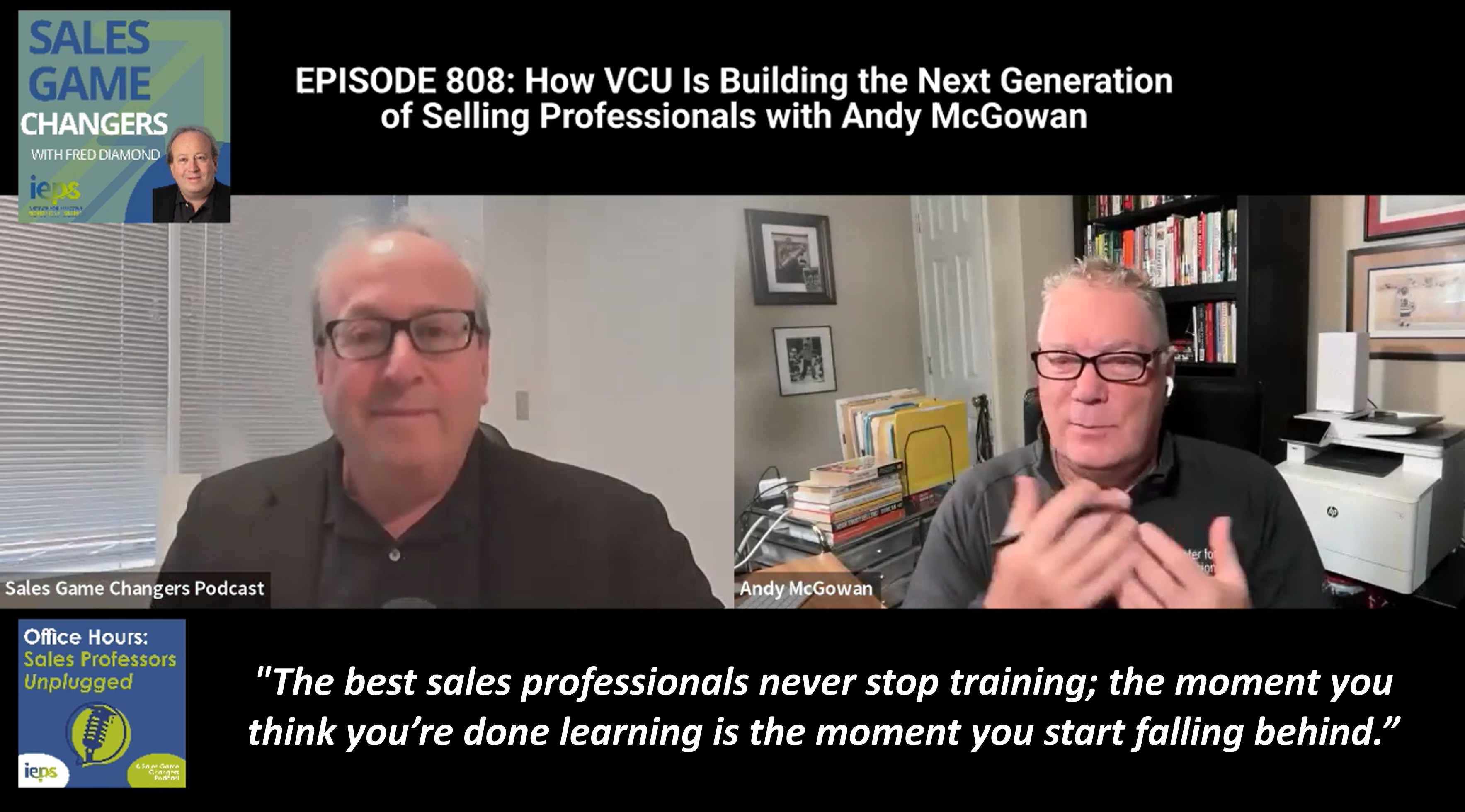
This is a special episode of the “Office Hours – Sales Professors Unplugged Podcast.” The show feature interviews with sales professors at universities with a sales excellence programs. Many of the universities are members of the University Sales Center Alliance.
Watch the interview on YouTube here.
The Sales Game Changers Podcast was recognized by YesWare as the top sales podcast. Read the announcement here.
FeedSpot named the Sales Game Changers Podcast at a top 20 Sales Podcast and top 8 Sales Leadership Podcast!
Subscribe to the Sales Game Changers Podcast now on Apple Podcasts!
Purchase Fred Diamond’s best-sellers Love, Hope, Lyme: What Family Members, Partners, and Friends Who Love a Chronic Lyme Survivor Need to Know and Insights for Sales Game Changers now!
Today’s show is a special “Office Hours – Sales Professors Unplugged” episode featuring Andy McGowan, Director, Center for Professional Selling at Virginia Commonwealth University.
Find Andy on LinkedIn.
Andy’s TIP: “The best sales professionals never stop training; the moment you think you’re done learning is the moment you start falling behind.”
THE PODCAST BEGINS HERE
Fred Diamond: Andy McGowan, I interview directors and professors at universities that have a professional selling program, either a major, a minor, or a certificate, or some degree of concentration. A lot of these universities are part of the University Sales Center Alliance. That’s where I met you a couple of months ago in September of 2025. I was excited to see that VCU has a program and that you’ve taken it over. I know a lot of the young adults from this area, Northern Virginia, go to school at VCU, and it’s a great school, so I’m really excited to talk to you. Why don’t you tell us a little bit about yourself and give us the overview on your journey to VCU?
Andy McGowan: Yes, VCU is a really happening place. A lot of students come from Northern Virginia and come to Richmond. The Center for Professional Selling at VCU was founded actually in 2019 by my predecessor, Dr. Wayne Slough, who did a great job setting it up. He retired a few years back, so I’ve come on board to hopefully continue his great work in trying to build a center for professional selling. My journey to it was I have gone back and forth from academia to business and back and forth. I was teaching in Atlanta and I was teaching business at Georgia State University, and we actually didn’t have a sales center, but my colleague taught a sales course. It’s interesting, we were right next to Kennesaw State, and I never knew that Kennesaw, which has the NCSC, great competition, I never knew about it. My wife was actually on faculty at Kennesaw, so it’s funny. When I went down there, I’m like, “We’ve never heard about this.”
I taught for a number of years. Before that, I led global media relations at UPS. Before that, my selling experience was I ran a multimillion-dollar printing company. I had gone in and taken over, someone had invited me. I thought it was just a business meeting. I was finishing my MBA, I was teaching at another university, and they’re like, “No, no, we want you to run the company.” I found out it was, you need to do everything, like sales. I had a sales staff of one, which was me. As I tell my students, I knew every Dunkin’ Donuts all the way from Boston to New York, and I was on the road all the time, which has served me well teaching the students now to go into meetings and prep them.
I worked in professional sports for the first 14 years of my career, and I sold season tickets for an NHL franchise, which was fun. My sister always reminds me, she goes, “You started selling when we were kids,” because where I grew up in Upstate New York, I played hockey through college, and you had to get raffle tickets every year. My parents paid our registration fee and then you would get the raffle tickets, and if you sold them, they were a dollar a piece, you got to keep the money. My mother made sure that my brother and I sold every last one of them, and my brother is three years younger than I am. He would sit in the car and complain, and my sister and I hit the streets, and we literally knocked on doors. My mom had a territory plan, she mapped out things and highlighted it all, and I got used to cold calling and knocking on doors. It’s funny, it’s come full circle for me now to be teaching at VCU and it’s a lot of fun. They have some really great students and I’ve been very impressed with them.
Fred Diamond: I don’t think I knew about your hockey background. What professional team did you work for?
Andy McGowan: I worked for the Hartford Whalers out of grad school. I was doing a PR internship and my boss goes, “We’d like to hire you next year, but the budget doesn’t start till September.” He goes, “But would you like to sell season tickets? We can pay you to work for the summer.” It’s like, “Sure.” I said, “My other sales job, I was one of those annoying credit card salespeople in college,” it paid way more than minimum wage, so I did it. At that point, this was back in the late ‘80s, early ‘90s, we did phone sales and then you did tours. I spent a summer selling season tickets, and I finished second overall of the whole sales staff. We had a woman, if you’ve ever watched The Incredibles, the lady who was there, what looked just like the lady in ours, and they had the same name and she was always like, “How is it that you’re so good at this?” I’m like, “I don’t know. I played hockey, I know the game, I knew the players.” I spent my summer doing that and they were like, “You sure you don’t want to stay on doing sales, because you’re really good at it?” I’m like, “No, I like what I was doing with PR at that point,” but I spent a lot of my career, like I said, I worked in pro hockey for the Whalers, and then I worked for the Capitals. I led comms for Mr. Leonsis when he bought the team.
Fred Diamond: I don’t know if you know this, but my son actually played college hockey, and hockey’s been a big part of our life. I worked for a software company in the late ‘90s that was owned by the guy who also owned the Hartford Whalers.
Andy McGowan: I know exactly who that is.
Fred Diamond: He was a good man in a lot of ways. Tell us about your curriculum at VCU and talk about some of the classes that you offer.
Andy McGowan: We’ve expanded our curriculum. When I started, we had an intro sales class. It’s sales one. They had a second semester advanced sales class, which will come back this spring. I have to update the syllabus. Dr. Slough had done one. Then we’ve actually added a sales analytics and enablement course. We have a sales minor. It’s part of the business school, it’s part of the marketing department, and students can get a minor in sales, it’s 18 credits, and they’re required to take intro sales right now. They have to take my other course, how I got into the school, was I teach consumer marketing. I was teaching marketing, and then it was sales. You have to take intro, you have to take consumer marketing, and then you can take a number of different electives, the two advanced courses in sales, sales internship is optional. Then you have some other types of marketing and management classes that they picked out. We’re going to be upgrading it more over the course.
Now that we’re adding the sales enablement class and advanced sales, I think we’re going to probably move those into required classes. Our goal is really for the students to come out with their minor and really step into sales roles. It’s been great. The students walk out and they’re like, “I can do this,” which I always tell my kids, “Sales is hard, and if anybody tells you differently, they’re lying to you. It’s hard work.” I think that they find that, because I try to make it like what it was when I was doing sales. You have to do cold calling. You have to do role plays like we do in the competitions. I make them prospect. We’re working on teaching them CRM. Then we have some great sponsors and I pick their brain all the time going, “What skills do you want to make sure they have when they finish?”
Fred Diamond: That’s a question I was going to ask you a little bit later on in the interview, but why don’t you tell us about that now? Talk a little bit about your relationship with potential corporate sponsors. What do they want and what do they expect?
Andy McGowan: We have a number of really great sponsors. We have CoStar, Curbell, Enterprise, United Rentals, Marsh McLennan, Lansing Home Design, and we have Fastenal. They all tell me some different things, and we actually have a competition in two days, and they’re going to come and they’re going to judge the students, and they walk out of there going, “They’re really good at presenting themselves.” That’s one of the key things that they look for. Can they speak well? Can they handle themselves? Can they handle tough questions? They can teach them sales, so I feel good that we’re teaching them the presentation skills.
Then from a sales perspective, they really want the students, and a lot of them have told me that prospecting has been the one thing that they’re not seeing at other schools or other programs, or that students are coming out with that skill. I’ve put that in going, “God, I spent hours when I was running the printing company researching.” You and I probably remember our first sales jobs were like the recipe box with index cards, and you would do that for a CRM. But that’s the other thing, we’re trying to get them to really think how to prospect, how to write effectively.
I’m also using AI as much. It’s been the big topic for USCA and for the Sales Educators’ Academy. We had a conference over the summer, it was all about AI. I’m trying to incorporate that. I don’t want the students to walk out and go, “They wouldn’t let us use it. Everybody’s using it.” You got to make sure you enable the students to do it and use it effectively.
Fred Diamond: There’s two sides to it. There’s, how are you being trained to use that as a selling professional? Then how your customers use it to learn more about what you’re bringing to the marketplace? You’re absolutely right. It has to be a critical part of every curriculum. Just curious, how interested are your students in the program? What I mean by that is how do they become aware of it? Do you have students who decide to go to VCU because they know that you have a sales major? Or is it the kind of thing where they just want to go to VCU, they’re not quite sure. Maybe they have an idea, but then maybe they happen to come to one of your classes or someone on their floor or someone in one of their programs talks about it. Talk a little bit about when the young adult comes, and then how they become aware of the program.
Andy McGowan: I think it’s both. I will say first I would’ve said it’s the form where they hear about it on campus and they go, “This is cool.” But my department chair, Bruce Huhmann, who is our assistant director and has been involved with the program, he goes now to the open houses that they have. He keeps telling me, every open house, there are a number of parents that come up to him of incoming freshmen and go, “We heard the marketing department has a sales program. My kids want to do that.” The information is getting out there. That’s good to hear.
Most of it is the marketing students are, I would say 60%, but what I’ve really tried to do, and again, build on what Dr. Slough did, is we offer internal competitions. We have one this week. It’s called Suited for Growth. It’s a networking competition. We make the students network. I have 22 sponsors coming this week, and they’re the judges, and the students have to network themselves, do their elevator pitches, compete against other students, and we started to get other students from different majors. We’ve actually offered it. We’ve just worked out a deal that our engineering students will now be able to take sales classes. It wasn’t offered in the past. It was shut out to them.
I have two of my top sellers, one’s a psych major, one’s a finance major. They’re starting to get in and they’re seeing it as an opportunity to broaden their horizons and do different things. The best one was we had a young man who’s on our board, our e-board. His girlfriend happens to be an engineering student. He brought her to a meeting. We had 40 students, and she’s hooked. She’s like, “This is cool. I got to do it.” We do a lot of networking with the students because it finally became an official club earlier this year. They get to go to all the official business school events and promote it. From that, we have over 150 students that take intro or our advanced class, and it’s growing. I use a line from Ted Leonsis when I worked for him, “Everything’s spiraling up right now,” because we’re getting publicity, we’re getting good students, the word is out.
Fred Diamond: A lot of the great selling professionals that I’ve met in my career, maybe they were a chemistry major or an engineering major, and they realized that maybe they had this skill, where they weren’t afraid to talk to people. As I tell people all the time, I do a lot of coaching with young adults in college, and I say, to really be successful in sales, you really need to be exceptional in two things, or passionate in two things. What it is you’re bringing to the marketplace, your product, your solution, or the market that you’re serving. Serving the government or hospitals or sports for you, if you will.
I want to go back to one thing you said about the parents being of interest. One of the great things about your child going into professional sales is that there’s going to be an ROI. If they’re going to get a job, a lot of the jobs at these sponsors you’re talking about, they’re starting probably in the mid-fives, but some of these jobs are being offered in the high five figures, and sometimes for the exceptional young adults, in the low six figures. What are some of the things that they want to learn? The ones who are passionate, what do they want to learn about professional selling? What do they ask you most about?
Andy McGowan: I think the first week of class, because I tell them selling is hard, I tell them that they have to do role plays and they have to talk to people. I think for the younger generation, that means we’re old, but my two children are just out of college, and for a lot of them, it’s like they took the class to put themselves out of a comfort zone. I’ve been surprised by that because most kids were like, “No, I don’t want to do it.” But I’ve had a number of students go, “I took this because it sounded interesting. I want to see if I can do it.”
The other thing that they’re telling me walking away from the class is that they feel they’re more confident speaking. They’re more confident presenting. I tell them, no matter what you do when you graduate, this class will help you because you have to present, you have to talk to people, you have to sell ideas. In our courses, working with our corporate sponsors, I don’t grade them. I have a score sheet. The students have to do a semester case study on a sponsor, and the sponsor comes in and judges their midterm and their final role play, and they give them the grade. They’re like, “Oh my gosh,” because our final is in three weeks, and I was prepping them yesterday, and I make them practice. They have to do a video like this. They have to record it, they have to submit it. A couple of students were like, “Really?” She goes, “I can do it.” It’s like, “You need to do it. You have to practice.”
You can’t walk into a sales role play and do it cold. It just doesn’t happen, especially if you haven’t done it before. The things they tell me coming in, it’s taking a chance on something, going out, and when they walk out, they’re like, “I can do this.” I think it builds their self-confidence that they are now like, “That was a hard class, but it was a practical class, and I can go use the skills someplace else, even if I don’t go into sales.”
Fred Diamond: Actually, I’m thinking back to my college days and I wanted to put myself out of my box, if you will, and I took a calculus class and I was a history major. It was one of the biggest mistakes. I say it was a big mistake because I failed the class, but it’s given me a story for the last 35 years.
Andy McGowan: I have one of those too. I tell my students all the time, like you asked earlier, I have a science degree. My major was biology. I took enough courses for a minor in chemistry. It’s interesting because the engineering piece of it, I have had this question, I’ve had three sponsors approach me about can you get me engineering students? I asked them back, I said, “Well, why do you like engineering students so much?” Three different people, one of the guys from Fastenal was wonderful. He was a biomedical engineer, and he went into sales. He goes, “Because we are process oriented.” He goes, “Engineers have this mindset of a process.” I’m like, “That’s brilliant. I wouldn’t have thought of that.” He goes, “Yeah. I didn’t think I would’ve been good at sales either.”
My buddy, he’s told me the story that his college roommate got him into sales, got him into Fastenal. He’s been there ever since. He goes, “It was because I could put a process to it and it made sense,” and he is doing very well. He is the regional manager for them. I guess maybe that’s my brain works from a science, you took the scientific method, and you got to do all this stuff in school, and so I can see the process.
Fred Diamond: It makes a lot of sense because a lot of the companies that you mentioned, it requires a complex or an enterprise type sales approach. At the Institute for Effective Professional Selling, a lot of the companies that we work with are tech companies like Amazon, Salesforce, Oracle, or Hilton, large enterprise type companies. It’s not a one phone call and it’s done. Maybe there’s six people as you grow your career. Maybe there’s six people when you got to think through strategy and process.
We talked about AI as obviously being a trend shaping the curriculum. We talk a lot about the trends in professional selling with the shift in customer engagement from the rise in digital information being accessible to them. Talk a little bit about how your curriculum and maybe your teaching methodology has shifted due to this shift.
Andy McGowan: It’s been interesting. I want to make sure we adopt it. The business school, one of our associate deans for this whole semester has been putting out AI seminars. Every two weeks she has something different. I’ve only been able to go to one of them, but I took a couple of workshops over the summer that are Center for Teaching Excellence offered. I was like, “This is interesting. How do I do it?” There’s a website that you can put prompts into that are academic prompts, that it helps you with syllabi, with assignments and grading. That was interesting.
The SEA conference that Leff Bonney down at Florida State ran, the focus for the whole two days was AI and sales. I walked away with pages of notes, and I came home and I’m like, “What do I do?” Part of it was I redid my assignments to say, “Hey, look students, if you get a job somewhere, you’re using it. I already know you’re using it for your assignments at school, but let’s be smart about it.” I let them use AI for research on companies when they have to do it. I make them prospect. That was part of it. They do research and present to prospects. They have to create a phone script to leave a voicemail, and they have to do follow up emails. I let them use that, but I make them give me the prompt and which AI engine they did, cite it like you normally would in a research paper.
I make them do that just like I want them, and I’m trying to learn more tools, there’s some other things. That’s my Christmas brave, is trying to figure out how to even improve upon it so that the students can walk out. Because there was a story recently, I think it was on the Wall Street Journal, talking about how everybody thinks AI is going to take away jobs. But the author of this article actually said it’s not going to take away jobs. You’re going to see people who do not embrace it lose their jobs, as opposed to people that embrace it to help their job. I want to make sure I enable the students and go, “Okay, this is how we use it in sales,” so that you at least can walk into a job going, “I’ve done this before. I have an idea.” That’s my plan.
Fred Diamond: Is there anything else you want to tell us? You’ve been doing this for what now? About a year and a half at VCU?
Andy McGowan: Yeah, a year and a half. We moved from Atlanta to the Richmond area, and I was teaching marketing, teaching communications, which are more my area. The department chair came, he was like, “Would you like to teach sales too?” This was two weeks before the start of the semester last August, and I’m like, “Okay, I’ll do that.” Then it was, “Can you coach the kids do that?” Then the center fell with it. It’s been fun because I’m an outgoing person, I like to work with companies. I think my business background of having been a senior leader for a couple of companies, I get sales, but I get partnerships, and it’s been fun. I’ve enjoyed it.
My mentor in college was someone who said to me, and I never thought I would teach in my life. I was doing my graduate internship, working for the Whalers. In a post interview, he said to me, he goes, “You should think about teaching one day.” I’m like, “Why would I want to teach? I love doing sports. I’m doing this stuff.” After about seven, eight years in the professional world, I was like, “Maybe I’m going to try it.” I wrote a bunch of letters and I got a teaching position at Iona College, and I was teaching. I look back at it and go, I guess that’s what mentors are for, because they see things in you. But it’s also that opportunity I feel for me where I am in my career, to give back to students to help them. Because as you were giving some salary numbers before, I think the one thing I am seeing now is sales students are getting picked off. If they’re good, they can get jobs. The kids that came back from ICSC, from the conference last week at Bryant, they’re walking out with internships and jobs. The sponsors are spending the money. Why? Because they’re seeing these kids that are prepared and they’re just picking them up. We have CoStar in town and they’re taking students left and right.
Fred Diamond: This is relatively new. I know there’s a couple schools, like Kennesaw, that have been around with their selling program for going on maybe two, three decades potentially. But it’s something that hasn’t historically been taught in the university world. As a matter of fact, this particular show that we’re doing, I’m going to be posting it to YouTube and Apple and Spotify, but I’m going to do a LinkedIn post as well, talking about some of the great things that you’re doing at Virginia Commonwealth University. Every time I post an Office Hours – Sales Professors Unplugged Podcast, two or three people are always going to comment, “Gee, I didn’t realize that they’re teaching sales at universities.” The reality is, these young adults that are going through the program, like the Center for Professional Selling at VCU, are ready to hit the ground running.
They need to understand how the company operates and where the bathrooms are, etc., but they have the skills that these companies know will be great, and the retention is probably going to be higher too. A lot of young adults who move into sales after college, they don’t really understand that a lot of times there’s two types of jobs early in sales. There’s the SDR type of job where it’s prospecting, like we talked about, making phone calls, emails, nurture. Then there’s the territory sales rep type jobs where they say, “All right, you’re going to call on 15 print shops or 15 Walmarts until you prove to us that you’re any good.” But the reality is, these young adults coming out of these programs that are recognized by the University Sales Center Alliance are steps ahead. It’s great to see that the companies that are sponsoring your programs see that. We see that all day long at the Institute for Effective Professional Selling.
Thanks, Andy McGowan, for the great insights. We’re doing today’s interview in November. I know I’m going to be coming down there in 2026 and look forward to doing some role plays with your young adults and seeing some of the things. Give us a final action step, something specific that you want our listeners to walk away with that’s going to help them take their career to the next level.
Andy McGowan: I would say the thing that I tell my students now is be open to all the technology. Like we talked about, AI, some students don’t want to do it. You’ve got to at least be open to it. Also, take the risk. Especially for the younger students that come into a sales class and like. “I don’t want to do sales. Why would I do sales? I want to be a marketer. I want to be whatever.” Then they come in, they take a sales class and like, “I can do that.” I think it’s really being open to the opportunity to do something, because sales really challenges you in a lot of ways. Not only professionally as a job, but personally, because you have to get better at presenting yourself. You put yourself out of your comfort zone to do sales.
I laugh at one of my former companies. My accountants that I worked with, they sat in a cubicle in the back corner and they were like gophers. They would just pop up every once in a while, but they never did anything. To be a salesperson, you have to really go out there and go get it. I would tell anybody, if you are thinking about sales and you want to do it, even if you are doing it, it’s really working on putting yourself out there. Then in today’s environment, embrace the technology. That’s my own task for Christmas vacation. Once I finish all my grading, I have a book to read on AI and LinkedIn and how to get better. That’s what I would tell you.
Fred Diamond: That’s great advice. Once again, I want to thank Andy McGowan from VCU, Virginia Commonwealth University. This is a Sales Game Changers Office Hours – Sales Professors Unplugged Podcast. My name is Fred Diamond.
Transcribed by Mariana Badillo