
Watch the video of this podcast on YouTube here.
The Sales Game Changers Podcast was recognized by YesWare as the top sales podcast. Read the announcement here.
FeedSpot named the Sales Game Changers Podcast at a top 20 Sales Podcast and top 8 Sales Leadership Podcast!
Subscribe to the Sales Game Changers Podcast now on Apple Podcasts!
Purchase Fred Diamond’s best-sellers Love, Hope, Lyme: What Family Members, Partners, and Friends Who Love a Chronic Lyme Survivor Need to Know and Insights for Sales Game Changers now!
Find Sehar on LinkedIn. Find Peter on LinkedIn. Find Joshua on LinkedIn.
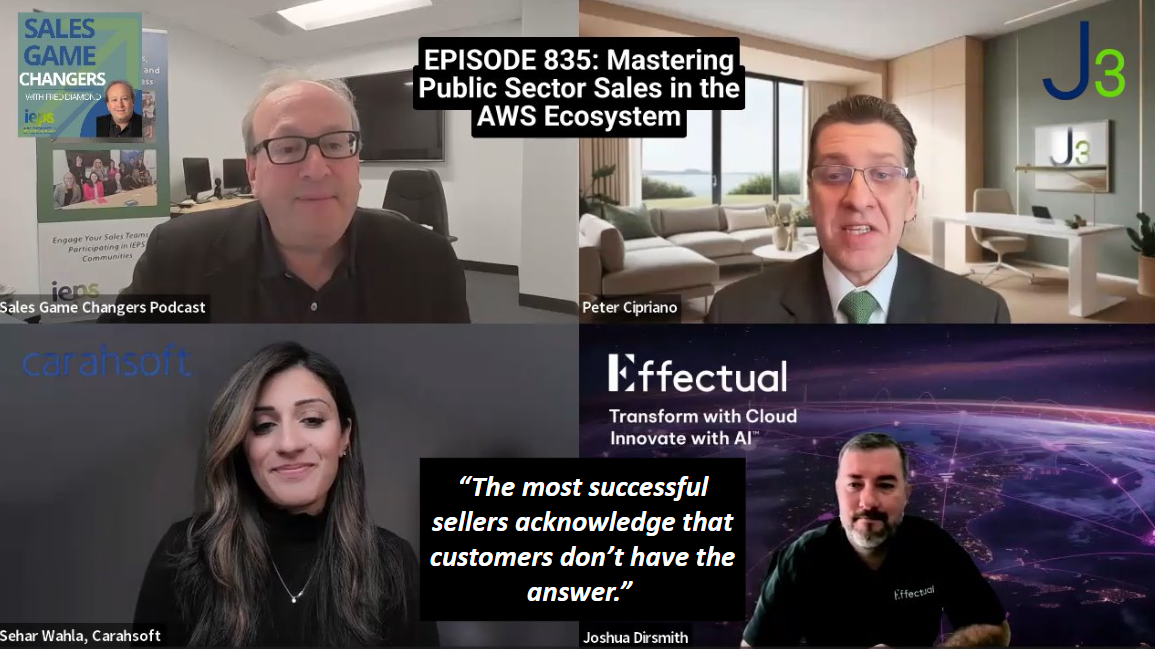
SEHAR’S TIP: “The most successful sellers acknowledge that customers don’t have the answer. They get close, become trusted advisors, and work hand-in-hand to solve the problem, not just sell technology.”
PETER’S TIP: “It’s not enough to have the best solution. You have to show how it fits the customer’s mission, their people, and their process. That’s what builds instant credibility.”
JOSHUA’S TIP: “Your success comes from adding value in every conversation and becoming a trusted advisor, so customers bring you their hardest problems, not just the easy ones.”
THE PODCAST BEGINS HERE
Fred Diamond: I’m doing a little bit of an opening here with Sehar Wahla with Carahsoft. Sehar, it’s great to see you. You’re going to be on the panel on May 14th. Why don’t you introduce yourself to the audience before we bring on Josh and Peter, and tell us a little bit about what you do.
Sehar Wahla: I am responsible for the AWS distribution business here at Carahsoft. I’ve had the pleasure of working very closely with both Peter and his team and Josh and his team, as well as Shannon Judd and a lot of the AWS partner leaders. I’m really excited to participate in this event.
Fred Diamond: Why don’t you give us an opening statement? What are some of your thoughts on what’s going on right now and what people attending on the 14th will be able to learn?
Sehar Wahla: I’m excited. This is my first event with you. I think it’s a very important event, especially now. We’ve all been part of this massive transformation, both from a technology perspective, but also the government adopting a lot of this technology. I think the partner community is very important in helping our government customers make this transition. This is going to be a great event for any sellers that are looking to learn from experts in this space on how to do that, because these guys and Shannon and their teams are experts at this.
Fred Diamond: Interesting word, transformation. I would say massive transformation. Obviously, a lot of things that happen with federal downsizing and the move with AI coming onboard and the move to cloud environments as well. It’s a perfect storm of a lot of things coming together. I’m excited for your organization and for the teams that are going to be there.
On that panel on May 14th and on our podcast today, Peter Cipriano and Josh Dirsmith, and we’re very excited to have you both here. Why don’t you both introduce yourselves and then we’re going to get detailed into what would be our advice for selling professionals right now in being successful. Peter, give us a brief intro, and then Josh.
Peter Cipriano: I’m the CIO at J3 Consulting. We’re a woman-owned small business working in the fed-cyb space. We support agencies across cloud, IT operations, and acquisition services with a focus on helping our clients make better use of their data so they can make faster and more informed decisions. Over the last couple of years, we worked very closely with Amazon and Carahsoft through programs like Think Big for Small Business and the Business Outcomes Xcelerator to bring more of our capabilities to our clients faster.
Fred Diamond: Josh, tell us about yourself and your company.
Joshua Dirsmith: I’m Vice President of Public Sector for Effectual. Actually, the day of this event in May is going to be my 10-year anniversary here. Very excited and blessed to have partners like Carahsoft and AWS, worked very long time with Sehar and Shannon and very excited to meet Peter and Fred in person.
Effectual is an AWS-only services partner. We do the professional services to enable the cloud for our public sector customers from those who are dipping their toe into the proverbial cloud waters, all the way up to those who are using it for advanced analytics, artificial intelligence, and deriving more value from the data that they have today. We were awarded Amazon’s 2025 Public Sector Consulting Partner of the Year for North America at re:Invent in December. Very excited and honored for that designation and we’re looking to use that as a megaphone to reach more public sector customers this year.
Fred Diamond: We’re excited to celebrate your 10th anniversary. As you mentioned 10 years, I was going to say, well, I guess nothing’s really changed in the last 10 years. If you think about what’s changed in the last 18 months, let alone 10 years, it’s actually remarkable. One of our commitments is to helping selling professionals in the AWS ecosystem be more effective and more successful.
Josh, if I’m a seller, if I’m in this AWS ecosystem, going after federal business right now, what would you recommend that they focus on?
Joshua Dirsmith: Great question. As we alluded to, there is so much change going on in the federal government today, from resignations and other departures and things like that, where the folks and decision makers and the individual contributors who remain have to be able to do their job more efficiently just in order to maintain the status quo, and leveraging technology is an incredible way to do that. There are tools on AWS. It’s not just the compute and the storage and the networking of yesteryear that everybody understands, but it’s these data analytics tools. It’s their artificial intelligence capability.
What I would say to the seller is become an expert in some of those things. The reason that my team has success in selling to the federal government is because they themselves are able to add value to the conversations that they’re having with federal customers. Our federal customers more so than ever need to be able to trust the people that are selling to them and selling your value as the seller, along with the products and technologies and services that you’re selling, is crucial so you attain that trusted advisor status with your customers and they come to you with the hard things, not the easy ones. You know your customers like you, whether they say it or not, if they come to you with those difficult challenges that they’re facing and they’re looking to you to enable them to solve them using Amazon technology.
Fred Diamond: That’s a great answer. We tell our sales professionals all the time, you’ve got to be an expert in your customer’s business and you’ve got to be a couple steps ahead. The most successful selling professionals that we deal with right now at the IEPS are experts in their customer’s business, or they’re so advanced in their knowledge of what they’re bringing to the marketplace, one or the other. Your customers don’t need you if you don’t have that value add.
Peter Cipriano: I’m going to answer from a small business perspective and it dovetails off that where it is expected as a small business you bring the intimacy that a larger integrator may not be able to. We have to be able to say, “I know you can use Amazon services within your culture and mission.” It’s not enough to say that you have the best Amazon solution. You have to be able to say, “I know how to integrate that technology into your program, make it personal. I know this will work because of X, Y, and Z.” Amazon sellers need to focus and understand those day-to-day challenges which can be people, process, and policy. It’s not always better technology will fix it, and that approach will give you that instant credibility that you need to sell.
Fred Diamond: That’s a great answer. Sehar, Carahsoft and your team, you’re on the leading edge of all of this because you’re working with so many value-added resellers and technology partners like the guys we have on today’s show who are bringing solutions. What should they be doing? What are you telling them that they should be doing? Maybe what are you seeing that they’re not doing that they should be?
Sehar Wahla: I think the most successful sellers that we work with are acknowledging that the customers don’t have the answer. A lot of times we all don’t have the answer, but they’re getting close with the customer, they’re becoming trusted advisors. They’re not just selling them technology, they’re not just a vendor, but they’re actually working hand-in-hand with customers to solve these problems. Josh, you’re spot on, if your customer is calling you with your hardest problems, they trust you. You are part of their process.
Whether it’s our team, whether it’s partners that I’m meeting with, my recommendation is always get to where you’re coming forward and providing a clear plan for our customers, because there’s so much noise, there’s so much technology available. Get deep in understanding what their problem is so that then you can propose technology solutions for it. Maybe it’s AI solutions that can help, maybe there’s cloud solutions, but how do they solve their problem in a scalable fashion using technology?
A lot of that too, and the last thing I noticed with successful sellers, is that they’re agile, and agile in terms of as you’re building a framework where the customer things are going to be changing, but so is technology. The most successful sellers, even in the last 10 years, are ones that have grown with their customers and grown into solving more complex problems.
Fred Diamond: That’s a great answer. Let’s talk specifically about that. One of the major changes over the last year or two is the mission criticality of what government employees are doing. Obviously, there was a lot of people who left their jobs in the last 18 months or so and the reduction with DOGE and everything else. The best selling professionals, what we’ve seen, they’re presenting their AWS-based solutions as mission critical, and not just like a generic offering. There’s no value if you’re just going in with generic or what customers can ascertain on the run.
I like that all three of you touched on the fact that the selling professionals who are successful now, and we see this not just in the AWS world, but in every vertical that we address, with every technology and every industry, you got to understand the mission criticality. Talk about how the best selling professionals are getting to that level. We talked about the value add. We talked about the expertise. How are they getting there?
Peter Cipriano: From what we’re seeing, your AWS story needs to be grounded in real operational and business context. Your solution at the surface may be the best, cheapest, most efficient solution they’ve ever seen, but if your solution comes with a lot of overhead like the need to retrain the entire staff, or if you’re not sure if their staff can even quickly pick up that solution, you probably will not be seen as mission critical. To be mission critical, you have to show you connected all the dots, from technology, to the business, to the people maintaining and using your solution. This builds that credibility with your client.
Joshua Dirsmith: Just to extend on that, one of the things we see is Amazon’s ability to do things compliantly that publicly-available technology cannot. Let’s take artificial intelligence. Everybody has used ChatGPT or the Google version or whatever the case may be, but to do so with mission-critical data on a compliant-accredited system, that’s a different can of worms. Our customers on AWS technologies are asking us, “Hey, what if I could do something like this technology over here publicly available, but do it compliantly on my systems on AWS GovCloud, for example?” That’s one of the things that we’re seeing a lot, coupled with having to replace human horsepower with technological horsepower, and enabling those people who remain, the decision makers, the individual contributors I was talking about earlier, enabling them to do not only their jobs, but the jobs of the folks who are no longer with them. That is critical in leveraging AWS technologies, doing it on GovCloud.
As an example, Amazon Bedrock is available in AWS GovCloud with all of the large language models that are the top of the top. It’s both Claude, it’s other models as well. Those kinds of technologies available in GovCloud compliantly, that is a game changer for our customers. We’re seeing it not only across the federal ecosystem, but also in aerospace and satellite, in manufacturing, in state and local government, in nonprofit, in healthcare. All of those public sector entities that are federal adjacent, they’re also using it as well because it is transformational for them to be able to do it and do it compliantly rather than hide their use of modern technology.
Sehar Wahla: I’m going to take a little bit of a different approach but weave together a little bit of just the work I know that Peter and Josh and their teams do. When I think of just a generic cloud offering, no one’s walking into the government and saying, “Here, buy some AWS.” They are taking AWS technology, they’re taking other SaaS that integrates or platforms on AWS. They’re taking managed services that are going to make those solutions possible. They’re looking at accreditation. They’re looking at procurement challenges. Sellers are helping, as best they can, simplify that all for a government customer.
I also look at the role of collaborating across the ecosystem and the importance of that. Actually, both of these gentlemen, they and their teams are experts at this. I have firsthand worked with them and their teams on some very complex government customers that they both support today. They’re also the first to say, “That’s not my domain. That’s not the part that I’m good at, but I’m going to partner with other people in the industry and the ecosystem to solve for that part. My team’s going to be hyper-focused and being a specialist in solving this mission-critical outcome for our customer. I’m going to partner and lean across the aisle with other peers at other companies or ISVs or AWS or Carahsoft to solve some of these other challenges.” I think the strongest partners are the ones that are not looking to become the experts on everything, but they’re very strong in where they’re solving a specific problem.
Fred Diamond: We’re having the event at the Carahsoft Conference & Collaboration Center and the Carahsoft team that you manage, the AWS practice, has such a wide breath in understanding who does what really, really well. I love that answer. The event is on May 14th. We’re going to be having Josh and Peter and Sehar and also Shannon Judd from AWS. It’s going to be a great day to learn what you need to do as a selling professional to be more effective, but let’s talk about the customers here.
They all have hard jobs. If there’s less of them, there’s obviously more oversight. We’re doing today’s interview in April of 2026. You guys and your teams, you’re all dealing with customers every single day and they’re under a lot of pressure. Things are changing not just from a government workforce perspective, but from a need to be technologically-advanced to get the solutions done that the United States citizens need. Give us some advice here on what government customers are really asking from you and from your teams and how you can bring those solutions.
Sehar Wahla: I think one of the biggest things and opportunities I see as industry to help our government customers is let’s work as fast as possible. I say this to my teams all the time, on all the commercial innovation and all of the technology that’s being developed, how are we getting that into the hands of our government customers faster? Because ultimately that’s going to make their jobs easier. As teams on the industry side, that’s what we’re so hyperfocused on. Is it alleviating contractual burden? Is it educating customers on how these new technologies are going to help solve their problems? Is it leveraging tools like AWS Marketplace? Is it getting more partners spun up on the programs that AWS offers so that we can help move faster?
I think as sellers, we should obviously be focused on being as smart as we can with the technology that’s out there and understanding what problems it’s solving. I think we’re obviously focused on let’s alleviate some of these procurement challenges. But I think the last thing, someone said this to me probably about a year ago that really stuck, but it’s being empathetic with where our customers are right now will go a long way. We’ve talked about reduction in workforces that have affected government, but just understanding the scale of the problems that they’re trying to solve right now and pairing that with the scale at which technology is moving, it’s a lot and it’s a lot more than they’ve ever been asked to do.
I think we serve our government customers the best by being partners to them, being invested in their mission, being invested in their success, and ultimately co-owners of those outcomes, because as citizens, we are co-owners of those outcomes. I’m hoping we can get into more of that in the event and how we’re supporting government, but that’s my thought.
Fred Diamond: That’s a great answer. I’m glad you brought up empathy. A lot of our listeners know, the number two most uttered word in the history of our show is empathy. It’s such a critical thing right now because yes, obviously industry has gone through a lot of transformation. Government customer has gone through a ton and it hasn’t been very pleasant for a lot of them, and the challenges haven’t gone away. The challenges continue to grow. By the way, the number one most uttered word, we’ve already used it a number of times on today’s show, is the V word, value. Josh, what is your advice for what we need to know about the customer?
Joshua Dirsmith: I’m going to double tap on something Sehar said. The contractual and acquisition flexibility, structuring arrangements with customers that are applicable for them today but also can be flexible enough to be applicable tomorrow, that is critical to the success of our customers. We talked about earlier on this show, they do not know everything they need to know today, let alone everything they need to know tomorrow. Helping them through the RFI process get flexibility within their awards and within their contracts to account for something changing tomorrow, something changing next year, that’s critical. Educating them for how to do that through the RFI process, through conversations between sales professionals and customers before solicitations are released, that’s critical.
I know Sehar and I are working on a very large one with a customer that we’ve guided in the past to what right looks like from an acquisition perspective, and it has shone through in the solicitation that’s active on the street today. It’s enabling that and having these contracts in place to enable these very modern technologies like Amazon Quick or Amazon Kiro or Amazon Bedrock, just to name drop a couple of artificial intelligence tools that Amazon is being able to make available to their public sector and government customers compliantly in GovCloud. But contracts that existed a few years ago, those tools didn’t exist. Having the flexibility to add them without having to restructure or re-award your entire contract ecosystem, that creativity and that flexibility is critical to enabling our customer success today.
Fred Diamond: That’s a great point. Obviously, you got to understand the technology, where the customer is going. But for listeners here who aren’t all that familiar with the federal marketplace and public sector in general, procurement, contracts, compliance is such a critical factor. For you to be successful in selling today, obviously you need to be an expert in that as well. Peter, why don’t you bring us home with some fresh thoughts here?
Peter Cipriano: This is a great question to end with because it brings home almost everything that we’ve been saying since we first started. What we’re hearing from our clients right now is the need for stability from the chaos that we’ve been in in the past year. There’s been a lot of disruption. We don’t need to repeat what we’ve seen. We’ve all seen a lot of our good friends of years of service go away. What that’s done is that’s exposed a tremendous amount of gaps in data services and IT services and decision making, as Josh just pointed out. I think it’s up to us to let them know that we understand that and that we are compassionate and we understand that it’s not just a solution. There’s real people that are hurting right now.
I tell my folks, “Sometimes you got to read the room. You have to know when not to say something and just let something go.” I think right now, like we said, empathy, compassion, we’re here to help you succeed. That’s all of our main goals here. That’s all of your main goal is. Sometimes we go in with one solution and we come out with something else, because you just got to read the room.
Fred Diamond: We always end the show with specific action items. You all have given us great ideas. Give us something nice, crisp, and succinct that people should do right now to take their sales career to the next level.
Joshua Dirsmith: I would say call your largest customer that you have in your portfolio today and talk to them about what their biggest IT challenge they’re facing is today, and then either react to that immediately or react to that within 24 hours about how you and AWS and Carahsoft can solve that problem for them.
Fred Diamond: Great answer. Get on the phone. Pick it up. Peter.
Peter Cipriano: If you are a small business, again, pick up that phone, contact the Carahsoft small business team, the Amazon small business team. We would not be here without their support. There is work to do, but pick up the phone, they’ll guide you through the process. As Sehar said, you will meet those other businesses that could complete your solutions.
Fred Diamond: Great decision. Sehar, why don’t you bring us home.
Sehar Wahla: As sellers, I think keep learning. Learn something new about technology and that’s going to serve you and it’s going to continue to serve your customers.
Fred Diamond: Once again, my name is Fred Diamond and this is the Sales Game Changers Podcast.
Transcribed by Mariana Badillo