
Watch the video of this podcast on YouTube here.
The Sales Game Changers Podcast was recognized by YesWare as the top sales podcast. Read the announcement here.
FeedSpot named the Sales Game Changers Podcast at a top 20 Sales Podcast and top 8 Sales Leadership Podcast!
Subscribe to the Sales Game Changers Podcast now on Apple Podcasts!
Purchase Fred Diamond’s best-sellers Love, Hope, Lyme: What Family Members, Partners, and Friends Who Love a Chronic Lyme Survivor Need to Know and Insights for Sales Game Changers now!
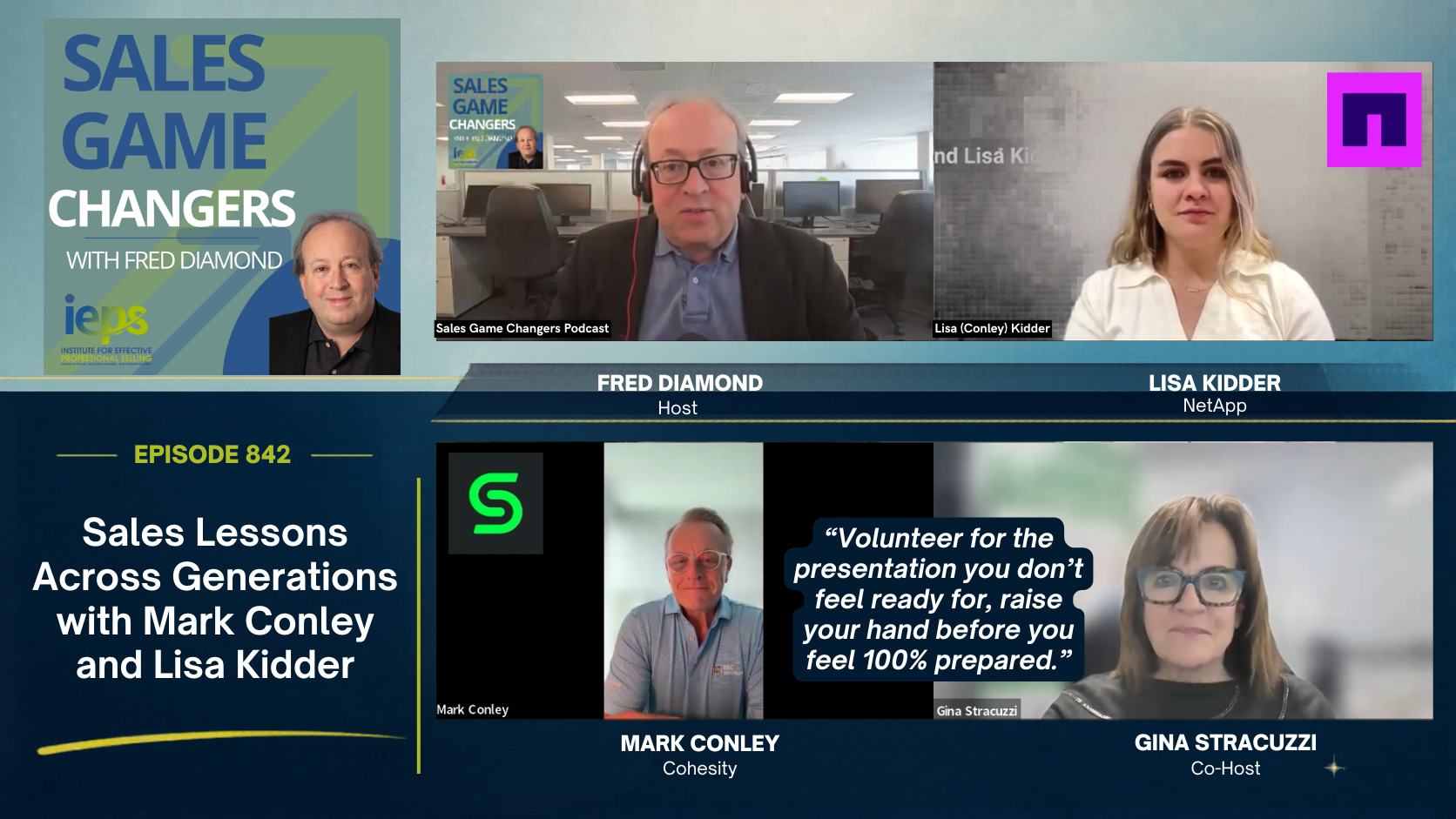
Today’s show featured an interview with Mark Conley, Vice president of Americas Channel Sales at Cohesity, and Lisa Kidder, Cloud Solutions Architect of Amazon Web Services at NetApp.
Find Mark on LinkedIn. Find Lisa on LinkedIn.
MARK’S TIP: “The three characteristics of great salespeople are ego, empathy, and guts. You’ve got to have a resilient ego, the ability to understand what the person you’re selling to wants, and the courage to commit to something that you’ve never done before.”
LISA’S TIP: “Volunteer for the presentation you don’t feel ready for, raise your hand before you feel 100% prepared. I think that’s the best way to not only gain that confidence, but get the visibility to just have your career take off.”
THE PODCAST BEGINS HERE
Fred Diamond: Gina, we’re doing a lot of shows and we’re doing a lot of work at the Institute for Effective Professional Selling with channel leaders, strategic partnership leaders. We have our new Partner Growth Program where we take partner manager through a six-session cohort over three months. We announce that at our award event on April 29th. It’s going to be starting in July, this summer. We’re doing today’s recording in April of 2026 but that program is going to start in July of 2026.
We’ve met so many great leaders in the channel side, we’ve been very fortunate to meet them. We reached out to Mark Conley with Cohesity, got to know him a little bit. Mark and I had some conversations about how he’s leading channel organizations at Cohesity, but also he’s been at Sun, he’s been at NetApp. We were talking about what we do at the IEPS and he says, “Well, you really need to talk to my daughter, Lisa Kidder.” We reached out to her and she had done some really incredible things, and she’s doing some great things at NetApp, helping on the AWS side. I said, “Well, why don’t we do another parent and child show?” We’re very excited. Let’s get started.
Mark, it’s great to see you. Thank you so much for introducing us to Lisa and for what you’re going to be contributing here. You’ve led channel teams at some of the top brands in technology in your career, I mentioned Sun, NetApp. You’re presently leading the channel business at Cohesity. How’s the ride been? Looking back, what were some of the key drivers of your success? Feel free to chime in with anything else that you want to mention from your background that I might not have covered. Then we’ll go back and forth asking questions to you and then to Lisa.
Mark Conley: I’ve been involved in channels, it feels like my whole career. I started working for a reseller when personal computers were brand new and worked with channels as a sales manager, worked managing channels for a long time. It’s interesting, I was with a group of partners yesterday, and everyone was introducing themselves and they were saying, “Well, I’ve been in this business for 20 years and 25 years,” and some were joking and saying, “I got into it when I was six years old.” It came around to me, and I was last in line, I said, “Folks, I used to think of myself as the young person in the room always. After today’s session, I can’t look in the mirror and say that to myself anymore, because I’ve been doing this for 45 years while in the channels.”
I’ve enjoyed every bit of it. It’s been a lot of fun. I think that the key drivers for me that have made me successful and helped me to do good work with the companies I worked for is that I feel like I’m a firefighter. I always thought that I could be a good fire jumper, the kind of person that gets into a forest fire and tries to assess the situation and make some progress right away. Not that I have anywhere near that kind of courage, but I’m pretty good at being dropped into a situation, assessing the situation, and figuring out what the next best path forward is. I do a lot of research, I make sure my decisions are well-reasoned, but I like to take action and I feel like there’s a law of diminishing return when it comes to assessment. I make those quick assessments and get into things really quickly.
Gina Stracuzzi: It’s awesome. I love hearing people who’ve been doing something for a very long time and are still super fired up about it. Lisa, let’s move over to you. It looks like you’re following your father’s footsteps and now you’re in tech sales yourself. What was it like growing up in your household? Did you understand what your dad did? Did you understand what sales was? Was that something you always wanted to do?
Lisa Kidder: My dad and I have always been very similar in many ways growing up. I never thought I would go into sales, and maybe that’s because I was thinking I wanted to be different than him. I always thought being so similar to him was almost a bad thing, but I never really understood what he did. I never knew what sales was and so I never thought, “Hey, I want to have a career just like my dad.” I knew he worked hard, I knew he travelled a lot, but probably the most thing that I noticed is that he talked all the time to a bunch of different people. His job came with a little bit of flexibility, but a lot of pressure. There wasn’t really a clear line between work and home. I was always aware of what he did, but I never really knew what it meant.
It really didn’t become clear until I started being in college and trying to figure out what do I want to do with my life? Where do I want to go? Ultimately, a lot of that led to technology. I never really thought about sales until my dad really connected the dots of, technology is people. Technology is just one part of the sales business, because sales is all about people. That’s really when I started to consider sales as a real career.
Honestly, not much has changed in our household growing up. I’m the only one that followed in my dad’s footsteps. Instead of now just my dad talking all the time about his passion at work, it’s turned into both of us going on and on at the dinner table and my mom has to remind us to take a breath and step back and include the rest of the family. It’s been nice having my dad as that role model. It made sales a much easier decision than I ever thought it would be growing up.
Fred Diamond: Mark, as a lot of listeners know, I have a daughter who’s in sales. She’s in sales at Hershey and she covers some territory for Hershey. One of the fun parts of that is that she contacts me almost every day. “Hey dad, this happened today,” or, “How would you have handled this,” or yada, yada, type of a thing. That must be fun for you.
What’s your advice for Lisa and others as they start their careers in sales?
Mark Conley: Listening to her first answer, I think I should be taking advice from her, frankly. I get a chance to talk to early-in-career people pretty often. We have an early career program here at Cohesity and we had one at NetApp when I worked there before Lisa worked there. It gave me a lot of joy to deal with early-in-career people and try to give them some advice and tell them about channels and about sales.
I always tell them that the most important thing you can know is yourself. That’s cliche, but knowing what you like, what you don’t like, what you’re good at, what you’re not good at, helps you to put yourself in positions where you can be more successful. Now, when you’re in your 20s and sometimes you’re even in your 30s, you really don’t know who you are. You think you do, but you really don’t. It takes some time to learn that.
I put myself in a position one time where I was a program manager, where I was back office, where I was writing things, developing things, talking to myself most of the time and not other people, I found that I really just didn’t like that kind of job. That’s not me. We had a situation recently where there was a female sales leader in an organization that was considering coming into my organization. There was a twist between doing that and doing something else that was back office related. I said, “Look, you can make your own decision. But when I look at you, I think of you as a front office kind of person. You’re a person that attaches to people, that motivates people, that wants to be with people. If you go in the back room and you’re a program manager, I tried that, I didn’t like it.” Know yourself, put yourself in a position to be successful, and be true to your personality.
Gina Stracuzzi: That’s great advice. Thinking about what your dad just said and figuring out what it is that works for you, you got your degree in computer science from Clemson. Did you take any sales courses at Clemson? Were you thinking along those sales lines at that point? Or what drew you to taking computer classes?
Lisa Kidder: I really wasn’t drawn to sales. I never really thought about it as something that would be on my radar. I didn’t take any formal sales classes at Clemson, to no fault of Clemson, but I thought of myself as a computer science person. My dad definitely helped me get into that field, because he said, “You can do whatever you want with that. It gets you into that technology.” I even liked math so much growing up. It was a good way to keep on to my very black and white math background while having a lot of different opportunities for careers.
Later in college, I did add a business minor, which I think gave me a lot more perspective to broaden my potential career path. Definitely with the advice of my dad, he kept always saying that I was very competitive and I was very confident. I never believed him until I started to realize that business had a lot bigger impact in technology than I ever thought. No real formal sales classes, but a lot of the ComSci background helped me get to where I am today. A lot of the technical background helps me get that credibility with customers.
One of the biggest things is a lot of the sales and technical combo is it’s just a lot of tech at the end of the day, because the people is, for me, the easy part and the fun part. The degree helped me understand that technical background that I needed. Then the people is the fun part that I get to work with every day.
Fred Diamond: We also do the Office Hours – Sales Professors Unplugged version of the Sales Game Changers Podcast, where we talk to directors of the professional selling programs. We recently did a show with a guy named Matt Radomski, who went to Clemson. We got to know the leader of the Clemson selling curriculum. It’s definitely a great school to prepare people for sales.
Mark, Gina and I both have children who recently graduated from college. Did you support your daughter’s choice of major knowing what you might have wanted for her as she came out of school? I’m just curious, were there activities that you encouraged her to do while she was growing up that prepared her for this career?
Mark Conley: I definitely was very proud and happy when she decided that she wanted to do that. It seemed like a natural for her because I always said that she’s a five-tool kid. She’s smart, she understands technology, she’s gregarious with people. She’s the one I don’t have to worry about. If you have more than one child, there’s always one that you just don’t have to worry about, and that’s Lisa, but I really encouraged her.
I remember it probably differently, I’ve made this story up in my head, but when she was in high school, she was a math and science person. She really understood that stuff. She said, “Dad, what should I go into it?”
I said, “Become an engineer, because number one, you’re smart enough to do that. Number two, you’re not a typical engineer. You’ve got a bigger personality than most engineers do.” I said, “If you’re a female engineer in computer science in one way or another, you are a blue diamond. You are a rare commodity.” As Lisa has put it to me several times, the people that are her peer group are typically balding middle-aged, white, left-headed males. She’s going to be a standout just from that point of view.
In fact, when we were interviewing at colleges, she went to my alma mater, which is Illinois, and she interviewed with the dean of the electrical engineering and computer science department. He said, “You would be a standout in my department.” I’m the proud father and all that and I said, “Why is that?” He says, “Well, because we just don’t have any white females in my group.” That’s the advantage you’re looking for, but I’ve always encouraged her to do what she wants to do.
Growing up, I can’t say that I put her in situations or tried to guide her into situations that would have helped her get into this line of work of hers, she just naturally chose it herself. She understands herself better than most people do at her age and so she’s got her own career.
Gina Stracuzzi: You’re absolutely right. Just even being able to be the subject matter expert and the salesperson, it’s an amazing thing. Let’s talk about that. You went into engineering sales right after school, and you’re moving up pretty quickly from what I understand. What’s motivating you to be that successful? Where are you going with it?
Lisa Kidder: I didn’t think I saw the competitive nature of myself until I got into sales. It might be the hardest thing to admit, but actually in that training program that my dad had mentioned that NetApp has, it’s called the S3 Academy, they had us rank what matters most to us, what’s most impactful in terms of feedback from a peer or a manager. What I had at the top of my list was actually recognition. It’s embarrassing to admit, but I think it’s very relatable in sales, because it’s very visible.
My dad mentioned one time, “When you do well, people notice. When you don’t do well, more people notice.” It was a lot of internal drive for myself of how can I be the best I could possibly be, and get the most attention for all the right things. Sales really gave that to me, and engineering, not necessarily did it lack it, but it didn’t have that personal connection or that personal motivation where when the people I care about praise me, it’s because of the preparation results. It’s truly because of what I have worked for. I think that’s what’s motivated me to stay successful in sales, is building that trust with people. When a customer trusts me or when a leader pulls me into a bigger conversation, it tells me that I’m actually adding real value. It’s really just that striving for the next big thing.
Fred Diamond: Mark, in the beginning of the interview, you talked about how it’s a people business, and especially in the channel. To be successful as a partner manager or channel manager or strategic alliance manager, a lot of times you’re bringing together the partner and the vendor, maybe other partners, maybe other vendors to provide, especially now, bigger solutions. What’s your advice for building relationships? You and I are probably about the same age and we’ve spent plenty of time at events and industry events, and we would go all the time frequently on a plane. That’s not as natural to a lot of people anymore. A lot of things are over Zoom and web broadcast, etc. Going to those types of events aren’t as intuitive maybe as it was back in the day, so to speak. Just give us your advice for junior sales professionals on how they need to build these relationships.
Mark Conley: A couple things, you got to show up. That’s cliche, but you got to show you care and you got to show up. I’ll give you a couple of good examples. You build your network brick by brick in a foundation, the people that you built that foundation with 10 years ago, you may not use those bricks for 10 years into the future, but you got to continue to build them your whole career. A couple of stories about that.
There’s an individual at one of our largest partners that was new to the role, but he headed up the Alliance Relationship Organization in that partner. He was the key man. He was an enigma, hard to know, not many people knew who he was. He was an intellectual, so he didn’t really fit into the sales culture like the rest of us did, but I thought, “I’ve got to get to know this guy.” I contacted him, and he was in New Jersey, so I said, “I want to come to New Jersey, have dinner with you, and get to know you.” That’s it. No agenda, of course, there’s always little things you want to talk about, but I want to get to know him.
I did that three times before I felt like we had a relationship going on. It was purely because he was the right guy for us to know. Turns out that about six months ago, he was given a new responsibility, including the things he had been doing, but now he’s responsible for their most strategic accounts group, the largest accounts, the global financial services accounts, the global manufacturing accounts. He has become even more important to us. It was because a year and a half ago, two years ago, I decided that he was a guy that I needed to know that it’s going to pay off for as long as I decide to have that relationship with him.
Another similar story is years ago, there was another individual who was someone that I was told didn’t really like us that much. He didn’t really like our line that much. He was ambivalent towards us. I got a chance to spend a few days together with him at an offsite. I said, “I’m going to make this guy my best friend. I’m going to spend every moment I possibly can with him. I’m going to have dinner with him.” He and his wife and my wife and I had dinner with him three nights in a row. I had a sneaky motive, and I don’t feel good about saying that, but what I found is that he was one of the most funny people I’ve ever met, just absolutely hilarious, your stomach hurts by the end of the night kind of thing.
He and I are friends now, real, real friends. Every time I go to his hometown, and he still works, and now he’s got a much bigger responsibility, we have dinner or lunch together, we just have a great time. Build your network, go out of your way to see people. There’s the old saw that says, “Fly a thousand miles for a five-minute meeting.” That really does mean something to people.
Gina Stracuzzi: Lisa, that’s a good segue into what I wanted to talk to you about. How are you working on building out your network? Have you taken some of your father’s advice on that? Because we all know that, especially salespeople, you live and die by your network and how far it extends. That’s internal and external. What are you doing to build that?
Lisa Kidder: I think my dad nailed it. It’s really just being dependable. It’s reaching out when you don’t need something. He always said that to me of, even around the holidays, he wouldn’t just send a gift or send a note. We would brainstorm a lot of, how can I make this thoughtful and intentional for this person? It wasn’t even that he advised me necessarily. He just did it with his network and he made those relationships a priority, both personally and professionally, obviously, as you just heard from his stories. I think I’ve taken a lot of that and just tried to live by it because he always told me similar things of the small actions are what actually builds the reputation.
I’ve been grateful enough to have seen that throughout my eight years at the same company. The people that I worked with eight years ago are now circling back and working with me all over again. Having that reputation that I’ve just built over the years from making those relationships count, it seems simple, even though it’s really hard, because you got to reach out over and over and over again, but that’s as simple as it can get.
Fred Diamond: Based on something that Mark said before, most people will stay in the same industry most of their careers. Maybe in tech, they’ll jump from companies, Mark, you’ve worked for some great ones. Especially now that a lot of companies have shifted over the years, you may find someone you worked with 30 years ago who now is working for a company that you’re targeting.
As a matter of fact, Gina and I were just talking about this the other day. A guy I worked with in the mid-90s and have loosely kept in touch with is now a senior person at one of our big targets for the Institute for Effective Professional Selling. He’s made introductions to the leaders at his new company. If I had pissed him off 30 years ago, he probably wouldn’t have helped, but he was great. By the way, Mark, how do you feel with all these great answers that Lisa’s giving us?
Mark Conley: It’s a pretty proud papa moment. I was looking forward to this, but it’s even better than I thought it was, because what’s funny is I’m hearing her talk and I’m hearing some things that I recognize and things we’ve talked about before, but I’m hearing all kinds of brand new stuff too. I think she’s attributing things to me that didn’t actually happen, but I appreciate the fact that she’s giving me credit for things like that.
Lisa Kidder: Well, no, like you mentioned in the beginning, Fred, all the phone calls you get from your daughter. My dad’s the first person I call when something exciting happens at work or whenever there’s a challenge or some advice I need. He is the first person I call. A lot of these things you may not remember saying, but it just happened in flip it conversations.
Fred Diamond: My daughter at Hershey, one of her favorite expressions is your network is your net worth. She’s very good at meeting people, and Gina knows who she is. Mark, when we first met, you told me about some of the interesting things that Lisa had done, some of the places she’s traveled to to broaden her horizons. How did these things prepare her for success?
Mark Conley: She’s living the life that I wish I lived when I was 30 years old. She’s gone to some amazing places. She’s been to more countries at her age than most people her age, and actually more countries than I’ve been to at my age. I’m really proud of that, her wanderlust and her appetite for different cultures and things like that. I’ve always appreciated diversity. I’ve tended to gravitate towards people that really weren’t like me. Engineers weren’t really like me, but I found I could learn an awful lot from them, and people that were in different countries, I appreciated their points of view because it was always different than mine. I always felt like I could learn from other people.
I haven’t really seen that in Lisa, but I’ve got to believe that she’s learned from that diversity too, because she’s seen different cultures. She can tell you, but they’ve been to Iceland and Spain and Machu Picchu and Southeast Asia and Fiji and all kinds of different places, just an amazing group of places. We’re actually going with her and her husband, Dylan, to Portugal in June. We’re looking forward to that. I’m sure that the experiences she’s had in those different cultures and those different rules and laws and economies and things like that has really helped broaden her perspectives on business and understand how to deal with a much wider diversity group of people.
Gina Stracuzzi: I’m just thinking how wonderful it is that you have this piece in common. I’m sure you’ll drive your respective spouses crazy talking about things while you’re in Portugal.
Mark Conley: Gina, if I can put one more thing in there, when COVID hit in 2020, Lisa was a sales engineer working in Atlanta. This is one of these stories that sticks in my head, so maybe it didn’t happen like this, but what I remember is she called and she said, “Dad, I’m not going to be able to see clients for a long time. This is really a shutdown.” I said, “You’re probably right. It’s happening with me. It’s going to be happening with you.” I said, “Why don’t you buy a motorcycle and drive across the country, or go live in Aruba for six months,” because at 23, 24 years old, in a situation like this, only you can do that, and they did. Her and Dylan, they lived in Denver for six weeks, and they lived in Austin for seven weeks, and they lived in Miami Beach for three weeks, not consecutively, but they really explored the United States and other countries as well.
She came back and she said, “Dad, we’re moving to Austin.” I said, “Wow, that’s great. You’re a grown woman. You can do whatever you want.” But it’s that kind of appetite for adventure and diversity that really is a big part of who Lisa is.
Gina Stracuzzi: Lisa, you and I would get along just fine. I did all that except for I did it without any money. There just weren’t those kinds of opportunities back when I was your age, but it was fun and I wouldn’t trade it for the world.
Lisa, where do you see the future of sales heading? What are some of the things that you’re striving to do with that particular view of the future?
Lisa Kidder: That’s a great question. I’m still trying to figure out exactly what my future looks like, let alone the future of sales. At the end of the day, I don’t think it’s going away or changing. I think that it’s going to become more and more about the people. I always strive to be one of those people that people can depend on. When they need something, they know that they can call me, they know that I’ll always say yes. Some people say that some of my biggest weakness is saying yes to everything and not knowing how to say no, but I use it as my biggest strength because I’m always itching for that next big thing, that next challenge, that next country, that next crazy place to go to and crazy person to talk to. I don’t know exactly what the future of sales or even necessarily my future looks like, but keeping it focused on the people and as strategic as possible is really my dream and my goal with my career.
Fred Diamond: You’ll definitely have a great career with all the things that you plant here and putting the advice that your dad, Mark Conley, had suggested. I want to thank you both for all the great ideas, the great conversation. Gina, like you and I have said many times, we got to do more of these because they’re always a lot of fun. Our audience at the Institute for Effective Professional Selling and Center for Elevating Women in Sales Leadership are leaders in professional selling looking to be more effective, typically B2B and B2G. What you both have expressed, Mark and Lisa, are definitely things that people should consider to help them become more effective.
We like to end each show with a specific action step. Lisa, why don’t you go first, you’ve given us a lot of great ideas along the way. Give us something specific that listeners should do right now after listening to the show or reading the transcript to take their sales career to the next level.
Lisa Kidder: I was trying to think about this before, what kind of advice, what kind of action I would suggest for people. I think for anyone, but especially for anyone early in career, to intentionally put themselves up in uncomfortable situations. Early in my career, I think that was my biggest growth point, is saying yes before I completely felt ready. Sales has a lot of confidence involved, and that could be really tough, especially early in career. My dad mentioned, you don’t really know who you are in your 20s, and even your 30s, but you still have to have that confidence in sales, whether you have it or not. Volunteer for the presentation you don’t feel ready for, raise your hand before you feel 100% prepared. I think that’s the best way to not only gain that confidence, but get the visibility to just have your career take off.
Fred Diamond: That’s a great point. Gina, you and I have talked about this many times, is that the customer is not thinking that. The customer is not thinking about what’s in your head. The customer is thinking about, how are you going to help me achieve my goal? What value are you bringing? If you do the preparation and if you really devote yourself to your craft, work on perfecting your craft as a selling professional, then there’s a lot of great opportunity. I love the way you express that.
Mark, why don’t you bring us home? Give us a specific action step to take their sales career to the next level.
Mark Conley: What Lisa said about courage is really important. The three characteristics of great salespeople to me are ego, empathy, and guts. You’ve got to have a healthy ego, not an overblown ego, but a resilient ego to be able to take no and keep on moving. You’ve got to have the ability to understand what the person you’re selling to wants from an epithetic standpoint and try to position what you’ve got as what they need. But it’s those guts that Lisa was talking about, is the courage to commit to something that you’ve never done before and step off the edge of the cliff knowing that either you’ll figure out a way to fly or something else will happen. That’s not really the next step that I wanted to talk about, but I just think it’s really important.
The next step I want to talk about is if you’re listening to the Sales Game Changers Podcast, if you’re reading the transcript, send me a LinkedIn connection request. I’ll challenge anybody who listens to this or reads this to send me a LinkedIn connection request, but don’t try to sell me something right away. Just reference the fact that you saw this or you heard this and you want to make a connection. Then maybe a month later, do some research and figure out what might appeal to me and then make a sales pitch to me. By the way, there is so much information about everyone available online that there should be no problem with you knowing who I am, what I like, how to appeal to me, and that kind of stuff.
One more quick story, I got contacted by an early-in-career salesperson about a week and a half ago, and she was trying to get in to see an IT leader at one of her prospect accounts. On his LinkedIn profile, it says he’s a music snob, it’s what she said. He said he’s a self-proclaimed music snob, and she knew that I was a huge music fan. I collect vinyl, I listen to records all the time, all rock records. She said, “If you could help me get in to see him, that would be great.”
I went on Facebook, and in 20 seconds, I found this guy. It says in his first post that his favorite new recording artist is Angine de Poitrine, which is a very unusual group. You can look it up, Angine de Poitrine. I got back to her and I said, “This is his favorite group,” and she goes, “How did you find that?” I spent 20 seconds finding this, so I guess the moral to be heard on this is trust in yourself, do some research, get to know somebody, be empathetic, and then try to appeal to them with what they care about.
Fred Diamond: There’s no excuse for not getting that type of information. Gina, final thought.
Gina Stracuzzi: I just want to say that, Lisa, you are spot on about raising your hand, making sure you try things that you don’t think you’re comfortable for. What happens too often to women, the higher up in your careers you get, the more that’s at stake and the less of you that you will see around you, and so that bravery and that courage starts to go away. You’re a little less likely to take a chance. Do it anyway. That’s what this book is all about. It’s about what happens when you don’t take those chances.
Fred Diamond: All right. I want to thank Mark Conley and Lisa Kidder for being on today’s Sales Game Changers Podcast. My name is Fred Diamond.
Transcribed by Mariana Badillo