
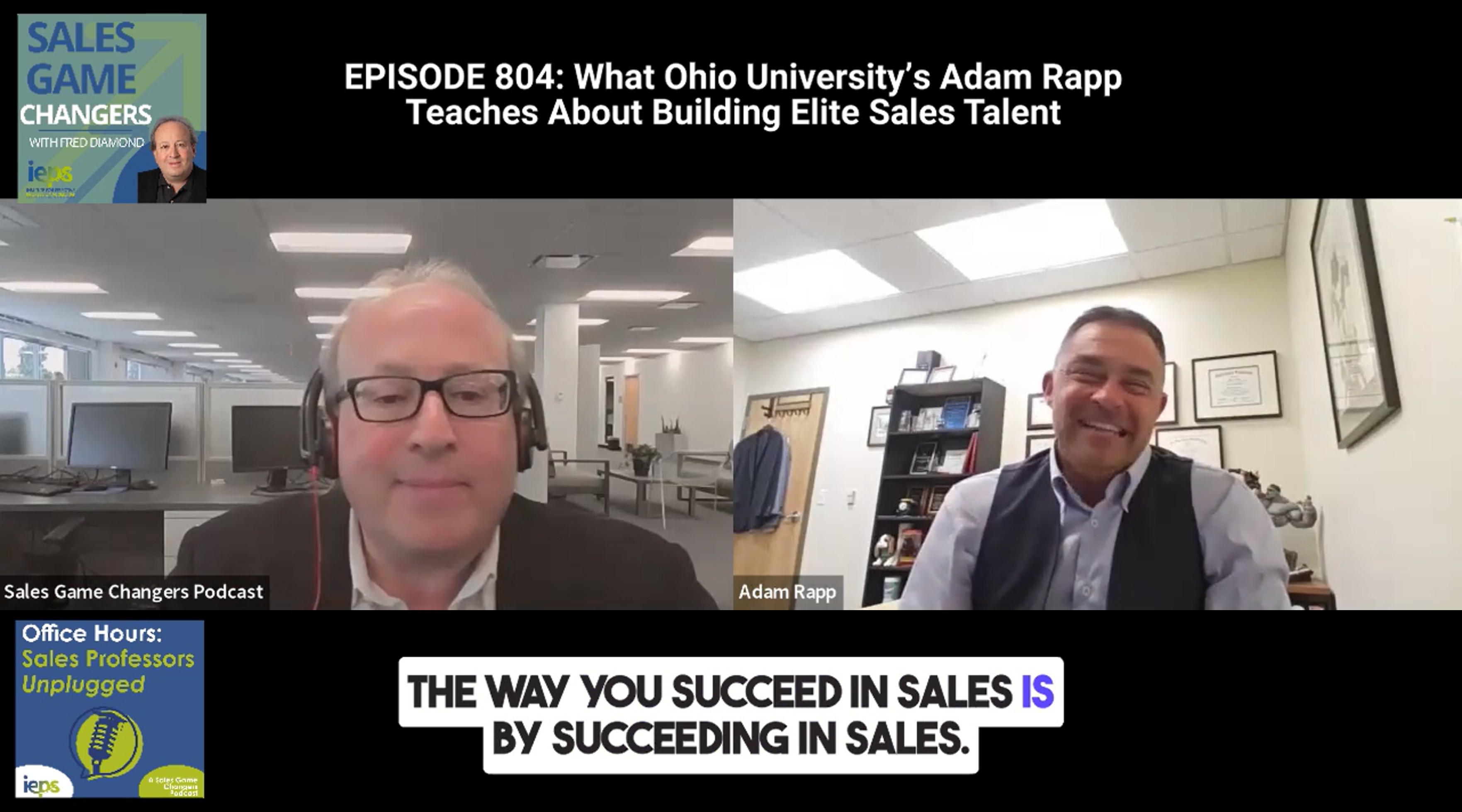
This is a special episode of the “Office Hours – Sales Professors Unplugged Podcast.” The show feature interviews with sales professors at universities with a sales excellence programs. Many of the universities are members of the University Sales Center Alliance.
Watch the interview on YouTube here.
The Sales Game Changers Podcast was recognized by YesWare as the top sales podcast. Read the announcement here.
FeedSpot named the Sales Game Changers Podcast at a top 20 Sales Podcast and top 8 Sales Leadership Podcast!
Subscribe to the Sales Game Changers Podcast now on Apple Podcasts!
Purchase Fred Diamond’s best-sellers Love, Hope, Lyme: What Family Members, Partners, and Friends Who Love a Chronic Lyme Survivor Need to Know and Insights for Sales Game Changers now!
Today’s show is a special “Office Hours – Sales Professors Unplugged” episode featuring Adam Rapp, Academic Director of the Ralph and Luci Schey Sales Centre at Ohio University and Vice President of Research Integration at Tyson Group.
Find Adam on LinkedIn.
ADAM’S TIP: “Sales talent isn’t born. It’s built through deliberate development, coaching, and repetition.”
THE PODCAST BEGINS HERE
Fred Diamond: Adam Rapp, I’m excited to talk to you. You’re a hard hitter. You’re making things happen. We learned that with Lance when we first got introduced to Tyson. I’ve learned a little bit about your journey to Ohio University. Give us a little bit of a background, what got you to Ohio University, and then let’s talk about some of the stuff you’re doing in industry, and then we’ll go through what are you teaching at Ohio University.
Adam Rapp: My journey, I think it’s like a lot of faculty members in the sales world. I graduated college, started a career, was in sales. My journey was that the company I worked for was bought out and the external sales force was moved internal. I had to make some decisions, and so decided to pursue a PhD. I was in marketing and I was in branding at the time, landed at the University of Connecticut. At that time there was a guy there named Michael Ahearne, who is a big heavy hitter in the sales research world, and had a chance to meet with him my first year. He asked me about researching sales and teaching sales, and I didn’t know that was even a thing, because when I came through college in the ‘90s, it just wasn’t.
Then early 2002, he was starting a program, University of Connecticut, I jumped on board with him, and I was fortunate because he made a move to University of Houston. I followed him down there, spent a year and a half at Houston. I took my first job at Kent State, which didn’t have a sales focus. I moved to Clemson where I helped start their first program, to then University of Alabama that has a very strong program, and now 11 years at Ohio University.
My journey has been sales programs pretty much from the first semester of my PhD program the entire way through. It’s been a fantastic space. I’ve been fortunate seeing how to run things at Clemson, how to run things at Alabama, what was going on at Houston. I was lucky. When I got here I was able to cherry pick the best of the best things I’ve seen over the past 20 years and then revise and revamp a program here at Ohio University that was founded in ‘97. The Ralph and Luci Schey Sales Centre has been here for quite some time now. But then I was able to make some minor tweaks and changes that really catapulted us to the next level, I would say.
Fred Diamond: You’ve worked with some of the heavy hitters. You mentioned Clemson, Alabama. I’m just curious, you mentioned you’ve made some tweaks along the way. Tell us a little bit about your program. Do you offer a major, minor, certificate, a class, whatever it might be? I’m just curious on some of the tweaks that you’ve made along the way based on places where you’ve been before.
Adam Rapp: We are a certificate-based program. I know some schools have majors, some have minors. We’re a certificate. We like that space because our attitude here is that everybody has to sell something. We tell students, be the best finance major, the best engineer, be the best major you can be on what you’re passionate about, and then add on the selling skills. We just want to add on those soft skills to give students more opportunities, open more doors for them. By doing that, we’re open to the entire university. 70% of our students are college of business, but we have 30% outside of the college of business from engineering, from the script school communication, nursing, education majors. We have the gamut of students, which puts a lot of nice diversity into the program and different ways of thinking.
The program currently is a little over 600 students. By the end of this year, we’ll hit 700, but then we graduate about 200 to 250 a year. We’re always turning folks over. Then we have about 48 corporate partners right now. We have a really nice balance between students and partners, but we’re a force on campus. We are the largest certificate program and we want to try to provide as many opportunities as we can to the students, which we think can really add value in their lives and help them along their journey.
Fred Diamond: For a finance major or an engineering major, do they come to the program because they’ve heard about it and they see this angle that’s going to make them more marketable when they graduate? Or is it the other way around? Do you do a lot of recruiting? Do you have tables in the quad? Just tell us about that.
Adam Rapp: We do both, and that’s one of the big changes. When I came here, I wanted to be very aggressive recruiting, because my attitude is I wanted 100% brand awareness. Even if people don’t come out to the program, I want everybody to know about the program. When they graduate, it was a choice that they made. It wasn’t something like they didn’t know about us, they chose not to. We got very aggressive. 11 years ago, the rise of digital marketing, we went where the students were. We went on the YouTube platforms. We went on Snapchat videos. We went TikTok. Everywhere where students were, and old guys like me aren’t, we found the right team of people to help us get there and get in front of students on their phones and devices, which really helped us out.
This most recent freshman class, at least in the college of business, we have 100% brand awareness. The attitude is like, “Hey, now you know about us and here’s how we can help you.” We got in front of the students. Then part of it was giving the strong value proposition. Like many programs, we’re a three-legged stool. One is our classes and our coursework, so curriculum, but that’s open to anybody. You don’t have to be just a sales major. Anybody can take our classes.
The other two things which are specific to the members are, one is access to our corporate partners. For example, tonight we’re running a career fair. We will have probably 35 to 40 of the partners show up, and it’s only available to our students. We’ll have 40 companies hiring for sales folks. We’ll put somewhere between 400 and 600 students through the room interested in sales. It’s a really nice match. It’s not like some career fairs where you’re hoping to find a salesperson, or you’re hoping to find the right company. We really get those people in the room and matched up together, which works out pretty well for us.
Fred Diamond: You mentioned like 48 sponsors and 48 companies. We’re doing today’s interview in the early fall of 2025. Obviously, you’ve done a great job attracting corporate sponsors and companies that are looking to hire young selling professionals. Tell us about that. What have you done to attract this great group of companies looking for talent?
Adam Rapp: I would argue it’s the quality of our students. Ohio University, we are Southeast Ohio. We are not the Buckeye. We’re not Scarlet and Gray. We’re the Bobcats. But our students come through and they have a lot of grit, they have a lot of tenacity, a lot of first generation. The partners really enjoy our students because the students are willing to grind. They’re willing to put the time in, and they want to be in this position because they see the opportunity that’s put in front of them.
The other piece is that we vet our students pretty thoroughly before they join the program. You have to interview to get in, we only have about a 25% acceptance rate. We will have 400 to 500 people come out for the program. We’ll take 100 to 150. A lot of that first round screener and vetting, we do that on our own. We do a 30-minute interview with a corporate partner and a student. Once you’re selected into the program, you still have eight weeks of professional development you have to go through. Companies really enjoy that because when they get in the room with students, they already know that they’re a certain level or a certain quality or value.
Beyond that, they know that they have an interest in sales. It’s not something new to them where they have to educate them what sales is, because we’ve already done that on our end. Companies have had a lot of success with our students, moving up the organization fast, moving into leadership roles and really honestly crushing quota at a lot of organizations. When that happens and you find good sales talent and a nice pipeline, companies keep coming back, and we only have to replace probably four or five companies a year. We have a lot of renewed business.
Fred Diamond: What do your students want to learn? Interesting, you mentioned first-generation college students. You used the word grit, grind, etc. When the students get into the program, what are some of the things that they want to learn that they really gravitate towards that you teach?
Adam Rapp: There’s two things. One thing, and this is the third leg of the stool, I would mention, it’s the professional development. Most of them, and this is where I identify strongly, I came from a family where first-generation, I didn’t have anybody to lean on for interviewing skills or resume help or elevator pitches or any of those things. A big part of our program is built on helping students improve themself internally so they can have more opportunities. Students are hungry for that. There’s a lot of career services on campus, there’s a lot of places for them to go, but this is geared towards them. There’s a lot of one-on-one type work to really work them through some of these steps and repetition and muscle memory like an athlete so that they really like that.
The other piece is just the foundations of selling, because when we talk about sales and with all the negative stereotypes that exist out there, and we know what those are, we take the servant-based selling mindset of how are we going to help? How do we identify problems or challenges? If we can’t, then we shake someone’s hand, thank them for their time and move on. That look is refreshing to a lot of them, because they think of some of the negative stereotypes. But when I tell them, “Hey, we’re here to help and to serve our customers, and if we can’t, then we’ll go find some people that we can.” Then they really lighten up to that. Then they’re all in. They want to say, “Okay, I do want to help people. I do want to have impact. Help me learn how to do that.”
Fred Diamond: That’s a great point. I represent the Institute for Effective Professional Selling. We believe that sales as a profession, the people who we work with are on board. I love the way you just used terms like service, servant leadership. The people that you and I know who long term succeed in sales really do understand that. It’s not about getting someone to do something that they don’t want to do. That doesn’t happen anymore in 2025. When we’re today recording the show, the customer is in charge now, the customer has information that they hadn’t had in the past. They have options. The sales professionals need to understand that, etc. What would you tell a business that they might not know? If a company, you approached them or they approached you, what might be something that you would share with them that they might not know about your program?
Adam Rapp: The big thing is, and this is one of my value propositions, whenever I talk to a potential partner, or we’re sitting down with a company or anybody, I give them the number 500, and I say, “500 hours. That’s the amount of sales training, experience and knowledge that our students have when they graduate.” I say the reason that that number matters is because as Forbes magazine showed, as Harvard Business Reviews has shown, that students graduating from a sales program hit quota, I believe it’s 30% faster, stay at a company 40% longer, so longer tenure. The big thing is, A, we vet the students, but B, when students make it through, they know that this is what they want to do. They know they’re passionate about this space.
From that standpoint, I want companies to realize not all career fairs are created equal. Not all programs are created equal. I strongly encourage, and if it’s not Ohio University and The Sales Centre, go find a sales program that fits what you’re looking for and the values and maybe location, whatever it might be. Because I really believe that there’s a lot of opportunity here for companies. That’s one thing that I’ll tell them. I’ll be like, “Look, it’s not just a class, it’s not just a workshop.” It’s, I don’t want to say way of life, but students are spending multiple semesters working through this process.
Honestly, some select out because they realize along the journey that, “Hey, this isn’t for me,” and that’s okay. Actually, I would argue that’s a good thing, because it’s better to find out here your junior year when you’re 21 years old, than your first job, you’re living somewhere and you’re nine months in and you realize, “Wow, this isn’t for me.” That’s one of the things I always try to tell companies, “Hey, realize that these folks coming through are getting a lot of experience.” A lot of the programs, like our program, it has a mandatory selling internship. We’re doing some live selling of real products. There’s things that are happening. I wouldn’t say it’s B2B-esque in the sense that they’re actually selling B2B products, but they are getting that experience interacting with clients and customers, and so they are getting a flavor for that.
Fred Diamond: Unlike accounting or operations or finance, the way you succeed in sales is by succeeding in sales. I like the way, again, I’m going back to some of the things you said before, the sales professionals who are successful long term, a lot of times there’s no script. You have to create things and you have to understand things. Customers have changed, especially over the last five years. A lot of how companies that we’re targeting, prospects, want to interact with sales has changed. You might be successful 1 out of 20 times and you’re successful. There’s a lot that goes into that. I love to hear some of the mindset and the mentality that you’re talking to.
One thing that you’re also doing a lot of work with, Adam Rapp, at Ohio University is you’re doing a lot of work to let’s just say mesh the research that’s happening in higher education and in practice, you used the term melding those worlds together. Talk about some of that and what’s your mission? What are you doing? What are you hoping to uncover and what are you looking to bring out into the marketplace?
Adam Rapp: A couple different things. First of all, when I started, obviously in sales, I didn’t know the research world existed. When I got into academia and I started working on research and Publish or Perish and did a bunch of that, I realized there was, and anybody out there will tell you there’s the disconnect. That’s always bothered me because the amount of times I would see something in the practitioner world or a new book come up, and I’m like, “Well, we wrote about that 20 years ago in the Journal of Marketing,” or there’s things that we’re starting to look into, and from a research standpoint, I would sit with a manager and they’re like, “Hey man, we’ve been doing this for 15 years.”
For me, I said, “Okay, I want to bring these worlds together.” I was fortunate knowing Lance Tyson, who you mentioned, from Tyson Group, we’ve been talking for several years. He asked me about coming on the team and actually, because he said, “What would you do in the perfect world?” I said, “I would try to bring these worlds together. I would try to interpret some of the research articles and the research that’s been out there, and then bring that into Tyson Group, and the things you’re doing, bring that into the research world.” It’s been going wonderfully, because I’m able to do that.
I’m finding that the platforms for disseminating this information, they exist now more than they ever have. If we looked at your LinkedIns, and just like this podcast, on YouTube and Apple TV or whatever it might be, there’s ways to get this information out there that it doesn’t have to be a 22-page journal article. Same thing is, I can talk to a manager today and I can get something up tomorrow that I just learned, or take it into my classroom. That’s been the ultimate goal. That’s what I’ve been doing, and we’re getting a lot of positive feedback and having some really great conversations on both sides of the coin with faculty as well as with sales managers and leaders.
Fred Diamond: Is there anything specific that comes to mind that you’ve seen a disconnect in academia that doesn’t really play in the real world that you’ve been bridging those two together with?
Adam Rapp: Yeah, there’s a few. Sometimes we go down the rabbit hole in higher education and academia, and we will look at one idea and we’ll go so far into researching this one thing, and then we forget everything else that’s happening in the rest of the sales world or sales environment. So many times, we’ll be looking at one construct or one variable, and then we won’t take into consideration the operating environment, the type of sales role, the experience the individual has. It’s like, “Well, this is really great in this isolated environment that’s a vacuum,” but realistically, you put it into a sales setting and it’s like, “Hey, yes, that’s a piece of it, but maybe not even the most important piece of it.” Having some of these conversations, people will say, “Yes.” As an example, emotional intelligence, incredibly important. However, that is one construct or variable in a world of a hundred. I see a lot of those different things. Trying to put some perspective on that, and I spent a lot of time recently with Tyson Group building out some assessments, which anchor academic research, but then also consider the holistic sales picture.
Fred Diamond: You want to teach, obviously, to use your example, emotional intelligence, and here’s where it is. But as you’re talking about this, there’s so many factors. Again, we’re doing today’s interview at the very end of September of 2025. I’m based in Northern Virginia, where the big marketplace is B2G, business to government. There are so many factors that have been thrown into the mix with the public sector marketplace over the last year, DOGE and layoffs of employees and a lot of the challenges related to AI, etc. You can’t just go in there as a sales professional and say, “Okay, I’m going to be emotionally intelligent today,” and that’s going to lead to a deal. If you think about it, it really is a sport, but not a sport in the sense that it’s a game. The people who are successful long-term in sales, they understand strategic selling. They understand what’s going on in the future.
I’m curious on your thoughts. One of the greatest bits of advice that we talk about a lot at the Institute for Effective Professional Selling is the fact that customers don’t even need you if you’re not going to bring them something that they haven’t seen that’s going to affect them a year or two down the road. Give us some of your thoughts onto how sales professionals, the ones you’re teaching, and again, they’re college students, so you can only teach them so much, but what are some of the things that you might be trying to get them to understand about how the customer operates, and where the customer’s going, and how the changing world has made them where the sales professional needs to add more value than they’ve ever done before.
Adam Rapp: There’s multiple conversations here. On the student side, absolutely. Trying to get students to understand that these customers, you’re not walking in there and they haven’t thought about this at all. I always use the example, I’m like, “How many of you do online research or check reviews before you purchase?” Every single hand goes up. I’m like, “It is no different in the sales world.” People are doing research, and maybe it’s not an Amazon review, but they’re absolutely looking at reviews or Googling stuff, with AI now, putting it into ChatGPT, looking at strengths and weaknesses. I’ve told students that I’ve been on sales calls and I’ve had people, I’ve watched them type in things I said into ChatGPT to see what it spits out. I’ve had people with clarifying questions challenge me on things, and I’m like, “We live in a world of real-time information now.”
Now, whether it’s all accurate or not, we can debate that, if you want to, but these things are happening. I’m trying to bring that across to students, but also the sales professionals. When talking to them, for them, I level up the conversation and I say, “Hey, we talk about insight selling. You need to bring something to the table, something new, something insightful, especially something that’s going to impact them in the future. Either immediate ROI or something down the road.” Talking about all these things in the past is okay, but today, people are looking for results, and they’re looking for immediate impact and return. We have to bring that to the table. If we’re going to be the order taker, if we’re going to be the person to just list a bunch of features and then say, “Do you want to buy?” You’re just not going to be along for the sales world if that’s how you’re approaching the job today.
Fred Diamond: That contradicts what you said before, is that the great sales professionals, the successful sales professionals, the one that will survive, are truly servant leaders, and they’re truly putting the customer first and understanding where does the customer need to go, and how can I help them solve some problems? Wow, this was a fast conversation, Adam. We zipped through a lot of things.
Is there anything else that you want to share? Anything else that you wanted to bring onto the show that we haven’t discussed that’s really top of mind right now that would be valuable to our listeners?
Adam Rapp: The biggest thing right now that I’ve been dealing with is several years ago, I wrote a paper over 10 years ago, and it was on the Challenger framework, Challenger model, and giving some opinion and feedback on that. Over the past 10 years, I’ve gotten more phone calls about that, and specifically sales methodology, about what methodology should we use, what process should we use, what’s the best one? I’ve recently just wrote a paper for a journal, the International Journal of Sales Transformation, about the idea of sales methodology and process. Methodology, this is something that a lot of people say, “Hey, I want to go adopt SPIN selling, I want to adopt Challenger, I want to adopt whatever it might be.”
The thing is that these are strategic frameworks. The idea of challenging the customer, the idea of bringing insight to the table, the idea of SPIN, these are approaches to selling. They’re a philosophy, they’re a mindset. I’m not going to say a go-to marketing strategy, but they embrace the way that we feel like we should engage our customer. Sales process are the actual tactical steps that we’re going to engage in. If we think of a general, if you use a wartime metaphor, it’s how are we going to go to battle? What are we going to do step by step? I talk to a lot of sales managers, and more now than ever, the past six months, of like, “Hey, look, a methodology that you embrace is wonderful, but you still have to understand there’s tactical steps that you need to train your reps on.”
If this is the strategy, what are you going to do to support that strategy? Because I’m having a lot of phone calls today of saying, “Hey, we adopted X, but we’re not getting the return.” I’m like, “Well, you didn’t actually teach them how to do it. You taught them what it was.” If I go into a classroom with students and I teach them all theory, theory, theory. Theory’s wonderful, but in the sales world, and you know this, it’s execution, it’s practice, it’s getting it done. I could talk about theory for a minute, but then I better spend 10 minutes on, “Here’s how we implement that. Here’s how we do it.” Right now, the big top of mind is methodology versus process and what that means, and how managers and sales leaders really need to understand that they’re different in how they embrace the two ideas.
Fred Diamond: I want to ask you an unfair question. Do you teach any methodologies at Ohio University? The reason I ask this is, I met with a bunch of your peers recently, and one of them said that a hiring from a recruit from one of the sponsored type companies asked this professor, “What methodology do you teach?” I’m not going to say what he answered, because I don’t want to shave what you’re going to say, but I’ll give the answer. My question to you is, do you teach any methodologies? Yes or no, and why not, or why?
Adam Rapp: Here’s what we do. We do a six-step selling process that’s agnostic. We do general foundations, and the reason we do that is, hey, if you go into consumer-packaged goods versus industrial versus tech, they may embrace different methodologies. It’s the same thing with CRM. We teach the idea of it, the concept of it, how we use it, why it’s important, but I don’t teach Salesforce versus Divalto versus whatever it might be. Same thing with sales. We do a six-step agnostic process. “Hey, we want you to master questioning. We want you to master rapport building.” But then once we get through that in our advanced selling course, we’ll add on pieces and say, “Hey, one way to look at questioning is through SPIN,” and we’ll talk about that briefly.
“One way that we talk about opening a conversation is with Insight Selling.” We’ll introduce that. We don’t embrace one specifically. We try to take more of a foundation of a pyramid, so that’s the big foundation, and then we’ll slowly start to add onto it, but we don’t deep dive onto any single one.
Fred Diamond: Yeah, that would be a waste of time, especially as your young adults get hired and, “We use insight versus SPIN”, whatever it might be. I’m glad you’re pursuing that, and maybe we can have a follow-on conversation on that particular topic. That’s really critical right now as the sales process is being uncovered, who you’re selling for and who you’re selling to. Especially as customers go through these dramatic changes that we’re going through, you got to be on top of that and you got to be a professional.
We changed our name at the Institute for Effective Professional Selling. We used to be known as the Institute for Excellence in Sales. After having surveyed 300 sales leaders who had said to us time and time again, “We just need our people to be more effective,” we had a shift to what do you got to be doing to be effective in 2025 and 2026 and 2027?
Adam, we flew through this. Thank you so much. Adam Rapp with Ohio University and the Tyson Group. You’ve given us a lot of ideas, a lot of great things to think about. Give us one action step, something that people should do right now to take their sales career to the next level.
Adam Rapp: There’s a couple different levels. Number one, for a younger sales rep, less experienced sales rep, I think the best thing you can do right now is get repetition. What I mean by that is, I know it’s tough making some of the calls if you’re SDR, BDR, if you’re dialing, if you’re doing virtual calls, get the reps under your belt because the only way to improve is the repetition. Then honestly, identify those weaknesses. If you hate objections or you hate closing or you hate whatever it is, it’s probably because you’re weaker at it. Go find a mentor, find a coach, and raise that skillset. That’s a big thing.
For my leaders, most sales leaders that I’m interacting with now, they were very good at selling and all of a sudden they found themselves in sales and they’re like, “Well, here I am. How do I do this?” I think the best thing you can do in that role is have some conversations with some different experts in the field, whether it be faculty, whether it be people in your organization, join some external groups. For example, AMA is an example of more of a traditional marketing group, but there’s groups out there where there’s like-minded individuals that you can build a mentorship network with. You got to do that because I think reading the books is wonderful, but I think getting face-to-face with somebody and having a conversation with like-minded individuals can really boost your career.
Fred Diamond: That’s great advice. If you’re a professional, what does a professional do? If you’re a golf professional, you’re on the tee box for two hours a day, you’re on the putting green for three hours, you’re studying the mental side, etc. Same thing with great sales professionals, I like the way you said that, if you don’t like it, you’re probably just not as good as you’d like to be, and you have to be. The reality too, Adam, is the sales professionals who are successful, they’ve probably made thousands of calls. They’ve gone through that to get to the next stage, and you have to. They’re not going to promote you on day one to being the VP of sales for the eastern region because you’re a nice guy. They’ve promoted you because you’ve proven that you are passionate about it, you’re passionate about the customer, and you’re passionate about helping your company achieve its goals.
Once again, thanks, Adam Rapp, from Ohio University and Tyson Group. My name is Fred Diamond. This is the Sales Game Changers Podcast Office Hours – Sales Professors Unplugged.
Transcribed by Mariana Badillo