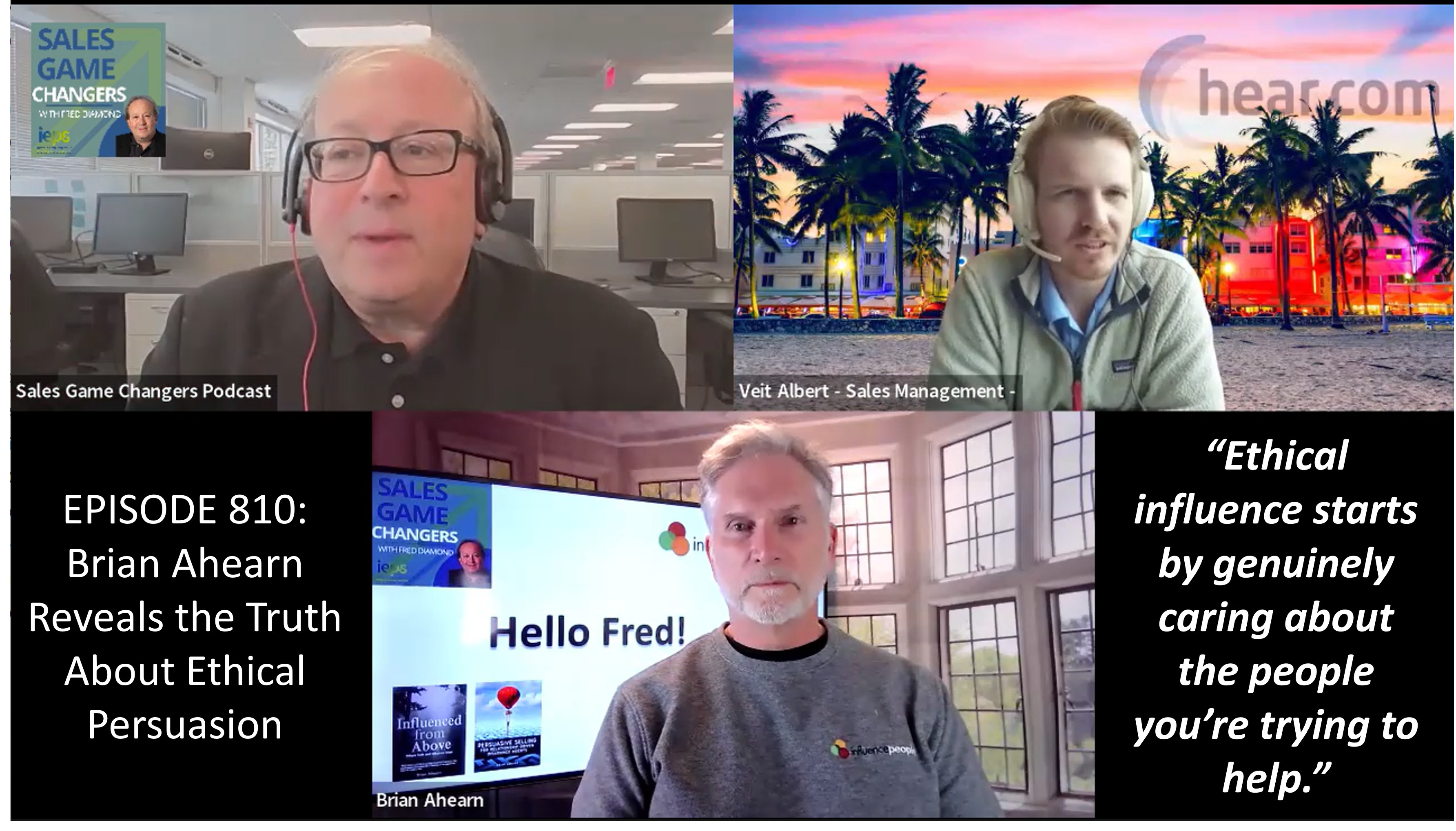
Watch the video of this podcast on YouTube here.
The Sales Game Changers Podcast was recognized by YesWare as the top sales podcast. Read the announcement
here.
FeedSpot named the Sales Game Changers Podcast at a top
20 Sales Podcast and top 8
Sales Leadership Podcast!
Subscribe to the Sales Game Changers Podcast now on Apple Podcasts!
Purchase Fred Diamond’s best-sellers
Love, Hope, Lyme: What Family Members, Partners, and Friends Who Love a Chronic Lyme Survivor Need to Know and
Insights for Sales Game Changers now!
On today’s show, Fred discussed influence in the sales process with Cialdini-trained expert Brian Ahearn, author of “
Influenced from Above: Where Faith and Influence Meet.” He was joined by Veit Albert, VP of Sales at hearing aid company
hear.com.
Find Veit on
LinkedIn. Find Brian on
LinkedIn.
VEIT’S TIP: “Influence is responsibility. You can use it to push people or to lift them up.”
BRIAN’S TIP: “Customers won’t buy from you just because they like you, but they’ll probably never buy from you if they don’t.”
THE PODCAST BEGINS HERE
Fred Diamond: Brian Ahearn, you’ve been on the Sales Game Changers Podcast once before. It was in the heat of the pandemic, I believe. We have you back here with one of your clients, Veit Albert, from hear.com, and I’m excited. To get people caught up, we’ll get to that in a second, but I want to read something from your LinkedIn profile to give people the perspective on what we’re going to be talking about today. “Does your success depend on getting others to say yes to your ideas, products, or services? Hint, it does. Whether you’re looking to enhance your sales, elevate your effectiveness as a coach or a leader, or excel in any role, your ability to ethically influence people is critical.” Veit, has Brian done that for you, before we start talking about his new book and his services?
Veit Albert: Yeah, absolutely. I’m not a bestselling author and podcast superstar like Brian. I’m in the sales trenches every day leading 150 people at hear.com, with targets, KPIs, sales pressure. My daily reality is influencing, persuading, leading people. Therefore, I’m super excited when we work with Brian. Pre-COVID, actually, for the first time, we have been strong Cialdini believers and followers for probably 12 years. That was when I got the first Cialdini book. Then we were looking in the US for Cialdini-certified coaches, and then found one of the few, who is Brian, and kicked off a very successful collaboration. That has been definitely life-changing.
Fred Diamond: Brian, I was going to ask about your book to begin with, but since Veit started talking about Cialdini and the influence, we’ll get to that. Just wanted to let people know that you have a new book that just came out. We’re doing today’s interview in October of 2025. It’s called Influenced from Above: Where Faith and Influence Meet. We’re going to get to that in a minute or two. Veit referred to Cialdini and his work, and that’s what we talked about in the original podcast that we did with you.
A little bit of a funny twist, which I told you about. I have a daughter who is in sales at Hershey’s corporation. She calls on Walmarts and Publix to ensure that they’re buying as much Reese’s Peanut Butter Cups as they should be to sell to their customers. She sent me a picture and said, “Dad, I just got this book,” and of course it was Influence by Cialdini. I said, “Well, coincidentally, I’m friends with one of the top Cialdini influencers in the United States.” I’m excited that she found that book on her own. I’ve recommended tons of things to her, and she had just decided to find some things to read.
Brian Ahearn, get us introduced to you. You’ve been on the show before. I encourage people to listen to that. But give us a quick one-minute update on how you got involved with Cialdini and his work on influence and persuasion.
Brian Ahearn: My introduction to Cialdini came back in 2003 when a coworker gave a video of Cialdini presenting at Stanford. I watched the video, I loved everything that he said. I was especially drawn to the fact that he talked about doing things in non-manipulative ways. Well, some short time later, I got a flyer from Stanford and that flyer’s advertising Cialdini in his video as influence, persuasion, and even manipulation. I just thought that was so wrong. I emailed Stanford to basically say, “I don’t know anybody who wants to be manipulated, and I do not know anybody who’s looking to become a manipulator. That word cannot be helping your sales, but it’s probably really hurting.”
I never heard from Stanford, but sometime later, my phone rang at work. It was a representative from Influence At Work, Robert Cialdini’s company, and she said she was calling to thank me on behalf of Dr. Cialdini because I had sent an email to Stanford, and because of that email they changed all the marketing of his materials. We had a wonderful conversation, before we hung up, as any good salesperson would do, she said, “Hey, if your company’s ever looking for a guest speaker, Bob travels the world and talks about this.” I said, “You know what? I sit next to the woman who plans our events and books our speakers. Let me transfer you.”
As fate would have it, Bob was in Columbus, Ohio in the summer of 2004. I went through his workshop, three years later went through the certification process, so I’ve been a Cialdini-certified trainer for 17 years, and the last 7 years I have been on my own. I left my corporate role in 2018 and get to meet people like Veit and work with people all around the globe. It’s been awesome.
Fred Diamond: I mentioned to you as well, I worked at Apple Computer for a long time. I read that book when I was at Apple Computer in 1990, and I remember very, very clearly, we had a book group, and we would find books and we would read and discuss. When we connected with you, and of course I mentioned my daughter, and I’m very excited about what we’re going to be talking about today.
You have worked with Veit over the years to help him, and Veit, I want to get deep into how you’re leading and managing your sales organization as well. But give us a little bit of an update. Tell us about your journey. I believe you’re from Germany originally and you’re in Miami now. Give us a little bit of an update on how you got to hear.com.
Veit Albert: I joined the company actually almost 13 years ago, back in Berlin, Germany. I have a business background and was doing a little bit of research on building my own company, but felt that that field I was looking into was not really the right direction. I thought instead of going back to my parents to ask them to finance my lifestyle and get a lot of questions about life choices, that I would rather find a job, earn some money to go back into my own endeavors. Then I came across this job offer for tele sales in MedTech, which was Audibene, our German company and brand we are operating in Europe.
I started on the phones talking to customers with hearing loss and fell in love with the company’s mission and with the customers, because being in sales, you can sell a lot of products and service, and you can be very successful with that and make good money. But when you zoom out and ask yourself, how much do you really impact the lives of your customers? You will come to the conclusion that many products or services don’t really move the needle for your customers.
With hearing aids, it is very, very different. It’s a life-changing situation, and not just situation, but a life-changing decision. This motivated me a lot to grow as a company. I got promoted to sales team lead, was responsible for sales in Germany, and then 10 years ago we entered the US market as hear.com. I moved with two other colleagues over here. We started from scratch again, no office, not a single employee. Now we have over 350 employees here in the US. Have built a fastest-growing hearing aid company in the online space in the US, which is very, very exciting.
Maybe referring also back to a little bit Cialdini, for us, it’s not just about getting the sale. We oftentimes say we are not really selling hearing aids. We are helping customers to buy, because we know that it’s not really about the sale. It’s about changing the situation the customer is in. Unfortunately, hearing aids are not a product of desire. Nobody here wakes up and says, “How exciting. Today I get those new cool hearing aids.” Unfortunately, this journey is very painful. You miss out on a lot of just wonderful moments. You miss out on great communication with your family and loved ones. You maybe underperform in your job due to your hearing loss.
Whenever we talk to customers, we feel also some of this responsibility. If we can’t get them to move forward with hearing aids in general, we are partially also responsible for the suffering of the customer. For that, it’s important for us to get the yes, not in a manipulative way, but we know the customer will be better off and the feedback will be, “Had I known all those things earlier, I would’ve done it way earlier.”
Fred Diamond: Actually, an interesting question there. Two quick questions, and then Brian, get us into how you tied the loop and how you came on board with hear.com. You mentioned about 150 salespeople. Is it all sales to individuals? Do you sell to retail, to doctors?
Veit Albert: Great question. In the US, you have 40 million people with hearing loss. This is an enormous number. At the same time, only 20%, 25% of them wear hearing aids. If we had the same issue with vision, this would be probably a national catastrophe. What we as hear.com want to do is we want to kill the stigma of hearing aids, because stigma is a major driver and roadblock for people to take action, people saying hearing aids are for old people. Even the 90-year-olds tells us, “No, no, it’s for the old people,” for the 95 or 100-year-old people.
The second is people saying hearing aids are these ugly, bulky bananas that we know from our parents’ and grandparents’ generation. Reality is, each of us here in this world could wear hearing aids, we wouldn’t even see it.
Third, 20, 30 years ago, hearing aids were analog and was not a great quality. Today, all hearing aids are digital. They are the most used device you will ever own in your life because you wear them first thing in the morning till you go to bed. That’s what we want to change, the perception of hearing aids in public.
What we do is we do online marketing. Brian is a huge Buckeyes fan, so there’s a college football game coming up on the weekend, to prepare for this, he will go on his favorite sports websites. We will show him ads about hearing aids, and he will click on it because there’s a novelty aspect in what he sees. Then he will read more on our landing page about hearing aids, fill out a form, and then we will talk to him. Yes, we are only doing B2C. We work with a nationwide network of local businesses where we fill up free capacity in the schedules. We also have a very unique tele audiology solution to take distance to the provider, mobility or flexibility in opening hours out of the equation, to lower all barriers to get customers to take the next step towards better hearing and a better quality of life.
Fred Diamond: Brian, get us connected here. How did you come to work with hear.com and Veit and his team? Tell us about the journey that you’ve worked with his organization on to get them more effective at providing this critical tool. You’re absolutely right, it definitely changes lives. Give us some insights on that.
Brian Ahearn: Paul, the co-founder of the company, tasked his admin to go out to LinkedIn and find somebody who was certified in teaching Cialdini’s methodology. That’s how we got connected, had a conversation, and he knew, from having read the book and some personal experiences, that figuring out how to bring this into the workplace could make a huge difference for the company. But he also recognized that he wasn’t the guy to be able to do that. That’s the challenge that so many people have. They hear about Cialdini’s work or they read about it, they’re fascinated, but the nuts and bolts is how do you put it into practice? That’s where I come in. I’m not a social psychologist, but I love studying that stuff, and I spent three decades in business.
When I got connected with them, we started doing workshops for people in their marketing team and their sales leaders and other leaders throughout the company, trying to start with that top down. We did many of those, some in-person, some were online, did some talks for the majority of the employees who could log onto Zoom, so everybody would start understanding the language of influence and persuasion. Over the years Veit, has brought me back to work with smaller cohorts of individuals to get them a little bit deeper. The relationship has just been awesome.
What I really like about hear.com is the people are really smart and they’re forward-thinking. As I worked with them, I remember the first time being in Miami, and before I left, I spent a few hours with his team that was doing the digital marketing, and they can do their A/B testing. We would talk about things and they would put it into practice so they could see for themselves which of these ads was being more effective in terms of getting people to click and come in and hopefully get that conversation started. That’s how the rubber meets the road for them, is we’ve given them the knowledge, and as much as they want me to sit alongside like a marketing person to talk about these concepts, to then actually try them out in real world practice.
Fred Diamond: Veit mentioned in his last answer that you’re a Buckeyes fan, and that would be the Ohio Buckeyes, the football team. You’re based in Columbus, Ohio. You’ve obviously formed a relationship, a friendship that goes beyond typical client relationship. I’m curious, how has that helped you? Veit, how has that helped you as a sales leader as well?
Brian Ahearn: I really believe in what I teach, and I think that the foundation of that is building strong relationships with the people that you work with, whether they’re your coworkers, vendors, clients. I put into practice what I preach. As I got to know Veit, when I was down in Miami, we had dinner and I made it a point to stay in touch. We even got to a point where I remember he said, “Hey, I don’t know that there’s going to be much opportunity for you given the way the economy is going.” I told him, I said, “That’s okay. I like you and I want to make sure we maintain contact.”
Where it really went to the next level was when our daughter got married three years ago. I sent him an email and basically said, it was best day of my life so far, and had some pictures, and he came back and congratulated me. Then he told me that he had just gotten engaged. He said, “Would you and Jane come to Germany for the wedding?” We’re like, “Heck yes, we’ll do that.” Something that I will say about Veit is what a conscientious person he is, because here we are at this wedding, at this amazing 700-year-old farm, hundreds of guests, so much stuff going on, and he makes his way over to me before the reception starts. He said, “I remembered you said you like scotch. I got Balvenie 14. I hope you enjoy it.” That says a lot about somebody who remembers the small things and then acts upon them. Our relationship has just continued to grow from there.
He has gotten into American football, and I told him about Ohio State. We text very regularly about the Buckeyes and things, but we have forged a friendship that even if I never do business again with hear.com, it won’t matter to me, because I have Veit as a friend. But I do believe this too, that if they have a need, he knows I care about him and that company, and they will probably turn to me to see if I’m the right person to fill the need. If I’m not, they’ll probably move on. But that’s the value, I think, of building authentic relationships.
Fred Diamond: Veit, I want to follow up with you. There’s a lot of sales professionals listening to this, and they’re striving to develop relationships with customers. Whomever it might be, with directors of IT, VPs of sales, whoever it is they’re trying to pursue. I presume you didn’t invite 50 people who are providing products or services to your wedding in Germany, and you didn’t whip out like 50 bottles of the scotch, and that is a very exclusive scotch. Give some of your insights and thoughts into what developing relationship is. For the sales professionals listening, and again, you’re also a sales leader, so you’re trying to develop relationships with people on the customer side. Talk about, is it possible to develop the type of relationships with many? Is it necessary to develop those types of relationships? Just give some more insights for the sales professionals listening who keep hearing you need to develop relationships.
Veit Albert: The one big Cialdini principle is liking. What I very obviously learned or consciously learned from Brian during our workshops together, was that liking always starts with you. You can’t wake up and expect that the other person likes you first. For us, in sales leadership, we work every day with people, and with some we connect very, very easily, and we have great relationships, we are mentoring them, we are leading them, we coach them to become the very, very best version of themselves. That’s very smooth and very easy, and we love working with those colleagues.
On the other hand, we have colleagues where we don’t click, at least not in the beginning, and then we say, “It doesn’t work really. This person is so difficult and we don’t have a good relationship.” Then I practice what Brian taught us and said, “Okay, I need to start liking the colleague first. I need to invest into this relationship.” What does it mean practically? Maybe giving the colleague a compliment, “I appreciate how hard you’re working.”
You get, all of a sudden, this facial expression, the colleague is surprised to hear this, and you do this over and over, “Thanks for implementing what we talked about.” It builds trust and this trust develops into liking, because all of a sudden the feedback that you are sharing is not perceived as criticism. It is perceived as more from a mental point of view that you are serious about their developing, and you are not saying those things to nitpick anything.
Maybe more from a strategic point of view and maybe also because Brian wrote the book, he talks about the sand castle that gets washed away. We in sales, it’s now almost last of the months. Every new month, the achievement is gone and we start from zero. This can be really, really difficult if you are all just primed towards numbers. If it’s just, “Okay, we have those KPIs. We have those targets. We have the quota to hit,” this works well for 6 months, 12 months, 18 months, maybe 24 months. But I think then you reach, sooner or later, a critical point where it feels you have done it all. What is next? It’s just numbers, numbers, numbers. There’s no real relationship. If you missed out building a relationship, if there’s not something bigger you achieve, retaining colleagues is really hard. Building a great retention is I think a secret for great sales organizations.
Fred Diamond: I agree. Brian, give us a little bit of the science behind that. Give us a little bit of the science from the Cialdini perspective on why that’s so important. That’s a great answer, Veit. We hear a lot about how relationships are less important because of the math and the analytics and things related to that, but we still hear about customer relationships 10, 15, 20 years ongoing because of the effort that you put in to get to understand what the customer’s trying to achieve.
Brian Ahearn: I think you know this, Fred, that customers won’t buy from you just because they like you, but they’ll probably never buy from you if they don’t, unless you have something that is so unique, they cannot get it elsewhere. It speaks to the importance of the principle of liking. Cialdini and other social psychologists have done lots of research that very clearly show if somebody likes you more, they’re more apt to say yes to you. The reason that starting with liking, in other words, of like me liking you, Fred, is so important. Because when you really get that sense that, “Hey, Brian really likes me,” then that starts to change how you view me. Because you probably believe deep down that friends do right by friends. Therefore, if you sense that Brian really does like and care for me, you’re much more open to whatever I might ask or whatever I might propose to you.
But the good news is too, then the more I’ve gotten to know you and like you, the more I do want what’s best for you. I really want what’s best for Veit and hear.com. You want to make sure that you are authentically tapping into that to make that become a reality. Then you’ve got what I’ll call a virtuous cycle where I really do want what’s best for you, that’s what I’m putting on the table, and that’s how you receive it. Even if you have to say no, it’s not the same kind of no that you might say to other salespeople. We’ve moved from, I’ll say, transactional to relational. Then the other thing that’s so important too is the more I get to know and like you, this then begins to inform all of the other principles that I might bring to bear, to state my case, to propose for you what I do believe is in your best interest.
Fred Diamond: It begs the question, how you answered that, is for the sales professionals listening, how can they become more likable? There’s a lot of pressure with sales. Veit mentioned, it’s the end of the month. We’re doing today’s show in October, we’re coming up towards the end of the year. It’s been a tricky year, 2025, in a lot of different ways. A lot of the people who listen to our show sell into the public sector markets. At this moment, we’re in the middle of a federal shutdown, and there was the Doge implementation of “efficiency”, if you will. Is that a fair question for me to ask you, how can sales professionals become more likable?
Brian Ahearn: It’s more about them getting to know and like the people that they’re with. Again, I’m not going to try to get you to like me, Fred. I want to find out about you, but then I will thoughtfully connect on the things that we have in common, so your daughter entering sales and for us to be able to talk about sales, and she bought Cialdini’s book, and I’d be happy to send her a copy of my book, that would hopefully enhance what her learning is. But there I’m engaging in what we have in common. I’m engaging reciprocity by making the offer of the book, and it’s all genuine, because I appreciate the fact that you had me on the show way back during COVID and that you brought me back on this time. I’m looking to connect on what we have in common. As Veit said, I’m going to look for things I can genuinely compliment, because the more I do that, the more it causes me to say, “I like Fred.” That’s what you begin to sense and respond to. I don’t have to come across as, “Look how interesting I am. Look how cool I am. Look at all the things I’ve done.” That’s not the way that it happens. It’s about the other person.
Fred Diamond: Brian, we’d mentioned in the beginning the new book. Talk for a second or two about the new book, why it’s out. Veit, I’m curious on your thoughts as we wind down this conversation. I’m also curious on how you also need to influence your sales team. We talk about influencing customers, but you got to get 150 sales professionals to do what you need them to do so that you achieve your goals and you can report back to your boss and to your CEO that, “Here’s where we’re going to come in.” I’m curious on how you’re using some of these techniques. Brian, the book is called Influenced from Above: Where Faith and Influence Meet. The book is out now. It’s up on Amazon, wherever you get your books. Give us a minute or so about the book, why you wrote it, what it is all about.
Brian Ahearn: I had done a presentation here in Columbus, had lunch with my daughter the next day. I wanted to find out what she thought, and she asked the question that was the inspiration for the book. She said, “Dad, what I want to know is, where’s God in all this? All the psychology that you teach, where does He fit in?” We had a wonderful conversation about that and it spurred some thoughts about this could be a really interesting idea for a book.
I began the book at the beginning of the year. It is a parable format where you learn about Cialdini’s principles, but also spiritual truths that underlie them. Example, reciprocity. If I give, people feel obligated to give back. Well, Jesus said, “It’s better to give than receive,” and he encourages us that we should take that first step. The book really looks at that through a story format and the journey of an individual as he is looking for ways to blend what helped him so much in the business world, but also recognizing that might not suffice in the congregation, and what motivates the congregation might not work in the secular world. He has to marry these two ideas, and that is what the story’s about.
Fred Diamond: Congratulations on publishing the book. Veit, how are you using the techniques to influence your team, the sales professionals in your organization to achieve what you need them to achieve, which of course is to reach and exceed their quotas in most cases, or whatever else you need for them to do?
Veit Albert: I think the first and most important thing is to see the bigger why, why we are doing those things. In every sales professional’s life, there are better months and there are some tougher months. If you are not really convinced by the bigger why, in those tougher moments, it’s so easy to throw in the towel to see, “Let me look for another job. The grass is greener somewhere else.” Every year we have a companywide summit here in Miami and we share customer stories. I can promise you, 80% of the room tears up hearing those customer stories, how we impacted the customers’ lives. The other 20% are hiding very well that they are tearing up. It’s super emotional. This is, first of all, important, and doing well to other people gives so much purpose also in a very number-driven, high-pressured environment like sales.
We just do try to use the principles of persuasion on the customer side to achieve this goal, but also on our employee side, who helps them achieve their individual goals. I’m a huge Ted Lasso fan, not just because there’s this football guy who teaches soccer, but also, you learn so much about sales just watching Ted Lasso. He says at the end, “It’s not about the wins and losses, but that those young fellows can become the best versions of themselves.”
Fred Diamond: It’s interesting, we just did a show with a woman named Lisa Earle McLeod, who wrote a book called Selling with Noble Purpose. We did a show with Lisa and a guy named Frank Passanante, who is the head of global sales for Hilton. They talked about how Hilton goes about the sales process with noble purpose, because hospitality and people staying in locations and having events. We talked about your wedding before. They’re such huge moments in people’s lives and I could definitely understand how selling hearing aids is definitely a selling with noble purpose endeavor as well.
I want to thank you for being on the show, Veit. I want to thank you, Brian, as well. Why don’t we wrap up here? We like to end every Sales Game Changers show with an action step. You both have given us so many great ideas and have clarified a lot of what Dr. Cialdini’s ideas are all about. Like we mentioned, we’re big fans. Give us something specific that people should do, sales professionals should do right now to take their sales career to the next level. Obviously, we’re going to put the notes on how to buy the book, but Veit, something brief, something crisp, an action step they should do. Then, Brian, wrap it up for us.
Veit Albert: I would say influence is responsibility. Whether you are leading a company, a sales team, or just a customer conversation, you can use influence two ways, to push people or to lift them up. I hope more people choose the second.
Fred Diamond: Very good, Brian, bring us home.
Brian Ahearn: I would encourage all the salespeople listening that change the mindset to this, I want to like the people that I interact with. Strategically how I’ll make that happen is I’m going to look for what we have in common, and I’m going to talk about that. I’m going to look for the good in that person so that I can genuinely compliment them. Not only will they feel good, but you will begin to convince yourself that, hey, that’s a pretty good person. I like being around them. Everybody wins.
Transcribed by
Mariana Badillo