
Watch the video of this podcast on YouTube here.
The Sales Game Changers Podcast was recognized by YesWare as the top sales podcast. Read the announcement here.
FeedSpot named the Sales Game Changers Podcast at a top 20 Sales Podcast and top 8 Sales Leadership Podcast!
Subscribe to the Sales Game Changers Podcast now on Apple Podcasts!
Purchase Fred Diamond’s best-sellers Love, Hope, Lyme: What Family Members, Partners, and Friends Who Love a Chronic Lyme Survivor Need to Know and Insights for Sales Game Changers now!
Find Mark on LinkedIn.
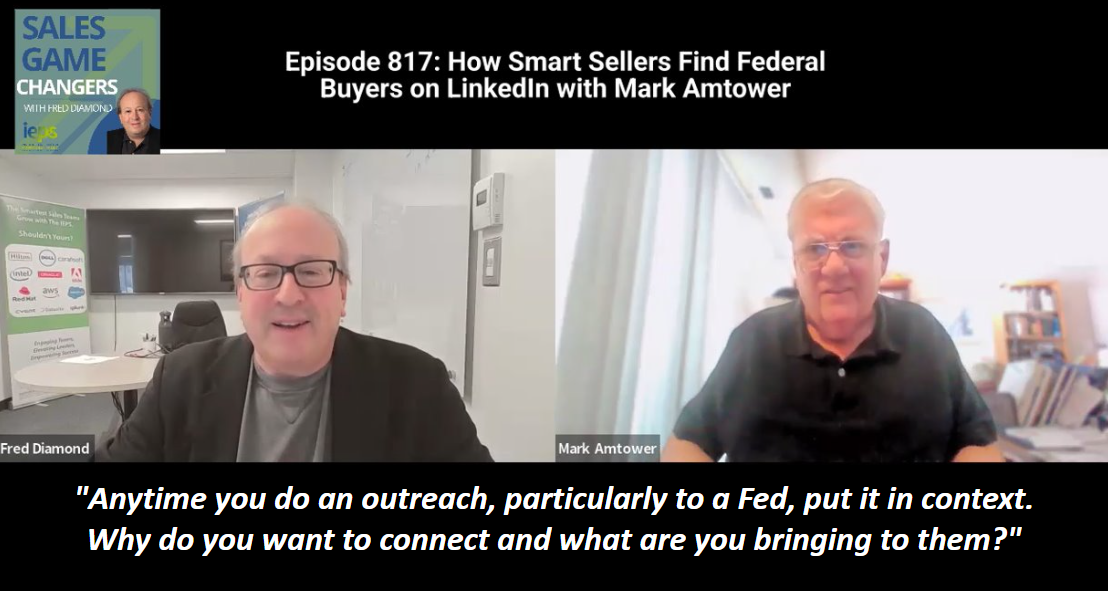
MARK’S TIP: “Anytime you do an outreach, particularly to a Fed, put it in context. Why do you want to connect and what are you bringing to them? Not what they can do for you, but what you can do for them.”
THE PODCAST BEGINS HERE
Fred Diamond: Today, we’re going to get really into some topics that are very interesting. We’ve got Mark Amtower here. If you recognize Mark, he’s been on the show before. Mark, I interviewed you before the pandemic, and it was a very well-received episode. You and I have known each other for a long time. As a matter of fact, when I was at Apple Computer, I believe I brought you in to educate some of the leadership about the federal government and how it works.
Mark Amtower: We worked together when you were at Apple, and I believe when you were at Compaq, a name from the past.
Fred Diamond: Yes. I’m also very fortunate, you were very kind to let me write the foreword to one of your books, the digital version of one of your books. I remember being at the library doing that writing probably 30 years ago. It’s great to have you here.
We’re going to be talking about LinkedIn, and you just published your Annual Census of Feds on LinkedIn. If anyone here that’s listening sells to the federal government, I looked through the census, the guy that you presented. It’s amazing. It’s amazing for a couple reasons. One is I discovered things that I had no idea were on LinkedIn, and you went right to the core, right to the meat to help people selling to the federal government.
It’s interesting, Mark, we’re doing today’s interview in January of 2026. For those of us who sell into any enterprise, let alone public sector, 2025 was a challenging year. It was very, very challenging for those who sell to the federal government because of things like the effect of DOGE and the shutdown, layoffs across multiple agencies. The work that you’ve done to identify what’s on LinkedIn will be of huge value.
First off, just give us a brief introduction to who you are, for people who don’t know you. Tell us about the guide and where people can get it. Then I’ll ask you to come up with maybe 10 or 11 things that they will get from the work that you’ve done.
Mark Amtower: I started my company 41 years ago. I focused exclusively on marketing to the federal government. 41 years ago, marketing to the government was a very different beast. I’ve had to morph a number of times. Largely, the last 20 years or so, with the advent of social networking, LinkedIn was actually up before Facebook. I’ve been on LinkedIn going on 22 years now in about a week. But that being said, my business still focuses on marketing defense, but I focus on leveraging LinkedIn to build thought leadership positions in the market, generating content that’s germane to your area of subject matter expertise and getting it out there in a findable way. But in order to do that, you need to build an audience.
Back in 20 11, 20 12, I kept hearing from executives that feds aren’t on LinkedIn. Even if they are, they don’t use it. I decided to prove the naysayers wrong. I did my first census in 2012, and I identified about three quarters of a million Feds on LinkedIn, just going to your usual agencies, the major cabinet departments, independent agencies. From that beginning, and you’ll see how I do it as we go through this interview, I identified two new sites today. We’re up to 790 company pages for federal departments, agencies, offices, and special operating divisions on LinkedIn. A company page can provide you some pretty neat stuff. But my census for this year identified 2.765 million Feds on LinkedIn, and that was with 788 company pages. I’m up to 790, but we added a grand total of about five people with those two other sites.
Fred Diamond: Just to clarify for people, we’re using the term company page, and that is LinkedIn’s definition of an organizational page. Could be IBM. Now, of course, there’s over 790 company pages of federal government agencies, sub-organization, whatever they might be. I don’t want people to get confused when we use the word company. That is LinkedIn’s term, but from our definition, it pretty much would be the agency page.
Mark Amtower: Correct. There’s just a lot of information there. Usually, people think of these as simply a way to identify the personnel at those agencies, and that’s a great reason to use it. But because LinkedIn in December of ‘25 took away, they have that all filters thing that used to offer you a lot of ways to slice and dice people. They’ve pretty much obliterated that, and they want you to use an AI search instead. The problem there is they didn’t tell anybody that they were doing this, and you had to figure it out on your own. The functionality is not nearly as good as it was when the all filters had all of the functions in it. Once again, I’m a little pissed at LinkedIn. That happens a lot. It’s still the best business tool out there for research and for advertising who the heck you are and what you do and who you do it for.
Fred Diamond: One of the things when I went through the guide, the Annual Census of Feds on LinkedIn, is a lot of times when you think about government, it’s like a quandary, because you think it’s private, there’s things that shouldn’t be disclosed. But then you also realize, a lot of things should be made available because it’s public, the information should be out there. One of the things we talk a lot about for those entities that sell to the government is things like, of course, it’s a little tricky now because budgets haven’t been approved, etc., but all of the information is available. There’s no excuse for selling professionals who aren’t finding information, and it’s because they’re really not doing the research.
Now, what you’ve uncovered here is going to save them a lot of time. I was blown away by how much information there is available by many of these federal government organizations. Let’s start talking with the About section. I asked you to come up with 10 to 11 crisp things and you found 5 things on the About section that you want to bring to our attention.
Mark Amtower: First of all, the About section, when you go to a company page, there’s the Home, the About, the Posts, the People, Employees, and Insights. Insights is available if you have a premium account. On the About side, you’ve got the overview of the organization itself. Usually, almost always, there’s a direct link to a website. You just don’t go to US Navy and expect to find everything. You go to NavalX, which is a significant research organization, albeit small, in Navy, and they have their own company page on LinkedIn and a webpage.
On the About section, you also get an accurate employee count, and that’s the employee count of their people who are members of LinkedIn. On the showcase pages, and there’s a lot of showcase pages, they don’t carry the employee count. You’ve got to find them other ways. Oftentimes there’ll be a physical location. Sometimes, not often in DOD, but always in civilian, you’ll have a physical address that goes with this, and occasionally you’ll actually have a phone number if you still pick up the phone and call people.
Fred Diamond: For people who don’t understand, if you don’t mind, can you explain a little bit about federal government organization? For example, there’s Department of Defense, now called Department of War. There’s civilian agencies and intel agencies, and then there’s departments. For Navy, for example, there’s not just one company page on LinkedIn called Department of Navy. Give us a little bit of an understanding, is there 10, 15, 100? You mentioned that you found, as of January 29th, 790 individual pages for entities within the federal government?
Mark Amtower: The Department of Navy, oddly enough, has the most company pages for any federal entity on LinkedIn. At present, I’ve found 122. It gets really, really granular. There’s pages, not with many people, but there’s pages for several of the SEAL teams on LinkedIn. But more importantly, for most contractors, you’re not going to be selling bullets and guns to SEALs. You’re going to be selling technology to various naval units, and other supplies. Again, there’s 122 of them. It’s broken down and largely functional areas, because that’s how the services break things down. If you know what to look for, you can just find a lot of information on who they are, what they do, the official website, if they have one. You not only have the LinkedIn information, you can go to their URL and look up the actual website.
Between the two, you’re going to come up with a lot of intel, no pun intended, on that particular entity. We’ve both seen people whose responsibility is BD for the Department of Navy. Well, do they know that there’s 120 company pages for entities on LinkedIn? Probably not. If they do, are they looking for all of the information that’s available? The About section is just a tip of the iceberg.
Fred Diamond: Wow, 122. First of all, it’s a great place to research, and we’re going to talk now about some of the things that you might find on that page. One of the best parts of researching these pages is seeing what they post. Because here’s the thing, if you’re a selling professional and you’re tasked, and let’s say you’re at the beginning or middle, or even at the highest end of your career, you got to be providing what we call a huge amount of value to the customer. The customer is not going to tolerate you if you’re not up to speed, if you’re not looking forward, if you’re not seeing where the organization is going, and there is gold. There’s gold in those posts, Mark. Tell us about that. What have you uncovered in the posts that these agencies are able to post?
Mark Amtower: In the Posts, you have four basic areas, Images, Videos, Articles, and Documents. Not all of them are filled in by all of the agencies, but when you click on Posts, you’ll be automatically on the All page. You can scroll down that and you’re going to see news items that you’re not going to read in government executive in Washington, and the usual suspects. You’re going to find some really niche stuff, particularly the more niche the organization is. Oftentimes you’re going to see, “We’re going to be hosting this event in coordination with these organizations in our immediate vicinity.” The smaller the organization and the more regionally focused it is, the more likely you’re going to find some events that you will not see elsewhere.
I was looking at parts of Navy earlier today, and I saw in the, what’s it called, it’s part of the tech bridge community. There’s a number of tech bridges out there, and this one was for the Pacific Northwest, and there was a couple of subpages there, and they were talking about events that are sponsored by local universities, state governments, local governments, and Department of Navy, and their innovation labs, but they’re innovation labs that are an event. They’re bringing together people who study a particular technology and saying, “Hey, let’s brainstorm for a day.” The value to this is not simply the outcome of that particular brainstorming session, it’s your ability to network with these people and get to know those who are neck-deep in this particular technology.
Fred Diamond: That’s a great point. The selling professionals who are successful in a market like this know the people and they’re in places where the customer is, and for ways to engage and to look for ways to bring value from your company. I remember when I was at Apple, this is a long time ago, selling to the public sector, one of the most valuable things that we could do was to bring Apple’s experts to the government side. I don’t mean the systems engineers who understood how to use Apple in a network, but I meant the engineers in Cupertino who were developing things that the government might be interested.
I’m curious here, and this is maybe a little bit off target here. One thing we talk a lot about with LinkedIn is posts and engaging on posts. If I see a customer of mine, a VP of sales who posts, “Hey, I’m excited about this new product offering that we’re bringing to the marketplace.” I’ll always comment like, “Wow, that looks great,” or, “That’s definitely going to help customers,” blah, blah, blah. What’s your advice for people to engage on these posts that the government is posting? Do you want to keep arm’s length because you don’t want to be seen as too obsequious, or do you just suggest people purview them so that they get these insights?
Mark Amtower: There’s a couple of different ways to look at this. First of all, if they are posting it out there and there’s a comment feature, I will say, “This looks like a great event. Do you mind if I share it with a bunch of other people?” If I get an okay on that, it’s going on my profile. Because if I’m focused on that particular niche, I want other people, not my competitors necessarily, but I want to share that information. I want to be known as an information conduit. That starts to attract more people and I believe the current LinkedIn algorithm likes stuff like that. The current algorithm is being more influenced by AI than the old pure SEO techniques.
Fred Diamond: That’s a great way to look at it, to share the information out there. You mentioned 2.7 million of what LinkedIn calls members are basically human beings who are associated with the 790 government entities that are up on LinkedIn. If I’m a sales professional selling to a government agency, what should I be looking for and how to engage with the people on LinkedIn?
Mark Amtower: You go to the company page, you look at the About section. That’s not going to be as informationally robust as that post page. You definitely want to look and see who the people are there, but now you have to use an AI type search to ferret out who they are. But on the Posts, Images, Videos, Articles, and Documents. I’ve seen on rare occasion pre-RFI types of requests, “Hey, we’re looking at these technologies. If you are involved in this, please let us know what you’re up to,” and they’ll give you a link. Or they’ll say, “We’re going to host this little event. Let us know if you want to attend and if you pass muster, we’ll let you come.” They’re not just going to let anybody show up at these things. They’ve got to be a value-add contributor.
Fred Diamond: If I’m a sales professional targeting the agency, tell us about the human beings, the people, the associated members. I want to know where they are geographically because I might want to meet them at events. What are some of the things that I should focus on on the LinkedIn profile to help me be more successful as a sales professional?
Mark Amtower: In order to find the people you want, the new search capability is more manual and they say AI driven. Once you’re on a company page, you’re on the People part of the company page, the search bar says, I am looking for. That’s where you start plugging in the job function areas of the people that you want. If you want program managers, if you want contracting officers, you can plug those in. But you can also plug in specific technology areas like AI, which is obviously huge now. Anybody with AI in their job title will show up in that particular search, understanding that that capability is still there, albeit in a new form.
When it was all filters, you could just scroll down to the bottom and it would say, first name, last name, job title. If you knew somebody who was in there, you could search by their name. But that job title function was always where I went to first. I would play, depending on who I was searching for, whatever the client did, I always start with program managers because those people are going to be key in the contracting process, in the selection process. Contracting officers are important, but they’re going to listen to the PMs when it comes to exactly the skillset that we’re looking for, and I know these two or three companies have this skillset, as opposed to the company that’s just not vettable at all.
Fred Diamond: What do you think about selling professionals connecting to people within their government agencies, where they might be, their target or their customer?
Mark Amtower: One of the many cool things on LinkedIn is seeing that you are a second degree to someone. Usually, you can see the people you are connected with, and if there’s other contractors there, you know they’re open to connecting with salespeople and business development people, so reach out. If they’re a third degree to you, the likelihood is they’re very selective about who they connect with and why. But anytime you do an outreach to, I’d say anybody, but particularly a Fed, put it in context, “Why do you want to connect? What are you bringing to them?” Not what they can do for you, but what you can do for them. “Hey, I’ve been working with your agency for X number of years. These are the contracts that I’ve worked with. I’d love to connect with you and when it’s convenient for you, have a short chat.”
Fred Diamond: Once again, it’s the Annual Census of Feds on LinkedIn. Mark, how can people get the study?
Mark Amtower: Go to my LinkedIn profile, it is a featured item there, or send me an email at markamtower@gmail.com. I’ll send you the information. I’ve been doing the research since 2012. I sell the report, including all of the URLs and the people count, for 245 bucks. That’s dinner for most BD people. It saves you a lot of research time, particularly if you’re going after an agency that has a lot of URLs.
Fred Diamond: It’s a gold mine. It really is. You’ve done all this work, and like I said, I go on LinkedIn every day, it’s always open. I don’t really do a whole lot of research of government, mostly companies because of who the Institute for Effective Professional Selling goes after.
Mark Amtower: Yeah, but the same information is available on the companies. Oftentimes, you go to those posts and they’re going to tell you where they’re going to be.
Fred Diamond: My point being is that I was blown away by how much information these government entities make available. What some of them post in it, it’s all good. I like the way you said, if you’re a sales professional, it’s very simple. You have to bring more value than ever before because the customer can get as much information as they need without your help. How are you showing them that you’re of value? There are so many things.
Mark, give us a final thought, an action step for the sales professionals listening to today’s Sales Game Changers Podcast that they should do right now after listening to today’s show to take their sales career to the next level.
Mark Amtower: If you’re selling to the government in particular, go to that company page and start looking at the About section. Take a deep dive into the posts, but don’t ignore, on the right-hand side, it says pages people also viewed. I have literally built this census from going to that page because that identifies other governmental entities, other collaborative situations like the tech bridges. But take a look and see what’s there. The more you know about the particular agency, the easier it’s going to be for you to relate to the people you’re talking to.
Fred Diamond: Once again, congratulations, mark, it’s a great resource. I want to thank you once again for being on today’s Sales Game Changers Podcast. My name is Fred Diamond.
Transcribed by Mariana Badillo