
Watch the video of this podcast on YouTube here.
This is an Office Hours – Sales Professors Unplugged sub-brand of the Sales Game Changers Podcast.
The Sales Game Changers Podcast was recognized by YesWare as the top sales podcast. Read the announcement here.
FeedSpot named the Sales Game Changers Podcast at a top 20 Sales Podcast and top 8 Sales Leadership Podcast!
Subscribe to the Sales Game Changers Podcast now on Apple Podcasts!
Purchase Fred Diamond’s best-sellers Love, Hope, Lyme: What Family Members, Partners, and Friends Who Love a Chronic Lyme Survivor Need to Know and Insights for Sales Game Changers now!
Find Dennis on LinkedIn.
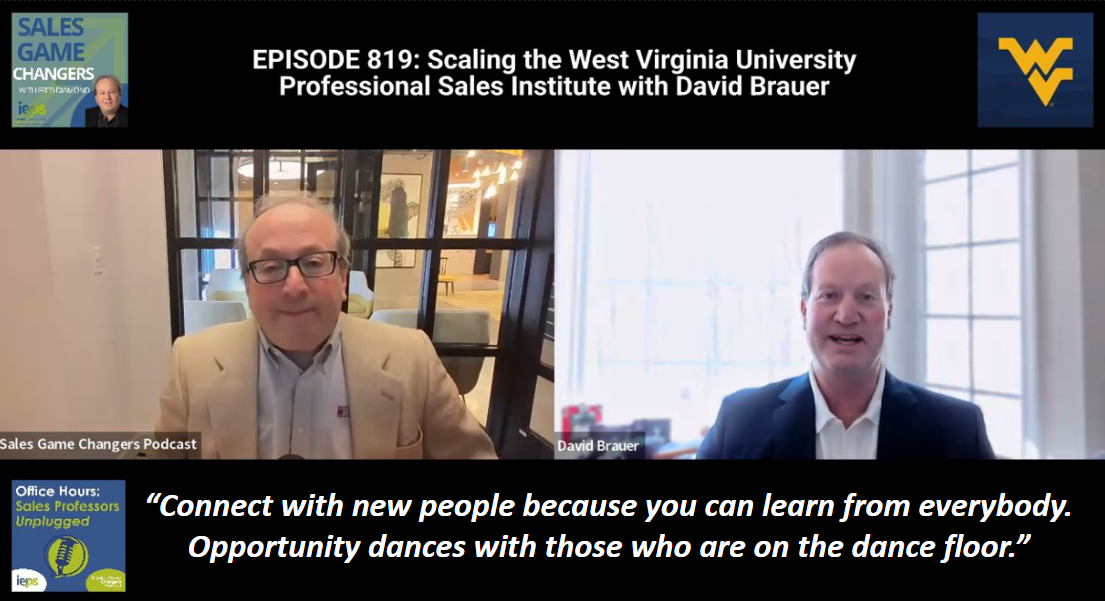
DAVID’S TIP: “Build your network. Always be growing it no matter how far along you are in your career. Connect with new people because you can learn from everybody. Opportunity dances with those who are on the dance floor.”
THE PODCAST BEGINS HERE
Fred Diamond: Today’s show is a special show. It’s our Office Hours – Sales Professors Unplugged. David Brauer, you’re with West Virginia University. I am in Northern Virginia, as a lot of our listeners know. It’s about a four-hour drive. It’s a beautiful drive to Morgantown, where the school is. Office Hours – Sales Professors Unplugged, we typically interview college sales professors, those who are running programs, typically at the University Sales Center Alliance universities. David Brauer with West Virginia, I’m thrilled to be talking to you today. It’s great to have you here. Why don’t you tell us a little bit about yourself and tell us about your journey to West Virginia University?
David Brauer: I’m married to my college sweetheart, Beth, and we have two boys, Grant, who rows at Syracuse University, and his younger brother who’s in 10th grade, Christian, who also rows. My journey to West Virginia University came through sales in general. I grew up in a household and actually many generations of salespeople. My dad was managing director of Marsh & McLennan and then Liberty Mutual and retired in his early 50s. It seemed like a pretty nice career to me from my vantage point.
When I graduated from college, I went into financial services working for a Fortune 500. My dad’s always been a good mentor to me. I had an amazing coach out of the gate, and I became annuity salesperson of the year. I was in the top 10 of annuity sales for four or five years in a row there at that Fortune 500 company.
When I was in my early 30s, my children were born and I wanted to have a career that lined up more with my family. The grind of the sales, I was no longer interested in once my children were born. I wanted to be a good dad more than I wanted to be anything else. We brainstormed to think about what type of careers could I possibly have. My wife was a school teacher, and I thought, “Well, I don’t want to be a high school teacher, but I might consider being a professor.”
I went to Durham University in the UK. I had a great mentor who told me, “Go to the best school in the world you can get into.” Durham University in the UK is a Russell Group school, I guess US equivalent of Ivy League. For some reason they accepted me and I decided to commute back and forth to the UK to earn my doctorate.
I came back to the United States and taught at a few schools before being invited to become the sales director at West Virginia University. I pounced on the opportunity. It was a young fledgling program, I wanted something to grow, and so I grabbed a hold of that opportunity and I’ve really enjoyed being the sales director there and really scaling the program.
Fred Diamond: Like I mentioned, I’m based in Northern Virginia, right outside of Washington, D.C. West Virginia University is one of those schools where a lot of people have gone to, or their children go to now or have graduated from. It even made me more interested to find out about your curriculum and the classes that you offer. Do you offer a major, a minor, certificate? Tell us a little more about your program there.
David Brauer: When I took over in 2020, we had about 80 or 90 students taking sales classes a year. There was just one or two different sections of sales classes and that was about it. Now we have over 600 students taking sales classes a year, and we’ll probably scale to 1,000 and then plateau in the next few years.
We’re one of the fastest-growing sales programs in the country. We do that by offering five different sales classes. Now we’re the host of the largest live sales role play competition in the world, which has over 900 sales role players and over 60 universities that are involved in that. That’s with our sponsors at Fastenal, and that is on the platform called Sales Role Play Arena, where you can go to salesroleplayarena.com and see that there.
Before COVID, there was probably only about 20 role players doing this comp. To go from 20 to 900, and then in our sales program to go from 80 or 90, scaling seems to be my thing with these programs. I like to grow them and make them big. We offer those. We have an area of emphasis in sales as well as a sales minor.
Fred Diamond: That’s great, to be part of something that’s growing so significantly. Everyone who’s listening to today’s Office Hours – Sales Professors Unplugged is a sales professional, or they’re in the sales world at some level. Either they work for a company with a large B2B, and in many cases, B2G, business to government, so they’re selling professionals. We also have a lot of young adults who are now moving into sales because of this particular show.
To grow a program from 60 students to close to 1,000, where you want to get to, I’m just curious, you must have a lot of the support of the university. Tell us a little bit more about how that came about. How did the university decide that they want to grow from 60 some odd students to 1,000? I’m curious on how that whole process worked.
David Brauer: They’ve been fairly hands off with me. When they asked me to be the director of the sales institute, they hired me because they wanted me to grow the program, and they said, “Have at it,” and so I did. We had two other professors teaching sales at the time, Emily Tanner and Suzanne O’Connell, and they were great. They were able to scale with it and help grow the load. They had lots of ideas and we collaborate very well about how to grow. In our marketing department, we’ve had a lot of support.
The person who brought me on, Dr. Michael Walsh, he was there at the beginning of the program and helped start the program with a gentleman who’s now at George Mason, Andy Wood, I think is his name. Those guys started it, and then they brought me in. Andy moved over to George Mason, Mike had it by himself, so they let me do that. They had also found a benefactor to help sponsor this.
All of these sales programs require outside funding. The state schools and these smaller schools and bigger schools, they can’t just draw that out of the normal funds. It’s fairly expensive to take students to these different sales competitions and go all around the country and do that. It’s really important that you have all stakeholders involved. Alumni who had previously been in sales, maybe even before we offered a sales program, a lot of those people are very successful and they come in and help and offer their support.
Fred Diamond: We actually did a show with a gentleman named Frank Hauck, who went to Bryant University and built the Sales Lab at Bryant University. He was a graduate of Bryant, as was his wife. He had a great career at companies like EMC and done really, really well. Then recently, within the last two years, made a pretty substantial investment into a sales lab, where the students can do role play with state-of-the-art AV. You probably know Dr. Stefanie Boyer over at Bryant. She does a competition every fall and I got to meet Frank. We had him on the Sales Game Changers Podcast. If any of your alum are listening and want to replicate what Frank did, I’m sure you’d be very welcome to that.
David Brauer: Yes, absolutely. Thank you. We would.
Fred Diamond: Tell us more about your students. How do they learn of the program? Do they come to West Virginia University knowing that your program is available or do they discover it as they’re trying to seek a major? Talk a little bit about that, and are there any requirements for taking classes?
David Brauer: More and more parents are asking about sales. There’s been this question out there about whether it’s even worth it to go to college anymore. People know that a lot of the trades pay fairly well and that whole generation is retiring as well, so there are opportunities out there to do other things. Where higher ed really needs to connect with where the rubber hits the road, is they need to offer skills that can translate into an ROI for those parents, for their children to have solid careers. Sales happens to be that golden nugget for a lot of people.
It is a field where at West Virginia University and many of the other great sales programs that are out there have a hundred percent placement rates. From our sales team, that’s an elite part of our program, the average starting salary is around 85,000. According to the ICSC, we are ranked eighth in the world at West Virginia University. People want to be part of a winning program. They want to be part of something where, “Hey, I can do sales and I can make 85,000 a year.” Now, that is not true for everybody, but the placements are quite good. For the right students, opportunities can go from that to we’ve placed students in the low one hundreds.
It’s an amazing opportunity for the right people that want to put in the hard work. We have lots of students that take the sales classes because of that. Also, maybe many people don’t realize it, but over 50% of people that are in business school are going to end up in sales at some point of their career anyway. It’s an amazing skill to be able to deliver for them. They hear about it from word of mouth. Then most of our students that start taking sales classes are juniors and seniors. They already have all of their core curriculum. Now they’re looking for a career. They go to career services. “Hey, what do different jobs pay?” Lots of students that age, if you ask them what they want to do, the answer’s maybe not the best, but I’ve probably felt the same way, “I don’t really care. I just want to get paid a lot of money.” Sales, if you work hard and they put their mind to it, this is one where they can make a lot of money fairly quickly.
Fred Diamond: It’s great that you’re teeing up the students with the skills. One of the great things I’ve learned since we started the Office Hours – Sales Professors Unplugged sub-brand of the Sales Game Changers Podcast back in the spring of 2025, is the students who go through a program like yours, they’re a couple years ahead of students who haven’t gone through this, who start their career in sales.
Some of the corporate sponsor-type companies that I’ve spoken to says that if a young adult goes through a program like yours at West Virginia University, they’re three to five to seven years ahead of general hires, which means that they can hit the ground running, they can progress faster. They still got to teach them their product and the industry and their sales process per se, and things about their company, but they understand what the sales process looks like. In general, of course, each company may have their own, doesn’t really matter, but they understand what it means to be a sales professional.
I want to ask you a question that I haven’t asked in a while, if ever. What do you learn? What do you learn from students? One of the things that we’re seeing in the industry is customers are beginning to retire out. 2025 was a challenging year for a lot. There were a lot of layoffs at the typical companies that we might sell to. There’s a lot of layoffs in government, of course, and related public sector. Now we have younger people who are customers. I’m curious, what’s a nugget or two that you’ve learned from the students that go through your program that might be interesting for our audience to hear?
David Brauer: Buying signals. I think that these students are amazing experts at knowing how to pick up buying signals. They may not recognize what it is they’re seeing or what it is they’re reading, but because they’re so adept at social media and because they were born as digital natives, because they can navigate information so quickly, they’re really good at being able to pick up buying signals with the right guidance.
You have platforms out there, let’s say software-buying platforms like G2, which was founded by Godard Abel. Those people have the foresight to be able to see that buyer intent and buyer signals are going to be really important. Our students can be really good with that if they know about those tools. ZoomInfo, same thing, has buyer intent and has the ability for you to be able to find all the contact information for those buyers that you need to see, when did they look at it? How long did they look at it? What were they looking at? It really adds a lot to the conversation.
With the tools that we’re delivering, the classic foundational tools of being able to communicate, along with their ability to pick up on buying signals, allows sellers to have more time to talk to the right people. In sales, with many careers, time is your most valuable commodity. If you can filter through the people who are actually going to buy more quickly, you have more customers, you make more money, you make more commission, you’re more successful for your company. I would say that these students are experts at buying signals. They just need to be guided into knowing what it is they’re looking at.
Fred Diamond: That’s a great answer. That’s something that we’ll definitely pursue on a future episode of the Sales Game Changers Podcast. In line with that, the students, it’s not just like, “Gee, I got a degree in sales. Now I’m going to make high five figures, early six, just because I have the degree.” It’s like an athlete. You got to keep working at it. You got to be hungry. One of the things that we’ve really enjoyed by getting involved with the University Sales Center Alliance and going to some of the competitions, is seeing how committed these young adults are at being great, and preparing and asking the right questions. I’m interested more in the ones who are going to succeed. What are some of the things that you found that they really want to learn about professional selling?
David Brauer: Reece Sutphin is a role player on the WVU sales team, and he was a D1 baseball player. What he brought with him was total work ethic. My dad volunteers to coach the WVU sales team and helps prepare them for being sales role players. People like Reece, with that amazing work ethic, want to absorb as much as they can from those people that have retired or are retiring that have a lot of skills that, frankly, they don’t teach anymore.
We start with foundational, How to Win Friends and Influence People. I tell the students, listen, we’re not teaching parlor tricks. I’m not teaching anybody really to sell anything. What we’re teaching you is how to make a best friend and how to make your best friend successful. If you can find out what it is that your friend needs by asking the right questions, whether you offer the product or service or not, if you know where it can be found, deliver that information to them, you’ll build a long-term relationship with people that will always know that you’re the trusted advisor to go to bar none, and that will build a successful career. I think they’re looking for that.
Fred Diamond: I love that answer. It keeps coming back to what we say a lot of times, is if you’re going to make your customer continually successful, then they’ll keep coming back and they’ll stay with you. How can you make them more successful? One of the classic lines is it might not be what you’re selling them today. It may be a referral. It may be an idea on something you’ve seen at one of their competitors. That’s a great answer.
You mentioned your competition before, and your work with companies like Fastenal. Tell us a little bit about your relationship with corporate sponsors. I like the way you said before that they’re very important to helping your programs grow. Every other professor and director at a university professional selling program has the same challenges getting sponsors involved. What do they want? What do they expect? For companies that haven’t considered this, or maybe they’ve been approached but haven’t gone to the next stage, what might you want to tell them to interest them in learning more about becoming a corporate sponsor of a program such as yours?
David Brauer: We have very few sponsors. We don’t take all comers. We don’t take everybody who’s interested. We’ve turned people away. We’ve let people go. If they’re not the right cultural fit for our students, then we don’t have any business having a relationship with them, regardless of if they want to give us money or not. We focus on quality over quantity of sponsorships, and we try to deliver an amazing ROI to our sponsors. We also offer exclusivity in industry. Let’s say for example with Fastenal, we wouldn’t bring on Grainger as a sponsor. They’re direct competitors. They compete just on every level. We have no business bringing in Grainger. We’ve got someone who fills that niche.
There are two areas that we’re still looking for, which are software and pharma. If there are sponsors out there that are in software or pharma, hurry up and grab it because there’s only one seat of each available. We deliver an amazing ROI. That’s what we’ve done with Fastenal. Fastenal was sponsoring some of the large competitions in the United States. With those competitions, and they’re great competitions too, they were a little frustrated that maybe they were looking for possibly more students to talk to. I was thinking, “How could we possibly deliver that to them?” I said, “What if you were the only sponsor of this program, and we scale it out to the other universities, but you’re the only one. You’re running the role play, you’re having the conversations with the students, and you’re the only one hiring there.”
They said, “That’d be amazing. No one does that.”
I said, “No, they don’t, but you should.”
We’ve now been doing that for two years. The first year there was 550 student role players. This year there was over 900. It has become one of the largest recruitment initiatives for Fastenal. This is an area where universities and their sponsors, it’s the job of the sales institutes to deliver ROI to their sponsors and to their students. Their students first, by getting the right sponsors in there that will give them the jobs, and then their sponsors who are helping support those students to make their dreams come true.
Fred Diamond: The main reason why companies would sponsor is access to these talented young adults who are going to be a couple years ahead of the curve. Maybe they hire a science major or something, or another liberal arts major or something. They’re going to have to teach them the sales process, all the things that you go through using various tools, etc. The main advantage for companies to sponsor is to get access to professional athletes basically at sales.
David Brauer: That’s absolutely right.
Fred Diamond: I know you’re also very active in the Boy Scouts, and you’ve also gotten your sales students involved with some activities. Tell us a little bit about that as well, because I see this a lot when your peers, and I’ve begun to meet a lot of the students who’ve listened to the Office Hours shows, they’re posting things related to community service and being involved in the community, et cetera. Tell us more about what you do with your students with the Boy Scouts.
David Brauer: I met a gentleman about a year ago, at this point, his name’s Mel Pirchesky. I met him at Carnegie Mellon at an event. We were just talking to a bunch of different people, and he asked me if I would donate to the Scouts. I said, “Sure, I could do that, but what are you trying to raise money for? What is it exactly for?”
He said, “There’s these disabled kids that it’s very expensive for them to go to camp. Their parents have a lot of other expenses with medical and other things, and sometimes people just can’t get there. There are these kids who are wheelchair-bound who are sitting on the sidelines and can’t participate.”
He showed me a video of this young man who was in a wheelchair and the zip line was adapted for him. When he did the zip line, at the end, they were talking with him, and his smile was so big, I thought he was going to break his face in half. He was so excited. It dawned on me that I’ve been on a zip line and I think it’s cool. I asked my students, “How many in the class have been on a zip line?” The majority of them have been on. I said, “Pretty exciting, right?”
They said, “Yeah.”
I said, “Now imagine you are confined in your body and you can’t really do a lot of things like that, but there’s this one thing you can do that’s exactly like the rest of us. You get to experience that thrilling exhilaration.”
Every time, even now, when I tell this story, it gives me goosebumps. I was overcome with emotion about that because I thought, “If we can give that to people and we can teach the sales process by giving that to people, then that’s what I want to do.” Mel and I worked together with some people at the Laurel Highlands Council from Scouting America. We talked about how we could develop a program that would not just work for Laurel Highlands Council, but work for a lot of different councils.
In the fall, I had my students learn the sales process by using ZoomInfo, profiling the profile of an ideal prospect. I had them profile people. I said, “Imagine your dream job. Where do you want to work? Find people who work in your dream job that might be 40 or 50 years old. Reach out to them, tell them you’d like to talk to them about their career, and reverse engineer from college to that job.” The second part of it is, in my sales class, we’re raising money to send these disabled scouts to camp. Is this something you could get behind?
Long story short, from that project last fall, we had four students land in their dream jobs. That was pretty amazing. This one gentleman reached out to a CMO in New York City, and the guy offered him a job after the phone call, and then gave a $500 donation on the spot. Their quota was $350 and he said, “Now what do I do?” I said, “Keep going.” But he landed his dream job. I had a really nice letter from him at the end saying, “Thank you. Had it not been for this project, I would’ve never done that.”
All of the students in our sales classes raised a little better than $79,500. It was a pretty good haul to send those scouts. That translates to about sending 24 disabled scouts to camp in the summertime. Either the Jamboree or scouting camp in West Virginia or Pennsylvania in our area.
It was so successful that two other sales professors heard about it. I’m on the board of the University Sales Center Alliance, and some of my friends reached out to me. Rhett Epler at Old Dominion University, shout out, he’s adopting this as well, and Andy McGowan at Virginia Commonwealth, who you recently had on your podcast. They’re adopting that for their classes as well. Who knows, hopefully lots of other professors in the University Sales Center Alliance adopt this in the fall. This is tremendously impactful for the social outreach, to send these children to the camp.
Fred Diamond: There’s so much benefit to that. By the way, Rhett was also on the Office Hours – Sales Professors Unplugged show as well. It reminds me of something, we talk about this all the time. When you’re really successful in sales, and we touched on this a little bit before about helping your customers, sales really is about service. It’s about serving your customers to achieve their goals. If you’re not going to help your customers achieve their goals, then there’s no value for them to even consider working with you or your company, and a major way that that represents itself by being involved.
Almost all, if not all, of the top sales professionals that I’ve worked with in my career have been involved with something else, some type of philanthropy some type of charity. Maybe it was personal, maybe it was related to a child, maybe it was hunger, whatever it might be. During the holidays you see companies posting left and right. By the way, we’re doing today’s interview on Martin Luther King Day in early of 2026, which is a national day of service as well. Good for you. I’m glad that the students found jobs, but also, hopefully that triggered a lot in them to continue being of that.
You mentioned you came on board in 2020. A lot of the students graduated when the pandemic happened, spent the first year or two of their college careers in the COVID world, remote classes, etc. Sales has changed in a lot of ways. We’ve covered this on almost every single episode of the Sales Game Changers Podcast. I’m just curious, what are some of the trends? Obviously, AI. It’s amazing we haven’t mentioned AI yet. But what are some of the trends in professional selling that are related to the digital transformation that has affected your curriculum and your teaching?
David Brauer: I’ve mentioned it a little bit earlier with tools like ZoomInfo and being able to find buyer intent and buyer signals. That lines up exactly with AI. Those people that can build the personal connection skillset that’s taught through things like How to Win Friends and Influence People, and talking with people who were born before social media and maybe came in early on emails. I remember my first sales campaigns, I was actually sending handwritten letters out to people for my initial prospect calls. I’d send those out, then I’d follow up with a phone call, now it’s a DM or email, and then follow up with a phone call. I would say a lot of the things are exactly the same except for the speed at which you can do it.
A smart, savvy salesperson should be able to work a lot more quickly and use their time to be in front of the customer more than it was possible for us to do in the past. Someone who can be extremely organized and regimented in that, and also be open to all of the different sales processes that are out there. There are a lot of companies that offer sales education, like Sandler and Dale Carnegie and Challenger, there’s a lot out there. But the University Sales Center Alliance and the schools that offer that now to expose students to different sales methodologies, really is super helpful and we’ll build professionals. We’re building a new reputation of sales.
Fred Diamond: That is great. Actually, at the Institute for Effective Professional Selling, we’ve gotten involved with a lot of the university programs and give some tutoring, some guidance, some career advice as well.
David Brauer, West Virginia University, thank you so much for the great insights. We covered a lot of ground here. I greatly appreciate it. We end each show typically with an action step. You’ve given us a lot of great ideas. For people listening to the show or reading the transcript, if you could give them one bit of advice, one thing they should do right now to take whatever it is they’re doing in the sales world to the next step, what would that be?
David Brauer: Build your network. Have a great network. Always be growing no matter how old you are or how far in your career you are. Connect with new people. You can learn from everybody. My son asked me that, he goes, “Why do you still go to all these sales conferences and different things?”
I said, “I go for the nugget. I go to find one nugget of something that can help me out.”
I have to tell you, connecting with you has been eye-opening for me. It’s been really nice, and you’re a new connection for me. This is really pleasant, but I think people need to always keep their eyes open and to always be expanding their universe. This is an old saying, but opportunity dances with those who are on the dance floor. If you’re not on the dance floor, you’re not going to have an opportunity.
Fred Diamond: What do you tell students who, again, a lot of the students that you work with, they grew up behind a screen. Because of the remoteness, they’ve grown up behind Zoom, they’ve grown up behind their phone, etc. How do you encourage them to get out and meet human beings? Because it’s still a huge part of the sales process, is knowing people. Even though you can meet a lot of people with LinkedIn and grow connections online and the social network groups, etc., being with humans in presence is something that really takes things to the next level. What do you tell your students about that?
David Brauer: We take them to these different sales competitions, but we also host sales networking nights on our campus. The whole sales networking night is just that. It’s our sponsors, it’s people who are in sales, it’s our alumni. It’s people who get together and we just spend a couple hours together socializing, networking, and learning about each other. The students always come away and say, “Wow, that’s really a lot of fun.” It is a people situation. The better you get at that, the more fun you’ll have, the more successful you’ll be.
Fred Diamond: Once again, I want to thank David Brauer with West Virginia University. This is the Office Hours – Sales Professors Unplugged Podcast, a sub-brand of the Sales Game Changers. My name is Fred Diamond.
Transcribed by Mariana Badillo