
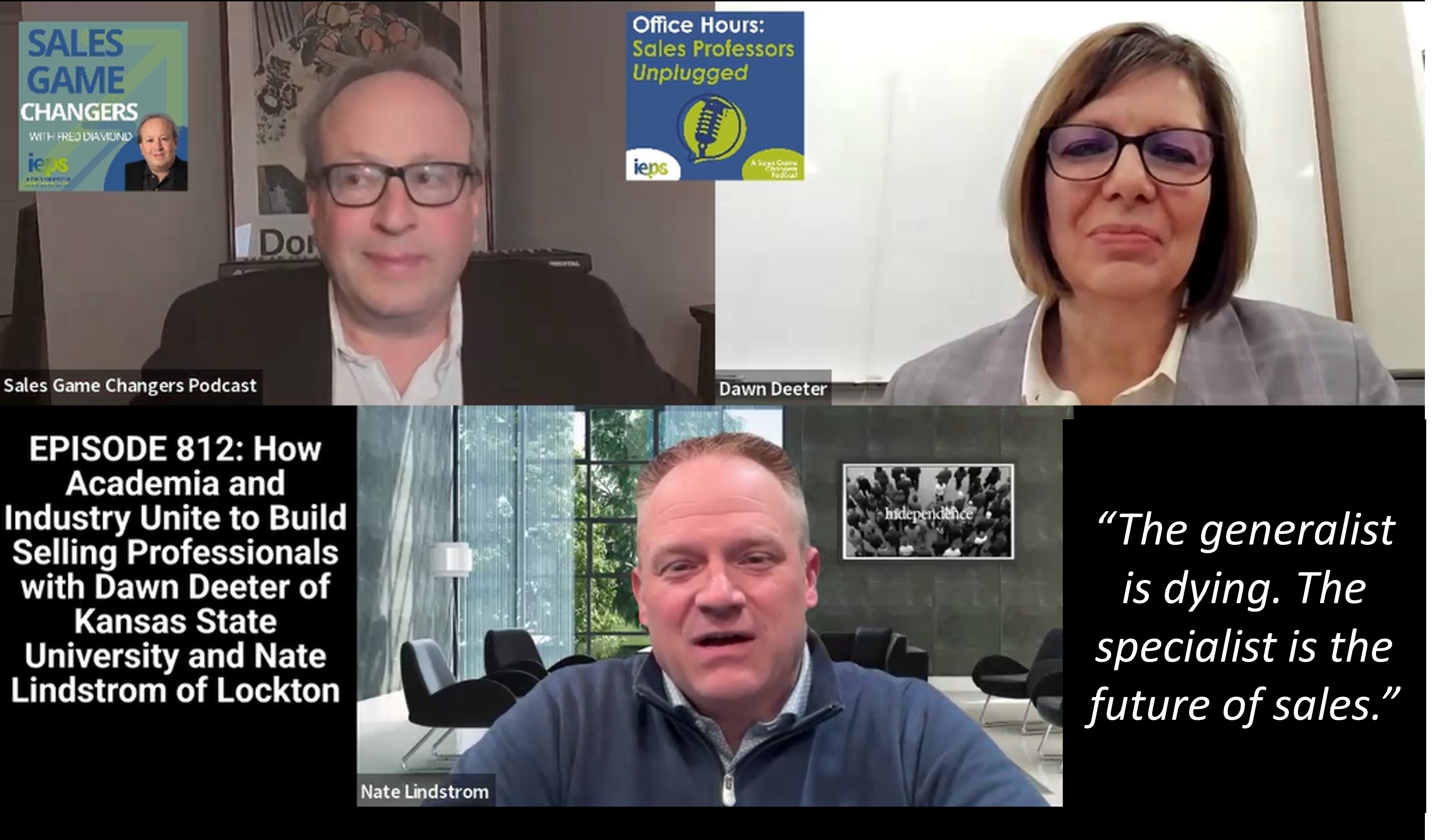
Watch the video of this podcast on YouTube here.
This is an Office Hours – Sales Professors Unplugged sub-brand of the Sales Game Changers Podcast. The Sales Game Changers Podcast was recognized by YesWare as the top sales podcast. Read the announcement here.
FeedSpot named the Sales Game Changers Podcast at a top 20 Sales Podcast and top 8 Sales Leadership Podcast!
Subscribe to the Sales Game Changers Podcast now on Apple Podcasts!
Purchase Fred Diamond’s best-sellers Love, Hope, Lyme: What Family Members, Partners, and Friends Who Love a Chronic Lyme Survivor Need to Know and Insights for Sales Game Changers now!
On today’s show, Fred interviewed Dr. Dawn Deeter, Director of the National Strategic Selling Institute at Kansas State University. She brought on one of her program’s sponsors Nate Lindstrom at Lockton.
Find Dr. Deeter on LinkedIn. Find Nate on LinkedIn.
DR. DEETER’S TIP: “If you’re a hiring manager, actively seek out nearby universities with sales programs. You’ll gain years of advantage by hiring sales-ready graduates.”
NATE’S TIP: “The generalist is dying.” The future belongs to specialists who deeply understand an industry and how their solution creates value inside it.”
THE PODCAST BEGINS HERE
Fred Diamond: I’m very excited because we have Dr. Dawn Deeter with Kansas State University, who was on the show by herself in March of 2025. It was a great show, and it got so much response that we met tons of your peers who reached out to us and said, “You need to get me on your show.” That was the kickoff of the Office Hours – Sales Professors Unplugged Show, which we do, where we interview professors typically associated with the University Sales Center Alliance. We talk about their programs, how they’re educating the young adults, and we also talk about how they’re working with corporate partners and how they’re creating curriculum to grow the young adults into sales professionals. This is the first show that we’re doing with a university sales professor and with one of their corporate partners. We have Nate Lindstrom.
Dr. Deeter, thank you so much. Once again, you appeared on the podcast in March of 2025. Seems like yesterday. Our good friend, Lee Salz, reached out to us. He was the IEPS Sales Speaker of the Year in 2022. He’s been a frequent guest on the show, and said, “You need to meet Dawn Deeter. She’s doing amazing things at Kansas State.” Give us an update. Tell our listeners about the National Strategic Selling Institute that you run at Kansas State University. It’s a very extensive program. Give us an update, introduce the people who don’t know you, and I’m excited to talk to you and Nate today.
Dawn Deeter: I’m the director of the National Strategic Selling Institute here at Kansas State. I was hired to found the program back in 2011. In 2013 we launched our certificate in professional strategic selling, which is exactly like a minor. It can be paired with any undergraduate major in the university. Then in 2018, we launched a major in sales, so students within the College of Business can get a sales major.
The program has been growing the entire time. When we launched the major, I was a little worried that it would cannibalize the certificate program, but in fact, both continued to grow. We are now at over 600 students earning either a certificate or a major in professional strategic selling. But our goal all along has been to prepare undergraduate students for careers in professional selling, so that when they graduate, they can hit the ground running and bring in revenue faster than their peers. The entire time, our goal was to work closely with businesses so that they can help us prepare those students, but then also, the students have the opportunities to get good internships and jobs coming out of our program.
Fred Diamond: As we tee up the conversation we’re going to have with you and Nate today, share some of the insights about the role of your corporate partners.
Dawn Deeter: I think that word, partners, is very important. We call them partners instead of sponsors because we don’t just want their money, we want their involvement. Their involvement is critical to our program and our students. Not only do they come to our sales career fairs that we hold in the fall and the spring, but they also come into the classroom. They speak to our students. They serve as mentors to our students. They do workshops and lunch-and-learns and have various opportunities to interact with our students. They play the buyer role in role plays, and they give our students feedback. They are on the ground here at Kansas State weekly. We have different corporate partners coming in to help us develop those students and to make sure our curriculum is up to date and where it needs to be.
Fred Diamond: Nate Lindstrom with Lockton, you’re the Senior VP of Growth Operations. Tell us a little bit about Lockton. Tell us a little bit about your journey and we want to start getting into the details about the relationship.
Nate Lindstrom: Lockton, I’ll just set the stage a little bit. We just surpassed about $4 billion of revenue, about 13,000 plus associates globally. We say it’s 20,000 clients plus, but it’s probably 5,000 clients for the larger commercial type clients. I’ve been at Lockton about 13 years. My journey to Lockton was in management consulting prior to Lockton. I helped a lot of companies improve performance. Then this became a natural fit to how do we hire the best of the best in the insurance brokerage industry for production, and then just turn them loose, let them do great things. It’s been a cool journey.
We’ve actually become the New York Yankees, or pick your favorite blue-chip sports team, but it’s definitely a destination place for top producers in the industry. There comes great responsibility. You can build an enormous book of business, but also, you have to be entrepreneur-minded and a business builder. It’s very much we attract that talent, and I know we’re going to get into this later in the podcast, but we’re looking for those that are elite in the sales world, is who we’re targeting.
Fred Diamond: I definitely want to pursue the entrepreneurial nature, and we’ll talk about that in a second, how that relates to what you’re doing, and Dr. Dawn Deeter also. But give us a little bit of an insight into your relationship with KSU. When did it start? Were you involved with getting it started? What are some of the skills that are taught at KSU that are attractive to you?
Nate Lindstrom: What’s interesting is we got involved probably in 2019. David Lockton, our chairman at the time, Greg Case, who is currently CEO of Aon, flew out to Kansas State to give a talk to the business school. That’s really where we started our partnership. We just got more intrigued with it and we were like, “Wait a minute, there’s a sales college?” Then you think about it for years, you could get an engineering degree, you can get a finance and accounting degree, you can get all these degrees, but it’s like 2020 and we’re just thinking like, “Now you can get a sales degree.” I’m like, “This is like wheels on luggage.” How long did we carry luggage before we said, “Hey, we should put wheels on luggage,” and that’s probably smart?
When we saw not just that K-State had the sales college, how good it was, like being one of the top sales colleges in the country in our backyard. I think it’s undervalued at this point. I think that more people are going to catch on. I think you’ll see it in the numbers that Dawn shares in terms of students that are coming through the program. People are catching on that this is a great program, a great university.
Fred Diamond: I want to follow up on what you just said, Nate. You mentioned it’s a great program, and you’re right. Whenever I post an Office Hours – Sales Professors Unplugged Podcast, and I always post on LinkedIn, as we have done with this show, people will comment, “Gee, I didn’t know that there were sales majors, let alone classes at universities.” You mentioned that it’s a great program. If you don’t mind, what makes it a great program from a corporate partner perspective?
Nate Lindstrom: Students for sure. You can see the quality of students coming through the program. When we do real sales competitions, this is probably where I see the talent the most, is how they come in prepared, that they have north of 14 type real scenarios where they’re working with companies and selling a product or service, that shows up. That’s real-world application experience, when you can enter and have good conversations, I can just see it in the talent that’s coming through in these conversations. It’s unbelievable.
Fred Diamond: Dawn knows, when we went to the National Collegiate Sales Competition, I was a judge during the role play competition, and even the student who performed the lease was great, and would be a great hire. Then of course, as they continue to grow in the competitions, you see the distinctions.
Dawn, tell us about your relationship a little deeper about corporate partners, and specifically, what is the benefit to your students? Do students understand how critical it is to have these corporate partners involved? How do they want to grow the relationships and what do they hope to learn from someone like Nate and the people who work at Lockton?
Dawn Deeter: One of the things we really stress to the students is the value of our corporate partners and the value in getting to know them early. We will have freshmen go to the sales career fairs because we want them to start talking to those partners, learning how to have those conversations, and then getting a sense of where they feel like they fit. It’s becoming more and more important for the partners too, to get to know those freshmen and sophomores, that then as they become eligible for internships and full-time jobs, you have that long-term relationship with that student. But the learning is just so critical.
I will tell you that I can say something in class and the students will just look at me, but if a corporate partner comes in and says it, the exact same thing, the students are like, “Wow, that is amazing.” I’m like, “Really? God.” But it’s true. They do respect and appreciate and have great questions for our partners when they come in. They know that they have this great opportunity and that our partners are valued highly by both faculty and students.
Fred Diamond: Nate, I’m going to guess the same thing happens when some people who work for you go to Kansas State for a presentation or a state of the industry, whatever it might be, that they’ll hear Dawn Deeter say something and they’re like, “Whoa,” when you’ve been saying it as well, because we hear sales VPs say that to us all the time.
Nate Lindstrom: A hundred percent.
Fred Diamond: Nate, Dawn mentioned that she wants to get her freshmen and sophomores involved with the career fairs to begin to understand what a career might unfold for them. When it comes to recruiting the college students, what are some things that you look for? What are some of the traits and the characteristics that you are looking to identify that will help you understand that you’re hiring someone who’s going to hit the ground running?
You mentioned before that one of the great things that we’re learning about these programs, like at Kansas State, the National Strategic Selling Institute, is that the young adults who graduate from programs like Dawn’s, and Dawn specifically, they hit the ground running. They may need to know the industry and your products and all those things, but they understand sales process, they understand negotiation, they understand leadership, they understand using technology. Give us some insights into what are you looking for to help you identify some of these young adults that will become great sales professionals?
Nate Lindstrom: I’ll take a big picture look at this. The way we grow Lockton, we start to open new markets, or we’ll go into Seattle, or we’re opening new geographies. When we’re going into new geographies, we’re looking for some pretty experienced people in the industry. When you think about somebody coming out of college, they’re going to be very new, they haven’t sold before yet really. The thing that I’ve observed is those coming out of school, they want to sell. Day one, they want to sell. I respect that.
However, you need to have knowledge before you start selling so you know what you’re selling. I love the passion. The challenge for us is how do we get those coming out of college to be patient to gain that knowledge, to then really set them up for sales in the future? Because as a CFO or a CHRO or risk manager, you’re going to handle how much of my millions of dollars on my balance sheet and my risk? Are you qualified to have this conversation? Do you have enough background to have this conversation?
What we’re observing is we look for entrepreneur, business builders, those that have that passion, they want to build something special. They’re just probably not ready yet to hit the level of production to be a really commercial producer at Lockton. Mylo, who is a partner organization of ours that we started, they sell a little bit on the smaller side, so smaller commercial, things like that. That’s a good pathway to bring somebody that wants to sell right away, learn our business, and then bring them into some bigger commercial type sales.
Then also Affinity, which is more of our franchise business. Think of your Chick-fil-A or Burger Kings. They might have a program, but we have to do some inside sales and continue to grow that program. We’re trying to match the person coming out of school so that they get experience that they can ultimately get a chance of becoming a Lockton producer. Because if you can become a Lockton producer, it’s a golden opportunity. I think for a 22-year-old, they say, “I can make over a million dollars,” or whatever, but it takes a lot of experience and knowledge to become specialized.
That would be the message I’d leave your listeners. I think the generalist is dying. I think the specialist is the future. You need to know real estate, you need to know construction, you need to know those businesses. Then you need to understand how insurance ties to those businesses and be specialized in it. That’s where we see our best do, is become highly specialized in what they’re selling.
Fred Diamond: I’m glad you said that, because that is one of the bit of advice I give all the time. When people ask me, “How do I become super successful in sales?” I say, “You need to come from one of two places. You need to be a true expert in what you’re offering, or you become a true expert in the needs of the community, needs of the marketplace.” The example I use, again, I’m in Northern Virginia, I say, “Be the guy who sells Dell computers to the Navy.” You’re selling hardcore technology to the Navy, which is a humongous customer, but you need to understand a lot about the Navy and how do they buy, why do they buy, how are they using the technology?
I want to talk about the entrepreneurial spirit in a second, but when you meet a lot of these young adults, Nate, do you have to educate them on the opportunities in insurance? Do you find that a lot of the young adults, they know, or maybe 2% of them know? Dawn, same thing with you. You’re placing people into a lot of these pretty intense vertical markets. The companies that you partner with, they sell pretty important stuff. Nate, you just gave the illusion of somebody who’s managing tens of billions of dollars. They need to talk to someone in sales who understands why it’s critical to manage tens of billions of dollars. It’s not just like, “Hey, what do I got to do to get you to buy a $10 billion-?” Talk about that, and then, Dawn, I’m interested in your thoughts on how much time and energy do you spend on helping them understand the various markets they may go into?
Nate Lindstrom: I’ll start with transactional sales or more strategic selling, I call it. You can get into transactional sales or one-time sales, but they’re one-time sales, and you’ll get commission on one-time sales. Then you have to go out and do it again and there’s no recurring revenue stream. That’s the one thing I try to educate people that want to go into sales, like find something that has recurring revenue stream. Because you worked so hard to win that deal, and you’re going to work hard to keep them as a client. Find something that has recurring revenue stream.
The transactional sale, it’s not complicated. Yes, it’s hard, but when you get into strategic selling, you got to fire somebody to get hired. Whoever they’re working with, you have to get them fired and then you have to get hired. To do that, you have to be creating value. You have to be creating something unique or something different that they haven’t heard or that’s going to make their business better, and that’s hard. That’s why I think that there’s such an opportunity to make a very good living working at Lockton, but you have to have more of a strategic approach, and you can’t be that generalist. You can’t be that transactional type seller. You have to really build something special. For us, we look for that entrepreneur DNA. We look for those that are really willing to go deep, build something special, get highly specialized in what they do, and they become the best at what they do.
Fred Diamond: Dawn, you’re training them for this, like Nate said, the complex strategic nature of selling.
Dawn Deeter: It’s difficult for us to prepare them for each individual vertical, because we have 30 corporate partners and we are very intentional about bringing in a diverse set of partners so they aren’t direct competitors. They’re all competing for the same talent, but we don’t want them competing in the same industry. But also, we want to offer our students a wide variety of opportunities that would fit a wide variety of interest.
The thing I always try to tell students is, look for the company that has the culture and the fit that you’re looking for, that you feel comfortable in that company. It doesn’t matter as much what you’re selling as it does that you’re comfortable in that company and their processes. This was a while back, but I had a student several years ago who ended up selling metal. She did not grow up dreaming about selling metal but she found this company that sold metal and she loved the company and she’s still selling metal. It has to be the right fit.
That’s the thing, I count on the partners to tell them about the industry and the ins and outs of the industry, but we try to prepare them for learning and being coachable and understanding that they need to build that knowledge base on the industry. Some of our internal competitions help with that. Like when we do the Lockton role play competition, we will be selling something from Lockton. It’ll be their context and their processes. That helps a lot too.
Fred Diamond: The word entrepreneurial came up a couple of times in today’s conversation. Nate, you kept talking about the entrepreneurial spirit. I went to your website, it’s all over there. How do you identify that in students? Dawn, I’m curious, is that something you could teach? Can you teach entrepreneurial spirit, or is it something that you have to be born with? I agree with you. We talk about that all the time, that you have to be creative in sales these days, and it’s changed.
We’re doing today’s interview in December of 2025. A lot has happened to the world in the last couple years. A lot of the young adults who are graduating from your program started during the pandemic. They’re spending a lot of their time here. They’re still learning professional interaction skills. Being in the insurance world, you got to have those personal skills. Talk about the entrepreneurial spirit, and Dr. Deeter, is that something you could teach?
Nate Lindstrom: We could have a good hour-long conversation on this, I feel like. I’ll tell you a story that can summarize what we look for in the entrepreneurial spirit. I remember, and this was not a K-State student, Dawn, so you’re all safe here, but we were interviewing for an internship. This potential intern comes in, he’s really eager, and he’s like, “I want to be CEO of the company.”
I’m like, “That’s impressive. You want to be CEO of Lockton. That’s fantastic.” I said, “But you could be CEO when you graduate school.”
He’s like, “What do you mean?”
I said, “Well, just go start a business and you’re CEO. You’re the owner.”
He’s like, “That’s too risky.”
I said, “Well, then you’re not ready to be CEO.”
I think that story encompasses what we look for in an entrepreneur. I won’t go into all the details of our financial model, but we are structured in a way that you are truly an owner. Expense-wise, how much you want to grow your business, do you want to spend $10,000 on T&E that’s out of your own pocket? You’re like, “Oh my gosh. You make them pay for their own expenses?” Absolutely, because they’ll know what to spend it on and what they won’t spend on. Sometimes they’ll spend $70,000 on an event and you’re like, “Oh my gosh, is this event going to be amazing?” I don’t know. You put your money in. Let’s see how it goes.
You truly are a business builder, entrepreneur with skin in the game, and we’re trying to mimic it as close as possible to where you would go start a business. Any business that you want, you’re going to have to go get capital. Anybody that wants to go start a business, either you have to bring your own capital or go secure capital, but that’s the opportunity. If you want to grow something special here, it is truly a business within a business, and we’re set up that way financially, and it can scare people off. It can be like, “I don’t know if I want to pay my own expenses. I don’t know if I want to go on a draw and have this deficit and I have to produce to make my income.” It can be really scary.
I think that in itself can self-regulate on who truly wants to be an entrepreneur and willing to put skin in the game. By that, that allows our producers to grow big businesses. But it also means that not everybody’s a fit here. Not everybody’s an entrepreneur. They may say it, but when you get tested to see, “Okay, the money’s on the line, and I’m responsible for this business,” just like any great business starter would be. I read the other day, Dawn, I think it’s 97% of businesses don’t ever get past $3 million of production, successful businesses. They never exceed like $3 million. The opportunity to become a Lockton producer, our average producer is $5 million. On average, our producers are out producing most businesses in the country. We’re looking for those that are willing to put skin in the game, build something special, offer something special to our clients and our communities, but they have to have that DNA.
Fred Diamond: Dawn, is that something that’s taught, or do you have to start with it? What’s your thought on that?
Dawn Deeter: I think we can encourage it. There’s an innate ability there, I think, to some extent, because different people are more risk averse than others. I see this a lot in my advanced selling class, and I think I talked about this class on the last podcast we did, that we put on a benefit auction to raise money for student scholarships and for a charity partner. Students actually have to sell, and they carry quota, and they have to manage their pipeline. Some students come in and it’s very entrepreneurial. They can do great things, it just depends on how they approach it.
Some students come in and man, they just do great things. They know what to do. They’re like, “You’ve set me free. I’m going to go out,” and they understand. They have the entrepreneurial spirit. Doug Hill, who’s one of our donors to our program, he often calls it fire in the belly. I think it’s the same thing. They have this fire in the belly. They want to do these things. They want to get out there. Then I spend some time with students just trying to help them get out of their own way. That’s what’s stopping the entrepreneurial spirit.
If I can build their confidence and show them that they can in fact do these things, I think that spirit develops a little bit, but it’s really about helping them get out of their own way. There’s usually at least two or three each semester that I cannot get them out of their own way. I know they are not going to do well in sales, really, because they are too afraid to try. It’s really about getting rid of the fear. What’s going to happen? You’re prospecting, so what? But some of them, it just holds them back. They hold themselves back.
Nate Lindstrom: Dawn, you got me thinking. That was such a good point about how it applies for us too, is like when I see somebody come in and they’re looking for the playbook, like, “Give me the sales playbook. Teach me how to do this.” I’m like, “You’re not going to make it here. You want to be told how to go do this.” We look for those that define their own path, that are resourceful, they figure it out, whatever it is. I’ve seen so many come in where it’s just like, “Just tell me how to be successful.” I’m like, “No, man, that’s got to come within.” I don’t know if you see it the same at K-State, but I see it definitely here.
Dawn Deeter: Definitely.
Fred Diamond: One thing that we talk a lot about is, you’d mentioned CEO, etc., we tell people, “You’re the CEO of your career.” You might be the VP of sales at Lockton, or Caterpillar, whoever it might be, but you’re the CEO of your career. What are you doing to be creative, to grow your career and to become the guy or gal who’s known as the insurance leader in Northern Virginia or Manhattan, or wherever it might be? We continue to see the middle of sales of corporate B2B getting compacted for a whole bunch of different reasons, AI, automation, etc. The elite performers are the ones who raise.
Nate, Dawn mentioned she has about 30 corporate partners, although they’re all different slots, etc., you’re still competing for the best to come over there. I’ll give you an opportunity here. Why would someone who’s at Kansas State, or a similar program, why would they want to come to work at Lockton? Why would they want to begin their career and hopefully have a wonderful career at your company?
Nate Lindstrom: That’s a good question. I’ll start with why they wouldn’t maybe. Insurance is not like, “Hey, let’s go sell some insurance, or help clients with their insurance needs.” I think insurance is one of those industries that it’s not as attractive coming out of school. If I put my college hat on and I’m coming out, I’m looking at AI, I’m looking at all these new things that are coming out into the world, and insurance is just one of those, “Oh, it’s insurance.”
I’d also say now, on the flip side, is insurance is also one of the most recession-proof type industries. Because guess what happens when property values go up? Insurance goes up. It follows the market of what we insure. While some of those startups are dying and there’s no sales to be had because the company went under, we’re pretty stable. We’re a pretty stable growth company. I think with almost 60 years or so of double-digit growth, it’s that consistent growth. With consistent growth, our founder, Jack Lockton, would always say, “If we’re growing, we must be doing something right. If we’re doing something right, it’s probably good for our communities, it’s probably good for our clients.” We look at growth as a healthy measurement of we’re doing something right.
I would say the reason that the top performers may want to consider Lockton at some point, and I say at some point, because it may not be the right time. If you’re willing to invest in yourself, you’re willing to take a risk, it could be one of the most lucrative sales positions in the country. But that comes with a lot of work. It comes with being resourceful, that work ethic, that drive, that intensity, discipline, curiosity, the best of the best come here and they stay here, but not everybody can be a Lockton producer, just like not everyone could be a Navy SEAL. For those that would want to take a risk and it might be a good fit, I’d say give us a call.
Fred Diamond: That’s a great way to describe it. We’ve been going for about 27 minutes and Nate just mentioned AI for the first time. Everybody listening was probably wondering, because AI of course comes up all the time. I don’t want to spend a whole lot of time on it, because we’ve covered so many great things here, but let’s just each give us a statement or two about where are we with AI. Dr. Dawn Deeter, why don’t you go first, give us a where are we with AI in your curriculum and then we’ll get to the action steps.
Dawn Deeter: We are, like everyone else, learning and continuing to look at what’s out there. I will say our partners have been very helpful with this. In fact, Nate recommended something that we are now looking at and probably going to incorporate in the spring. But we have two things going on. We have to teach them how to use AI properly and how it can be an effective tool. At the same time, and this was Nate’s line from our advisory board meeting, not let them become AI stupid, because there is the temptation for them to plop something into their homework and just let AI write it. You can tell. They’re using words they’d never use. It is very obvious. They still need to be able to write and think, but can they take that tool and then use it to become a more effective salesperson? That’s where we’re focusing our AI efforts into our sales technology class. I’m going to be bringing it into the advanced selling class. We’re using tools that have AI incorporated that will help with that, but it’s getting them to use it to be more effective, but not to take over the work.
Fred Diamond: Nate, do you want to give a statement or two on AI in your industry and with students?
Nate Lindstrom: That’s funny, Dawn. I still go back to the AI stupid, and I think AI is a little bit overhyped right now. I think there’s two camps. There’s the, “I’m afraid it’s going to take over and we’re frozen,” and then there’s, “Oh my gosh, it’s changing the world. Everything’s AI. I’m going to use ChatGPT for everything.” I think we’re going to settle somewhere in the middle. I think what the power is going to be, is when the human can harness AI to support. I think if you can get really good at that in sales, I think that’s where the magic’s going to happen. I’ll give you a couple examples.
We look at conversational intelligence. We have to be specific with AI. What do we mean when we say AI? AI would be intelligence in the conversation. It could take the recording of this podcast, it could summarize it, it could put together a summary, send it back to a client or potential client and say, “Here’s what we heard.” We’re starting to use AI note-taker so that we can summarize the conversation, be more present with those that are considering to come to Lockton. Then I can go back to the notes and say, “Oh, yeah, that’s pretty much what it is. Let me add a few things,” and then send it off. That’s becoming more efficient. That helps people in sales. Versus me taking all these copious notes the whole time and then I have to go summarize. That’s more efficient.
I think we’re going to see some efficiency in AI, but I will make a bold statement. AI is not replacing sales. AI is augmenting sales. All this fearing like someday a robot’s going to sell to us, I don’t think that’s going to happen. I don’t think it’s going to happen for a long, long, long time, because I think as people, we buy on emotion, we don’t buy on facts. Part of the emotion is, how am I feeling in this conversation? How am I feeling that you’re going to have my back and be a trusted partner? How am I feeling that you know what you’re talking about versus regurgitating what ChatGPT just said? It’s bringing that knowledge of what AI power is with the knowledge of what we can bring to a prospective client or client, and helping us become more efficient in what we do. I think those are the greatest opportunities in front of us right now, but who knows? We’ll see. It’s such a rapidly-accelerating topic right now.
Fred Diamond: Once again, I want to thank Nate Lindstrom with Lockton and Dr. Dawn Deeter at Kansas State University. We covered a lot of great ground. Dawn, thank you so much for inviting Nate to join us as part of the Office Hours – Sales Professors Unplugged, to get deep into the relationships between the great universities that are with these amazing sales education programs that are really producing just fabulous young adults. Nate, thank you so much for sharing what you’re looking for and how they can be more successful as they embark upon their careers.
We like to end each show with a specific action step. You both have given us a lot of great ideas. Give us something specific that our listeners should do right now after listening to the show or reading the transcript. Dawn, why don’t you go first? Give us a specific action step. Nate, why don’t you bring us home?
Dawn Deeter: I would say if you’re a hiring manager and you have never hired entry-level talent coming out of university, I would look around at the universities near you to see if they have a sales program. Because there are a lot of good programs out there, and there’s a lot of good talent coming out of these schools. I still come across people who think, “Well, I want them to have a few years’ experience.” I understand that, and certainly, I understand as everything becomes more complex, the product becomes more complex. But these kids are prepared, these students are prepared to sell. They know how to sell. That’s half the battle. I think I would encourage people to look around at their local universities to see if they’re teaching sales.
Fred Diamond: Dawn, we estimate that a company will get a five-year advantage by hiring a young adult who comes from a program. Yours is one of the elite programs, so it’s definitely on the five to seven side. Yeah, they need to know, as Nate mentioned, they need to learn the industry. They can’t just start right away selling to the C-suite, but at least they have the understanding of the process, and they know how to ask questions. They know how to listen. They’ve been taught emotional intelligence. They’ve been taught research, preparation, listening skills. What’s coming out of these universities, particularly yours at the cream of the crop, it’s five, seven years, we’ve estimated, of an advantage. Nate, that’ll save you hundreds of thousands of dollars, if definitely not tens of thousands. Nate Lindstrom, thank you so much for being on the show. Give us your final action step.
Nate Lindstrom: I’ll speak to all the sales professionals listening. Think like a buyer. Don’t think like a seller. Put yourself in the buyer’s seat. What do they want to know? What do they need to get educated on and what are they potentially going to buy from you? Take yourself out of it. It’s not about you, it’s about them. Then be passionate about what you do, because if you’re passionate about what you do, whether it’s selling metal or insurance or anything, just be passionate about it. I think when you find passion in sales, it doesn’t feel like a job. Just find your passion.
Then the final point is invest in yourself. If you’re listening to this podcast, don’t just listen and keep driving, but take a couple notes, put something into action. That goes for any podcast you listen to, or anything that you’re investing in yourself, you can read a lot, but put the things into action. Put it into your business plan and test out the strategy and see how it works, and you’ll become a better sales professional.
Fred Diamond: Thank you for being here, both of you, Dr. Deeter and Nate. I agree with you. It’s not about you. It’s 100% of the time about the customer, about the buyer. Once again, my name is Fred Diamond. This is the Office Hours – Sales Professors Unplugged Sales Game Changers Podcast.
Transcribed by Mariana Badillo