
Watch the video of this podcast on YouTube here.
The Sales Game Changers Podcast was recognized by YesWare as the top sales podcast. Read the announcement here.
FeedSpot named the Sales Game Changers Podcast at a top 20 Sales Podcast and top 8 Sales Leadership Podcast!
Subscribe to the Sales Game Changers Podcast now on Apple Podcasts!
Purchase Fred Diamond’s best-sellers Love, Hope, Lyme: What Family Members, Partners, and Friends Who Love a Chronic Lyme Survivor Need to Know and Insights for Sales Game Changers now!
Find David on LinkedIn.
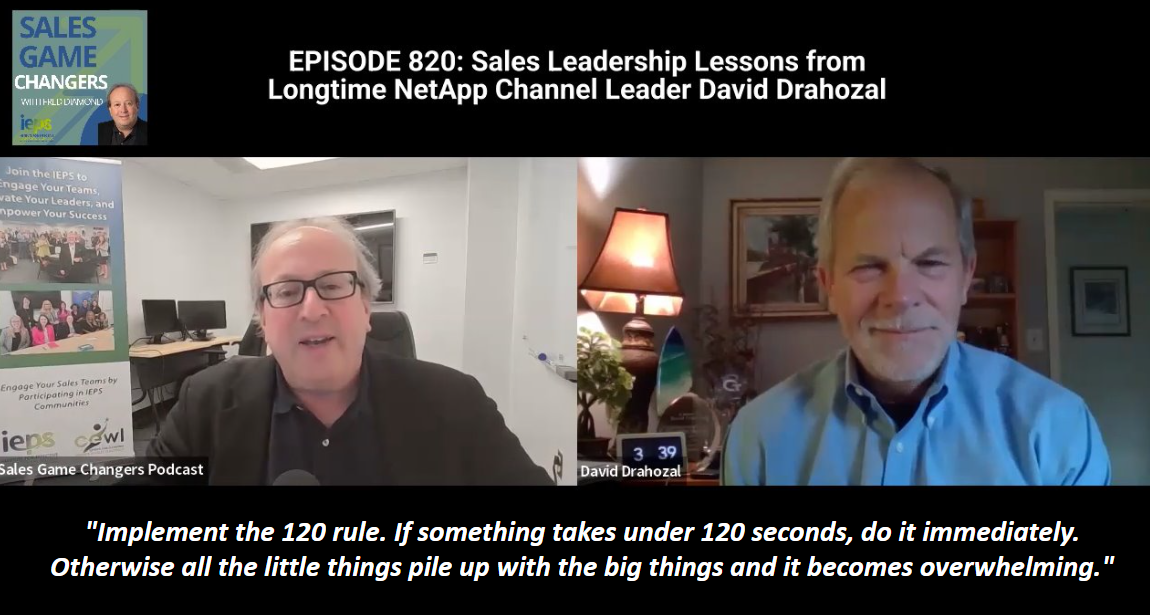
DAVID’S TIP: “Implement the 120 rule. If something takes under 120 seconds, do it immediately. Otherwise all the little things pile up with the big things and it becomes overwhelming.”
THE PODCAST BEGINS HERE
Fred Diamond: Dave, I’m excited to have you on the show. We’ve probably had dozens of people that you’ve worked with over the years. A NetApp channel leader for 19 years. We talked about Mark Weber on the prep. Before the pandemic, we used to do our shows in person. Mark, when he left NetApp, he went to the Catholic University of America and started their world-class sales education program there. When I interviewed him, I interviewed him at the Catholic University of America. We took a picture right in front of the Basilica at Catholic University, which is in Washington, D.C., not too far from downtown or from Capitol Hill. I know you’ve done a lot of work with him and probably many people. Introduce the audience to who you are.
David Drahozal: I’ve been at NetApp for 19 years. Prior to that, I was at HP for 25. Wide variety of sales backgrounds, almost all of them focused on public sector, but the pinnacle was really my 19 years at NetApp, working directly for Mark for roughly half of that timeframe. The responsibility of the role really is public sector, Fed and SLED. To me, one of the fascinating things that makes it kind of an MBA case study to a degree is started off to be a fairly small business. Today, it’s a rather large business. You got to see all the different growing pains and the exposure to the wide variety of companies that participate in those markets. It’s really super interesting. That’s a very quick snapshot.
Fred Diamond: For people who don’t know, tell us what NetApp does and what it does right now. We’re doing today’s interview in February of 2026. Give us a little peek into what the business is.
David Drahozal: NetApp is in the data storage market space. The key is not just placing the data somewhere, but it’s protecting the data, having the ability to move it into the different clouds, move it on prem, set it up for disaster recovery, integrate it into a couple of the big industry needs, right now being AI. That’s a big piece of the business. But the other business is also making sure that you can secure the data. We have some data security that makes the offering a bit special. When you look at the whole picture, it paints why NetApp is the top supplier of data storage to the federal government. That gives you a great ability to say a whole boatload of the federal government’s data resides on NetApp.
Fred Diamond: Actually, it continues to increase because obviously all the stuff that’s happening with AI. For people who are listening, I’m based in Northern Virginia, they’re building a lot of data centers in the Northern Virginia area. Matter of fact, they’re popping up almost like fast food places nonstop. I remember I asked a friend of mine who is in sales for one of the data center companies, I said, “Don’t we have enough?” He goes, “You haven’t begun to see how many data centers we’re going to have.” Some of these centers are just for a vendor. You would think that they’re like a department store with cages and stuff, but a company may have their own space, if you will. The need for storage is going to continue to grow and grow.
I’m interested in some of your thoughts. We’re going to talk a little bit about your leadership approach. You’ve been doing this at NetApp for 19 years, then HP before that. I’m also curious on your advice on what people should do when they start a new job, or when they move into a new company. Then I’m curious on some of your tips and tricks, things that you’ve gathered along the way that would be valuable for people to listen. We’ve got a lot of people in the channel who listen to the podcast. We’ve got a lot of people in public sector and B2B in general. Let’s get started here. I’m curious, your leadership approach, give us some insights into that.
David Drahozal: I’ve led teams, that’s the important thing, is the word teams in there. I’ll start this description off by, I was always fascinated by really, really excellent leaders. I went and looked at the University of Maryland’s men’s soccer team, is always top 10, frequently top four, and I’m not talking for a year or two, for decades. They’ve had a single coach over there, Sasho Cirovski, just a little bit of reading. His number one rule I adopted as my number one rule, and that is, pick the right team. You want to pick the best available athletes to put on your team. You always have to keep in mind when you’re picking people on your team that you’re never going to have enough people and headcount to accomplish and cover everything that you want to cover. It’s really, really critical to pick the right people on your team.
There’s another rule I use here. I use the next-door neighbor rule in this, and that is, if I’m going to put somebody on my team, would I be happy with them as my next-door neighbor or not? If not, I want to be able to have them as a great next-door neighbor. That creates just a good positive environment for everybody.
Second thing there is also empower your team. I know some of this might sound a little cliche-ish, but when you put all of this together and actually do it, it has a very powerful impact on the team. I just had lunch with one of my former team members today, and he specifically commented on this, “Dave, you gave us the mission. You showed us the tools. You let us do our thing in our way, not just making it the way that you would do everything.” You have to have a lot of trust and that trust is first off kicked off by picking the right team.
The other element of picking the right team is often you’re going to have different types of people. In some scenarios, covering and dealing with a certain partner, you have to be very technical. In some other scenarios, you have to be very methodical. You have to recognize what those differences are and pick the right team members and then mesh these individuals together to actually become a team. That’s all in the people.
The second is really creating the vision. I drew this off of the old saying of the most powerful thing in the world, it’s an idea. When you build the idea, and the idea that I always had, and even when I interviewed people, was at NetApp, I wanted to have the best team in my industry segment and I wanted to have the best team within NetApp. That means that you have to do some things that might be a little bit different. It might be a little bit more and you have to be committed to that goal or you’re not going to fit in well on the team. Creating that vision for the team to all work against.
Next item is, one of your key roles as leaders, put your people in a position where they can be successful. That’s giving them the right tools, making them feel empowered to succeed. Every time they need to make a decision, they shouldn’t be coming to you to make the decision for them. If you pick the right people, they have the ability to make the decision, let them make the decision and support them through that journey. A great team, all the different members support each other’s success. That’s all driven by understanding the mission.
The last thing I’ll throw in here around my leadership fundamentals is the people on your team don’t really care how much you know until they know how much you care. I’m quoting Tom Mendoza, one of the founders of NetApp in this, but it’s really super applicable. You can’t create a team over here and then have you over here. You have to be a part of that team. You’re going to lead the team, but you have to be a whole part of that team. Those are the fundamentals that I really just start off when it comes to leadership in order to get all these people working in a singular direction in order to execute against that vision, which is to be the best team in the industry and the best team within NetApp.
Fred Diamond: You’ve been in the channel space. For people who don’t know, that means there’s NetApp and then there’s companies that bring your solutions to customers. You’ve focused on value-added resellers, partners, solution providers, whatever the terms might be. How does that apply when you’re leading these cross-company teams? When you’re leading a team at NetApp, one of the things that we all know is that the reason why NetApp has been the leader in the industry is because they’ve had great technology and the ability to have great people to be on these teams, to be led by people like you. Give some insights into how the people listening could be effective leaders with other companies that are part of bringing your solution to the marketplace.
David Drahozal: That’s a skill set. What I coach people to do is, first off, identify what your assets are. Your assets are partially certainly going to be things that your company provides, but we are in a role, like my team’s role, which is dealing with multiple organizations, multiple companies, and perhaps even different segments of the organization that you’re employed with. In order to bring a singular solution or a singular message to a government agency’s mission, you have to go out and identify what are all these different assets that are brought by all of these organizations.
Your own personal company’s assets might be things like demo equipment or marketing money, or different incentives and all that. But the other assets from the other companies are just as valuable, whether it be contracts that they have, services that they deliver, expertise in particular areas. You identify your assets as one of the key things that you do when you walk into a situation like that. As you’re doing that, you’re also going to be building your extended team. Most of the time in our industry, it’s not going to be just one organization that has absolutely everything in order to support the mission.
You’re going to have to develop those relationships with those other organizations. You’re going to have to get them all together in order to buy in on a single mission and a single goal in that particular project so that you do have alignment and goal congruency. They should be clear, they should be action-oriented, and they should be measurable. All these team members should hold each other accountable towards driving towards that vision, that mission, which is ultimately to support that agency and their mission.
Fred Diamond: I’m just curious, and this may open a can of worms, but let’s say that you’re the leader. Do you believe that people, who may not be great followers in the beginning, maybe they came from another team with a great leader, but there’s some tension. Do you believe that people can be brought into the way you want to be the leader, or is it best to cast them aside? That’s a broad statement, but can you teach someone to be a good follower if you’re a different type of leader than they’re used to? Or basically, is it, “You know what? You’re just not going to be good for me as the leader. I’m going to find you another job in the organization,” and bring on more people who would be better followers.
David Drahozal: That’s a really good question. That’s a determination that leader is going to have to make quickly. You can get verbal feedback, “We’re in agreement, we’re in agreement,” but you’re going to have to also look for different ways that they’re communicating to you on whether they buy into that mission or not. There’s a saying of it’s better to fail fast. That’s something that is a really good rule to follow as a leader. I fundamentally believe in the idea that if you’re a good leader and you are aligning with the customer’s mission and everybody sees that, that they can support that singular approach, even though in some instances they might give up a piece of the puzzle that they want to have, but they can do that. That’s the job of the leader, is to monitor that very, very closely with steely-eyed objectivity and make that determination. That goes both with the overall project and with the people themselves.
Fred Diamond: I think you made a good point there also. It’s so critical because everything is about the customer right now. We’ve been talking about customer centricity, everyone’s trying to understand what does that really mean? In a lot of cases, in some certain tech companies, it was lip service. We believe in the customer, but you knew they only had one option, perhaps. Some of your competitors, I know, definitely have had that type of permeation. But now the customer doesn’t need you unless you provide such value and you’re showing them that they are first and foremost. It behooves the leaders to bring the great people together so that their company is doing that so that they can survive and grow. It’s very challenging times.
We’re doing today’s interview in late February of 2026. We all just ended 2025, which was a very, very challenging year for not just people in the public sector, for all the reasons we’ve discussed multiple times on the podcast, but the world’s going through change, AI is making a lot of things different. Now is really a great time for the top leaders to stand up. One thing that you’re also pretty savvy on is how to start a new position. Could be a new channel position, could be something else in sales, or with a new company perhaps. I’m interested in your thoughts on that as well.
David Drahozal: I’ll melt that together with some key tips and tricks, because some of that just has to do with identifying your assets and building your extended team. That’s certainly a big piece of this. But when I had somebody coming in and they’re starting, and I learned this from the most difficult guy and the best guy that I ever worked for, who you’ve had on the show before, preparation. We emphasize that, I emphasize it, do your homework before the meeting, before the discussion every time. I’ve witnessed this over the years, both when I wasn’t as prepared, and I witnessed it when other people are not prepared, you walk in and you expect other people to have the answer to the meeting and you don’t do the right preparation. The meeting doesn’t accomplish the goals or only takes a small step forward when you could have taken a much bigger step forward. Do the preparation, do the homework.
The other thing, I talk about a tip and trick here, is have the meeting before the meeting. In particular in these partner roles when you’re going to have maybe different companies or different organizations within companies and you have to bring them all together perhaps on this example of a topic that you brought up a second ago, where maybe somebody has to give up a little piece of what they want to propose in order to make the overall solution better. You get with each one of these organizations or each one of these pieces to work with them, communicate with them on what the objective is, what their objections might be, starting to handle those objections, and you work on down the line with all of the major stakeholders in that meeting. When the meeting actually happens, to a large extent, you’ve already had the meeting. You have a much more predictable way to execute against the objective of that meeting. I found that to be super powerful over the years.
Fred Diamond: There’s a couple of words that continue to come up time and time again. We’ve done over 800 Sales Game Changers Podcast episodes. When I talk to a lot of sales leaders, I’ll say, “What is your superpower?” “I’m a great listener.” I would then say, “Great. Well, give us some advice on how you’ve become a great listener.” Then one of the answers has been, “I prepare more than anybody. I know almost anything that’s going to come up because I’ve prepared.” If you do the preparation, very few things are going to catch you, especially when you’ve been doing this for 19 some odd years to the same customer base.
Now again, there’s been a lot of things that have changed over the last year, but still, there’s no excuse because the customer is meeting with you now only because you’re proving to them that you can help them achieve whatever their mission is, and hopefully, things that they haven’t thought about that will help them achieve their mission.
David Drahozal: Couldn’t agree more. In fact, the next tip and trick that I have specifically had to do with listening skills, and I agree, it is super related to preparation. The other dimension that you can hit on listening skills though is continue to be curious and dig for the facts. There’s a lot of times you get emotional feedback, “I don’t like this.” “Well, why don’t you like it?” Well, dig for what the real issue is and be curious. When you love what you do, you’re going to ask all these questions. Those are two super related topics. I really emphasize, listening is not the easiest skill out the gate. People, their first reaction is to want to express how much they know about something. They want to talk first.
Fred Diamond: Listening for that opportunity to talk. I’m curious here. You’ve had a very successful career in channel with some brand names, world-class companies, kudos to you for a great career. If someone were starting out and considering taking a job in channels, maybe someone who’s three years out of college, maybe they were an SDR or something along those lines, sales development rep, or BDR. Channels are becoming bigger. They’re becoming more important. Almost every company right now, it’s so dependent upon their channel partners because the channel is closer to the customer in a lot of ways. Or they may have a market where the company needs to go into, or a skill set.
To a lot of people who are taking looks at jobs in the channel, what would be your advice? Would you say absolutely? I’m just curious, if someone said to you, “Dave, should I pursue a career in channel management?”
David Drahozal: I think it’s a great business job. Now, one attribute that I typically look for was, did they have any direct sales experience? I think it’s super important to have that experience because you need to empathize with how that partner, that customer of ours, which is the partner company, what motivates them, how do they work, etc.? I think that’s super important. The partner job is a very business-oriented job. You’re going to work with everything from legal, to contracts, to engineering, to corporate, to salespeople, sales leadership. Then your other customer set is the actual partner themselves, the whole stack within the partners. It’s a very good, challenging job, and you can learn a whole lot from it.
I would encourage you to go into direct sales first, and then transition into partner world. Other people may have different experiences and different opinions on it, but that’s one of the fundamentals that I really did look for, because there’s nothing like taking all these pieces of the puzzle and putting it together and working with the customer to turn one dial up and one dial down in order to get the optimal outcome for that agency.
Fred Diamond: I like your answer. At the end of the day, the reason why channel exists, and by the way, my MBA thesis was on channel theory and design. It’s very inapplicable. In retrospect, I wish I had done an MBA thesis on an online bookstore, which would have been a little more effective, or a chain of ice cream shops or something. But seriously, at the end of the day, the reason why there is channels is to sell. I remember one of my professors said, “The whole purpose of channel theory and design is to find the highest quality, lowest cost way from the manufacturer to the customer.” I tell that to people all the time. Maybe a big part of it starts with, how does the customer require their purchasing? But then still as the manufacturer, you got to figure out, how do we make that as effective as possible?
David Drahozal: Yeah, put the technological puzzle together. The most effective partners that I’ve dealt with, period, are the ones that really understand the mission, really understand the mission. They’re committed to the mission first and making money second, versus the other way around.
Fred Diamond: Right, but it’s not 99% of 1%. The reason why we’re here, at the end of the day, yes, is to serve customers, but it’s to sell things, services, solutions, products, partnerships that are going to help the customer.
Dave, this has been great. Thank you so much for all your insights here. 19 years, public sector NetApp channel, and I’m excited to post this show. Congratulations on your success and all the value that you brought to NetApp. How many partners have you dealt with, do you think, over the course of your career? Definitely thousands. Do you think tens of thousands maybe?
David Drahozal: Well, a hundred or so in federal. We set a bar that we want the partners to obtain before we fully embrace them. SLED side is a little bit different. You’ve got a much broader, much diverse market, probably 4X the number of partners in that piece of the business. It’s a lot of partners. It’s a big number.
Fred Diamond: Dave, you’ve given us a lot of great ideas, some great things for people to follow for selling professionals. Give us one specific action step that people should implement right now after listening to today’s show or reading the transcript. We like to end every show with an action step that people should do to take their sales career to the next level.
David Drahozal: One is the Ted Lasso quote, “Doing the right thing is never the wrong thing.” Always do the right thing. That’s the quick one. The second one will be equally as quick. Implement the 120 rule. That rule is, you often walk out of a meeting, you’ve got a lot of tasks, blah, blah, blah. If something takes under 120 seconds, do it immediately, because otherwise, you get all these little things plus big things that pile up and then it can get a little bit overwhelming. I do it in my personal life as well as my professional life. It’s 120 rule. If you can get it done in 120 seconds, do it right away.
Fred Diamond: Once again, Dave Drahozal, congratulations. Thank you so much for being on today’s Sales Game Changers Podcast. My name is Fred Diamond.
Transcribed by Mariana Badillo