
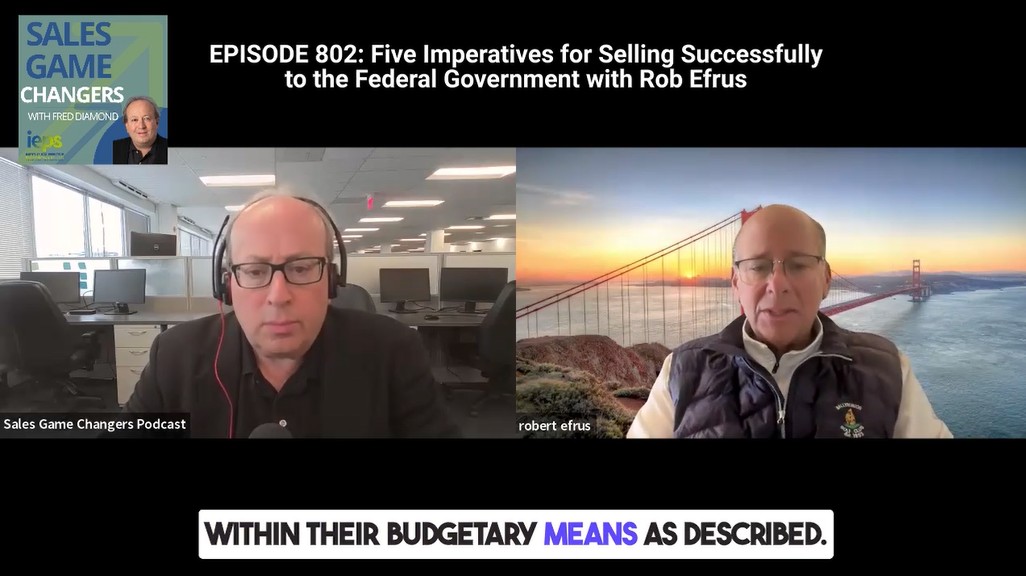
Watch the video of the podcast here.
The Sales Game Changers Podcast was recognized by YesWare as the top sales podcast. Read the announcement here.
FeedSpot named the Sales Game Changers Podcast at a top 20 Sales Podcast and top 8 Sales Leadership Podcast!
Subscribe to the Sales Game Changers Podcast now on Apple Podcasts!
Read more about the Institute for Effective Professional Selling Emerging Sales Leader Program here.
Purchase Fred Diamond’s best-sellers Love, Hope, Lyme: What Family Members, Partners, and Friends Who Love a Chronic Lyme Survivor Need to Know and Insights for Sales Game Changers now!
Today’s show featured an interview with Rob Efrus. He presented at the Carahsoft 16th Federal Budget Breakfast on December 13, 2025.
Find Rob on LinkedIn.
ROB’S TIP: “In federal sales, success doesn’t come from chasing budgets. It comes from understanding mission priorities, timing, and where money is actually allowed to move.”
THE PODCAST BEGINS HERE
Fred Diamond: Rob Efrus, you’ve been on the show before with one of your clients at GitLab at the time, and we talked about how to be more effective in working with government customers, particularly the CIO level. We’re talking to Rob Efrus today, and we’re doing today’s show only three days after you presented at the Carahsoft Conference and Collaboration Center. It was the 16th Federal Budget Breakfast. It was at Carahsoft. It was sponsored by Carahsoft. Thank you to Carahsoft for all that they do for the community. There was about 1,500 people, 500 people in the room, about 1,000 people virtually. I’ve attended at least a dozen of your Federal Budget Breakfasts in the past. You go into very granular detail on what the federal government is spending money on, and what the budget looks like, and what each individual department is allocating in contract movement and trends.
This past Friday, we’re doing today’s show in the middle of December of 2025, your presentation last week had a different tone to it, I felt. Of course, you were very granular, and good for you for speaking nonstop for an hour, taking two five-second breaks to take a sip of water. For anybody who is not familiar with Rob, I’m going to ask him to do an introduction in a second, but this is the sixth time he goes through the budgeting trends in very important detail. It’s probably one of the most important sessions of the year to help people who sell things to the federal government. Obviously, it’s been an interesting year, 2025, with the shutdown and DOGE and everything related to it.
Throughout your presentation last week, you kept saying, “More than ever, selling professionals, you need to take note of this. Selling professionals, this is what you should be doing,” and I just said, “Okay, let’s do a show with Rob real quick and let’s go to your five recommendations for selling professionals.” Introduce yourself, you’ve been on the show before, but let people know who you are and what you do, and then let’s go through your five recommendations.
Robert Efrus: I’ve been a lobbyist and business development consultant focused on federal business outcomes for over 40 years. The focus of my efforts has always been on adding value to the federal and public sector sales teams, including the executives as well as the public sector sales reps. Last week’s presentation was chockfull of information, as you point out, primarily because it was a watershed type moment relative to where the President Trump’s second administration has laid out its plans for the next four years in essence, or starting that process. I wanted to have a specific emphasis on helping the sales professionals in that room as well as online understand how the policies and priorities that the Trump 47th administration is impacting the sales climate. That’s why it had a little different tone because there was so much to discuss. That’s a little bit about me and what I was trying to do in the presentation. I spoke to Craig Abod afterwards, and his comment to me was, “Rob, you made everybody in that room, as well as online, a lot smarter.” That was my intended objective.
Fred Diamond: Let’s make them even smarter on today’s Sales Game Changers Podcast. Let’s highlight your five recommendations for selling professionals. Let’s just go through the list. Let’s start with number one.
Robert Efrus: Number one is figure out how your solution that you and your company are selling align with the latest priorities coming out of the Trump administration. They involve market segments, including artificial intelligence, cybersecurity, as well as broader policy objectives reflected in the president’s management agenda, which was just recently released, as well as what’s left of the Department of Government Efficiency, or DOGE. Where even though the leaders of that DOGE effort, namely Elon Musk and his lieutenants, have all moved on, the principles underlying DOGE are still very relevant. My goal was to highlight to the folks in the room and online that a part of your selling motion needed to identify how your specific offering aligns with the priorities in those various areas. Absent that, when you’re talking to end user customers, when you’re talking to contracting officials, when you’re talking to partners, having that alignment baked into your messaging is going to increase, I believe, the traction you will get in terms of chasing business at the agency level.
Fred Diamond: That’s a great point. We talk a lot, on the Sales Game Changers Podcast, about vertical strategy, understanding where your customers are going. I don’t want to sound ignorant here, but it seems more than ever that the management direction is really going through all the agencies.
Robert Efrus: It is, and that’s a great point because you talk about AI, the administration released in June an AI action plan, and that’s spelled out priorities in terms of how agencies should use and procure artificial intelligence. It included a specific shout out to a subject near and dear to me, and that is use more open-source software. But the point I want to make is that now agencies are implementing their own action plans that are aligned with the White House action plan for AI. Sales reps that have an AI element in their solution or are pure AI, they need to figure out how their value propositions align with that White House policy, as well as what the agencies are trying to do, because for all, it’s a work in progress. If the sales rep hasn’t figured out that messaging, they’re missing a tailwind that they can leverage. That goes as well to cyber and DOGE and the president’s management agenda, which had a discreet focus on IT modernization.
Fred Diamond: Before we go to bullet point number two, for people who don’t know, can you give us the status of DOGE? Like you mentioned, Musk and a lot of his lieutenants have moved on, but I talk to a lot of government people in the tech space and they’re still engaging at some level. Where are we? Again, we’re doing today’s interview in the middle of December of 2025.
Robert Efrus: A headline broke about two or three weeks ago that DOGE is dead. The administration stood up a response to that saying, “No, it’s not dead.” They identified a good number of projects underway, one of which I spoke about at the budget breakfast in terms of the Department of Interior digitizing all of the permit application processes core to their mission. That gave you an indication that from a policy standpoint, even though the organization is not active out of GSA, its principles in terms of efficiencies and consolidation and managing software costs are all very much priorities of the administration, even in the absence of Elon Musk.
Fred Diamond: I do want to say that I got an email from Carahsoft right afterwards, where they have all the links to the various things that you went through and some of Craig Abod’s remarks as well. We’ll put those links on the show notes on Sales Game Changers Podcast. Robert Efrus, number two. What was your second observation?
Robert Efrus: Familiarize yourself – this is to the sales reps – with the billions of dollars of funding that are available in the One Big Beautiful budget bill that was passed last year. It contained a very, very significant amount of funds in general for many different activities. But specific to federal sales, there are billions of dollars that were approved for AI and cyber in specific market segments like maritime and defense autonomy, border security, weapons testing and cyber, rural broadband, rural health, and nuclear and science cloud matters. We are taking a step back with a very tight budgetary environment as the bulk of federal agencies are still operating under a continuing resolution and the administration is taking more discretion away from the Congress in terms of how it reallocates funds that have already been appropriated.
All of that suggests that agencies are under the budgetary gun and federal sales reps need to be familiar with these pots of One Big Beautiful Bill funding that are still available that agencies can access in the areas I mentioned, IT and cyber being two broad categories. So that when you get budgetary related objections to your deal and your customer is out of tricks in terms of how to find money, having a knowledge of where these One Big Beautiful Bill funds reside and how agencies can access them, will be a feather in your cap.
Fred Diamond: That is a great thing. For people who are listening who aren’t familiar with selling to federal and public sector for that matter, a big part of the selling process is understanding where the budget is, what’s available to be spent, etc. Before we get to number three, I just want to ask you to define for the audience continuing resolution. For people who don’t understand, just give us a synopsis, because we throw that term around a lot. Even last week, I’ve had some people explain to me parts of it that I didn’t understand. Just give us a one-minute overview for people who are ignorant on what that means.
Robert Efrus: Congress is required by law every year to enact and fund the federal budget. Many years, over the last 20 plus years, Congress hasn’t been able to complete that job by the end of the government’s fiscal year on September 30th. As a result, they have to pass a temporary funding measure that freezes the spending levels of federal agencies funded under that CR at the enacted levels, which is typically a year prior, and run those spending levels out on a month-by-month basis, depending on how long the continuing resolution lasts. During a CR, agencies can’t embark on new starts and they have to live within their budgetary means as described.
Fred Diamond: Very good. Number three.
Robert Efrus: Number three, I spent more time than ever on acquisition reform. There’s a once-in-a-generation effort to rewrite the procurement rules governing how the government purchases IT products and cyber products and services. I challenged the sales reps in the room and online to at least have a cursory understanding of what is trying to be accomplished. In a nutshell, these reforms which are occurring at a national level through a rewrite of the Federal acquisition regulations, as well as an agency specific level, and notably the Department of Defense rewriting its own rules. They’re intended to try and make the government buy things more on a commercial basis versus a custom basis, which typically costs more over time.
The rules are trying to be biased in favor of new innovative entrants into the federal market that don’t have the years and years of experience in meeting all the various rules. There are some specific exceptions that lower the barriers for new innovative companies to enter the federal market to exclude them, if you will, in a favorable sense, from having to deal with all the minutia of federal contracting. The goal is on agile procurement, and with regard to the Department of Defense, ensuring that the acquisition process doesn’t stand in the way of speed-to-mission type requirements.
Fred Diamond: For people who don’t know, who manages the federal acquisition regulations, where does that get centered, and who’s responsible with modifying those?
Robert Efrus: There’s a couple of key players. The first is the Federal Acquisition Regulation Council. That has traditionally involved the Department of Defense, my old agency, NASA, and the General Services Administration. They’ve been supported by an entity within the executive office of the president called the Office of Federal Procurement Policy. I would also add the Office of Management and Budget as the parent of the Office of Federal Procurement Policy, is also another key stakeholder.
Fred Diamond: I know you don’t have a crystal ball, and this is a little bit off track, but where do you think that’s going? Is there going to be an end point where the government will be able to just purchase the same way a typical corporation would, or where do you think we’re going with that funding?
Robert Efrus: I wouldn’t go that far, but what we’re looking at is a much more streamlined rules and regulations. One example I gave during the presentation last week was the FAR, which is hundreds and hundreds of pages long, had formally contained 1,500 references to the word shall, the shall meaning that contracting officers must follow these specific rules. They’ve eliminated 1,200 out of those 1,500 shalls to give the contracting officers more discretion.
Fred Diamond: That’s powerful, man. All right, number four.
Robert Efrus: Number four is in relation, also acquisition reform related, to an initiative called OneGov. Many in the enterprise IT space are familiar with a GSA initiative managed by its federal acquisition service to scrutinize how much the government is spending on large software deals, and provide more larger discounts that involve direct contact with those large enterprise IT vendors. A list of which I presented during my presentation, and I noted how much Carahsoft has been involved as it represents many of those large enterprise vendors, but achieving discounts on the order of 70% to 90%. It’s been an invite-only process where the GSA has identified the companies it wants to achieve those type of discounted outcomes, but there’s a second form of the OneGov type arrangement called OneGov-type that doesn’t require these massive discounts, but rather can include terms and conditions that are different from the status quo that don’t rise to that massive discount level, but work toward that direction.
This is where I challenge the folks in the room and online to become familiar with how offering better terms to the government and leaning in on that, even as a smaller and medium-sized enterprise IT vendor, is going to achieve a strategic benefit to the vendor. To the extent, on the one hand, they recognize that this is what this administration is trying to do, the vendor is doing what it can as contrasted with these larger companies. That’s a strategic investment I encourage the vendors represented in this breakfast that I spoke at to try and figure out what they can do, because strategically, it’s going to put you in an advantage position with your customers down the road.
Fred Diamond: It’s interesting, as you’re going through your four bits of advice, I’m saying to myself, the reason we do this is it’s such a huge marketplace. As you’re talking, I was thinking like, “Wow, does this even make sense for people to want to sell because of all these things that makes it a challenge to sell to the federal government?” But it’s still Fortune One. I tell people this all the time, everything that happens for the most part in the government is critically important to the citizens of the United States and the world. We’re talking like people who are devoting their careers to fixing highways, and obviously the safety of the citizens in war areas, etc., and of course, research and health and human services. As you know, I’m a world-renowned expert on Lyme disease awareness. Today, on December 15th, RFK Jr. is going to be holding the first round table on Lyme disease to address more research and treatment. The things that happen in the government impact everybody every single day.
Robert Efrus: For the sales rep who is dealing with a large federal agency, which has a siloed implementation of that rep’s company’s software, one step to take that a sales rep otherwise wouldn’t is to have a good sense as to where your software is running in that federal agency and proactively identify how the consolidation of those different stovepipe implementations can be done in a way that lowers the cost to the government, but still maintains the position of the vendor in that agency’s install base. It’s a step that sales reps you would think would not want to do, because the more silos, you could argue, the more commission the sales rep will get. That’s true, but in this environment, leaning in in a way that can demonstrate good faith on the part of the vendor in terms of trying to streamline in that illustration all the various licenses around an agency, will put you in good stead with that agency customer.
Fred Diamond: I had a couple of CIOs from the government on the podcast about a year or two ago, and I asked them for their advice and they said, “Just help us work with your company. Help us understand the vehicles that we have and how we can optimize our business relationship with your company.” That’s sound advice.
Rob Efrus, I’m asking you for your five bits of advice for selling professionals, and these are actually more than bits, give us number five.
Robert Efrus: Number five is in an area that not all federal sales reps are involved with, but it’s one where the efforts of President Trump and his team to get the NATO countries and other foreign countries to agree to buy more from US suppliers, is a trend that is underway. In the first Trump administration, President Trump sought that those NATO countries and others allocate 2% of its defense budgets to buying from American suppliers. Now, that percentage has increased to 5%. Both the administration and the executive branch, as well as the Congress, are taking steps to make US companies more competitive in these global marketplaces where the US is competing against adversaries like China. For those reps that have some involvement with foreign military sales, I am suggesting that you become familiar with these reforms and redouble your efforts to position your offerings to NATO countries and others because you’ve got tailwinds coming out of the White House and coming out of the Congress that I think is going to enable your company to get a larger piece of the pie.
Fred Diamond: That’s a great bit of advice. I want to follow up on one topic that you didn’t bring up, but I see is a huge trend, and it goes into some of the things that we talked about here. A lot of government professionals have left. Either they’ve been laid off because of downsizing, a lot of them have reached retirement age and have chosen the packages that were made available to them over the last 12 months. One of the things that we’re seeing a lot of is there’s new people being in responsibility. I remember we’ve spoken with a number of sales leaders on the podcast and at the Institute for Effective Professional Selling who have been at a company for 30 years, the Oracles, IBMs, Intels, etc., and their government customer has gone with them for the 30 years. Now, a lot of those relationships are going away because a lot of the government people have left. What would be your advice for selling professionals to reengage or to newly engage with the new people who are in these roles, who might be new to government, perhaps, or new to an agency, or have been promoted, whatever it might be?
Robert Efrus: This was the basis of my first point, that is you’ve got an administration with approximately 4,000 political leaders, Schedule C appointees, that are new to their roles and new to government. Then you’ve got this major workforce gap where over 300,000 federal employees left government service. The goal, first and foremost, is to show how engaging with your company will address the administration’s priorities. Because agency leaders, political appointees, as well as folks who are new to government, all are seeking to make their agencies and their agency leaders look good with the Trump administration, which has aggregated more power in the executive branch in over a generation, unprecedented. You want to have that policy perspective.
You also need to consider how your solution can address those workforce gaps. This administration has placed a great priority on AI and the related automation outcomes that are achieved through AI. If you’re selling an AI solution that enables the government to do more with less manpower, that would be a perfect example of how to address some of these gaps.
Fred Diamond: Rob Efrus, thank you so much. Thanks for doing this for 16 years and for all the value you’ve provided to the selling community. Like Craig said, we’re all smarter every year by attending your session, but this year there definitely was a unique tone to it. Any final thoughts? Anything you want to wrap up on that we might not have discussed that you definitely want to get across to the audience today?
Robert Efrus: I am a salesman at heart, I have sales DNA, and so that is why my focus has been on making the sales stakeholders smarter and enabling them to do their jobs better on behalf of the government. The government needs industry more than ever. There’s more of a focus on ensuring that industrial base is vibrant so that we can achieve both for our country as well as in the global marketplace, the US can continue to be a leader.
Fred Diamond: Once again, the Institute for Effective Professional Selling, every month we’re going to be addressing these topics with sales leaders as part of what we call our main stage live programs, which are held hybrid. The live portion is at the Carahsoft Conference and Collaboration Center in Reston, Virginia, and virtually around the globe.
Once again, thank you, Rob Efrus, for the great job, for being on today’s show. My name is Fred Diamond. This is the Sales Game Changers Podcast.
Transcribed by Mariana Badillo