
The Sales Game Changers Podcast was recognized by YesWare as the top sales podcast. Read the announcement here.
FeedSpot named the Sales Game Changers Podcast at a top 20 Sales Podcast and top 8 Sales Leadership Podcast!
Subscribe to the Sales Game Changers Podcast now on Apple Podcasts!
Purchase Fred Diamond’s best-sellers Love, Hope, Lyme: What Family Members, Partners, and Friends Who Love a Chronic Lyme Survivor Need to Know and Insights for Sales Game Changers now!
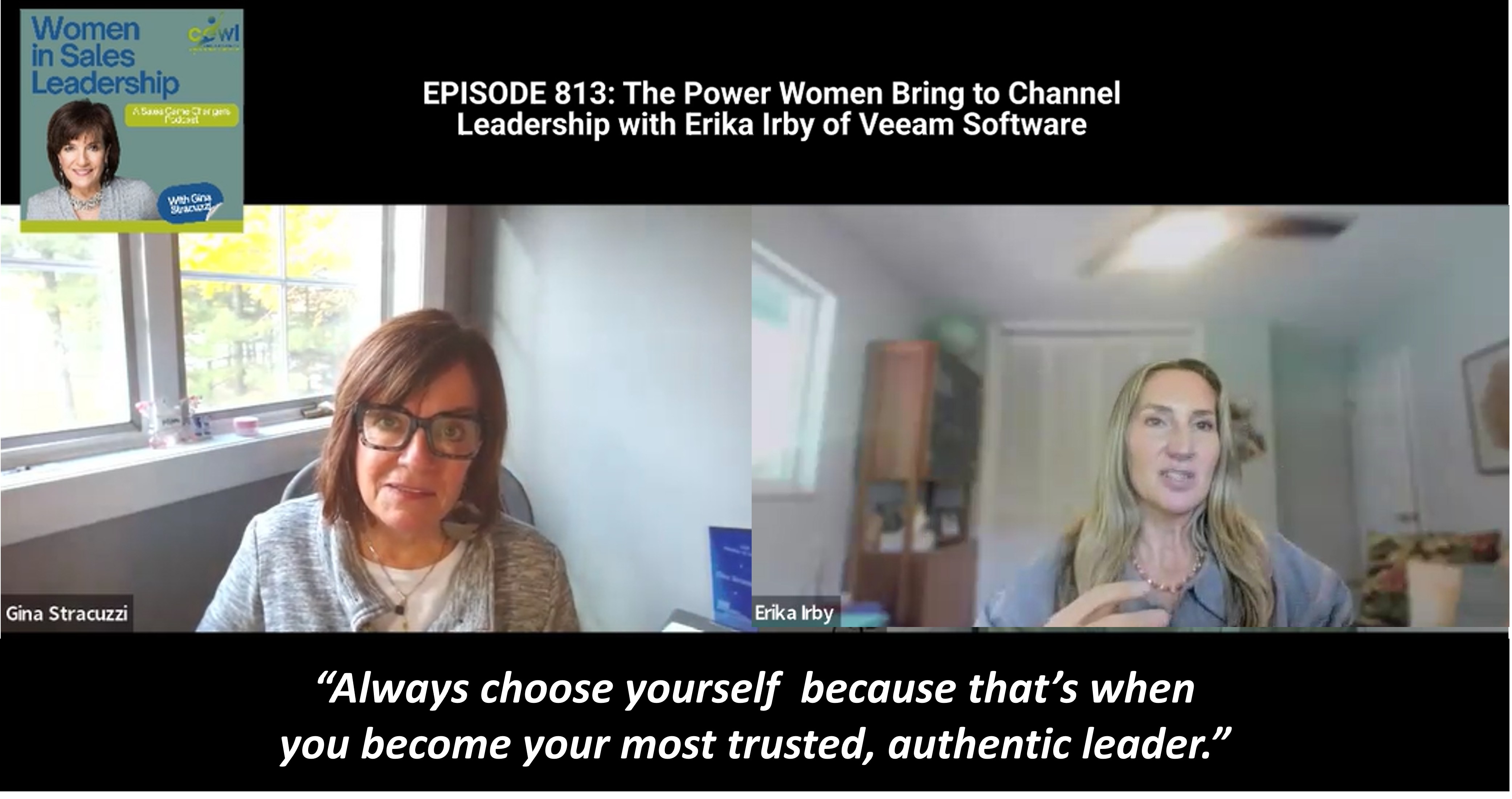
On today’s “Women in Sales Leadership,” show, Center for Elevating Women in Sales Leadership President Gina Stracuzzi interviewed Erika Irby, Director, Channel Marketing, Americas for Veeam.
Watch the video of this podcast on YouTube here.
Find Erika on LinkedIn.
ERIKA’S TIP: “Always choose yourself because that’s when you become your most trusted, authentic leader. In the channel, trust and relationships are everything. Without them, you never get past the first conversation.”
THE PODCAST BEGINS HERE
Gina Stracuzzi: Hi everyone. Welcome to another episode of the Sales Game Changers Podcast. This is a Women in Sales segment. I am super excited. My guest today is Erika Irby. She is director of Americas channel marketing at Veeam Software. Previously, Erika was the go-to-market director at Microsoft across global partner solutions and device organizations, owning the strategy and channel marketing direction across US and Canada. She is well-versed in all things channels. She has over 20 years’ experience in education, global IT distribution, vendor marketing, and she’s been named CRN’s Women of the Channel list and one of the 100 most powerful women of the channel. She’s a speaker, a writer, and a leader in the IT industry. Welcome, Erika.
Erika Irby: Thank you, Gina. I’m so glad to be here with you.
Gina Stracuzzi: Me too. I know as we were talking a little bit off camera, it’s taken us a while to get this organized, but those are usually some of the best conversations. I know I gave the audience a brief little introduction. Is there anything else you’d like to tell us about yourself before we get into our conversation?
Erika Irby: I’m super happy to be here and I think it’s interesting the way that we got connected, was because of an Ultimate Partner Live event with Vince Menzione, who connected me with Fred, even though I didn’t really know we were connected until he approached me. But this is exactly how the channel works. This is how the network works. We go to these events, we come together, something sparks something, we have that conversation, and then boom, we’re connected, and then things happen after that. I think it’s such a great example of how a channel works and how it can bring us all together.
Gina Stracuzzi: It’s something that comes up in the Women in Sales Leadership Forum that I run quite often, just the critical importance of your network, both internally and externally, and getting visibility like this. You’re not going to get these kind of opportunities if you don’t network like you did. It’s a good example.
Erika Irby: Absolutely, a hundred percent.
Gina Stracuzzi: I want to really dive into both your background and what you see as opportunities for women and the value that women bring to customers, partners, companies, and let’s just talk about the layered nature of it all. Based on your experience leading go-to-market and channel marketing across organizations like Microsoft and Veeam, what are some of the specific behaviors that you see women consistently bringing that actually change outcomes with customers and partners? Not just in culture, but in revenue, trust and those long-term relationships?
Erika Irby: I really love this question. I really try to think about women are definitely unique, but as a whole, I think we bring a lot of empathy, patience, and attention to detail, I think are three huge qualities that, in general, I think women tend to really bring to the table. I think we’ve mastered those soft skills required for good business relationships a long time ago, long before people called them soft skills. That was just something that women naturally exuded. I think that we also have the ability to be super savvy, keen, mindful. I think we also lean into our natural situational awareness. Often, we can pick up cues and things that maybe others may not notice.
Just like men of course, though, women are absolutely unique. Some of us bring a very strong financial acumen or a strategic insight background or a really keen business discernment. I think others bring incredible creativity and these big bold ideas and bravado and swagger. We hear in the industry a lot of times referring to people as a badass, but a lot of times it’s talking about a woman. Nowadays, we call them a baddie, which I think is really hilarious, but they bring that attitude and that persona a lot of times. I think often, some women, they’re just sitting there at the table and their physical being just exudes this sense of strength and power. That in itself can really endear customers and partners to a company, to an idea, to a strategy, to a path forward, simply based on their belief that that leader is trustworthy and informed and is capable of handling their business, and they really feel confident in that.
Gina Stracuzzi: It absolutely shines through. I need to ask, because you’ve been in some big rooms, are there ways and areas where you think organizations still fail to fully recognize or utilize that innate power, those innate strengths that women bring to the table?
Erika Irby: I think sometimes. I think there’s still a notion in our society about women being very emotional. I think there’s some negative connotations around that, because the truth is, when I’ve been in rooms and there’s been emotion, and especially if it’s a frustration or an anger, it is often coming from a man. But that is seen more as them being aggressive and passionate and wanting to push the business, and they’re expressing their frustration as they should be, and things like that. Whereas if a woman demonstrates any frustration, then she’s too emotional and she’s upset and she’s not handling the situation and not reacting well.
That sometimes is just part of this stereotypical society feeling this way. But I think there are many cases where in an event like that, if a man sides with the woman or expresses a similar sentiment or suddenly normalizes what she’s doing, then the conversation can continue and then everyone realizes, “This was a valid reaction or a valid thought,” or, “We need to go back and revisit that,” or, “Let’s work together to have a path forward. But it was okay that she brought this up in such a way.” I don’t think it’s companies necessarily that are doing this. I think it’s really about the folks in the room, what kind of leaders they want to be, and then are they setting aside any type of societal biases and instead just looking for the situation for what it is and then reacting as if they would react that that person is a completely competent person regardless of their gender.
Gina Stracuzzi: That’s very powerful, Erika, because I think you’re right, it is situational and it’s interesting because when I talk to men and I say, “Do you support the women in the meetings?” or, “Do you stop people from talking over them?” or whatever, and they’re like, “Wait, what?” I think it’s just that we’re thinking about the next thing that needs to be said in a meeting or taking notes or something. We’re not paying attention necessarily to the dynamics. Your point is so valid because there’s a lot of allies in every room, it’s just sometimes they’re not paying attention to what’s actually happening in terms of dynamics. They’re more focused on, “Okay, she said that, now I’ve got to say this to drive the deal home,” or whatever the case is. I like the way you said that, and I hope that every man that listens to this will pay attention when they’re in meetings and really bolster the power that’s there with your female colleagues.
Erika Irby: Some people it feels really overwhelming, your point about allies where they think, “Oh my gosh, what do I have to do to be an ally? What do I have to say?” It can become almost this overwhelming task, like a part-time job, but really to me, because the truth is women have to be allies too. We should all be allies to anybody in the room who may not be getting their fair share of their voice time. If you just approach it, even very small things like if the leader is a man and a woman actually owns the business, she’s the one that is leading that team, if he says something like, “Well, I’m going to defer to Erika. Here’s my opinion,” that little comment of saying I’m going to defer to her indicates to the room that while he is sharing his opinion, and it is very valid, the ultimate owner of the business is Erika. When she speaks, that’s what we really need to keep in mind. It seems like such a small thing, but it helps to shift the folks in the room to just know where the decision is going to lie and then nobody is questioning it.
Gina Stracuzzi: You’re right, it’s just little things, like, “I have an opinion on this, but ultimately it’s Erika’s decision which way we go.” Those little things mean the world. That’s a great coaching opportunity there. I’m glad you took it.
Let’s talk a little bit on sales and marketing evolution. We’ve been reading more and more, and we even have a podcast now as part of the Sales Game Changers Podcast lineup. It is really the intersection of marketing and sales. This next area that I want to talk to you about is really timely. We know that the intersection of sales and marketing, it’s always been a little bit of a struggle for the two entities, but now it’s absolutely essential that they’re working together. How have you seen that relationship in the channel world between sales and marketing evolve and how complex is it in the channel area?
Erika Irby: I think that that is a really great question. I would say first of all that sales and marketing are no longer these bifurcated orgs that they used to be. Now more and more we actually see that sales and marketing are together and they create a go-to-market team or a go-to-market strategy and execution team. This isn’t groundbreaking. I think people in sales and marketing would say this, that since the beginning of time, that the intent was that they would work hand in hand to create and drive and close pipeline seamlessly as one team.
This can be very complex, and I experienced this at Microsoft because it was such a massive company, but I even see this at Veeam too. It can be a very complex matrix organization because it’s critical that we all move in this complimentary action, but folks have different jobs, and that’s why this is created this way, that they’re supposed to have different jobs, but we are supposed to work really closely together. Ways to make that happen, we are seeing marketing teams now gold on sales pipeline, because having that direct connection when it comes to compensation is a surefire way to get people to work together. We also see some sales development rep teams gold on certain marketing pipeline. I think that this is important because we’re seeing a shift from MQLs and SQLs really to goals that better align with each organization’s position in the funnel or customer life cycle. That way we all are interconnected along this journey and everyone has their place. Then one action feeds into the other.
Marketing is no longer seen, in my experience, as this event planning, party planning money bags. Sales is also not seen as this just die hard, we’re going to get every single deal and we’re going tell marketing, “We don’t need you.” It’s really not like that anymore. I do think in the past there was a little bit of this tension between sales and marketing and sales didn’t necessarily maybe feel the value of marketing, and then marketing was frustrated because they had leads that were just sitting there in the queue that sales wasn’t touching because they had their own priorities. But now I do think that has changed and marketing really is seen as more of a strategic investment managing all that investment, driving demand gen that is in alignment with sales priorities. I think we have evolved.
I think it’s now a true partnership. Even for companies that are still struggling with that, that’s what they strive for. We can see this a lot. We can see even some go-to-market teams actually have marketing and sales on the same team, and they’re rolling up to the same leader instead of being in two separate orgs. We also see go-to-market sections mandatory in QBRs and marketing folks invited to different critical sales meetings, and marketing teams ensuring that their sales teams are in lockstep with all their marketing plans and not moving on any investment until the sales folks have agreed and have signed off. It’s truly this combined integrated plan. I think all that is really super positive and I do see marketing being very tight with our sales counterparts and vice versa. We’re seeing huge success with that. I will say at Veeam, we blew our sales target out of the water for FY25, and we also blew our marketing target out of the water as well, and that’s no coincidence, that both teams over-achieved and really worked hard together to hit that final goal.
Gina Stracuzzi: That is amazing and really great advice. It’s a true-life example of what can happen when pretending they are and but aren’t really. Looking forward, if you were advising a chief revenue officer and a chief marketing officer, what would you tell them to stop doing if they weren’t working in alignment such as your teams are?
Erika Irby: The first thing I would advise them to look at is their team targets. Always go to compensation. That is such a driver. If folks are compensated on two totally different disparate things, that would be an immediate thing to fix. Then from there you can look beyond compensation, but also goals, targets, prioritization. Sometimes what happens is if the marketing team is totally focused on just pure top-of-funnel demand gen, that’s lovely, but the sales team is focused on nurturing, but then also closing. That leaves a gap in the middle sometimes because we can have a million leads coming in the top of funnel, but they’re quite cold. To get them down the line, we still need marketing to have multiple touch points and triggers to get them to continue to demonstrate their interest to make those leads hotter and hotter so sales can actually jump in there and then take us all the way home by closing the deal.
There’s also a lot of pre-sales activities that marketing should be involved in. That goes hand in hand with sales. Also with your engineering teams, you need to make sure that they’re also involved and making sure that we’re there helping with those pre-sales activities, that there’s investment there from both marketing and sales to help that. Then finally, I would also say, look at your programs. Those should be built in conjunction between marketing and sales to make sure that partners, “Hey, we have to have these value incentives.” That absolutely needs to be in there, but marketing shouldn’t be creating those alone. They should be incenting the activity that we want to ensure that that product or whatever it is, that that is the prioritization of sales. Priority, alignment on programs, I think alignment on campaigns, alignment on compensation, and then making sure that you’re not leaving big gaps in your funnel.
Gina Stracuzzi: That’s great advice. Really powerful advice. Let’s talk a bit about if you were looking back over your career, and this is turning things back to the women in sales piece of this, what’s one lesson you wish women knew earlier in their careers and what they understood about influence, credibility, power in the partner-driven organizations? Because you’ve had a very specific kind of career, and it happens a lot that we think to ourselves, “Gosh, I really wish I’d known this 20 years ago, because I would’ve done this differently.” What advice would you have along that line if you were looking back?
Erika Irby: That is a great question. I think I would have two main things that really stick in my mind. One of them is from a purely career standpoint. One of the mistakes I made very early in my career, I had a company say, “Can we see your latest pay stub from your company?” I was so naive, and I was so eager to jump into a bigger role that I shared it, not realizing that there was zero reason for me to do that. I just was so eager to move forward and get this new role. Because of that, I started off at a lower salary than I probably could have negotiated, but I didn’t have the confidence and I didn’t have the awareness at the time. I was in my early 20s.
Looking back on that, there was no reason for me to do that. I should have been like, “This is my salary expectations. What are you offering me?” Instead of them looking at my pay and being like, “Great, this is a big raise for her,” and then I just took it. I would say if you’re super young in career and have a salary requirement, don’t be afraid to stick to it. If a company asks for your previous, which I don’t even know if they do this anymore, but if they do, the answer is no and this is your range, and there’s that.
Then from a partner perspective, I remember very early on hearing that the most critical element of success in the channel is relationships. In some of my jobs, I was actually dinged on having that quality because it was considered like, “That’s an easy thing. You should have more financial acumen. You should have more strategic acumen. You should have more business.” Those things are all super important, and you will never be able to drive a successful business without those things, but I will die on a hill that when it comes to the channel, the utmost important element I think in success is absolutely trust in relationships.
I think in the channel, one thing we, and if you work in the channel, you’ll a thousand percent agree with me, but it’s actually quite small. Even though there are just thousands of companies, billions of dollars, the channel itself is a pretty tight-knit org. We see this all the time because folks go from job to job. If you’re a channel chief here, you’re likely going to be a channel chief somewhere else. We see this with, this is a simple thing, but it is a huge indicator, the CRN Channel Chiefs list. People vote on that from your own community, from your own ecosystem.
You’re a channel chief at Veeam, it’s Kevin Rooney, he’s known throughout the ecosystem because he’s worked at other companies and those channel leadership, they know him as well. It permeates throughout the ecosystem. Everyone knows the channel chief that’s at Microsoft, everyone knows the VMware channel chief, etc. All these folks, HP. It’s because so many of us have these connections with one another because we go to these industry events together, we work together, we invite these people to our partner advisory councils. We are included in other boards and other advisory councils because we all work together. Clearly, we compete, but we also are driving technology together and ultimately what is really best for our partners, which are shared across the ecosystem.
Having these relationships and really being able to connect with somebody on that level ultimately lays the foundation of trust and then will ultimately help you be more successful with that business because they already know that you’re on their team. They already know that you’re somebody that they can trust and believe in, especially if you’re going to convince them to do something that maybe is outside of their box, or ask them to try something new. You have to have that element of trust and relationships or you will never get past the first discussion.
Gina Stracuzzi: I have often joked at the kind of incestuous nature of public sector.
Erika Irby: That’s even smaller.
Gina Stracuzzi: People move from employer to employer and everyone knows them. You really cannot burn a bridge or even smoke it, because to your point, it’s quite small and I think there’s a lot of opportunity in there for women. But to your point, once you get that trust, you have to keep it and you have to earn it. It is not something to be taken lightly. That’s where your influence and your credibility comes from and your network will expand, and that gets you visibility in the industry as well as visibility in your company. That is all great advice and keeping in mind each time that it is a small community, so you have to keep that credibility up. That is really important.
One of the things we like to do is ask for any remaining advice you would like to give, and then I will ask you for one piece of advice that listeners can put into place today to help bring their career or their selling up to the next level. First, if there’s anything else you would like to share with us, we would love to hear it.
Erika Irby: One thing I think is super critical from both a sales and a marketing standpoint, I think this is really critical from a company standpoint, is storytelling. At Veeam, you may have heard through the channels that we have a new CMO, Allison. She really has introduced to Veeam the story of Veeam about where we originate from and why we’re different and all these unique factors and even weaving in our culture. It’s an incredible story, and I really cannot wait for it to be honed so we can go and tell it. We have to tell it internally first, and then we’re going to go tell it to the world.
The truth is, when you’re in any job that you have, you’re telling the story. That’s what you’re selling. You’re selling either the story of how this product will drive your business, or how this service will save you money, or how what you can do will change the world. This is what we’re all doing. I think honing in on that ability to not just speak about features and benefits of a product, but to tell the story of what you do for the world, what you stand for, the difference you make in our ecosystem and how you are going to contribute to someone’s success is a way more powerful way of selling than just traditional success stories. Really telling that true story. It also helps endear your customers and partners to you because it’s something that they can believe in.
Gina Stracuzzi: Years ago, when I first got started in selling, I was a commodities broker, and that means you have to really get farmers and producers to believe that you have their best interest at heart in how you’ll approach the markets and trade for them. I just very naturally talked to them about my immigrant grandparents and how they struggled and grew things and really appreciated the value of things. Without even realizing, I was telling a story that they could relate to and it served me so well before I even realized that this was a thing. That’s how you build trust. It’s always been a great lesson for me and it’s something that stuck with me. I love that you’ve driven that home for a whole new generation of people.
We hear about storytelling, but it’s that relationship to trust building that I think is so critical because we all have biases, and a similarity bias is something that people can see in a story, even though we don’t want necessarily to perpetuate bias. But when they can see that you care about something, and perhaps that’s something they care about, and really that’s ideally what’s going to happen in the sales situation, you both are trying to achieve the same goal. It’s really important to keep all of that in mind when you’re telling stories and align it with what you’re trying to achieve. It is probably one of the best ways to build trust that you can do. I love that.
What piece of advice do you have for our listeners that they can put into place today to start telling better stories or propelling their sales career?
Erika Irby: Your comment about bias, you’re right, we don’t want to perpetuate negative bias, but we do want to perpetuate a bias for our products. Everyone wants to do that in the channel. They want to drive a bias for their product and services. If you keep that in mind, the stories you’re telling are to drive that, nothing negative, but to drive that focus, that natural inclination to what you’re selling, and you can do that naturally with your storytelling.
My piece of advice, and this is going to sound super selfish, and people might be like, “Oh my God,” but I would say always choose yourself. What I mean by that is you are your best and most validated and the best version of yourself to everyone around you when you choose yourself. What I mean by that is you’ll be a trusted leader when you follow your own instinct. Because when you’re authentic and when you make a decision based on what you think is best, and maybe despite other pieces of guidance, in your heart, if you’re like, “I think this is the best decision,” you’ll be a more trusted leader than if you decide to make a decision that somebody else thinks is right, but you don’t totally believe in, and then you’re only half invested because another part of you is like, “Ugh, this is not what I wanted to do. I can’t fully give myself.”
Every time that you’re in a situation, just be super mindful of what your gut is telling you, what you think is for your best, and when you do that, you will not end up letting other people down because you said yes when you really wanted to say no. You will always be in a position of confidence and accountability when you choose what you think is best, even if what you choose turns out to not be the best decision, or maybe it didn’t go according to plan, you will be able to take accountability for any of the missteps or mistakes or missing the target or whatever, with a true and open heart because you made the decision in the first place.
It just comes down to it, and also for your own mental health and physical health and all those things, even with your family, and again, this sounds selfish, but if you have children, you cannot be a good parent if you are not putting your own wellbeing first, because you’ll become exhausted or frazzled or stretched too thin. Then you will not be a good parent, you will not be a good partner, you will not be a good friend, you will not be a good coworker if you are not fortifying yourself first.
Gina Stracuzzi: That is phenomenal advice, and something that most of us women need to hear again and again, because it is very easy to get stretched very thin and to put everyone in front of your own needs. That’s why they say put on your own oxygen mask first.
Erika Irby: Yeah, exactly. It’s hard to do that. It can be super challenging.
Gina Stracuzzi: It can be. Erika, this has been a great conversation. Thank you so very much for your time and your expertise and insights. We look forward to talking to you again sometime in the future.
Transcribed by Mariana Badillo