
The Sales Game Changers Podcast was recognized by YesWare as the top sales podcast. Read the announcement here.
FeedSpot named the Sales Game Changers Podcast at a top 20 Sales Podcast and top 8 Sales Leadership Podcast!
Subscribe to the Sales Game Changers Podcast now on Apple Podcasts!
Purchase Fred Diamond’s best-sellers Love, Hope, Lyme: What Family Members, Partners, and Friends Who Love a Chronic Lyme Survivor Need to Know and Insights for Sales Game Changers now!
On today’s “Women in Sales Leadership,” show, Center for Elevating Women in Sales Leadership President Gina Stracuzzi interviewed Jessica Baker from AchieveUnite. AchieveUnite is an Institute for Effective Professional Selling Selling Essentials Marketplace partner. She was a presenter at the October 9 Women in Sales Elevation Conference.
Watch the video of this podcast on YouTube here.
Find Jessica on LinkedIn.
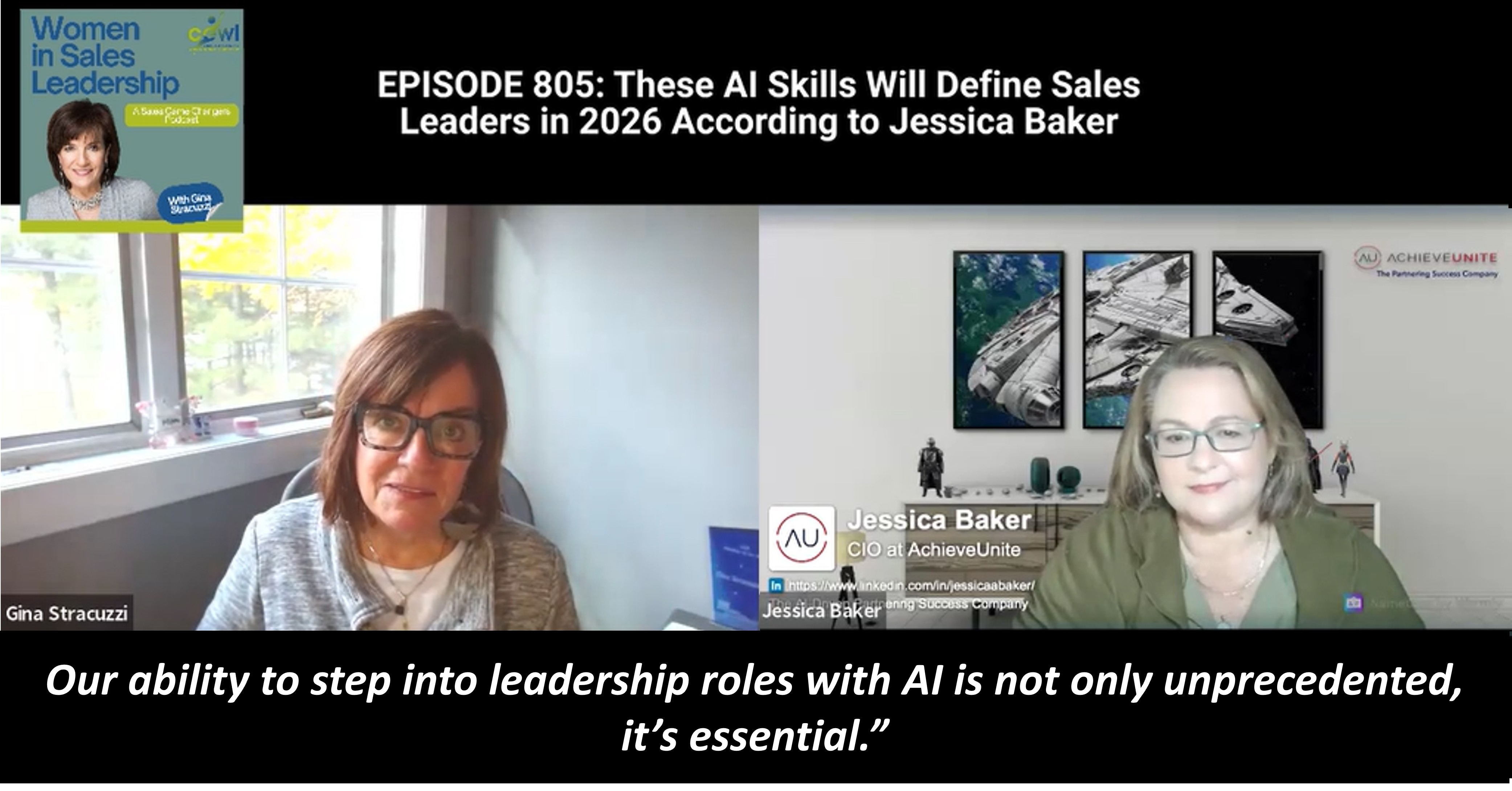
JESSICA’S TIP: “Women are uniquely positioned to help with this because we bring empathy, opportunity, and creativity to thrive in an environment where the shiver of sharks is coming so quickly. Our ability to step into leadership roles with AI is not only unprecedented, it’s essential.”
THE PODCAST BEGINS HERE
Gina Stracuzzi: Welcome, everyone. I’m so excited for the next segment of the Women in Sales Leadership podcast. Today, I have a really phenomenal guest. She was a speaker at our recent Women in Sales Elevation Conference. What she talked about was so well-received and interesting that I thought, “I’ve got to share it with a larger audience.” Sit back and listen to my guest, Jessica Baker. She is Chief Innovation Officer at AchieveUnite, which is a partner of the IEPS.
Welcome, Jessica. I always like to let our guest talk a little bit about themselves, give their background, and how they got to where they are. Then we can take the conversation off from there.
Jessica Baker: I’m the Chief Innovation Officer for AchieveUnite. We are a partnering success and AI company. We help a lot of companies enjoy success when it comes to a go-to-market model that uses partners, channels, ecosystems, things like that. My career has been suited in all of that working for many different companies over the years. About 10 years ago, I came together with Theresa Caragol, who’s our CEO, to start AchieveUnite.
Here at the company, I oversee a lot of the strategy and program work that we do. I also lead our AI practice which has been a really interesting thing for me for the last three years or so. I like to work with clients. I still help with strategy and program, and things like that, but I have a very much AI-focused or AI-forward lens on everything that I do these days.
Gina Stracuzzi: That’s exactly what you talked about at the conference, which was really all around AI, and in particular, how women can use AI to advance their careers and why it’s important that we’re involved in these discussions. Why don’t you start us off and talk to us about what you’re seeing in selling? We are at a crossroads between traditional selling and what’s happening with AI, and what’s happening in a hybrid world. Here in the DC area, we have the federal chaos to contend with as well. Buyer expectations are changing, so much has changed. How are you seeing all of that through your lens of partnerships and AI? Then we’ll go into some real questions on AI piece.
Jessica Baker: We’re still at the very early edge of that adoption curve. I don’t think that companies have really gone to the depths that AI can deliver in terms of seeing a real return on the investment that you do, and embedding AI into your company. As a salesperson, I think this manifests itself as maybe an icon on your desktop. A lot of clients that I know have a copilot icon, or maybe their company has a ChatGPT that they’ve spun up just for their organization. Of course, it makes a lot of sense because when AI first came on scene, everybody was really careful and cautious about preserving their confidential information.
The way that AI works, the more that you interact with it, the more it learns. It’s learning off of your chat. If you were to have chats in a public forum like a ChatGPT or a Gemini, your interactions usually go back into the model to have it continuously learn. That’s great for the model, but not so great if you’re trying to talk about corporate secrets or anything like that. What we do in sales is a lot about programs, positioning, pricing, and stuff like that. A lot of these internal applications make a lot of sense because it does preserve some of that privacy, but also because of that, I think people haven’t really gone to that next step in taking AI and really feeding it into their workloads that they do, and having AI be more than just a content generator.
AI is fabulous at things like helping you brainstorm or just being a thought partner, helping you get really prepared for things, a learning and development partner. There are so many things that AI can bring to you, but what I see right now are just surface-level use cases that are happening. “Give me an email, give me an outline for a presentation…” Those types of things. There are a lot of skills that need to be associated with this use of AI. Prompting skills is the first thing that I go to so that you really understand everything that you can do just from prompting. You can get really deep into understanding a buyer’s perspective or understanding how to overcome objections, anticipating what you might say to a CEO versus what you might say to a frontline manager. You can really get smart about how you’re using AI to make you a little bit more efficient and let AI do some of the things that are more administrative that we have to do as salespeople.
As an individual contributor, you can’t really take it much more than that. What I really start stressing in these organizations is how do we embed AI into the workflows so that things can be done on your behalf? That feeds into the whole agentic layer that people talk about. That is where I think we’re going to see real cases of ROI and real adoption and use cases that everyone’s going to be very excited about. It’s where we are at AchieveUnite right now, but we’ve also been in this game for about three years. We’re still there in the early adoption with everybody, but this year, 2025 has been crazy with people wanting to learn and wanting to expand their skills. That is, in my mind, just the note that this is going to start to take off in 2026.
If you don’t have AI skills in 2026, you’re going to be left behind, no matter what. Whatever occupation that you’re in, the writing is on the wall. I encourage people to jump in and start to look at the things that you can do. A lot of predictive analytics as well in sales. Understanding what your funnel might look like in six months based from where you are now. Understanding who the players are. There’s so much you can do, but we’re still at that very early stage.
Gina Stracuzzi: It’s funny to think about companies and people still being at very early stage because it just seems like you can’t turn anywhere without some new AI tool or someone wanting to talk about it. I know that there’s still a lot of fear that we’re going to be replaced by AI, and to me, if you embrace it and learn it, you’ll be invaluable. What do you say to your customers or partners that feel that way? Like, “It’s taking over the world!”
Jessica Baker: You’re right. You can’t hit a golf ball without seeing something about AI. My feeds everywhere, all of my social media is all about AI, so we are being bombarded a little bit by it, but I think there are a lot of people that are still trying to figure out how to make a quick buck on it. I see a lot of those people selling prompts or doing something that people think, “That’s going to be my saving grace.” But it just doesn’t work because I think that that fear is the fear of the unknown. A fear of, “Well, if I give up this little thing that I do in my company and I have AI do it, then I’m not going to be valuable anymore.” But I think the opposite is actually true.
Let me tell you a little bit of my perspective here. AI has brought in a new era for us. We’re living in it now, and it’s going to be here for another 10 or 20 years. We are leaving the knowledge-based era. The last 20, 30 years it’s been the knowledge that you have in your head, the experiences that you have, those are the things that are of value when you walk into a company or you’re working with clients. I think AI and the advent of having everything that you need at your fingertips is leveling that playing field. Now, as humans, we need to learn how to be much more resourceful in how we access information because anything that you want to learn about is on the internet.
Any kind of Gen AI makes it super easy for you to learn any topic that you want. If you want to learn a language, you want to know about geography, you want to know about guard rails… Anything that you want to learn about is there. What is really of value going into this AI era are those human characteristics that AI can’t do. Trust, creativity, one-to-one relationships. Those things cannot be replaced by AI. Will you be replaced by AI? No, I don’t think that you’ll be replaced by AI, but you will be replaced by someone who knows how to use these resources to their advantage, and knows that, “I really have to capitalize on how I build trust with people, the relationships that I have, the creativity and problem-solving, my ability to be resourceful and bring new things to the table.” Those are the things that are going to be of high value for us going forward.
Absolutely, AI is going to change how we are all working, not just working, how we go about our daily life. When the cloud first came, everybody was really concerned about the security of their data. “I’m going to have it in my data center. You’re never going to have it.” Well, see where we are today. That all has changed. But that was really driven by a business culture. AI I think is really driven by a consumer culture of understanding what this can do for me personally and how I use it. Now, I want to bring that same thing to my business and the work that I do. There’s a push-pull that’s happening there. You have to really dive in and learn it and use it because if you don’t, you will be one of those statistics
There was another report about Amazon laying off ten or fourteen thousand people today. All these things that happen. Some of it is just normal course of business, people trim, trim percent, they just want to be healthy. I think the Covid trim has already happened. Definitely, workers, skills, and positions are changing. You either can go along with those changes and be a part of that organization or not. So, it’s up to you about where you want to find your source of value, but I will say that those human characteristics are going to be more important for us going forward.
Gina Stracuzzi: Let’s transition and talk specifically about sales in practical terms, and we’ve talked a little bit about workflow, but how do you see AI changing the traditional sales playbook?
Jessica Baker: I think there are going to be opportunities to use AI to do a lot of the grunt work of sales like putting together presentations or quotes, writing content that is specific for that customer. A lot of the things that we’re going to be doing now are going to be so specific to one person, hyper-personalized. So, in sales where you typically do a business development motion where you could fire out a bunch of emails or do something, and you could do a lot of things the same, AI, you need to twist it for every single person and make it hyper-personalized. But that is easy to do at scale with AI.
There are going to be things that you can do. Let’s talk about presentations and how those are all pulled together. You can easily adapt presentations with company information and customer information and create a net-new presentation or solution or quote or something that is really specific to what you’re doing and what you’re using. AI can take all of that data and do it for you. If you’re ever responding to RFPs or RFIs, all of that can be automated. Something like, “Here’s a question. Now, take this information and create an answer for me for the question.” That can be done very quickly, in seconds. It doesn’t take long at all.
Some of these things that have taken our time with fingers on keyboards, that can go away and be put into an agentic workflow. If you are in a position where you’re in sales but you have an existing customer, an account, maybe you’re doing continual cadence of working with them, providing big solutions, QBRs, things like that, all of that can be done for you. You can have assistance that sets up calendar meetings for you based on, “Hey, we known it’s the new quarter. You’ve got to go check in with your top 10 customers, I’ve already emailed them, scheduled them, and they’re all on your calendar. Done.” You don’t have to do any of that block and tackle. You spend your time doing more of the strategic things. The relationship building. The understanding. The creativity. Building that trust. That’s where you will need to focus going forward.
There are a lot of point products right now that do things. I think I’m going to see that collapse under bigger solutions going forward here because you can’t end up paying $20 a month for every single little thing that you want to do. We’re going to come into more of an enterprise solution. I think people are also lightening up a little bit on restrictions that we use Gen AI. I’m seeing more and more companies that at first, took that very clear, “You’re not allowed to use them” stance. Now, they’re starting to open up and wanting to have people be creative. There’s still a fear, though amongst people that, “I don’t know what this is and I don’t want to try.” There has actually been a lot of research that’s been done. Earlier this year, a writer put out a document that said 40% of AI initiatives within companies are being sabotaged in some way, shape, or form.
Gina Stracuzzi: Purposely sabotaged?
Jessica Baker: Yes, sabotaged. Intentionally not signing up for training. Intentionally not using it. Intentionally putting company confidential information into a public space. That kind of thing. Derailing these things. You see that, but then you also see some people that are super onboard this train and they want to go as fast as they can with AI. They’re bringing everybody along with it.
Gina Stracuzzi: Something you said there made me think. We’ve all probably at one time or another been that person very young in our careers. Certainly, we’ve witnessed them. Those are salespeople who don’t want to be on the phone or whatever, so they keep themselves busy with that busy work that you were talking about, “This can be done in a heartbeat.” I’m thinking that is really going to separate the producers in a big way. The ones that are embracing it and don’t want to be tied down with that busy work that other people who are like, “I don’t want to get on the phone. I’m so busy making this calendar thing.” It popped into my head that you’re going to really see the separation there.
Also, it dawns on me that, to your last point about enterprise level solutions for smaller and medium-sized companies, that’s really going to be difficult. It’s almost like depending on how it rolls out and what the subscription costs to those things, and probably, they’ll be very tailored to each big company because they can afford it… The rest of us who are building things, it could leave a lot of companies behind in certain aspects. That was a really interesting thought that you shared with us.
Jessica Baker: Small and medium businesses are the lifeblood of commerce. There are the big players that do it, but I think a lot of the innovation comes from these small and medium businesses. They’re more nimble. It levels the playing field between a big enterprise and a smaller or medium-sized business. AI can scale you extremely fast and make you capable of things that before maybe you had to have a 50- or 100-person sales team. Now, you can scale it with a lot less in terms of those people. The small companies now can look almost as good as those bigger enterprises. It’s just a matter of how you are using the technology, how you’re adapting, how you are really putting your value proposition out there, and the things that you can do with them.
When we talk about AI, everybody thinks about ChatGPT, Gemini, Claude… Maybe they think about Llama or Grok because there are these household names for AI LLMs that everybody knows, but there are actually hundreds and hundreds of them. There are some that are really fit for purpose. We call them SLMs or Small Language Models that can be super beneficial for a smaller company. Think about having like a ChatGPT but have it be completely trained on your company, all the information, all your products, all your value props. Everything that you know about your company, now instead of doing keyword searches or something like that, all of a sudden, AI can get you exactly what you need, how you need it super fast. We’re going to have some leveling at some point of what SMBs can contribute versus what enterprises can. Enterprises are still trying to find their way with those big solutions.
Gina Stracuzzi: I like to hear that. Let’s talk a little bit about how partner leaders and sales leaders can balance technology and trust to drive sustainable growth. You gave some examples at the conference that were mind-blowing. The whole audience gasped. To your earlier point, that is that initial lack of trust because of examples like you gave. Maybe you could give one here in just a second. It makes people leery. My husband used to be in cybersecurity and he’d always say, “The bad guys are busy today.” They’re working 24/7 to break into everything. How do you handle that desire to keep up with current technology and have sustainable revenue growth, but also protect what you need protected?
Jessica Baker: Let’s just put some of this into perspective. ChatGPT.com actually came onto the internet in November of ’22. At that point, it was widely available to anybody that was on the internet. It became a real interest with people. As people started using it, soon after that, companies really started hammering down in terms of security and things like that because we did see some cases of it going badly. In ’23, the year it came out, companies like Samsung, Amazon, and Chevrolet all got hung up in some pretty public oopses about what has happened with some of their private company confidential information. Samsung had their entire source code that they were working on completely leaked out into the internet. Amazon had some confidential documents leaked. Chevy’s AI system got gamed and a guy actually bought a car for a dollar because he convinced the agent that it needed to happen that way. There are all these things that happened, but then you look in history.
In 2024, I think that was the year where everybody went, “Okay, I am not going to do this,” and everyone put a lid on it and said, “No, we really have to control this.” If you look at what happened in 2024, there were not these examples anymore. I would go and do my talks and I would be able to say, “Look, see? We’ve learned our lessons. We understand how to use it now.” This spring, the thing that broke that time, the Chicago Sun Times published an article on their website about the ten books that you need to read this summer. You would think that’s a good thing for a newspaper.
Gina Stracuzzi: Yeah, the Washington Post does it every year.
Jessica Baker: But the problem was that the books weren’t real, the authors weren’t real, the synopses of the books weren’t real. It was all made up by AI. They published it thinking that it was the truth, and they learned very quickly that this was wrong. They took the article down. I don’t know where that journalist is these days, but what I say is that you do have to be a human in the loop. You have to bring your brain to work when you’re doing anything like this. Since then, there have been many other examples.
Just this year, Replit, which is a code company, had an internal person working on their base code going back and forth with an agent. I guess the conversation got a little heated and the person was saying things to the agent and the agent got upset. We’re still talking about a GenAI agent. Got upset, deleted the whole source code, recreated it from scratch, and then lied about the whole thing. It took everybody offline while they scrambled to bring everything back from the backup until they could actually go and do it again. Think about governments, how we’re interacting with these things and what we give them access to. The control that they could potentially have over all of these things. There are many things that have happened since then.
As much as these are use cases of what’s gone bad, there are also hundreds of use cases about what has gone good. While these are a little sensational, I use those as a setup to say you have to have three elements of trust when you are doing anything with AI. You as a person have to have these three elements of trust. One, you have to be able to trust the platform. That comes from where is the information coming from? Is it a public source like a ChatGPT or am I really diving into my own company’s proprietary information? Can I trust the information that I get out of the GenAI model? Can I trust that agent? It’s trusting in the people that are giving this to you. Do you know really who has given you that information if you’re using a public setup? You don’t really know, because it’s been created by somebody else, it’s been fine-tuned with somebody else.
I think there are some inherent biases that you see in every LLM because humans are fine-tuning these things. But if it’s your own IT department who’s saying, “Here’s the tool. We’ve sanctioned it. It has all the information about our company. Please feel free and use it.” Now, all of a sudden, you’re like, “Okay, I can trust the information. I can trust where I’m getting it from.” That third one is do you trust yourself in using it responsibly, sustainably? Do you have the skills to be able to use it to your advantage? If you can put a ring around those three different levels of trust, I think some of that fear of the unknown starts to go away. You start to almost feel powerful over the tool instead of the tool having power over you. I try to encourage people with the speaking that I do, with the classes that I give, I try to give people that confidence in those three areas that you really can use it very well. Trust is a very big conversation when it comes to AI. Those are the three points that every individual needs to be aware of.
Gina Stracuzzi: Great stuff there. Let’s talk about one piece of advice that you would give sales professionals. I would like you to answer this two ways: for sales professionals in and of themselves, but sales organizations who might be hesitant. They probably feel like, “I don’t have time to integrate all of this.” What would be your advice to them?
Jessica Baker: To the individual person, I say stay curious. Be curious, become curious if you are not already that kind of a person because you do have to understand a lot of these things yourself. I don’t think companies are doing a great job at educating people across the board. Be curious. It does move very fast in terms of the AI market that’s out there. I’m in it all the time. I’m in it every day, so I know what’s going on, but if you just take the time to be curious, to understand the technology a bit, have a bit of AI fluency or literacy and being able to understand what all of this technology is and what it can do for you, be curious there.
For the organization, I see this. We have our own AI platform that we use within for our clients. I usually give demos. I can show clients what it is that we do and how we do it. Beyond a conference call and giving my demo, I can look and see because there’s a moment when the person that I’m giving this demo to, they disengage and stare off into the void for a little. I know that in their mind, they’re thinking, “Oh, my gosh. It can do this, this, this, this…” And they just multiplexed everything that it could possibly potentially do for them. They get overwhelmed and they get shut down because we don’t have an infinite amount of time. When that happens, I say, “You’re not solving everything right now. If your corporation isn’t giving you some of these things, then let’s find one thing in your organization. Let’s find a group of people that really want to see AI succeed, and they want to be experimental and curious. Things like that. Find out what that process is that has friction or that has people tied up in front of their laptops instead of in front of clients. What is that? Then mapping that whole process end to end and seeing, where could we plug in AI to help here?”
I’m just talking about one process. You really have to start that specifically and intentionally. Find the one thing. Let’s solve for this one thing. Let’s see how it works. Does it work as you intended it to? Are people liking it? Does it really relieve some of that frustration or busy work time? If it doesn’t let’s go try to do it again and fix some of those things. Once you get it right, now you have a blueprint on how to do the next thing. It does need to be intentional. The first time that you are trying to do this, it could take months. Whatever it is could take a very long time, but the second time you do it, it’ll be shorter. The third time will be even shorter. Now, all of a sudden, you can look at use cases and get things solved in a matter of hours because you’ve just done the play so much and you understand how it works.
Pick up the reigns. If your company is not bringing you solutions, pick up the reigns and find one place where you could be innovative. Get a tagger team. Solve that. Publicize the heck out of it because people want to go where they’re finding success. If somebody’s like, “Oh, my gosh. This just saved me four hours this week by using this one thing.” Four hours? That’s a lot. You can get a lot done in four hours. People will start to gravitate toward those solutions that are working. Definitely, if you have an IT team in your company that is trying to be experimental or is forward-thinking, pair with them. Find somebody in IT that you can work with because there’s a lot that can be done. You just have to do it one step at a time. Put one foot in front of the other.
Gina Stracuzzi: Honestly, you could get a little group together. Get a little AI committee within your organization. That’s a great idea to find fellow people who are intrigued and come up with a use case inside your company. Working with IT is a really good idea because then you make sure that it doesn’t have any holes in it.
We always like to leave our audience with one final tip that they can put into action today. Then talk to us just a little bit about your company’s platform because this came up a little bit at the conference. Thinking about that, if you’re a company that doesn’t know exactly where to turn, it fits right into the IEPS’s Selling Essentials Marketplace of which AchieveUnite is part of. How can companies use a company like yours to maybe get their feet wet or really think about how they’re going to move forward with things?
Jessica Baker: We have three legs to our AI offerings. We do have a platform that is a private GenAI platform that we can use within for our clients. If you wanted to have a solution where you had your company information that was in a confidential database and you wanted your team to be able to interact with that content in a way that is secure and private, that’s the type of platform that we offer. We also offer a couple of things that support that motion. One is the training. I talked about that third element of trust and being able to trust yourself.
Prompting in how you work with a GenAI platform is really the key to unlock a lot of this productivity. A lot of us came up in the internet era. I can remember the very first time that I saw Google, or that I was like, “A webpage? Why do I have to do H-T-T… What is all this?” I can remember that. We got really good at googling. The company became a verb. We became really good at searching. We searched across our Dropboxes, our SharePoints, keyword tags, we did all of that. We have to forget that and relearn the skill of prompting. Prompting is really about how you put together your questions and get the agent to act a specific way. What is it that you want the agent to do? What is the context of the situation that you’re talking about? What is the end result that you’re seeking?
When you have a proper prompting format and you understand the different techniques, you can get really a lot done. We do a lot of training with individuals, groups, and things like that to give them those basic and advanced prompting skills. We have the platform, we have the skills, but we also do outsourced development type things. If you have your own platform and you’d like an agent to be able to do X, Y, or Z, we can work within your platform and get some of those things created for you. If you needed an agent that was really great at doing RFPs or creating custom content for client meetings, filling out account plans, or whatever it is, we can do that for our clients as well. We do it for Achieve, we do it on our platform, but we also do it on other platforms as well.
Gina Stracuzzi: That’s a lot.
Jessica Baker: It’s a lot. It’s a practice that we built solely over the years, but I’m really proud of where we are right now because I do think we have an awareness, skillset and capability to help a lot of people get into this AI era that we’re in right now.
Gina Stracuzzi: Absolutely. We are super excited to have AchieveUnite as part of the Selling Essentials Marketplace. Any listener could reach out to us and we can connect you. For the end of this wonderful program, what would you like to leave our audience with that is one piece of advice that can start today? Maybe you can lead us into a prompt or something.
Jessica Baker: If you’re sitting here today and you still really haven’t quite adopted it, maybe you’re fearful or something but you just haven’t quite taken that leap, go search on the internet for some introductory things to AI and prompting. Give yourself the ability and some grace to be able to learn a new skill. If you can commit that to yourself in expanding your skills, at least you’re starting to step in the right way. If you’re already there, just keep going. There are so many places out there that you can learn about what’s happening. I published a monthly newsletter that’s all about AI. I call it AI Unpacked. It does not have to be as technical as some people think it is. You start talking about LLMs, tokens, agentic… Sometimes that can be really scary for people, but if you can type a sentence, you can prompt. I know you can do that. We do offer training, so if you’re interested, go to the Marketplace. Reach out and we’ll connect you with that.
Gina Stracuzzi: Absolutely. Thank you so much. I have used some of what you talked about at the conference. I was pretty good, I thought, at giving prompts, but the “imagine that you are…” changed everything. I was still talking to it like my mind works. That doesn’t necessarily help it to use its mind. You have great stuff.
Jessica Baker: There’s a lot to be done with personas. The first thing that you should be doing when you’re talking to somebody is making sure that they have a role. Making sure that you give that agent a role. It could be one role, it could be three different roles. That right there is the power move. “Imagine that you are…” It could be an enterprise salesperson, but it also could be, “Imagine that you are the CEO of this company,” that you’re about to go talk to. What is that CEO concerned about? What are the main things happening in their market? What are the things that your company can provide value with? Structuring your content per audience. This is what I mean by hyper personalization. If I’m going to talk to you, I can say the same thing but in your language and then I could go and say the same thing to a marketing person, a technical person, or a finance person. Say the same things, use their language, and it all seems hyper personalized but it’s all just done with AI in scale.
Transcribed by Mariana Badillo