
This is a Sales Story and a Tip episode! Watch the video of the interview here.
Subscribe to the Sales Game Changers Podcast now on Apple Podcasts!
Read more about the Institute for Effective Professional Selling Emerging Sales Leader Program here.
Purchase Fred Diamond’s best-sellers Love, Hope, Lyme: What Family Members, Partners, and Friends Who Love a Chronic Lyme Survivor Need to Know and Insights for Sales Game Changers now!
Today’s show featured an interview with Joe Mindak, Cofounder of Nolodex, an Enterprise SaaS Platform focused on revolutionizing and monetizing B2B referral transactions within communities.
Find Joe on LinkedIn.
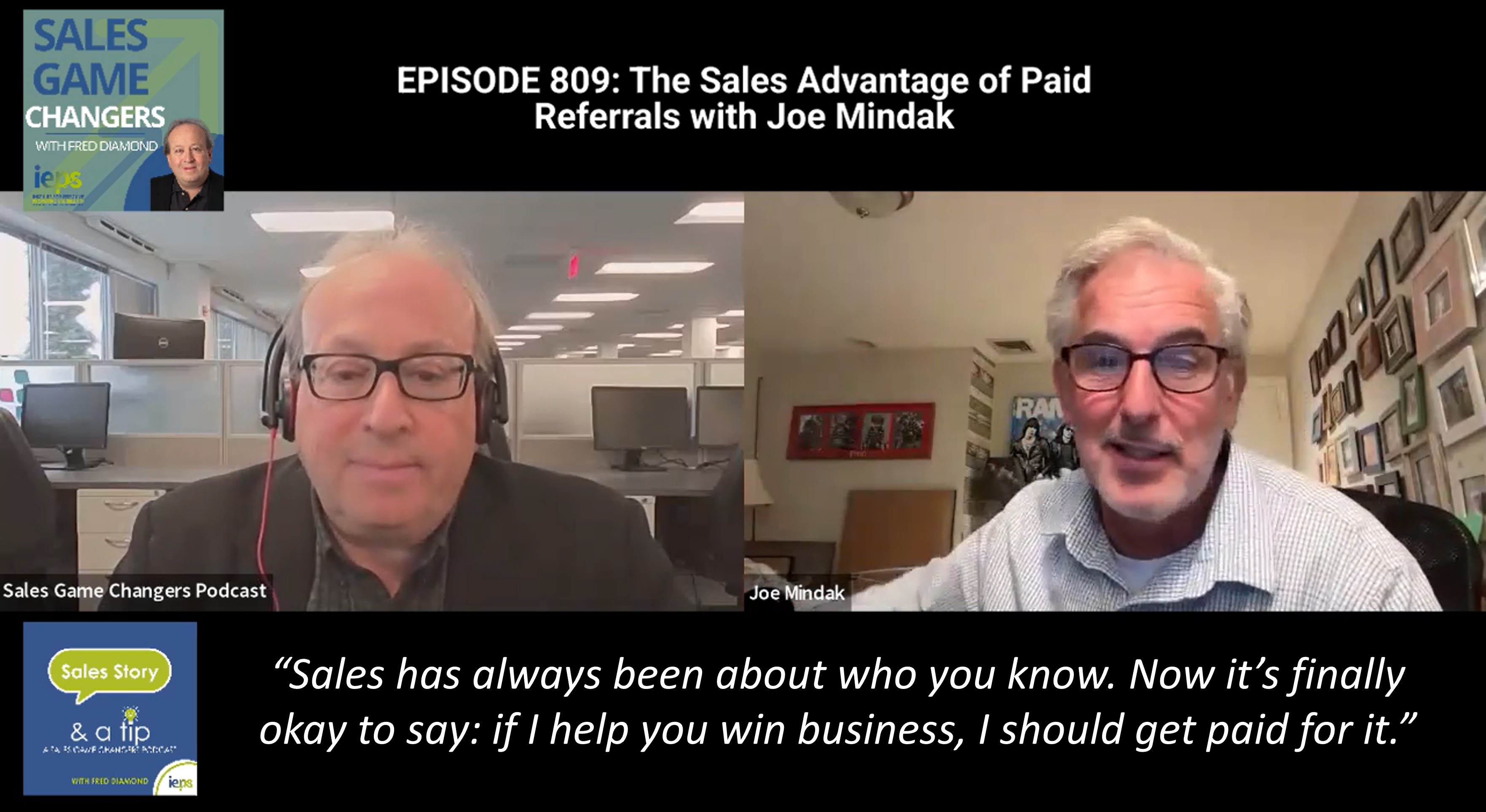
JOE’S TIP: “Sales has always been about who you know. Now it’s finally okay to say: if I help you win business, I should get paid for it.”
THE PODCAST BEGINS HERE
Fred Diamond: Joe Mindak, you’re the author of Connectors Get Paid – Build a Referral Network that Pays. The book just came out. We’re doing today’s interview in late September of 2025, so first off, congratulations on the book. That’s always exciting. Is this your first book?
Joe Mindak: It’s the first book I’ve published. I wrote a book probably 9 years ago. I finished it. I had that one last chapter that I wanted to finish and I haven’t done it. I wanted to sell a business for a lot of money. I’ve sold two businesses, not for money that you can retire on and never work again in your life, so I wanted to really finish it because that book was about things I screwed up in business. All of these are things we do as entrepreneurs when we start a business and screw up. By the way, I also sold a company for $50 million or something like that. This book is the first one that’s actually out and live and you can buy.
Fred Diamond: Good for you! You’re a published author now. Either you’re a published author or you’re not, so you are. That’s great news. I’m excited to hear your story. Joe Mindak, why don’t you tell us a little bit about yourself? Then let’s get into this story.
Joe Mindak: I went to the University of Dayton. Got out of college, came home, and essentially fell into the marketing world. I started a marketing company. I did that for 20 years, loved it, really knew how to do marketing. I was always a sales guy, so I was always going to be a sales guy or a politician is what my friend Amy used to say. So, I chose sales, which is almost one and the same.
I sold a company about seven years ago, and I was starting two other companies, and I was just always a networker. I started to connect and network people and asked them to pay me for my introductions which has now led into Nolodex, which is our software platform which allows other communities to do the same thing we’ve done in our community, which is let everybody start paying each other. If you’re a connector, you should get paid. Sales is all about who you know, it’s always been the same. Now, it’s, “Fred, who do you know? I’ll pay you to get me into that place. If I close a deal, I’ll pay you.” It’s a simple concept. We’ve built a platform to track it all. It’s an exciting time.
Fred Diamond: It’s pretty impressive. You gave me a demonstration.
Joe Mindak: Nolodex, like your networking Rolodex, nolodex.com. We built the platform for our own group and we are now getting tons of different communities. Chambers of commerce, alumni associations, fraternities, networking groups that are already out there. They’re liking the fact that their members can get paid passive income, so those really good connectors are finally saying, “I always want to be paid for my referrals.” I finally built a platform where they can do that. The people who aren’t such great connectors are like, “I will pay you, Fred. Bring me business. I’m happy to pay you. I don’t like selling. I don’t like networking, but I’m happy to pay you to do that.” Then the community owners get a part of the referral fee as well for running those communities. All these communities are working so hard to build their communities, connect their people, and they’re getting most of the time some sort of dues, but why aren’t you getting these deals going on throughout your group all the time? You should be getting a little piece of that for putting this all together. Everybody wins in that situation, so it works well.
Fred Diamond: Good stuff. All right, Joe Mindak, tell us a great sales story.
Joe Mindak: I’ve told this one not too many times. Thinking about it as you’re asking it, it wasn’t a definitive sale but it led to a lot of sales. When I was in my marketing agency, I focused on all my salespeople. I had to focus on different industries. My industry that I decided to focus on was higher ed, it was one of the industries I focused on. Every time you go on LinkedIn, you’re like, “I’m trying to get into a higher ed marketing department at Fordham University, marketing department here.” That’s what I was going after, marketing.
This one woman was always connected to every single person I was trying to get to, and her name was Anne. I was like, “I want to connect to Anne. I would send her notes, “Hey, Anne. Every time I’m looking to talk to someone in marketing in the university, you are connected to them. Can we please have a conversation?” Called her. Emailed her. LinkedIn. You know sales is a hard game and it’s hard to get in to somebody you don’t know to take a call with you, whatever sales you’re doing or if you’re just trying to get into a company. But this woman, Anne, I really wanted to get to because everyone she was connected to and sales is all about networking. Who can you refer me to?
Thank goodness, we have the internet now. There’s a lot of information you could find about Fred Diamond or Joe Mindak online, right? This had been going on for probably six months or longer at this point. I just could not get into her. So, I finally go online and find a website she’s got on with her artwork, she’s a photographer. It’s her hobby. She loves to take pictures and has a whole website with all her pictures on it. I find a really distinct image of hers. It’s a street image with the light, you know it’s her. I printed it out and made a postcard of it. Basically, the front of the postcard was her photography, and I made a big postcard, 6×9 like a nice-sized postcard. On the back was just my logo. “Hey, Anne. I’ve been trying to get in touch with you. I would love to meet you and talk about stuff.” That’s all I wrote, very simple.
Two days after I sent the postcard, she reaches out to me. “Oh, my goodness, Joe. I got your card in the mail. I can’t believe it. Where did you find that?” It hit that personal note with her. She gets the mail and there’s her postcard. She couldn’t not respond. The next week, I was in her office at the college she was working at in the city. From there, she made tons of introductions for me. “Yeah, Joe. I’m happy to help you out.” Just that personal touch. How do you break through to people to get to meet them? There are probably a million people calling, everyone we’re trying to sell to, how do you stand out? I teach that to my kids. I teach a class on entrepreneurship at Stevens. I teach them that. You’re trying to get a job, so are the other thousand engineering students graduating. How are you going to stand out in front of all those other kids? And it cost me nothing. The printer, the ink, and the stamp. That’s all it cost. Probably 35 cents total.
Fred Diamond: That’s a great story. A couple of things come to mind. I remember during the pandemic there were a bunch of gift-related services that popped up because everybody was working from home. So, it was pretty easy to send things to people and get their home address, and things like that. It’s nice. Getting a basket of fruit is nice, but getting something specific, and I don’t mean like a pen with your company’s logo, something personal. Something not too personal where it’s like, “How did you know about…?” Something unique, specific to them that’s going to show that you took a few moments, a little bit of extra care that they could then use. The goal is you’ve got a meeting. Like you said, you were in her office the next week and from there, you’ve got to sell yourself. You have to provide value and help whoever it is that you’re trying to get something to do to show that you understand what they’re trying to do. How can you help them be more successful?
That’s a great story. What’s a tip you took away from that story?
Joe Mindak: The tip from that is do what you’re just saying. Find something personal you can relate to that person and send a thank you. People don’t send thank you’s anymore. We used to have thank you cards. Send something personal as a thank you. Look, you’re not going to do it every time, but if it’s a good lead for you, a great meeting, and you know this can be a lot… I went in a couple months later to a university. Anne didn’t connect me to this one, it was another university. I got in through networking, somebody introduced me to this woman in Newark. I met her and said, “I’m a digital marketing agency,” like the other hundred digital marketing agencies. We were good, but how do you stand out? She had Legos all over her desk, so she must have had a kid or something giving her these Legos. So, I came home and I had my kids who were probably 5 and 7 at the time. I took the flat green Lego which was the grass, and I said, “Hey, guys, write ‘thank you’ on this in Legos for me.” So, my kids took Legos, they wrote ‘thank you’ in Lego letters on this little flat thing that I was able to stick my business card on, and I put it in FedEx, and she got it the next day. That was my thank you to her. She knew who it was. All I said was thank you, nothing else, and my card. A week later, I had a purchase order.
So, do you want to stand out? You can show great designs and the stuff our agency did, not much different than anybody else, but the fact that they took the time and did that… Sending a thank you and making it a little more personal is always good. I’m not going to do that every single time, but I knew that was a big college, she was the head of marketing, and I got a bunch of business from her afterward.
Fred Diamond: You make a great point. We’re seeing this a lot right now with a lot of the companies that are members of the Institute for Effective Professional Selling. We deal with companies that are typically B2B, business to business, or business to government, with at least a hundred salespeople. It used to be very clear what your company did. You were a hardware manufacturer, a tool, some type of networking device, or some type of specific software. Now, a lot of companies are merging together. It’s hard. My partner, Gina Stracuzzi and I who runs our Women in Sales programs, we went to a big conference put on by one of the top five software developers. We walked the expo floor. It was very hard to tell the difference between company to company. As sales professionals, like you just said, customers are going to see you. You might be great, but how do you do things differently? How do you show up differently? How do you get them to notice you? Joe Mindak. The book: Connectors Get Paid – Build a Referral Network that Pays. Thank you so much for being on today’s Sales Story and a Tip podcast. My name is Fred Diamond.
Transcribed by Mariana Badillo