
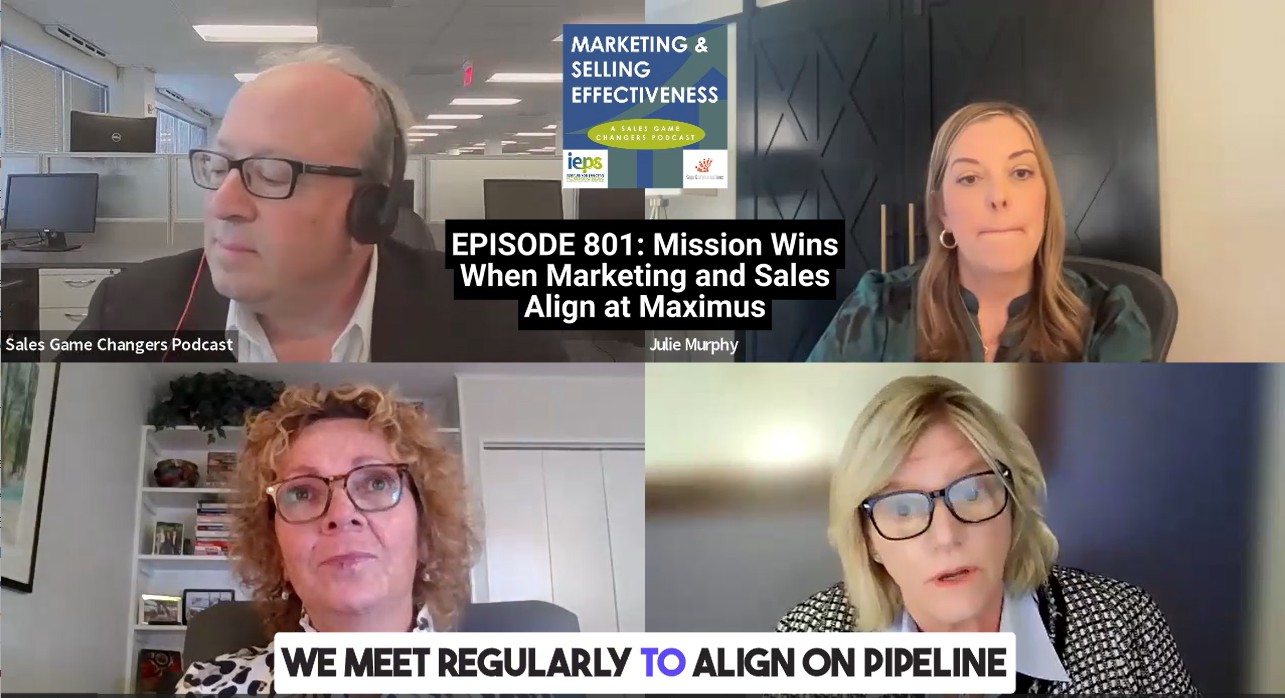
This is the sixth episode of the “Marketing and Selling Effectiveness Podcast.” Regularly, the IEPS posts a new show with Selling Essentials Marketplace partner Julie Murphy from Sage Communications.
Watch the video of this podcast on YouTube here.
The Sales Game Changers Podcast was recognized by YesWare as the top sales podcast. Read the announcement here.
FeedSpot named the Sales Game Changers Podcast at a top 20 Sales Podcast and top 8 Sales Leadership Podcast!
Subscribe to the Sales Game Changers Podcast now on Apple Podcasts!
Purchase Fred Diamond’s best-sellers Love, Hope, Lyme: What Family Members, Partners, and Friends Who Love a Chronic Lyme Survivor Need to Know and Insights for Sales Game Changers now!
On today’s show, Fred and Julie meet with Kelley Harar, a Managing Director at Maximus, and Liz Anthony, a former marketing director at Maximus.
Find Liz on LinkedIn. Find Kelley on LinkedIn.
LIZ’S TIP: “In B2G, marketing effectiveness isn’t about generating noise. It’s about enabling sales to earn credibility long before a deal is on the table.”
KELLEY’S TIP: “Marketing and sales effectiveness isn’t about alignment meeting. It’s about showing up together around the mission and earning trust at every step of the buying journey.”
THE PODCAST BEGINS HERE
Fred Diamond: Julie, before we get to our two guests from Maximus, how are you doing, how are things going? I’m excited to be doing another show with you. We’ve done about a half a dozen. We’re always looking for marketing and sales organizations to have on the show.
Julie Murphy: Yeah, absolutely. I’ve been doing great. It’s been really busy. I feel like we’re in the middle of busy season leading up to the holidays. Congratulations to you, Fred, on 800 episodes. That’s pretty incredible. I’m really excited about this power duo that we have on today.
I’d love to give a little bit more of a formal introduction, first to Liz, who is a longtime marketing leader in the business-to-government technology space. I actually first met Liz through Women in Technology. I don’t know if you remember Liz, but it was probably like 20 years ago at this point. If you’re not familiar with Women in Technology and you live in the Washington, D.C. area, it’s a great local community of women who work in tech, and it’s wonderful. We’re both still somewhat involved. Liz is highly strategic. She’s known for some of the most impactful marketing campaigns for some major brands in this space, and I’m really excited to hear what she has to share with us today.
Liz also brought along with her one of Maximus’s top sales leaders, Kelley Harar. We’re so excited to have you here today. She leads the company’s federal health practice and Kelley has driven capture and proposal efforts, totaling more than 67 billion, according to her bio on the website, which is pretty incredible. Welcome to you both.
Fred Diamond: I’m very excited to hear some of the insights here. Just to follow up to how Julie made the intro, Kelley, Maximus has a great deal of work with technology-enabled health services for federal agencies. For those who may, may not be as familiar, share a little bit about what Maximus does and what excites you about this work.
Kelley Harar: As you know, Maximus partners exclusively with federal agencies to deliver health mission critical support services, and we use that. It’s powered by technology, data, and most importantly, human-centered design. As we all know, we can’t instantly create medical professionals, so we rely on technology to extend their reach in delivering administrative services related to clinical practices to support our health tech enabled services. We deploy proven technology. The government does not like to be a guinea pig, and so we always baseline our solutions with proven off-the-shelf solutions. We keep up with that through understanding our missions, and we will talk about that a little bit later in the podcast as we talk about our efforts in growth and marketing together. But we know that it is a continuous and fast-paced innovation, and we balance our delivery and technical solutions with our people.
We help citizens, military members, and their families, and veterans improve access to care, streamline health benefits, and support readiness through digital transformation. I think what excites me most is knowing that our work directly impacts the lives of service members and their families. We’re not just implementing systems, we’re enabling better outcomes, and we also support national security through readiness of our soldiers. We do a lot of work with the DOD and health readiness is a critical component to the Department of War. We ensure service members can take on the mission of national security. We use the term whole health, which includes how family members are cared for while a soldier is deployed.
Just like we avoid distractions while driving, our programs ensure service members aren’t burdened by healthcare logistics while deployed, such as locating a network provider to a newly relocated family member, or ensuring that their primary care doctor is updated in the DOD systems. This work excites me just knowing how we directly impact the lives of our service members and their families.
Julie Murphy: There’s no doubt that Maximus is having a huge impact in so many different ways. I love how you talked about the access to healthcare and even extending clinicians’ abilities through technology. That’s really neat. Also, the whole health, that we need our soldiers focused on the mission. The fact that they don’t need to worry about it or don’t need to worry about the care of their families helps them do their job as well as possible. That’s wonderful.
Liz, I’d like to talk to you a little bit about messaging and reputation. Maximus has long held a really strong and trusted reputation in technology services and as a government contractor. What do you think about balancing brand consistency with the need to innovate in marketing? Whether that’s new channels, formats, or campaigns that reach decision makers in new and fresh ways.
Liz Anthony: I think that’s always the challenge, is to try to be on the edge of what’s new and how to reach the audiences. When I look at brand and elevating the brand for Maximus and the message of innovation, I have to look at new ways to communicate with our audiences, and especially in a time like the changing administration or a government shutdown. You have to be looking at different ways at how people are going to consume, the time period they’re going to consume. I think that that really is a great model that Maximus has chosen us to do integrated campaigns that are on multilevel. It’s the podcast, it’s TV sessions, it’s the events, it’s on panels, it’s articles, it’s TV, etc. You’re not just really showing up in one place, but you’re showing up wherever the audience is really looking for information to share thought leadership on a variety of topics.
Fred Diamond: The reason why we’re doing this podcast, the Marketing and Selling Effectiveness Podcast, and we’re doing it towards the end of 2025, is because marketing and sales have had the need to come together as customers get access earlier through social media, and as AI can direct customers to places where they need to go to select vendors, and to understand where the vendors value might come from. We’ve seen that marketing and sales is critical now for the interaction. There are no longer silos, there’s no longer marketing, and then things get handed off into sales. The sales journey is mixed up a lot more than it’s ever been before.
The alignment between sales and marketing often comes down to structure and what we like to say, process. Give us some insights for our listeners on how you collaborate with Liz and her team and doing that to ensure that your teams are set up effectively, where marketing can enable sales. Concurrently, sales is providing meaningful feedback to marketing as they do all the great things that Liz just alluded to.
Kelley Harar: I think you said it well, collaboration, collaboration between growth and marketing at Maximus. It has to be built on transparency and shared goals. Liz and her team have done an outstanding job with that. With my background, I grew up in finance and operations, and so my growth role has been relatively new, but I value that process that Liz and team bring to Maximus to support our sales effort. We meet regularly to align on pipeline priorities, how our campaigns are performing in the market, and most importantly, customer insights, reactions. We want to know what’s going well, and we want to know what’s not going so well and what we need to adapt in terms of messaging. We have these valuable customer insights through the technology and the social media and the way that Liz and her team communicates our message.
I think marketing is enabling more and more today with technology by creating targeted content and thought leadership that opens doors for the growth executives. In turn, the sales and growth executives are able to provide that real-time feedback from the conversations, from attending conferences, from their podcasts, from interactions that they have. If it’s not working, we adjust it and we’re able to see emerging needs early on. It’s a continuous loop that keeps us, to use a technical term, agile, but more importantly, customer and mission-focused.
I think through that communication, we can do more of what’s meaningful to our customers. As Liz answered in the question before this, we can adjust that messaging real-time because her team allows us to open up conversations with our clients that might not happen without that marketing support. The podcasts, the conferences, the events, white papers, webinars, together, both teams are focusing on solutions, and most importantly, what is relevant to our customers.
Julie Murphy: Kelley, what you said about the really targeted content is so important. Actually, Gartner put out a report just recently that was saying, it was, I believe, 70% of end user customers are doing research before they even talk to the customer. It was around, I don’t want to butcher this, it was around in the 40s percent that they actually make a decision before they even engage with sales execs. That’s how important it is that the content is so targeted and right on, a lot of times before sales teams can even engage.
In thinking about that, Liz, you know better than anyone because you’ve been in this space a long time, that in a field as complex as technology and government, messaging that resonates and is really well understood is so important. How do you engage both Kelley and your other sales leaders that you work with in your organization to really help refine and shape that messaging? Do you have a secret process that allows you? Because you’ve done a really nice job with that, I’m curious how you go about it.
Liz Anthony: It’s not a secret, but I’ll share that. There’s a couple of things that really work, I think, and that is being engaged with sales from the front end, not catching up on the back end. I think that’s critical. We have to know and understand what are the goals and objectives? What are the needs of the customer? Really, what Kelley was saying, the teams at Maximus are exceptionally focused on what’s the outcome we’re trying to achieve? When sales and marketing knows that together, then it really is a strong relationship to move forward faster. I think that we can see in a variety of ways how customers are engaging in a very elongated educational process. Especially as things are more complex, they spend a lot more time looking at us before we even know it.
Really making sure that we are different places and saying the same thing consistently in different ways, but really creating that surround sound, if you will, for the audience for those customers to understand, and allowing them to raise their hand when they’re ready to engage. That’s really critical. But I also would say that the pivotal point of marketing and sales working so closely together now is more obvious because the stakes are higher in terms of the volume in the market being really high. There’s a lot of people saying a lot of the same things. What is going to make the difference? It’s the differentiation. You can differentiate when you understand what we’re really bringing to market. That differentiation then becomes easier to explain. In a complex world, simplifying the complexity is critical.
Fred Diamond: That’s a great point. Actually, a long time ago, I was what we now call a fractional CMO. Remember, Liz, it was not a sexy term back then, but now everybody’s fractional at something. I had a motto which was, “Marketing that doesn’t lead to revenue reward is a huge waste of time and money.” I love the way you answered that, Liz.
I’m curious, Kelley, we’re talking about how well you’ve worked with marketing. Can you think of an example or a time when marketing content or maybe even brand awareness efforts contributed directly to closing a complex or high-value opportunity?
Kelley Harar: Definitely. We have had several large opportunities and we have several current large opportunities coming up. Liz and her team and marketing efforts continue to support our growth. They create an awareness of our capabilities, and then we work together to figure out how those capabilities are going to meet the mission of those large programs. I’ll give you a real-time example.
We have a targeted campaign around digital health modernization, and it’s not just buzzwords to us. The marketing team and the growth teams developed white papers, webinar series, all that positioned Maximus as the thought leader that we are for several existing and near-term opportunities. This kind of content and developing this kind of content opens doors with key clients and stakeholders, and it gives our sales teams the credibility, and even more importantly, the context to have deeper conversations around how contractors can meet the mission of these large complex programs.
Ultimately, bringing together sales and marketing has helped us win multimillion-dollar health support contracts across various agencies focused on improving care coordination for the military. It also supports veterans during a time of anxiety within the climate that we’re in, where they’re calling the VA and needing answers. We’ve also proved that our strategy was invaluable during COVID, when the government needed trusted partners to support customer service in a time of great need for this nation.
Julie Murphy: I really appreciate all the concrete examples that you both are giving us. Sometimes sales and marketing can get a bad rap for some of these empty buzzwords, so I’d love to have some fun with this next question, and I’d love to hear from both of you. What’s one marketing or sales buzzword that you’d love to see retired?
Liz Anthony: I have a couple actually. There’s reinventing. It drives me a little bit crazy. The other one is leveraging. Those two words are just overused tremendously. I think that if you really have strong communications and collaboration, you don’t have to be leveraging everywhere. I just think that those are a couple things that should be retired.
Julie Murphy: Liz, you hit the nail on the head too, that once words become overused, I think that’s when they become meaningless too. We have to be really clear in our own communications about what it is that we’re talking about. Kelley, what do you think?
Kelley Harar: We do. Maybe I’ll go back and read the transcript and make sure I didn’t use those two words. I tend to use leverage a lot, but hopefully in appropriate ways. Great question, Julie. I think for me in thinking about talking to customers and talking about programs and talking about meeting their needs, one word that I feel is overused, and in many instances vague, is synergy. I’d rather talk about real collaboration and measurable impact and outcomes, keeping it very simple and meaningful. A lot of people like to talk about the synergy of technology and delivery, or the synergy of technology innovation and human-centered design. Well, exactly what does that mean? I want to be straightforward about how technology and humans solve and meet the mission of our government customers, rather than just saying it’s synergistic.
Fred Diamond: Those are interesting. Julie, we’re going to have to change the title of the show based on what I was going to do based on that answer, just as a quick FYI. I was going to use all three words in the title. I’m just curious, Julie, are there any thoughts you have on what Liz and Kelley just shared?
Julie Murphy: I agree with you. I also think reinventing almost sounds like something’s gone wrong, like if you have to reinvent yourself. I also agree with synergy as well. I feel like that’s a term that’s been used for a long time, and it is very vague and it’s just a filler word. I agree about communicating with precision and being clear about what exactly it is that we’re talking about so anyone can understand.
Fred Diamond: That’s a great point. Like Liz said before, the stakes are high. The competition’s getting tougher. Again, we’re doing today’s interview towards the end of 2025. People are listening to it in 2026. There have been so many factors in the world that have made every sales and marketing effort much more critical. It needs to work, more eyes are on it, and you have less time to fail.
I want to thank Liz Anthony and Kelley Harar with Maximus for the great insights today. We like to end each show with an action step, so I’m going to ask you both to give us something specific, you both have given us a lot of great ideas, something specific that the audience should implement to take their company’s sales efforts to the next level.
Kelley Harar: I would have to say, in my many years, I won’t say decades, but it’s probably decades too, I find that staying curious and staying close to your customer, whether you’re in sales, marketing, or even delivery or finance, really understanding your customer’s mission and challenges is the fastest way to add value and grow your career. I’ve done this through asking questions, listening very intently. They always say, always be closing in sales. Well, I am one to say, never stop learning. Always be learning. We have to use our past experiences to invent new and innovative ways to address our future markets. With technology advancing so rapidly, you can’t rely on what worked in the past. Today’s government sales are built on trust and delivery. Our operational performance and innovation with technology drive our business forward at Maximus. Don’t take your eye off the customer’s mission or how your delivery team executes on programs. The most successful folks that I have worked with over the years are ones who stay close to the mission and never stop asking the key question, how can we do this better?
Fred Diamond: Liz, why don’t you bring us home?
Liz Anthony: I think that what I would say is it’s absolutely critical to bring marketing to the table and have a voice at the table because the insights and the understanding of the audience and the impact that we can have together really start to draw that what’s the art of the possible that sales and BD and capture, those leaders that I know throughout my career, have really desired. When you have the perspective of sales and marketing at the table, their conversation is really strategic and it’s really very deep so that you can move faster and really have the outcomes that you’re desiring.
Fred Diamond: Very good. Julie Murphy, thank you so much for this Marketing and Selling Effectiveness Podcast. I want to thank Liz Anthony and Kelley Harar with Maximus for being on the show today. My name is Fred Diamond. This is the Sales Game Changers Podcast.
tant too. That’s great advice.
Transcribed by Mariana Badillo