
This is a Women in Sales Leadership sub-brand of the Sales Game Changers Podcast.
Watch the video of this podcast on YouTube here.
The Sales Game Changers Podcast was recognized by YesWare as the top sales podcast. Read the announcement here.
FeedSpot named the Sales Game Changers Podcast at a top 20 Sales Podcast and top 8 Sales Leadership Podcast!
Subscribe to the Sales Game Changers Podcast now on Apple Podcasts!
Purchase Fred Diamond’s best-sellers Love, Hope, Lyme: What Family Members, Partners, and Friends Who Love a Chronic Lyme Survivor Need to Know and Insights for Sales Game Changers now!
Find Louise on LinkedIn.
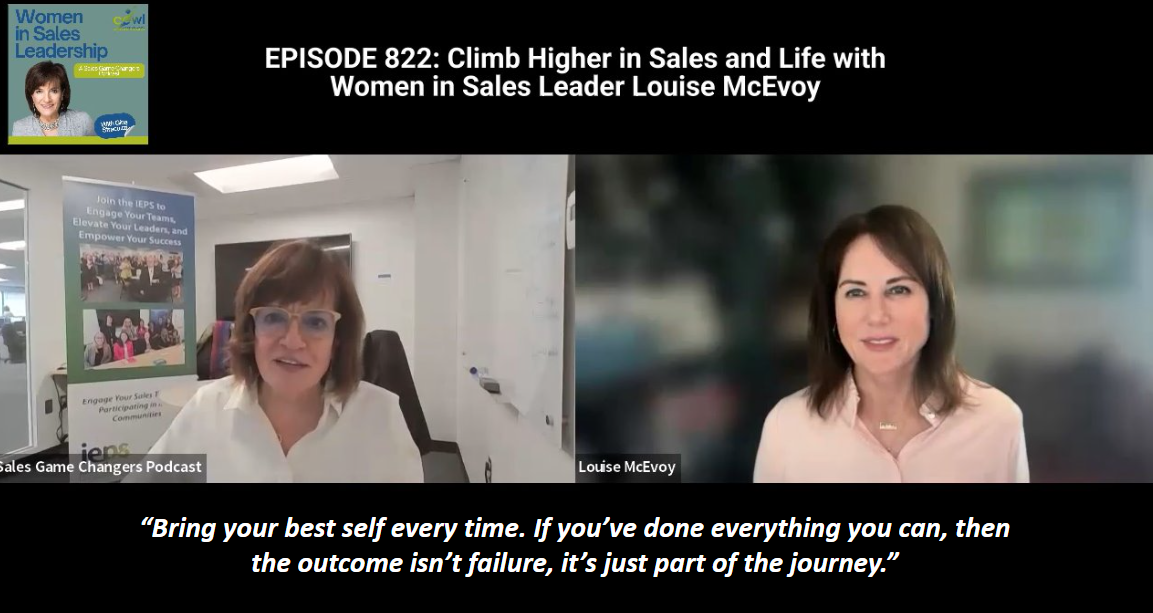
LOUISE’S TIP: “Bring your best self every time. If you’ve done everything you can, then the outcome isn’t failure, it’s just part of the journey.”
THE PODCAST BEGINS HERE
Gina Stracuzzi: Louise McEvoy is the Senior Vice President Global Channel Sales at Keyfactor. Welcome, Louise.
Louise McEvoy: Thank you, Gina. It’s a real pleasure to be here. I appreciate the invitation.
Gina Stracuzzi: Tell us a little bit about yourself, and go in to some of the things that you do in your off time, but we’re going to dig deep into that as we speak further. Give us a little bit of you background and then well go from there.
Louise McEvoy: I would say my brand is channel and cybersecurity. That’s where I’ve spent the majority of my career. I recently moved to Keyfactor, it’s a cybersecurity company focused on cryptographic risk. You think, what is that? It’s all quantum forward. If you want to talk quantum later, it’s a fascinating discussion. It’s also very, very scary. But we can set that aside for now.
Spent the majority of my time in the channel with IBM and a number of big companies. I’ve just really enjoyed cybersecurtity. It’s a fascinating place to be. I didn’t realize you could have a career solely based on cyber and channel, but it’s possible and I’ve really enjoyed it. I moved just six months to Keyfactor and really had my eyes opened to the quantum space and just what’s coming and what we should be prepared for. It’s a fascinating discussion.
Gina Stracuzzi: It’s interesting to me that you used the word scary because you do a lot of public speaking, which is scary to people too, and your other little side hustle, exciting thing you do, is climb mountains. It seems that you have a predisposition to scary things and you take them on with a lot of enthusiasm. I love that. Before we go into the mountain climbing, just give us a brief synopsis of what quantum cybersecurity is.
Louise McEvoy: People talk about cybersecurity about protecting their email, their endpoint devices like laptops, iPhones, etc. But beneath all of that are these certificates, public key infrastructure or cryptographic certificates. These certificates have been in place, those standards have been in place for years and years and years, decades even, and they haven’t quite changed or been updated. There are millions all over. In any one organization, you will have enormous amounts of certificates.
As we get more and more into AI, and AI gets better and better, at some point, we’re going to hit this tipping point, and it’s going to be quantum. Quantum will be able to decrypt cryptography, or these public key infrastructure, the PKI. We need to update that so that everything that we have in this underlying layer is secure. Right now, everything that we do has these certificates from decades ago in places we don’t even know exist. We need to make sure that we have a cybersecurity layer on top of that. We offer that to our customers.
People are thinking AI and cybersecurity, but they’re not quite seeing the bigger picture from what we’re seeing and talking to customers and partners, that this quantum forward mindset needs to be in place because there’s a risk involved if we don’t take care of what’s going to happen at quantum. Who knows when quantum breaks? I’ve been talking to a lot of thought leaders around this and we’re seeing it not in the next decade, but in the next few years. When quantum hits, when all these computers have gotten so, so smart and they can break these encryption codes, there’s a lot of information that will be out there for public consumption, lots of information. That includes public consumption that could be taken by threat actors, bad threat actors. What do they do with that data? What do they do with all the information? It could be a different world and we just need to be mindful that quantum is coming.
Gina Stracuzzi: Color me scared now.
Louise McEvoy: I don’t mean to scare you. It’s more about there’s preparation ahead. In the channel world, it means there’s a lot of opportunities for partners because we need to talk to our end customers about what quantum looks like. There’s enormous services engagements with everything that we’re doing. There’s a lot of opportunities, but we need to start now because eventually, we will get to the point where AI has gotten so smart we’re now looking at quantum computing.
Gina Stracuzzi: It’s the next thing forward. My husband is cybersecurity as well. It’s an evolution. You’re absolutely right. There are ways to protect ourselves, but preparation is everything.
Now that we’ve talked about the sales part of things and the work part of things, let’s talk about the really exciting stuff that you do. I know you have a public speaking company with your sister and you do a lot of public speaking, but before we talk about that, because it is what you talk about in those opportunities, that is the real exciting piece, and that is mountain climbing, but not just any mountain climbing. Tell us about what you do and how you got into it.
Louise McEvoy: Thank you for thinking so much about that journey. I do high altitude mountaineering. A lot of people get confused that it might be rock climbing or it might be hiking, but it’s the high altitude. I’ve climbed the highest mountains in the world. If you name pretty much any mountain, I may have climbed it, including summiting Mount Everest in May of 2018. It started as a very, very different type of journey, and part of the speaking I do is that we’re all on a journey and sometimes bad things happen to really good people and that puts us on a journey that we may not have realized.
I moved countries, I had a life change and I needed to break away. I started reading a book about Everest and it was fascinating. I didn’t know that people like me could go on these types of journeys, like climb high mountains, and I became fascinated with it. I made a promise to myself I’d one day see Everest. I saw Everest from base camp. I made a second promise, one day I would climb Everest. I spent the next 14 years climbing all over the world in pursuit of that goal so that I can get used to that high altitude, the training, the expeditions, different conditions, mountains, weather, and I made Everest on my first try.
Since then, I’ve gone on to many more mountains and I’ve been asked to speak a lot about this and so it’s a little joint venture between my sister and I, she lives in Canada, I live in Southern California, really just to bring us closer so we get a chance to talk every day, week, whatever. It’s been very fulfilling.
Gina Stracuzzi: That’s wonderful. You read a book, you got intrigued. You started doing high altitude climbing. Did it not strike you to start smaller to begin with?
Louise McEvoy: I did start smaller. I did a trek to base camp at Mount Everest, which was a three-week journey. From there I decided I want to try something more. I climbed Mount Rainier, which was a little bit more technical. From there I climbed Mount Kilimanjaro and then it just became something more and more and more and I just got bigger and bigger and bigger, and took lots of different climbing courses, technical courses, avalanche courses, wilderness first aid, just in pursuit of getting better and better and better at this passion of mine.
I don’t even know if you’d call it a sport, but it’s definitely a passion. It’s something I wake up to every day and I’m excited to know what the next story in the news is around climbing and who’s doing what, and what the next goal is, and where the next trip will take me. It’s been very, very fulfilling and I would encourage anyone just to find that passion and it could be in some far-flung way that you never even expected. I didn’t grow up in any way in high altitude and it just became something that I got introduced to, from moving countries and not knowing anyone and someone suggested I read a book just as something to do that weekend, and from there it took off. I had no idea that journey was ahead of me.
Gina Stracuzzi: That is so exciting. Let’s combine the two things that you do. I know you started, with a friend, you started a community of women in IT, I believe it was. Now you do retreats for these women in this community. The first question that came to my mind was, did you start this as an IT community and then it expanded into the climbing, or did you decide, these are women that could really benefit from pushing themselves and really trying something different? How did those two come together?
Louise McEvoy: I firmly believe everyone’s on a journey and sometimes these journeys start in the most benign ways and ways you don’t even expect. I’ve been climbing for approximately 15 years, doing this high altitude climbing. An acquaintance of mine in the industry reached out to me and she heard me speak about Mount Everest and she said, “Do you want to go hiking sometime?” and I said, “Yes, of course.” We met months later, we didn’t know each other that well, and we started hiking together.
From there, we did it a lot more and I introduced her to what’s called a 14er, which is a mountain over 14,000 feet. There are only mountains in four states in the U.S. over 14,000 feet, a 14er. We did a 14er together and it was her idea, she said, “Well, what if we invited other women to hike a 14er?” In my mind, “Who wants to hike a 14er? This is just my little world,” but I introduced her to that world and she said, “Let’s make this bigger. Let’s expand this to other women.”
We invited women to join us on a long weekend in Breckenridge, Colorado. We hosted in a big house and we brought in a private chef and we had swag, and it was just a fun thing and we had nine women join us. Then we realized, “Wait, there might be other women who might want to join us,” and more women joined, and then the next year more women, and now we’re hosting teams 13, 14, and 15 in September. We’ve had already 12 teams of women and there’s approximately 12 to 16 women on each team, and we hike a mountain, non-technical, and we hike it over 14,000 feet. It’s a little oxygen, it’s a long day, it requires some training, and we do that together virtually.
Then these women meet and they become friends and there’s great networking opportunities and just friendships that have been formed in ways I never expected. I sit back and I’m so proud of the women who come together, women who don’t know one another. They decide to go on this retreat and we all share a house and rooms. We had one of our teams last year who they bonded so well they wanted to, as a team, come back again this year, and these women didn’t know each other. Some come with friends and others just come alone, and they bonded so well, so quickly, so strong that they asked to have a trip just for them. We’ve set up a trip and there’ll be over 200 women who have come through this by the time this year is over, and so many interesting stories from this. I’m really proud of it. As my friend, Erin Figer, says, it’s a labor of love. It takes us some time to put this together but it’s something that is very fulfilling, nourishing, and we get a lot out of it as well. We have a college SheSummits14ers.
Gina Stracuzzi: I did rock climbing once and I have a tremendous fear of heights, and I made the mistake of looking down. Now, I’ve done some hiking and climbing mountains, and I didn’t have that experience when I would hike a height necessarily, it was something about looking over and there’s nothing there. Do you find that people adhere to the situation pretty quickly, or do you have people who get up there and just find it really difficult? How does that work for most average humans?
Louise McEvoy: It’s a mix. Some people really embrace that challenge and they don’t have that fear. We had one woman last year where we had a pretty narrow traverse on rocks and she was terrified, absolutely terrified. I’ve got a lot of experience in this and we handheld her through this narrow section. At the summit she was freaking out about how does she descend through this narrow section that was really tough for her. She started descending and she realized she’s already made it to the top, she’s just coming down, that’s the easy part, and she flew down and she was so proud of herself when she got back to the trailhead. She couldn’t believe she did it. She couldn’t believe she overcame that fear. It was wonderful to see that bright light in her and how she could conquer that so quickly. It took some effort, but she made it through and she was so proud of herself. We were all proud of her.
When you get a community together who are proud of you for an accomplishment, it just feels good. We’re all very supportive of one another and people wait for each other. We just do whatever we can to make sure everyone is successful, because it’s a team. This isn’t an individual approach. It really is, let’s all make the summit as best as possible, and we go back to the house and we celebrate with lots of festivities. We have a number of those successes.
I also think it’s a mindset too, and I talk about this, is when I’m climbing Everest, there’s a lot of scary things when you’re climbing, like climbing over those crevasses on those rickety ladders, but I also think you got to accept that fear. Once you do it often enough, you overcome it. “Okay, now I’ve done it.” Now it gets easier because you know you can overcome hard things. But if you don’t take that first step and you say, “No, I’m too afraid,” then you’re stalled. But if you’re like, “I’m going to try it, and I’m going to try it again, and I’m going to try it again,” before you know it, it becomes muscle memory and it’s no longer fearful. I try to use that in life in general, just, “Okay, it’s scary, but I know I can do it. Just step forward, just keep moving forward.” If I step back, then I’ll be stepping back in things. I try to use that mindset in everything I do.
Gina Stracuzzi: I’ll make a generalization here that sometimes women tend to let their fears rule them. Fear of not being accepted, fear of sounding silly, or whatever the case is, whatever environment you’re in, you have those little voices that talk to you. Doing something like this and stepping far beyond that voice, that fear, that thing that holds you back has got to be incredibly liberating.
Louise McEvoy: It is. When I first started mountaineering, it’s a very, very male-dominated sport. Kind of like our industry, channel sales, there’s a lot of men in the boardroom. It is a little intimidating. When I started mountaineering, it was hard. Sometimes I’m the only female in the team, so I get my own tent. The guys bond on their own because they’re together and there’s a different type of environment.
One of the life lessons I learned when climbing Everest, we had nine people on that team. Out of the nine people, we had four women and five men. When we think about the numbers, you’d think most of the men are going to summit. No. In fact, all of the women summited and only two of the men summited. I say this because it’s not to say men or women are better or whatever. It’s that we’re different. Everyone’s different. We all have strengths in different ways. When we think about Everest, it’s an endurance mountain versus a strength mountain, because you’re going for very, very long periods of time. Women are really good at endurance. Men are really good at strength. Where there is a mountain that requires you to carry heavy, heavy gear, sometimes the men will be stronger there. But in the endurance mountains, the women are stronger.
I always try to make that distinction. We all have a strength that may not be visible, but we do have it, and not to judge people and not to look at anyone different. When it comes to the SheSummits14ers, it’s a community of women. There’s a different mindset and we all want to make it to the top. We all want to do it together versus individually. We come together as a team, we go together as a team, we look to summit as a team. It’s a different type of feeling and it’s not about rushing to the top. It’s about getting there together and we want that team picture, we want everyone to succeed. It really is a supportive environment in that way and it just makes the difference when we’re all in it together.
Gina Stracuzzi: I can appreciate the difference in mindsets. Sometimes people do things just for the glory of it. From what you’re explaining, for most of the women that go on your retreats, it’s the journey. It’s the process of overcoming fear, of doing something as a group, for the experience of it, not for the glory of it necessarily.
Louise McEvoy: Sometimes glory is okay. That’s fine. But in this environment, it’s about supporting each other, becoming friends, and growing together and doing hard things together. I think it’s a lot more satisfying when you’re doing it with someone else, with your team, versus, “I made it to the top and nobody else did.” It’s a lot more fun when you’re in it together. You support one another.
Gina Stracuzzi: That’s really awesome. We will make sure that in the show notes, and when we post this, that people know how to reach out to you, because I’m sure there will be other women that will want to join. We have a lot of women in IT in our group, and sales, not that it’s necessarily limited to those.
Louise McEvoy: We have people who bring their friends and they may not be in IT. It’s moms who might be needing something different, or someone outside of IT who just wants to go on a retreat weekend. It’s not limited to women in IT. We started there, and it’s grown, but our main connections are women in IT, but it’s definitely not limited to them. It’s just a retreat for women.
Gina Stracuzzi: Most of the women that listen to this are in sales and they’re in IT sales, so it’ll be a natural connection, but hopefully they’ll share it with their friends and bring them along too.
One of the questions that came to mind too is, how does all of this translate into how you approach sales? Has it changed your approach to it or your thought process about winning? Because it’s all about winning those big contracts and winning the sale. How has this impacted that?
Louise McEvoy: That’s a good question and I think I’m still learning every day. It’s not like I’ve got this fixed mindset and therefore this is how I’m going to do it. I really look to surround myself with people who have a growth mindset and I want to have that as well. I do think what the lessons from the mountain have taught me is that I can do hard things, I can take risks. I have to set myself up and allow failure to happen, but know that I can go back and try again.
Sometimes the best reward is from things that have been hard and things that I’ve had to learn. Sometimes setbacks are also a teaching moment. I recognize that. When I’m in an environment at work, I try to bring my best self. When I’m training for a mountain, I am not going to not summit because I haven’t trained enough. I am absolutely at my best capacity. It’s something else that has not allowed me to summit, whether it be the weather or conditions on the mountain. I try to take that mindset with everything I do.
In business, I am the best I can be. It’s some other extenuating factor that allows me not to have that success at that moment in time. That’s okay as long as I bring my best self to the business, to our partners, to our customers, it’s only so much you can do.
Gina Stracuzzi: That’s true. It’s a great mindset too. That makes me think of one other question that came to mind. I noticed that you have a lot of speaking engagements, and you mentioned like Boy Scouts and school groups and what have you. I was wondering, what message do you deliver to them? Both as a sales professional, do you push the industry too? Like, “You should think about sales.” Also, from the climbing piece, what do you share with them?
Louise McEvoy: Interesting. It just depends on the audience. I look at the audience and what message that people want me to deliver to them. If it’s a women’s group, it could be around women in the boardroom and we can do hard things. If it’s schools, I look at what’s the main message that they’re looking for. I present to a kinesiology department at a university, so it’s the effects of the body on high altitude. It may not always have that sales message in it. It might just be the motivation, the inspiration, things like you get out of bed every day and you have that mindset, put two feet on the ground and go, “Okay, I’m going to reach my Everest today.” What is your Everest? It doesn’t have to be a mountain. It could be getting that next job, getting that house, something. What’s your Everest and how are you going to get there?
When I talk to industries, schools, community groups, I always say, “What is it that you’re trying to reach and how do you get there?” Sometimes it’s a mindset. You have to do hard things. You have to train, you have to plan. You’re going to have setbacks. How do you get over setbacks? I really try to break through all that. There’s so many lessons that I’ve learned from the mountain. Sometimes there’s a setback, you have to go back down to base camp, but that doesn’t mean it’s a failure. You can still go up again. You have to read your environment. You’re on the mountain, you have to read the weather, the snow conditions, the team, who’s sick, who isn’t, and figure out a different plan.
I try to get them motivated in different ways and it really is just the audience and what is it that they’re looking to accomplish? If I look at the Boy Scouts, when they were trying to summit Mount Whitney in California, “What does your training look like and what are you going to do when you hit hard times and hard things?” Those breakthrough moments and what I did to break through and reach that summit.
Gina Stracuzzi: Those are good lessons. I’m sure, as you say, you have a wealth of them across a number of audiences. That’s really fantastic. Tell us a little bit about your next big challenge.
Louise McEvoy: That’s my Achilles heel. I sigh heavily. I’m trying to finish what’s called the Seven Summits, which is the highest mountain on every continent. When I started off climbing, I had no idea I was on this journey to the Seven Summits. I did Base Camp, I did Kilimanjaro, I met someone on Mount Rainier who introduced me to Mount Elbrus, which is the highest mountain in all of Europe located in Russia. Just through a series of events, people, and different things that I came across, I was on this journey to the Seven Summits. I had no idea the Seven Summits even existed. I started climbing and climbing and I realized, “Wow, I’m halfway on the Seven Summits, let’s keep going.”
The last and final, I’ve had six of the Seven Summits completed, that’s the highest mountain on every continent. I still haven’t completed North America. Highest mountain in North America is called Denali, also known as Mount McKinley. It’s in Alaska, very, very cold environment. The weather holds you back most of the time. A lot of crevasses, a lot of avalanches, and just high winds, extreme cold. I’ve tried it twice now and we didn’t make the summit due to weather. I’m going back again in May for the third time to hopefully finish Denali and complete my Seven Summits. It’s an extraordinary amount of training. When I talk about endurance mountains versus strength mountains, this one’s strength. We don’t have porters, Sherpas, cooks to support us on the mountain, you’re carrying your own gear.
I was there last year and we carried 50 pounds in a sled that we pulled and 75 pounds in a backpack, so 125 pounds of gear going uphill at altitude on what’s called fixed lines. Those are the ropes in the mountain on a rope team where you’re all climbing together. It takes some effort, some coordination, some training. I’m really, really, really hopeful that the weather gods are on my favor and I can summit Denali. If I do, I will have summited the Seven Summits, and there’s a lot of women in the world who have done the Seven Summits. I’m hoping to be part of that very elite club.
Gina Stracuzzi: That’s exciting and a little terrifying, just listening to it, to be honest. Mostly the cold and the icy conditions, that would take a lot. Hopefully the third time’s a charm, as they say, and this will be your crowning effort. But then one must ask, what’s next?
Louise McEvoy: There’s a lot of mountains still left to climb. There’s a lot of 8,000-meter peaks in this world that are over 28,000 feet that I would like to climb before I get too old. I always say it’s more of a sport for younger people. It’s hard on the body when you’re sleeping in a tent. Denali, it’s over three weeks in a tent. Everest, it was seven weeks on the mountain, six weeks without a shower, and you’re eating really bad dehydrated food. It’s very hard on the body being at high altitude in that kind of stressful environment. I want a couple of more big mountains under my belt before I do something that’s not quite high-altitude mountaineering.
Gina Stracuzzi: Maybe then you can start teaching it or something. You could become a coach.
Louise McEvoy: Maybe.
Gina Stracuzzi: I will say those last bits of information are not key selling points for talking other people into it, but you might as well know what you’re getting into. This is really fascinating and I am really excited for you and what you’ve accomplished. As someone who works with women sales leaders, I work hard to get them to understand their own innate power and strength. I hope they’ll all do at least a 14er. It’s exciting stuff and I am thrilled to have spoken to you about it.
We like to leave our audiences with one piece of advice that they can put into place today to take their career, their sales, their life to the next step, something they could do right away, what would that be for you?
Louise McEvoy: I love that question. I alluded to a few things, like we’re all on a journey, so you might be already on a journey that you don’t even know is ahead of you. I would say, embrace things, say yes to hard things, say yes to new challenges. You may not even know that that challenge going forward will lead you into your Everest. You don’t know. I would also encourage people to try hard things. Yes, things are scary, but things are less scary when you do them over and over again. It becomes muscle memory. Crossing a crevasse on a rickety ladder, no big deal anymore.
It doesn’t have to be on mountains. I think just life in general, just embrace that challenge and just say yes to doing new things. Opening up that opportunity will give you insight into something you didn’t even know was there. I didn’t realize high-altitude mountaineering would become part of my life. I didn’t realize that my high-altitude mountaineering could open the doors to women experiencing a mountain over 14,000 feet. I had to be introduced to someone who had the idea, and from there, it just became a thing. New people, new experiences, just say yes. I would really encourage that.
Gina Stracuzzi: That’s great advice. Absolutely great advice. Thank you, Louise. I appreciate you joining us. It’s been a fabulous conversation. For our listeners, we’ll talk to you soon. Thanks for everything.
Transcribed by Mariana Badillo