
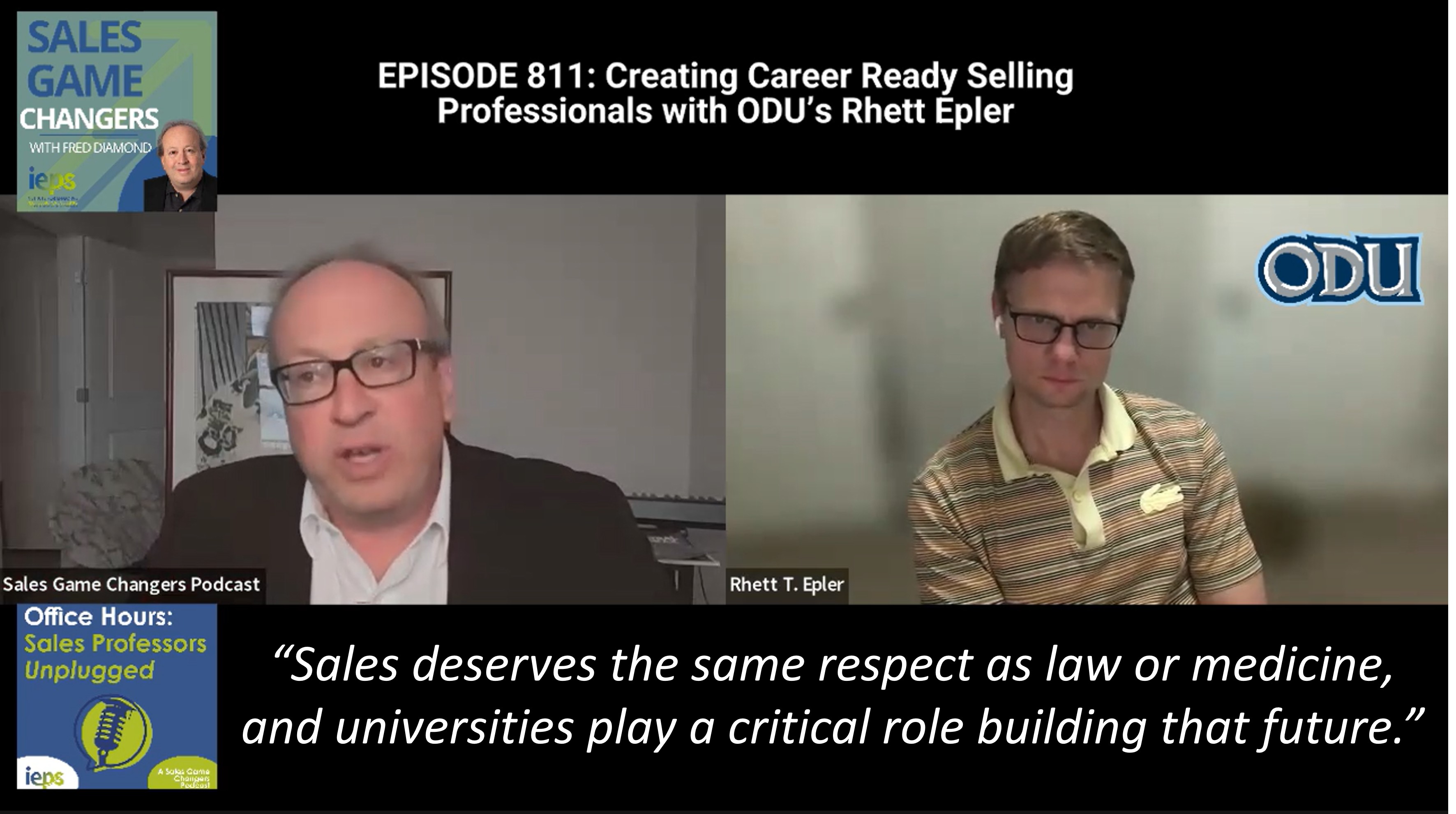
Watch the video of this podcast on YouTube here.
This is an Office Hours – Sales Professors Unplugged sub-brand of the Sales Game Changers Podcast. The Sales Game Changers Podcast was recognized by YesWare as the top sales podcast. Read the announcement here.
FeedSpot named the Sales Game Changers Podcast at a top 20 Sales Podcast and top 8 Sales Leadership Podcast!
Subscribe to the Sales Game Changers Podcast now on Apple Podcasts!
Purchase Fred Diamond’s best-sellers Love, Hope, Lyme: What Family Members, Partners, and Friends Who Love a Chronic Lyme Survivor Need to Know and Insights for Sales Game Changers now!
On today’s show, Fred interviewed sales professor Rhett Epler at Old Dominion University.
Find Rhett on LinkedIn.
RHETT’S TIP: “To see somebody get into a great career just changes their life. To be even a small part of that is one of the most underrated privileges this job has to offer.”
THE PODCAST BEGINS HERE
Fred Diamond: I’m very excited. I’m based in Northern Virginia, right outside of Washington, D.C., and we’re very fortunate, Rhett Epler, that there are a number of universities in the DMV, specifically in the Commonwealth, that have great programs for selling professionals and they’re helping these young adults launch great careers. You’re with Old Dominion University. Tell us a little bit about yourself and your journey to ODU.
Rhett Epler: Thank you, Fred. I appreciate this and I think what you’re doing is really great because you are advocating for the professionalism of the sales function. I think we all have the same goal and I think all of us in the state of Virginia, and really broadly speaking, have the same goal. It’s really neat to see all this coming together.
In terms of myself, I’ve been here at ODU for four and a half years. I moved here in the summer of 2021. It’s been my first job since getting my PhD at the University of Wyoming. It was during COVID and it’s a wild story, but I moved out here sight unseen. The job market was really weird because that was during COVID and I thought, “Yeah, that sounds like a cool adventure.” Everything was sight unseen and I moved out here.
They did have a sales program and that was really the biggest reason why I was interested in coming out here, is because that’s what I was trained under. That’s my professional background. It’s been really great to be here and help it grow and watch it grow and seeing students get really great jobs. I’ve now been here for four and a half years, so I’m starting to see students that have been out there for a few years.
Last week I reconnected with a student for some interviews for a research project. She’s now at Johnson & Johnson. I’m starting to see these students get into these really great careers and it’s really one of the most rewarding things about the job because to see somebody get into a great career, it just changes their life. To be even a small part of that, just having them in a class or two or writing a letter for them or anything like that, I think that’s really the most underrated privileges and experiences that this job has to offer.
I’m really excited about what we’re doing here at ODU and I’m sure I’ll be able to share more about it. Really, sales in Virginia in general, I think Virginia has really great universities. Both hands, you can count really good universities and most of them are involved in sales in one way or another. I just connected with somebody from the University of Richmond the other day. They’re getting a sales program and it’s just all these really great schools are now getting into this and it’s really super exciting.
Fred Diamond: Dr. Epler, what was your PhD dissertation in?
Rhett Epler: My dissertation was on how salespeople work in really dynamic and chaotic environments. I was working on this idea like the entrepreneurial salesperson, because that was my professional background, was I’d done real estate during the ‘08, ‘09 crisis. I was in residential and a little bit of commercial real estate. It was an atrocious time to be doing it. I somehow managed to do okay during it, and I think it was because I was pretty entrepreneurial. I also did some stuff in oil and gas, and oil and gas is obviously very volatile. When I was working in it, it was 2015, 2016, and that’s when oil was down at like $30 a barrel, and it was really dire. Of course, it went negative at one point. That’s another story. But it all informed how I was thinking about how salespeople respond to dynamic environments. I started to look at the entrepreneurship literature because entrepreneurs are mired in chaos all the time. There’s a lot of overlaps here and there’s just many similarities.
I got into the University of Wyoming. I studied under Mark Leach, who is just a phenomenal person. He’s been around sales for a very long time, and he’s of that generation that really helped to reduce a lot of the stigma towards sales. He’s part of that generation who really has done so much to advance this and put us all in the place we’re in now. I’m eternally grateful. In a nutshell, I’ve always been interested in how salespeople respond to really dynamic environments. I think entrepreneurs play a key role in understanding that there’s some differences, but I think there’s a lot of similarities and overlap that are pretty interesting.
Fred Diamond: We’re doing today’s interview in November of 2025. 2025 was a very challenging year with all the transformation as it relates to technology and government’s role and shifting transformation across all industries as we continue to come out at some level from the pandemic. Obviously, it’s great things that you’ve learned there. For people who don’t know, tell us a little more about the curriculum at ODU and some of the classes that you offer.
Rhett Epler: At ODU, we’ve got a sales major and a sales minor, and we have a really interesting selection of classes. We have obviously intro to professional sales, we have advanced sales, we have an influence and persuasion class, that’s replacing our sales management course next fall, and we also have negotiations. ODU is very unique because we have a school.
As of right now, to my knowledge, it’s the only school of professional sales and negotiations. It was endowed in 2022 by Dick Thurmond and his wife Pat Jennings. They’re very nice people. He was a real estate guy and he was very successful locally, and he did very well and obviously he wanted to pass a lot of that on. I can send you the information on why he endowed it, but he really wanted to provide negotiation and sales skills to everybody, with a particular focus on women and minorities because of some experiences he had in real estate and just watching how the world worked. That’s our ethos.
What is really interesting about us, I think is our focus on experiential learning. I’ll give you a few examples. I’ll just tell you the story. A year ago, I started hiring a professional improv comedian to come into classes and start to do some seminars in my classes. It was really great, and the students really liked it, he is a wonderful person, and he’s like, “Why don’t you come take a class?” I was like, “All right, I’ll take a class. That’s fine,” because he teaches his theater too. I started taking these classes and watching people’s communication abilities and literally six weeks go from sometimes not very good at all to almost miraculous transformations. I started doing all this and I was watching, and all it was was six weeks of training in a show and it was like, “This is really crazy what I’m seeing.”
Him and I hatched a plan over the summer and this last fall we got done in early October. We had the first instance of that in a sales class where he taught on Tuesdays. It was only for six weeks. He taught Tuesdays his improv stuff. Then on Thursdays, I would back up what he was saying with, “This is what this means for sales,” or communications, or emotional intelligence, listening, and all the neat stuff you learn in improv, because there’s so many overlaps. At the end of the six weeks, the students all participated in several live improv shows at his theater. It was really great because they all bonded and I watched all of them get really confident and I just am convinced that it’s something that can really benefit people and in so many ways, help them get jobs. You’ve worked in sales, I’ve worked in sales, it’s nothing but improv a lot of the time, because you don’t know what’s going to happen next and you always have to be quick on your feet.
I think the sales parallels are there, and that’s just one example of what we’re doing here. I think that we have a real focus, and not that other places don’t, I’m not saying that, but our ethos is skills and jobs. I think that’s something we really pride ourselves on. I talked earlier about seeing students get jobs and I truly enjoy doing that and advocating for them or reaching out to somebody and saying, “Hey, here’s a really great student,” or writing letters for them. I got an email in right before we got on the call and as I was getting on the call, I was looking up internships for them. It’s just a rewarding thing helping somebody out because I’ve been helped so much. I would say that’s what sets us apart.
My colleague, Aaron Arndt, he teaches the negotiations, and we have a lecture and we’ve got some adjuncts and we just have a lot going on. If you know anything about the area of Norfolk, you know there’s a lot of industry here and there’s a lot of huge B2B companies with a presence. It really is a pretty fruitful area for students if they want to stay here. But a lot of times they want to go back up to Northern Virginia because a lot of them are from there. That’s why I’m so excited to meet you, Fred. You have so many good connections up there and I hope to be able to send students that way and just further this relationship as well.
Fred Diamond: That’s interesting that you mentioned improv. We have done a couple of shows with people in the improv world. I remember about three years ago I did a show, and it was a guy who had got his training at Second City. One of his tutors was Tina Fey from Saturday Night Live. He said that, this is interesting, based on our conversation, he said that Tina’s advice to him was, “Stop trying to be funny.” We talk about this a lot in sales. When you try too much to sell, you throw the customer off. A lot of the advice is stop selling. Be informative, allow the customer to figure things out. Listen.
We did a survey of the most uttered words in the history of the Sales Game Changers Podcast. Listening, right after value, was the number two most important word. I remember he said to me, “Tina said, stop trying to be funny.” The same thing in sales is you want to learn the trade, you want to learn to understand the process and punchline, etc., but as you’re out there trying too hard, it just ain’t going to work.
I’m just curious. How do students become aware of your program? Do they know as seniors in high school to come to Old Dominion, or do they wind up and then they see you at a career fair or something? How does the awareness happen?
Rhett Epler: The path is interesting. I would like to circle back to the improv because I have one point on that that you brought up, because I think you’ll find humor in this, and utility. I think it’s like a lot of things, there’s so many good schools in Virginia and they try to choose where to get in. I go to any open house I can, wherever they are, because I just want to get in front of students and say, “Look, this is my value proposition. This is what I think I can do.” Pick the best school for you. This is not a high-pressure sale by any means. Do what’s best for you. To me, it’s a lot of that personal connection and just getting in front of students. Word of mouth is starting to spread, I think, because we’re doing such innovative and novel stuff here.
I do want to give a big shout out to my department and really my college, because I have a lot of these crazy plans sometimes and they usually are like, “Yeah, that’s a good idea. You should try it out.” It’s a culture of innovation and it’s really nice to be able to share that with students and say, “This is how we’re innovating, and here’s what we’ve done. Here’s some evidence of it.” I have found great support in doing many of these things.
Like the improv thing, I was so ready. I had this big thing written up, I had all these citations in there, and I was like, “Here’s what it’s going to cost,” and they were just like, “Yeah, that sounds great. How can we help you?” I really went in there prepared for something that was going to be this huge ordeal and it was pretty much a, “Yeah, that’s a really good idea. We think you should do that. That sounds really fun.”
There’s like a magic to some of this stuff with students because they go where they want to go, but then they have siblings or they hear from people, and it does take time. You have to be around a place for a while for people to maybe learn your name or something like that. The local newspaper, The Pilot, just wrote a story about my usage of AI in the classroom last week. I was really thrilled to see that because we use a lot of AI in the classroom. I pair AI role playing technology with sales competitions and things like that. You can get the practice and then put it into fruition, if you will, to see what a sales interaction or call looks like. That’s another thing they’ve been supportive of and we have a lot of really good corporate partners that help with all that.
Fred Diamond: What do you find out that your students want most? What are the main things that they’re curious about or interested about as they embark upon this career?
Rhett Epler: I didn’t come up with this, somebody else did, but they said their intro to sales class is like the change-your-mind class, because people go in there, and a lot of students, if they don’t have a family member that works in sales or something, which a lot of times they don’t, I find they come into sales classes almost reserved or in a way where they’re skeptical and it’s like no, professional sales people are value creators. There’s nothing unethical about any of it. You can’t be in the B2B world pulling scams on it. It just doesn’t really work that way. People are very sophisticated. We talked about that in our intro call.
I think they’re curious about sales, and I also find that they really want to learn how to communicate and they want a job. We’ve figured that out. They want communication skills, they want to learn about sales, and at the end, they want a job. I think that’s something that is fairly simple, I think, in many ways, and that’s what I believe our role is, is to act as a mediator in between their desired state and then the end goal they want.
Fred Diamond: One of the great things about the programs of places like Old Dominion University, and you mentioned a lot of the other schools in Virginia and the DMV, is that you have relationships with corporate sponsors. These are companies that are looking to hire great talent. I heard someone say recently that if they hire a young adult from a program like yours, the young adult is getting like a three, four-year head start because they understand the skills. They have to learn the products and the markets, but for the most part, these companies love to be associated. More and more of this is happening because we are producing young adults that understand that this is a profession, professional selling. I run the Institute for Effective Professional Selling.
You’re also right, Virginia, for people who don’t know, it is a great business state. All through the Tidewater area, the Northern Virginia area, Hampton Roads, whatever you might be calling it, all through Richmond, it really is such an illustrious state for so much. Talk about your relationship with corporate sponsors and how much they know about what you do and what do they expect?
Rhett Epler: We have tons of good relationships. These are some of the biggest companies in the world, United Rentals, Fastenal, Enterprise, ADP, CoStar. These are all huge. I tell students, I always say, these are big serious companies that want to come in here and hire you all because they have a lot of grads that work for them. They just come in knowing that they’re going to have students that have got some real-life experience. I do want to give a shout out to the rest of the state of Virginia because you can go to Tech, you can go to JMU, you can go to VCU, I can just rattle these schools off. I suppose they’re peer schools in a way, but I don’t really look at it in that way because we’re all in this together, in my opinion.
Like I said, you could just randomly pick a city in Virginia and, “There’s a really great sales program there. I know the people there. I think the students there are getting a fantastic job.” Companies are realizing this too, because if you look at the partnership list with all these schools, it’s the same companies. The companies involved with tech are the same ones involved with us. They understand that students are getting a good education here, and they’re really happy to hire them and then go put them into these roles.
Sales is something where you can have a, if you’re a college student and you want a reasonable path to six figures within probably three or four years, it’s imminently doable. It’s almost expected at this point that this could be really a game changer for you socioeconomically. They come here knowing these students are going to be able to go there and perform, and that’s why they’re such good sponsors. They partner stuff and they’ll pay for events and they’ll travel. Then we’re doing site visits, we’re starting to roll some of that out. In this upcoming spring, I’m working on something now with doing some paid job shadowing, or we’re going to pay students to go out and shadow with a few companies so they can just see what this is really like. I think that’s our role as educators, is to expose them to that and teach them the skills.
Fred Diamond: That is great. You’re working with a lot of these young adults, preparing them. What you view these students, the ones that are really going to excel, what are some of the things that you see in them? For example, I’ve judged at a couple of competitions recently. The thing that blows me away is all of these young adults who are part of these programs, they’re all talented, from the least to the top. But then as you go up in the competition, you see some things come through in some of the ones who might be a little more elite. I’m just curious, what do you see working with a lot of these young adults that some of the elite ones have? What are some of the drivers, characteristics that you see in them?
Rhett Epler: That’s such a good point, because there are so many. You’re right. I’m actually quite optimistic on the future because I deal with a lot of the future leaders, I will just say that. I think they’re really smart and quite a bit further along than I was at that age, we’ll just leave it at that. But with that said, I think the things that I’m seeing that really sets the top students apart is that they are super engaged with everything on campus.
We just had a sales competition and it was absolutely a great competition. The winning team had two student athletes on it, and they’re just two girls that practice all the time. They get the benefits of practice, and they were so competitive and they were like, “We’re going to win this. What do we need to do to win this?” That was their question. They weren’t cocky at all, but they asked me, “What do we need to do to win this?” I’m like, “You need to practice. That’s really what it’s going to come down to, is you have to be hungry. You have to show up and have a good day, obviously,” and they’re like, “We will do just that.”
I would say students that are in clubs, that do sports, it’s almost like you can look at their resume and you can see what they’re doing and it’s like, “This student gets it, that they need to be doing clubs. They need to be really actively involved in many places.” Some of that other stuff, if they’re quick on their feet or if they’re good listeners, they’re going to do well, but there’s little intangible things to me that indicate drive. That’s just somebody who’s really plugged into life in many ways. You see that a lot with students that are just really top performers. It’s like they’re just excelling at everything they do, and they’re involved and they’re engaged, and they’re just really active all over campus. I would say that’s something that I’ve noticed over the years.
Fred Diamond: That’s a great answer. It’s one of the other keywords that has come up innumerable in the over 800 episodes we’ve done of the Sales Game Changers Podcast, is preparation. I want to talk about that as it relates to some of the trends shaping the curriculum. Dr. Rhett Epler, we haven’t mentioned AI yet, and we’re 20 some odd minutes into the show. We talk a lot about the trends of professional selling, with the shifting in customer engagement, because of the rise in digital information being accessible to them. What are some of the trends you’re seeing in your sales curriculum? How has your teaching and those of your associates shifted due to that?
Rhett Epler: That’s a really good question. I think with the incursion of AI, we’ve been able to adopt some technology because our program is set up to where we can really leverage some of these tools. We have companies that are willing to help us out with that and things of that nature. But I would say, there’s been a real push to understanding this and getting on top of it and leveraging it. I would say, I can only speak for myself, but I do know a little bit about my colleagues’ curriculum and everything is pretty much experiential now because we’ve realized that students are using AI in ways that may not be the best. I’m not really interested in reading a five-page AI type paper.
There are ways around that. You can do in-person testing with pen and paper, and I would actually advocate for that. I know people doing that. But I would say it’s pushed nearly everything I do to just being experiential. My final exam is a sales competition with Enterprise, and I make all students participate. You get four or five students that do it, but instead, we get 40 or 50 and they get to see what a sales call is like. I have learned that over time, with students, I can pull levers as a professor, and it’s like, “No, this is your assignment right here. Here’s what we’re going to do, and here’s why we’re going to do it, and here’s what you’re going to benefit from.” If you can get them to buy into it and just explain this is really going to be beneficial and explain to them why we’re doing this, I think that’s what I’ve learned over the years.
I just encourage sales professors or practitioners watching this, we’re doing a lot of really good things in the sales classrooms. That’s why you do this, Fred, because I think that college is getting so much pushback and critique right now. Some of that is without a doubt warranted, but I will stand up for sales in saying, the salespeople are over here, we’re doing all this really cool stuff, it’s experiential. These students are learning a lot. They’re getting really good jobs. It’s really super exciting to be involved in it. In general, there’s just this push towards everything experiential. We’re all salespeople, former, or most of us are. We have that mentality of we’re going to try stuff and we’re going to work together and we’re going to figure it out.
Fred Diamond: I love that, experiential, because sales happens in front of customers, it happens in the field, it happens with partners. The ones who are successful, I love the way you said your two young ladies wanted to win, so what do I got to do to win? In sales, it’s about service, of course, but it’s about winning. It’s about winning the hearts of the customer. It’s about winning their confidence that what you’re bringing to the market is going to help them achieve their goals. It’s not about you selling your stuff. It’s about helping your customers achieve their goals. Anything else you want to share? Anything else you want to bring up that we might not have covered that you want to make sure you get across?
Rhett Epler: I wanted to bring this up about the improv, because there’s some rules to improv that I think were sold, because when the guy was teaching it, he’s like, “How are you going to translate this into sales?” I’m like, “This is so easy,” because one of the rules of improv is you use props if you’re up there, but you don’t talk about props. It’s the same with sales. You don’t want to talk features, you want to talk benefits. It was just all of that stuff. Character work is nothing more than adapting to somebody’s communication style and their persona, if you will. It was just so fun to do that and to explain it to students. To me, the idea is just look at the world around you and there’s so many things to learn from, and if you can leverage this stuff, you can do really neat things.
I do communicate that to the students too. It’s like, “I’m just a guy that tries stuff and I want you all to have this mentality too, to where you get out in the world, don’t be afraid to try things. If something works, that’s great. If it doesn’t work, that’s also great because you learn from it.” If you just have that mindset all the time, like, “I’m going to learn from this,” then it will be okay. That was the one little thing on improv.
I touched upon just the sales community in Virginia, but I really will just say it really is fantastic. I know you had talked to me, Fred, about we’re going to do this Virginia State Sales Competition at ODU this spring. We had to pivot on a sponsor, so we’re finding a new one right now. You approached me about judging there, and I would just say that’s the mentality in Virginia, is how can we help out? Then what can we do to benefit each other? I would say that’s so rewarding that people are just here to help out. We have that mentality too. Really there’s so many good things going on here. Really proud to be a part of it.
Fred Diamond: I’m glad you brought up the improv. I want to talk a little bit more about that. People say when they think about creative jobs, they think about marketing and graphics and design. The reality is, sales professionals have to be quick on their feet. It would be nice to have a script, and we all try to work on that so that there gets to be a rhythm and you make sure you communicate, but sometimes the customer says, “All right, I only have five minutes.”
“Well, I had a 20-minute script prepared.”
“Okay, you have five minutes.”
You need to figure out, “How do I get to the core?” By asking the right questions and maybe shifting along the way, trying to think quick on your feet. The customer throws a curve ball all the time. Like, “Well, we love what you’re doing, but we don’t have budget.” Well, how do I show more value and how do I help them?
I’ve worked at large technology companies. I used to have an expression, “I may not have budget, but I have money.” I’ve worked at billion-dollar companies and I’ve been told, “Hey, your budget’s been cut.” Okay, well we’re a $10 billion company. I’m sure there’s 50,000 bucks sitting in an account somewhere that we can use, but how do you be creative? As you’re always thinking about where the customer needs to go, those are definitely, I love that you brought this up, they’re definitely skills that easily can be transferred into professional selling.
Rhett Epler: I totally think so. They picked it up very quick and I’m like, “Look guys, we’re having fun up here, but really you’re going to take these lessons with you.” I had students after that say, “Look, I had to give a presentation and it was nothing, because last week I got in front of a stage.” We’re at a theater, it’s a hundred-person theater, and they got up and they did an improv. There were multiple teams and they were up there for 45 minutes a piece. To your point, it’s like a mindset of just, “I will figure this out. There’s a way out of this. I’ll find the money somewhere within the organization. I’ll be a good team player. I will find somebody that will help me out. We’ll get this done.” I really want them to take that attitude with them and they will absolutely go and be sales executives someday and just have wonderful careers because of that. I’m really convinced of that.
Fred Diamond: Dr. Rhett Epler, thank you so much for being on today’s Office Hours – Sales Professors Unplugged. It’s great to learn more about what’s happening. I look forward to helping you with your program in the spring that we’re going to be judging. One of the great things about this Office Hours – Sales Professors Unplugged is I’m talking to people who are setting young adults off on a career. Like we said, we view sales, it’s a profession. Our mission at the Institute for Effective Professional Selling is to help companies, B2B or B2G, engage their teams and their customers more effectively, elevate their sales leaders, and empower success. What you guys are doing is very much in sync and glad to have you on today’s show.
Rhett Epler: Thank you, Fred, so much. I really appreciate your time and it’s always nice talking with you. I really am a fan of what you’re doing, so thank you for letting me play a part in it.
Transcribed by Mariana Badillo