
Watch the video of this podcast on YouTube here.
The Sales Game Changers Podcast was recognized by YesWare as the top sales podcast. Read the announcement here.
FeedSpot named the Sales Game Changers Podcast at a top 20 Sales Podcast and top 8 Sales Leadership Podcast!
Subscribe to the Sales Game Changers Podcast now on Apple Podcasts!
Purchase Fred Diamond’s best-sellers Love, Hope, Lyme: What Family Members, Partners, and Friends Who Love a Chronic Lyme Survivor Need to Know and Insights for Sales Game Changers now!
Find Rishi on LinkedIn.
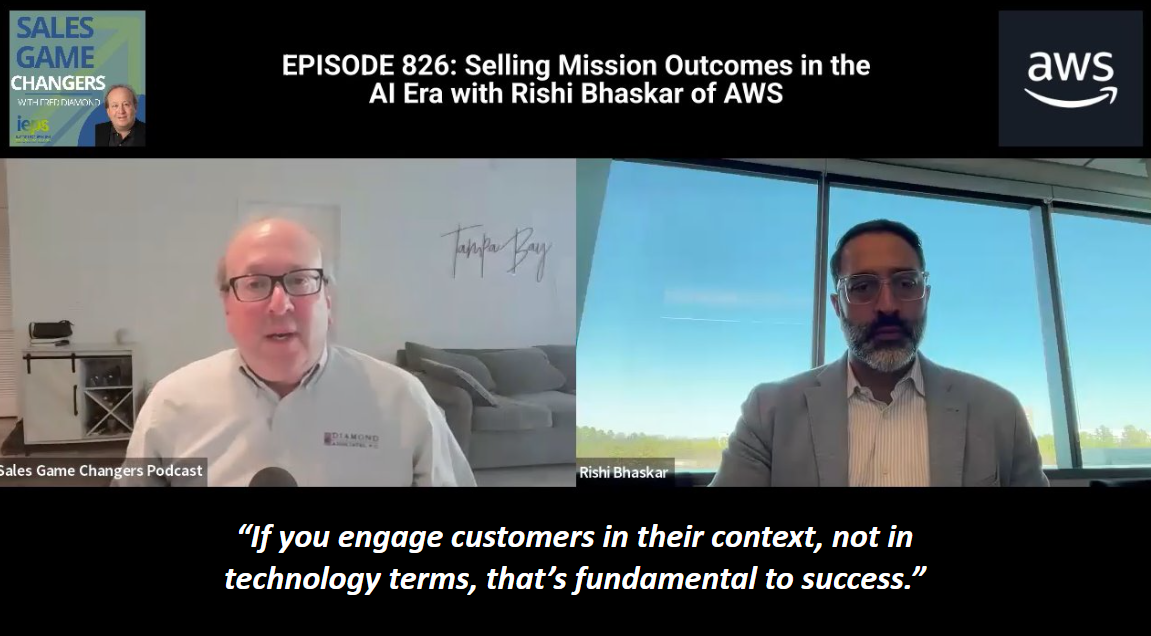
RISHI’S TIP: “If you engage customers in their context, not in technology terms, that’s fundamental to success. When you can speak both mission language and technical language, your credibility is established immediately.”
THE PODCAST BEGINS HERE
Fred Diamond: We’re talking today with Rishi Bhaskar, and I’m going to let you introduce yourself in a second, but I just want to acknowledge that AWS is an IEPS Premier Sales Employer. It’s a great place to work. You have so many amazing people there leading teams. What AWS is doing, particularly in the public sector, which we’re going to be talking about, is not just remarkable, but it’s so vital to what’s happening in the public sector, and everything that’s going on.
I just want to tell people we’re recording today’s show in March of 2026. There’s a lot of things going on in the world, and we’re going to touch on some of that. For partners who may not know your background, briefly describe your role and how you support the partner ecosystem at AWS.
Rishi Bhaskar: In simple terms, what we do here in my organization is we’re essentially what I would call the connective tissue between AWS and our public sector partners. We help our partners build, sell, and scale their solutions alongside AWS in really some of the most complex and consequential technology environments in the world. We really look after this from a global perspective, so when we look at our partner base, yes, there’s regional nuances that we account for, but we support the public sector business worldwide for AWS and our partner network.
Fred Diamond: We have a lot of sales professionals listening all over the globe, and a number of them are in public sector, of course, a lot of them are also in commercial enterprises. We have a lot of B2B, a lot of B2G people that listen. On the Sales Game Changers Podcast, we talk about how sales leaders are leading teams now, working with customers. We do a lot of shows with sales leaders who are leading partner ecosystems and the whole partner world. I’m just curious for our listeners, what’s fundamentally different about selling cloud into defense as compared to commercial enterprises?
Rishi Bhaskar: It’s a great question. What’s interesting about AWS is we define public sector as pretty broad. It’s not just their traditional government organizations. Yes, we cover all levels of government, national, local government, but we also cover education, state, and local government, as well as healthcare and life sciences inside of our public sector definition. What’s really interesting about what’s different in the commercial world or the defense world or the public sector world is we really lean with mission outcomes.
We don’t go into our customers and talk about technology, essentially, as a first lead-in. We go into our customers and our partners together to really talk about, what’s your mission outcome? Is your mission outcome effectiveness, efficiency, security, supply chain, edge compute? There are so many different use cases that we get after with our partners. But the key, though, is to look after their opportunity in the context of their mission outcomes. That’s what really drives the difference.
I think there’s one other thing that’s really important, is when we go into that environment and try to solve their mission outcomes, when we have relentless customer obsession combined with domain expertise and their mission outcomes, that’s when we really drive transformational change for our customers.
Fred Diamond: Before I get a little bit deeper into this, I’ve thrown around the term partner frequently. For our audience, can you define what the partner ecosystem looks like with AWS Public Sector?
Rishi Bhaskar: That’s a great question. Because we define public sector in a really broad way, we define our partner network in a really broad sense as well. From our setup, it’s a bit unique. We look after all of our partners that sell into public sector and customers. That goes along with the definition of public sector I talked about earlier, governments, education, healthcare, life sciences, nonprofit organizations as well. Then we look after the diversity of the partner ecosystem. We look after everything from big global systems integrators, national or regional systems integrators, defense industrial base providers, as well as distribution reseller partners, and right on down the line.
What’s also pretty unique about how we go to market is we have an inflection point of our partners essentially being customers. The defense industrial base is a remit that’s within my organization. We partner with the defense industrial base to deliver mission outcomes, but we also look at the defense industrial base and several ISV partners as customers in my organization as well. We’re a bit dual-hatted from that perspective. We’re essentially a customer team and a partner team in one organization.
Fred Diamond: Let’s get specific on what you’re seeing right now across the Department of Defense or Department of War and defense contractors in terms of cloud adoption. Give some insights into what’s accelerating and maybe what’s holding things back.
Rishi Bhaskar: What’s interesting about the Department of War or Ministries of Defense around the world is we’re in an inflection point. A few years ago, the conversation was about whether cloud was viable for defense workloads. I think that conversation is actually over. Now it’s about operating at scale across mission-critical systems. The biggest acceleration is around AI and machine learning. We’re seeing defense organizations that are sitting on enormous volumes of data. There’s a real urgency on how do you make that data actionable? That’s driving cloud adoption by itself, because we have to get on the data journey in order to make the data valuable from an AI perspective.
We’re also seeing really significant momentum around software modernization. We see agencies around the world moving off legacy monolithic systems toward cloud-native architectures that give them speed and flexibility. But it’s still hard. It’s still hard. It’s less about technology and more about organizational change. Legacy systems integration, data silos, workforce readiness, navigating a complex acquisition process. There are real friction points in this process, but frankly, that’s where our partners add enormous value. We bring a technology portfolio, we bring context of the mission outcome, and our partners turn that technology portfolio plus mission context outcomes into transformation across the world for our customer base.
Fred Diamond: Let’s talk about the best ones. What separates the high-performing partners in this space from everybody else? You’ve dealt with thousands, if not tens of thousands, of companies that fit that wide ecosystem. We’re doing today’s interview in March of 2026. What are the best ones doing differently from everybody else?
Rishi Bhaskar: We have such incredible partners in our partner network, and thousands of them as well. But what I see consistently with the partners who win the most is that they don’t wait on us. They don’t wait on AWS or the customer to tell them what to do. They show up with the point of view. They’ve already studied the mission problem, they’ve built a solution around it, and they’ve come to the table ready to execute. You contrast that with partners who claim they can do everything, we see that all the time, it’s not really helpful, to be honest. The best partners are specific. They show up. They say, “We solve a problem for this type of customers. Here’s the proof point where we’ve done it already.”
The other thing that’s really interesting is what the best partners do, and I’ve seen this firsthand, they invest in people. They invest in clear talent, especially in the defense world that we work in. They invest in operational understanding of the defense environments. It’s incredibly valuable and incredibly hard to find that type of talent that has mission experience, plus the right credentials to work in this space. The partners who prioritize and understand that investment need, they stand out immediately.
Fred Diamond: I like that answer. One thing we talk a lot about on the Sales Game Changers Podcast is the fact that if you’re not bringing value to the customer, that the customer hasn’t thought about yet, that you’ve shown, you’ve put the work in, the energy, the thought into where the customer is going, that is really where you’re differentiating yourselves. Otherwise, with AI and with everything else, customers can get a lot of the information that they need. They could find anything they need about what AWS is bringing to the marketplace. How are your partners bringing some unique value? I’m just curious, are there any vertical specializations that you see really emerging today that you would search for, I would say recommend, but I would say maybe you search for right now?
Rishi Bhaskar: Our customer base is so diverse in public sector, but the key theme with every single one of these customers is vertical specialization. Understanding the customer’s challenges, the context of how they’re solving problems, and that leads you to the right technology solution every time. If you engage customers in their context, and not in technology terms, it’s fundamental to success, both for you as a sales professional and your customer, and delivering those transformative outcomes for your customer.
One of the things that I think is super interesting is we can teach anyone cloud skills. We have training programs all over the world, in-person, virtual, we have certification programs that go across our entire portfolio. You can do them online and a lot of them are free actually. What we can’t teach sales professionals is that 15 to 20 years of experience and understanding how a specific mission community operates. What are their real pain points on the ground? That only comes with domain and verticalization and expertise.
When a partner walks into the room that can speak both mission language and technical language, their credibility is established immediately. We see that as a real game changer for our partners and our partner sellers. Conversation quickly changes in that environment from a vendor pitch to really solving a problem that the customer is desperate to solve.
I don’t want to also dismiss broad technical capability entirely, it’s super important. The ideal partner combines deep domain expertise with strong cloud fundamentals. What’s really important in that is if you’re a partner and you’re a partner leader in these organizations and you’re trying to decide where to invest first, I believe you should invest in the customer’s real-world deep understanding of their context and the technical skills can be brought along, but they are foundational to driving success.
Fred Diamond: Let’s talk about AWS and how you’re supporting partners right now. There’s a whole slew of things that your organization does. Talk about some of your priorities from a how can we and how are we supporting your partners right now?
Rishi Bhaskar: We support our partners in multiple ways. We support our partners in building solutions. We look at solutions that are required in the industry. Again, whether it’s in any one of our public sector disciplines or verticals, we really look at partners that bring unique opportunities to say enterprise resource planning transformation programs. That’s a big opportunity across the sector right now. We also look at generative AI and what opportunities our partners can bring forward from a GenAI perspective. I think there’s one bucket of we look at the solution capability of a combination of AWS with the partners technology or partner services.
Then we also look at how do we enable those partners to get to market to drive those solutions into the end customer’s hands. As we started this discussion, Fred, we know where there’s a lot of moving parts in our industry right now. There’s a lot of opportunity in our industry right now as well. Finding the gaps and opportunities around our partners’ capabilities with AWS is transformative capabilities and really bringing those together from a solution. But then also a go-to-market execution mindset, which is really what drives our results with our customers, is super, super important. If I just pick two things that are foundational that we focus on, it’s developing solutions and executing in the market.
Fred Diamond: The channel is expanding. More and more partners are coming on board. Developers, manufacturers, the OEMs, the AWSs of the world need to have a great channel organization to get to the customer, because that’s where a lot of the relationships are. I’m just curious, what are you looking for? What are some of the skills that a channel manager at an AWS needs to have? If you are starting an organization from scratch or looking to hire more people, what are the two or three things that you want your channel professionals to have as skills?
Rishi Bhaskar: It’s an interesting question because it’s different in a lot of partner organizations around the industry. I’m slightly proud, slightly embarrassed to say I’m in my 28th year of my career. I’ve seen all walks of life around the partner ecosystem or the partner networks across multiple industries. I think what’s really interesting, what I look for foundationally is not just someone that can go create solutions and do partner enablement. I really look for folks that understand industry disciplines, as we talked about, but then also know how to sell in a multi-tier sales environment.
We actually are all salespeople in my organization. We do some partner enablement work, yes, but we really focus on selling and executing through multiple tiers with our partners. Sometimes that’s just simple, a prime with AWS. Sometimes it’s a prime with multiple downstream partners. Sometimes it’s a distribution partner that has multiple downstream partners. Sometimes it’s an independent software vendor that’s selling our portfolio into multiple end customers. I think from my perspective when I look for that capability and skill set, domain expertise in any one of our disciplines and ability to sell and understand a multi-tier sales model.
Fred Diamond: If you were advising a channel partner CEO today and they came to you and said, “Rishi, what is one strategic move that I should make this year to grow cloud revenue?” What would be your go-to advice for them?
Rishi Bhaskar: There’s a lot of advice out there, but I think one of the things that sometimes gets lost on the industry is building one-off versus repeatable solutions. There are tremendous opportunities out there where you can focus on a repeatable solution around a specific mission challenge. Whether that’s in one agency in one country or multiple agencies across the global opportunity set, it’s really important to make sure we’re building repeatable solutions. Those point solutions are going to be a good way to get a little increase in your revenue opportunity, but then it’ll stagnate after that. I also think it’s also important to really, really identify the right talent, the right talent that can bring those solutions forward in a repeatable way and drive scale.
Fred Diamond: AWS is at the forefront of all of this, the leading company in all the things that we’re talking about here. What are some trends that your partner should be preparing for in the defense world, the defense cloud over the next 12 to 24 months?
Rishi Bhaskar: In the defense area specifically, we’re seeing AI move from pilot to production. Our partner network is really focused on that. We’re obviously helping our partners move through that AI journey, but what’s really important right now, considering where we sit today, Fred, is the experimentation phase is ending. Organizations are going to start demanding AI capabilities that work in real operational environments at scale. But we have to have the right governance and security frameworks to support them. Partners who help customers operationalize AI and not just build models, but deploy, monitor, maintain them in production, are going to be an enormous demand by our end customers. I think that’s really fundamental and that’s the first big trend.
The second I think is data interoperability. It is the strategic imperative, the ability to connect data across systems, domains, classification levels, that will really elevate mission outcomes.
I think the third one, and we’re seeing a big push here, is around edge and tactical cloud capabilities. Computing, as we all have seen, is moving closer to where the missions actually take place, at the tactical edge, in disconnected environments, in contested spaces. That requires a very different architecture and a very different skill set. Partners who start building edge capabilities now are going to have a very significant head start in some of these big trends. We’re very excited about this opportunity. We’re really excited about the opportunity to work with our partners to lead in these areas now.
Fred Diamond: I’ve interviewed over 800 sales leaders over the years, and many of them have built their career in public sector. I’m just curious, what motivates you personally? You’ve devoted your career to the defense ecosystem. Why is that?
Rishi Bhaskar: As I said earlier, it’s been 28 years at this career, which has been a lot of fun. It’s been a cross-section of some commercial work early in my career. It’s a lot of public sector work in the last 10 or 15 years. I’ve always been very passionate about creating the right outcomes that help society, that help humanity. Whether that’s in defense or whether that’s in public safety, I spent a bulk of my career in the public safety world as well. Whether that’s in providing better health outcomes for our citizens around the world in our healthcare life sciences discipline of our business.
To me, it’s all about trying to use technology for good. You asked me what motivates me, that’s it in a nutshell. I’m a technologist at heart. I was a software engineer earlier in my career, and trying to understand and figure out how to use technology to make the world a better, safer, more efficient place for all of mankind, I think is super, super important. That’s what really keeps me motivated to put in the blood, sweat, and tears to make sure we’re delivering the right outcomes for our customers.
Fred Diamond: Congratulations on your success. You’re leading a huge organization that is touching so many entities, so many critical organizations around the globe to make the world a better place and to solve so many problems. When you were describing the breadth of what public sector looks like in AWS, it’s not just defense, it’s not just the U.S. government, it’s organizations, you mentioned not-for-profits, healthcare, etc. We all just want to make the world a better place. Kudos to you and to your organization for all the great work.
I want to thank you for all the great insights that you’ve shared. Give us one specific action step, something that sales professionals should do right now to take their sales career to the next level.
Rishi Bhaskar: Learn how to leverage AI. I know it sounds easy to say, and a lot of folks are familiar with the commercial tools out there, but I think spending the right time, understanding how to not only just use AI but use it specific to your discipline and how you can actually create the right outcomes, it doesn’t happen quickly. You’ve got to spend the right time and make sure you’re leveraging the right tools that are out there and available to you to drive your AI skillset. I think that’s super, super important for all sales professionals.
Fred Diamond: Once again, I want to thank Rishi Bhaskar for being on today’s Sales Game Changers Podcast. My name is Fred Diamond.
Transcribed by Mariana Badillo