
Watch the video of this podcast on YouTube here.
The Sales Game Changers Podcast was recognized by YesWare as the top sales podcast. Read the announcement here.
FeedSpot named the Sales Game Changers Podcast at a top 20 Sales Podcast and top 8 Sales Leadership Podcast!
Subscribe to the Sales Game Changers Podcast now on Apple Podcasts!
Purchase Fred Diamond’s best-sellers Love, Hope, Lyme: What Family Members, Partners, and Friends Who Love a Chronic Lyme Survivor Need to Know and Insights for Sales Game Changers now!
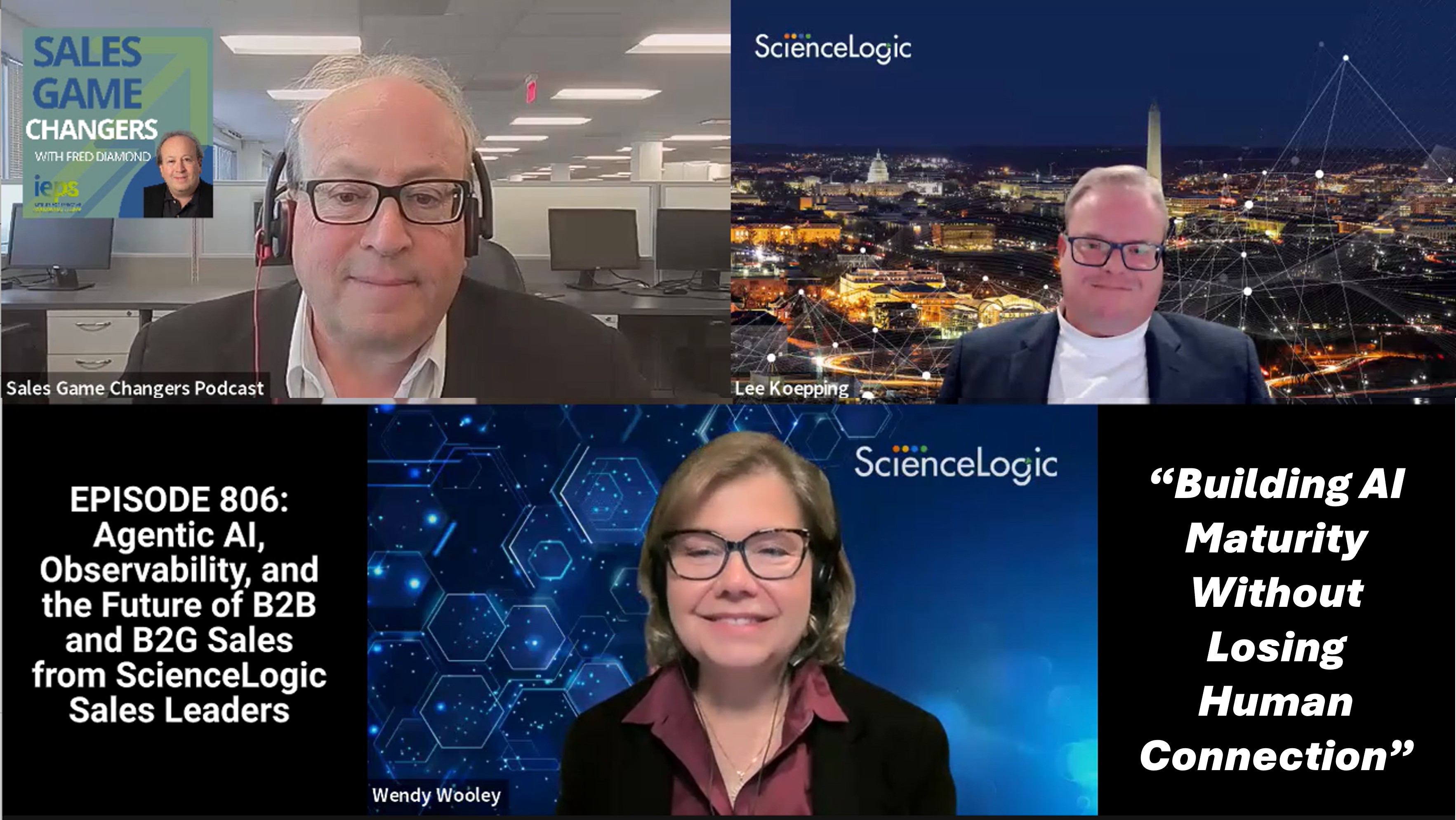
On today’s show, Fred discussed where we are with AI and B2B and B2Government sales with ScienceLogic leaders Wendy Wooley, VP of Customer Advocacy and Strategy, and Lee Koepping, Global Sales Engineering at ScienceLogic.
Find Wendy on LinkedIn. Find Lee on LinkedIn.
WENDY’S TIP: “You can’t replace human relationships in sales, but AI helps you stay proactive when organizations change.”
LEE’S TIP: “Sales is still very much a human game. AI won’t replace that but it can get you to the right people, at the right time, with the right insight.”
THE PODCAST BEGINS HERE
Fred Diamond: I’m excited today. We have Lee Koepping and Wendy Wooley with ScienceLogic. This is the first time in over 800 shows that we’ve had sales leaders from ScienceLogic. One of the reasons is your headquarters is not too far from my office in Reston, Virginia. I know you both are outside of the area this morning, but I broadcast live from Reston, Virginia, which is the heart of the Northern Virginia tech area, for people who don’t know where I am based. We’ve had over 17 million listeners or interactors with the Sales Game Changers Podcast. It’s the business, the tech center of the DC region. We’re not too far from Dulles Airport. I pass your building every day on the way to work. I’m very excited to get to learn more about you both and your company and how you go about the sales process. This is exciting.
Lee, why don’t you get us started? Tell us a little bit about ScienceLogic and its AI-powered observability platform, and what you are selling to both government and B2B enterprises.
Lee Koepping: ScienceLogic, the core of what we deliver, we’re myopically focused on delivering an agentic AI platform that observes, it advises, and it automates IT operations. We can see across the entire digital estate. I think really, if you wanted to sum it up, we’re an IT productivity tool for IT operations.
Fred Diamond: That’s very cool. Wendy, I’m curious, how would you describe ScienceLogic as well?
Wendy Wooley: That’s a great question. For describing ScienceLogic, I concur with the observability tool and really for helping our customers improve the day-to-day IT operations for what is so important in every business. IT operations management is the key that allows things like this podcast or other primary functions of their business to run and operate. You want to make sure that it is always on operational, and you’ve got that observability for what is most important in today’s world in getting everything to work as expected and have the observability to do so.
Fred Diamond: You’re the VP of customer experience and strategic programs. How do you support the sales organization across customers and your partners? Tell us a little bit about your partners. What types of companies are partnered with ScienceLogic to bring your solutions to market?
Wendy Wooley: We have a number of MSPs. We’ve got long-time MSP partners. We’ve also got GSIs. They’re both serving different parts of the marketplace. We’re very blessed to have those types of companies as our partners. It gives us the ability to expand beyond just the ScienceLogic footprint for sales and allows us to get that global reach and work with some of the best in the industry.
Fred Diamond: You mentioned GSI, for people who don’t know, that’s Global Systems Integrator. Explain to our audience who may not understand what they do, what they do.
Wendy Wooley: I would say whether it’s the MSP, our federal partners, our GSI partners, they all have specialties. The GSIs definitely have their own way of going to market with their own platform. We become part of their own solution. They’re not bringing just ScienceLogic to the table, but we are part of an entire ecosystem that they bring to their customers. They are unique in that manner. GSI being global, they’re definitely some of those largest global systems integrators in some of the names that you would hear.
Fred Diamond: Lee, you’re the VP of Global Sales Engineering at ScienceLogic. Tell us what you do, tell us a little bit about your background to get you to this point as well.
Lee Koepping: As the name implies, sales engineering is the team that I run worldwide here at ScienceLogic, which all that really means is I’m bilingual. I speak sales fluently and I’m a technologist. We’re very much in the forefront of both introducing our platform, our concepts, our operations to our partners and to our end customers, as well as delivering that value proposition and translating it between business and technical terms often.
Fred Diamond: You mentioned agentic AI. Let’s get a little bit into that. Wendy, at ScienceLogic, and by the way, I went to YouTube. You guys have a couple of very good videos that crisply explain what ScienceLogic does. If there are people listening and there are who are partners who are more curious to see a nice crisp grasp of what you do, I encourage you to go to the ScienceLogic website, and some of these videos really crisply explain that.
You have a framework for not just selling and delivering features, but also ensuring that you’re delivering measurable repeatable business outcomes, business results. Tell us how this is applied by your sales team. I run the Institute for Effective Professional Selling. People usually listen to the Sales Game Changers Podcast for solutions on how to have their sales team be more effective. How do you convey the strategic advantages of your technology offering to them and out to the field?
Wendy Wooley: That’s a great question, and thank you for asking. ScienceLogic developed what we call the Autonomic IT maturity model, which is our AI maturity model. One of the things that changes as far as the playbook for AI is that the technology is not necessarily front and foremost. The business outcomes become very important. There’s also maturity. You’re not going to get to agentic AI day one. There are a number of things that happen for our customers over time and with a journey. This is not the how you are a customer, this is where we’re going together in partnership, and strategically, how are we moving forward for people, process, and technology. It’s not just technology, especially with AI. Workflows have to play in as well. That’s very much people and process in order to get customers to where they want to go using our solution.
The framework helps to explain what a customer does in using our solution over time, but it also allows us to use it as a go-to-market tool. We have trained our salespeople against this maturity model so that they understand how to sell the value and the outcomes, not just sell the technology. It’s become a very important tool for us, both internally and externally with the customers, and we do have it client-facing in a blog series and other resources on our website. We use it extensively.
Fred Diamond: That’s actually great. Every sales leader is looking to understand AI and how do they use it. One thing that we’ve discovered is there’s a lot of selling organizations who are just using tools. They’re just throwing tools and maybe the salespeople are using Chat or Claude, whatever it might be, to generate emails. If they’re smart, they’re using it for various ways to prompt to find what their prospect’s challenge is. We’re doing today’s interview in November of 2025. I had a conversation this weekend with a senior sales leader at a well-known company who said that he has a 39-prompt approach to understand the challenges that some of his customers might be using. For both of you, what are the sales leaders that you’re interfacing with challenged with as it relates to AI? I know you like the solution, but what are they asking you for? What are they saying their biggest challenge is?
Lee Koepping: On the on the sales front, our own as well as a lot of our peers in the industry, I think their biggest challenge is variety. AI has exploded in a way that I don’t know that anybody could have anticipated. We barely had these kinds of conversations less than a year ago. Agentic AI beyond that now is AI connected to AI and multiplies, if you will. The biggest challenge that we’ve seen in sales is there are just a variety of different ways you can leverage AI to get information, almost too many. Like any new technology to the market, I expect that to settle down, to gel, either through acquisition, through market demand, it’ll settle itself out. But I think the biggest challenge right now is how do I use AI? Where do I use AI? When do I use AI? Because sales is still very much a human game, that face-to-face really understanding a problem, trying to achieve an outcome. AI is not going to replace that. But AI can definitely be used to get to the right people at the right time in the right place. But the magnitude of offerings available to try and do that, I think is really the hard part for sales professionals today. This will evolve, I expect.
Fred Diamond: Wendy, what do you think?
Wendy Wooley: I agree with that. It’s interesting to see the different tools that different parts within our sales organization, what they might be using. A BDR is going to use something different than an AE, for instance. The tools in tech within those different roles, and then the tech stack that they’re using have some overlap. I’ve seen a lot of that shifting out over this last year, where you’ve got two tools that start to do the same thing. You’ve got to then understand which one’s going to get you the best value for your day as a salesperson, and you can make sure that you are the most efficient with the best information. That’s been something over the last year I’ve watched, and it continues to change at a really rapid pace. I imagine over the next 12 to 18 months, it should settle out a little bit more, but it is ever changing, and I think that’s probably a challenge that everyone’s navigating.
Fred Diamond: One of the things that we’ve seen in talking to a lot of the sales organizations is exactly what you both said. Some people have used the expression, the Wild West, because there’s so many tools, and Lee, I like the way you said that there’s now tools connecting to tools, which is providing a multiplier effect. Where do you see organizations going as it relates to AI, either standardization or governance? Do you see that? One of the things that we’ve seen is organizations are struggling with that, but they want to get to that point, like how people should be using social media if they work for the company, or how they should be using the internet 20 years ago. What is our stance on that? Are you seeing that from customers that you’re interfacing with, that they’re struggling with this and they want to get to it? Or are they just so overwhelmed that it’s not even on the horizon, so to speak?
Lee Koepping: No, it’s definitely on the horizon for sure. I think our customers, even ourselves, and I like how you harken this back to the social media introduction. Social media is and was a sales tool itself. AI is harnessing that same data and just making it faster. But how you adopt to that, how much you contribute to AI, I think is a big fear factor of a lot of organizations. They want to use AI to consume, but they don’t really want to share a whole lot because of the machinery that it is. It could expose things, et cetera. I think we’re seeing that same struggle now with obviously the variety of how do I consume it? How do I make the most effective use of these platforms? How do I chain them together? But also, how much do I contribute? How much does my organization allow me to contribute? There are a lot of organizational rules now around access to those tools and filtering that goes on within a corporate network. We’re very much at an inflection point of when that starts to become normal and when the acceptable use policy start to form. We’re pretty early days in that regard.
Fred Diamond: Wendy, what do you think?
Wendy Wooley: I really like that you used the word governance. That’s really an important part of being able to adopt and engage successfully with all of the AI options that we have out there. As someone who’s a PMP, I take a look at things from very much a workflows and standard operating procedures, and do customers have that or do companies or do sales organizations, whoever it happens to be, do they have SOPs? Do they have workflows? Because you’ve got to know how you’re doing it now to figure out how you can really use AI and you can improve what you’re doing. I think that governance is so very important in being able to effectively use it, no matter what your role is.
Fred Diamond: Lee, I’m curious, how do your sales and go-to-market, GTM, approaches vary between B2B, business to business, and business to government? It’s interesting. A lot of times I’ll tell people, the Institute for Effective Professional Selling, we’re all about helping B2B and B2G selling organizations be more effective. Almost everybody understands B2B. So many times when I say B2G, people are like, “What does the G stand for?” Of course, we’re all based in Northern Virginia, which is a big hub for government sales. Lee, what are your thoughts on that particular question?
Lee Koepping: As it relates to the use of AI for selling, there are a lot of differences. This goes back even before the advent of AI, how you approach these two markets. First of all, they all want the same outcomes. Fundamentally, they’re using the same technologies toward the same outcomes. They have many of the same challenges. Government may have a few more acronyms for their challenges versus what we would consider commercial, but by and large, they’re seeking the same outcomes. As it relates to approaching them as a market, it’s very different. A lot of the information that you would use, whether manually or whether through AI, to find the right person at the right place at the right time, it’s very different between government. Email address is not necessarily exposed, different regulations that they have to follow through, how you start those conversations and what’s relevant to them, even though they’re looking to achieve the same outcomes. There is a difference in go-to-market.
AI has to some extent democratized that difference, because the information is so readily available, much harder to manually find your way through approaching a potential government customer because they don’t have a large LinkedIn presence, for example. Most of their contact information is not published. AI has brought that out and can find that information faster than a human in many cases. I think it starts to normalize that, but there is a very different approach in how you use those tools to go to market.
Fred Diamond: Wendy, let’s get a little more specific about that. For people who don’t know, tell us some of the things that you do differently to sell to the federal market. What do federal customers demand that isn’t as required as much in commercial? Also, for example, you all just became what they call FedRAMP certified, which is timely. Maybe you can tie that in as well.
Wendy Wooley: It’s an interesting question because it gets down to the point of security. FedRAMP, for those who may or may not know, it’s not just a certification or an authorization. Is it an authorization? Yes, it’s an authority to operate, but it is not just technology. FedRAMP is people, process, and technology, and you’ve got to do it all in order to ensure that you are keeping government data safe. That is really at the core what FedRAMP is about. Any company who can reach that high bar has a solution and a company and an organization that is working in a compliant manner with what the federal government is looking for.
Now, you say, is there a crossover over to our B2B customers? There absolutely is. While our customers may not be using the FedRAMP solution, that does not mean that the technology, again, that people, process, technology, it doesn’t mean that technology is fundamentally different. We really do, by means of having gone through that process to become FedRAMP authorized, ensure that not only our government customers are getting that highest level of security and understanding of the importance of data security. We also have that for our B2B customers because it is one platform. Whether it is on our on-prem solutions or whether it’s our SaaS solutions, we get to share that with our customers regardless. But then there is that higher bar that we’ve got to meet in order to serve to the standards of the US Federal government and other agencies that can use that FedRAMP state and local, etc.
Fred Diamond: I want to get a little more specifically with you about some of the AI processes and things you might be doing before I ask you for your final action steps. Wendy, you can chime in after Lee speaks as well. But Lee, you’ve started to touch on this, but how are you using AI in your selling processes currently? What are some of the things that you might be doing? I like your answer before, there’s so much going on. There’s so many ways, but people are also trying to figure out what are the best practices? What should our people be doing? What is just taking us down these paths of non-importance? Curiously, how are you using AI in your selling processes?
Lee Koepping: First and foremost, we’re using it to identify the correct contacts. Those people that have the buying signals, as it were, are they at the right position in the organization? Do they have a strategy? This is information you can harness with AI. There are a lot of purpose-built systems that delivered just that. Then the next portion of it is, how do I start to craft that message? How do I approach a potential client or an organization with that? Then we also leverage AI just from a pure marketing perspective, doing things like geofences and putting the right information to the right crowd at the right time, for example. There’s different categories of how AI can be effective depending on the sales cycle, initiating it, nurturing it, maturing it, and then ultimately closing it. Then how do you leverage AI then to start to replicate that and make life easier for each person in that step, whether it be marketing, whether it be the sales professional, whether it be sales ops, for example.
Fred Diamond: Wendy, anything else you want to contribute to that?
Wendy Wooley: I work with the renewal, so I’m looking at customers’ full lifecycle, and there are some fantastic capabilities within the tools that we have to identify changes in buyers, organizational changes. That is becoming more and more important as we look at the fact that relationships in sales continue to be important. You can never get past that human relationship, but you need to know the changes happening in organizations, be proactive, and then be able to reach out accordingly. I think that’s the additional thing that I would add in, is if you’ve got those tools in tech, set it up so that it lets you know in advance if there’s changes, and then you can proactively work within the organization to have the right messaging and welcoming to some new leaders that may be coming into play.
Fred Diamond: We mentioned the word governance before, and that’s a word that has been chiming up a lot on the Sales Game Changers Podcast. Does somebody add ScienceLogic own AI? You mentioned, Lee, a couple different organizations. You mentioned you lead the sales and engineering side, and Wendy, you just mentioned you’re on the renewal side. Is there a czar or something in the company that was appointed who’s in charge of everything AI as it relates to going to market, or still bring people together to figure it out? Because like you said, Lee, the train is moving pretty quickly and a lot of companies are, as they say, changing the tires as we’re driving.
Lee Koepping: Within our organization, each of those departments that play a role in the lifecycle of a sale, they very much have the autonomy to do the research and say, “This is a technology we want to use, that we want to adopt.” However, and I don’t suppose this is different in any organization, governance is still security. We do have a single focal point of security, a gentleman in our company that will, “Yes you can,” or, “No, you can’t use this tool.” I think the tools themselves, the strategy behind them would be promoted from within across any department, but the authorization to actually use that to potentially expose data that the company may have or use AI in ways that they would be used, that is actually governed. I think most organizations are going there. I feel like we’re a little ahead of most. We had a lot of rules early on about as a manufacturer, for example, how much could we leverage AI? What do you upload to AI in order to get an insight? You don’t want to expose vital information about the product or the R&D process or things like that. That’s always going to be a concern.
Fred Diamond: I want to thank Wendy Wooley and Lee Koepping from ScienceLogic. You’ve given us both so many great ideas, so many things that are thoughtful, and I appreciate that. Why don’t you both give us a final action step, something specific that our listeners should do right now to take their sales career to the next level. Lee, why don’t you go first and then Wendy, why don’t you bring us home, specific action step for people listening to the show or reading the transcript that they should do to become a more effective selling professional?
Lee Koepping: First thing I’d recommend is you use AI to do the homework. That’s what it’s for. It’s there to save time, it’s there to provide insight. It’s there to shape your initial ideas. I would recommend settling in. If you don’t have governance, if there is no recommended tool, you’ll find one that you’re comfortable with, there are plenty of them. But that critical homework, I know what I have, I know what the customer may or may not need, but how do I find the right person at that right time, and how do I get as much information as I can so that first human contact is that much more meaningful, is that much more relevant?
Fred Diamond: Very good. Wendy, why don’t you bring us home?
Wendy Wooley: I’ll go on the people process side, since Lee had a great thing on the technology. Fundamental is always be closing. It doesn’t matter if you’ve got a new deal that was signed or if you’ve got a renewal. When it comes to that customer, you know that there’s a way that you’re going to be engaged with that customer across the business, building that great customer experience. I think the more you understand how your own company works, the better you can ensure that no matter what you’re doing with the customer, you’re ensuring that they are always having a great experience and everyone understands the ABCs.
Transcribed by Mariana Badillo