
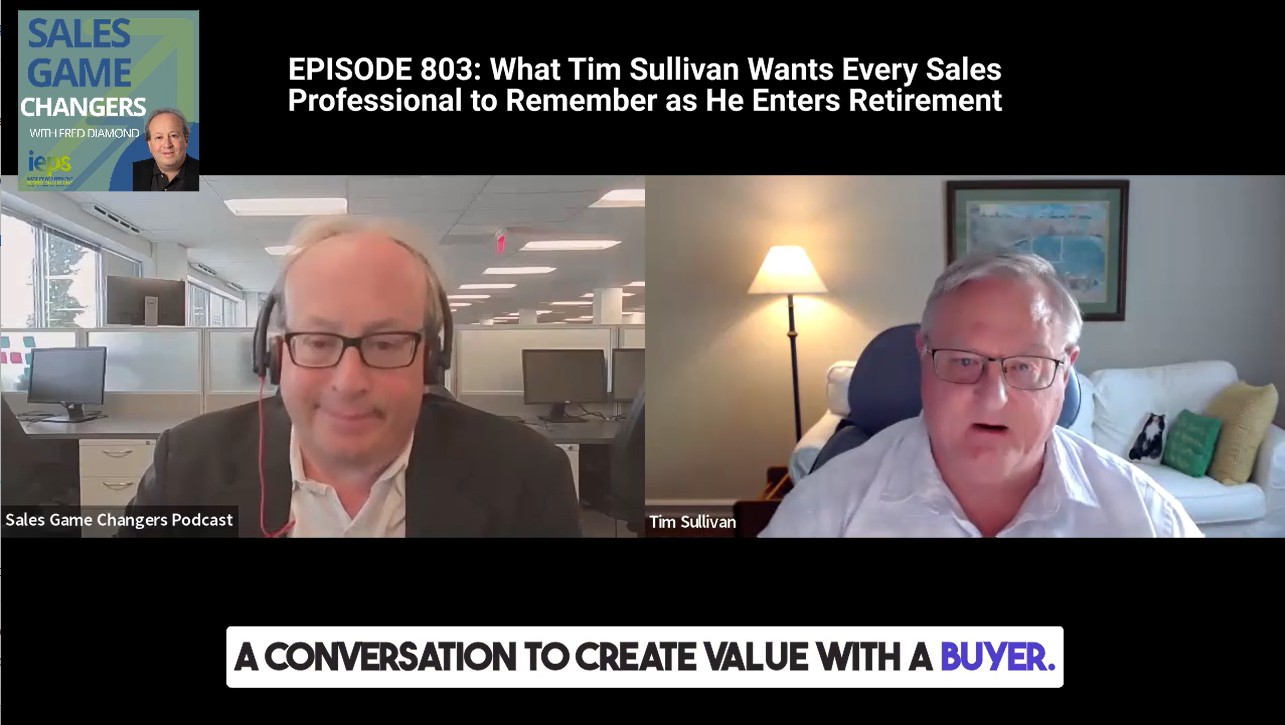
Watch the video of the podcast here.
The Sales Game Changers Podcast was recognized by YesWare as the top sales podcast. Read the announcement here.
FeedSpot named the Sales Game Changers Podcast at a top 20 Sales Podcast and top 8 Sales Leadership Podcast!
Subscribe to the Sales Game Changers Podcast now on Apple Podcasts!
Read more about the Institute for Effective Professional Selling Emerging Sales Leader Program here.
Purchase Fred Diamond’s best-sellers Love, Hope, Lyme: What Family Members, Partners, and Friends Who Love a Chronic Lyme Survivor Need to Know and Insights for Sales Game Changers now!
Today’s show featured an interview with Tim Sullivan, former sales training leader at companies including Richardson and Sales Performance International. He also authored numerous books and worked in technology sales. He was a past speaker at the Institute for Effective Professional Selling.
He has trained hundreds of thousands of selling professionals at the world’s leading sales organizations. I invited him to share his three tips for selling professionals as he enters retirement.
Find Tim on LinkedIn. [Note that he announced he was leaving LinkedIn on December 31, 2025!]
TIM’S TIP: “People still buy from people they trust. That was true in 1981, and it’s true today.”
THE PODCAST BEGINS HERE
Fred Diamond: We’re doing this interview in the middle of September in 2025, and I’m very excited. It’s going to be a different format than we typically do for our regular listeners. Usually, I bring on a sales leader and I typically ask them how are you working with customers? How are you leading teams? How are you using AI? Etc., whatever it might be. But today’s show is a little bit different. I’ve known Tim for close to a decade now. When you were at Sales Performance International, you were actually one of our first Sales Performance Improvement Partners. I’ve thanked you for that over the years but want to thank you again for your participation.
You came and spoke in Northern Virginia at least once. We’ve had many conversations. You very kindly invited me to come down and speak at your annual user conference. This was about a year after I had started Sales Game Changers back in 2017, 2018. You asked me for the 10 things I’ve learned from doing the show. It was great to drive down there and meet your people. Always impressed with what you’ve done. I saw that you had posted on LinkedIn that you were retiring. Good for you, and we’ll talk about it this second, and I said, you know what? Let’s give Tim an opportunity, you’ve touched, I don’t know, if not hundreds, definitely tens of thousands of sales professionals in your career, and I’ll let you give your history here in a second. But I said this will be fun to talk to you as you go off doing whatever it is you’re going to do in the next phase of your life. To give our audience maybe three things, the three big observations that you want to leave us with, that you want to influence some of the selling professionals listening to the show.
Tim, it’s great to see you. For people who don’t know you, give us a little bit of an introduction and then let’s hit the three things that you want to part onto us.
Tim Sullivan: I started selling back in 1981, worked for Management Science America, which at the time was the world’s largest software company. Nobody remembers them today, but I will say that was a great place to start. I started in sales operations and then later on I had an opportunity to actually do sales support and actually be a full-time salesperson. From there I went to work for Culpepper and Associates, which is an industry trade analyst organization. I wrote books for a living, and I talked to a lot of different software company executives in particular in sales. We talked about sales compensation and setting goals and sales organization structure, etc. and so forth. I dipped my toe in the consulting realm for a while.
From there I went to work for Target Marketing Systems, which later became OnTarget, the sales training and development organization best known for the Target Account Selling Opportunity Management methodology. Did that for a number of years. Then we were acquired by Siebel Systems. I had three very challenging years, shall we say, working for a big CRM company trying to figure out how sales methodologies and process work within a CRM structure. That was interesting. Then I had a chance to join Sales Performance International, which I was at for a long time, well over a decade, doing development of sales methodologies based on the research that we had done with our clients on sales best practices.
While I was there at SPI, had a chance to help write a couple of books, one of which being The Collaborative Sale, which sold very well, and another one focused on solution selling, which was the methodology that we marketed there. That was very enlightening to go through the book-writing process. Then SPI merged with Richardson company and had a chance to be the VP of Business Development at Richardson helping to sell there and also manage our international sales channel there, which was very rewarding. Richardson recently had got an investment from Truelink Capital, and frankly, I got a little money out of that, so have an opportunity to retire fairly comfortably, so made that decision to do that just this year. That’s a brief rundown of my career.
Fred Diamond: That’s great. For the various people who are listening to the show who have been in sales, and many have been for decades, two to three decades, some of the names of the entities that you had brought up, Siebel Systems is something I hadn’t thought of in a while. They were one of the original CRM systems out there. I’m not even sure if I knew that that was part of your resume. Again, you’re moving on, and you deserve it. Like I mentioned in the intro, you’ve helped at least hundreds of thousands, if not tens of thousands of people take their sales career to the next level.
We first met you officially when The Collaborative Sale had come out. We brought you to the Institute for Excellence in Sales to speak. I’m really interested here, and people are waiting with bated breath is, what are the three things that you want to sum things up with as you, I know you’re not going to go out into the sunset per se, but let’s get started here. I’m really anxious. What’s number one? What is the number one observation, thought, or lesson that you want to share with the audience?
Tim Sullivan: I love salespeople and I love the sales profession. I think this is where value is created in organizations. I think it’s an undervalued profession, unfortunately. I made the decision early in my career to try to raise the status of the sales profession. To some extent, I hope that I’ve been able to do that. But having the opportunity to work with thousands of organizations and have an opportunity to work with tens of thousands of different salespeople, as you mentioned, I do see some common trends, and I think that are still relevant today as I’m exiting my career. I’d like to share those.
The first thing is, one of the things we always said in solution selling was people buy from people. That was true in 1981 and it’s true in 2025. The nature of the dynamic between a seller and a buyer or seller and buying organizations certainly has changed, and that’s driven primarily by technology. We have better communication technologies. We have AI and access to information. We have this thing called the internet, which you may have heard about, which gives us almost unlimited access to all kinds of information, both good and bad, but still extremely helpful, which has accelerated the kinds of interactions we can have with potential customers.
What I have discovered is that the organizations that consistently perform well and have always performed well are the ones that are able to develop a good relationship between their selling organization and the buying public out there, or whatever that audience may be. I think a lot of salespeople have forgotten that, especially recently, because all of the layers of technology have gotten in the way of trying to help foster relationships between buyers and sellers today. When I started it was you got on a plane or got in a car and you went and you pressed flesh, and you looked at people in the eye, and it was toe-to-toe selling. It was relatively easy to build a relationship under those circumstances.
This is much more difficult today, but it is possible to do it. But because of the ease with which technology has facilitated sales-assisted selling, computer-assisted selling, or whatever you want to call it today, I think many people have forgotten that. Ultimately, buyers buy from people that they trust. That trust has to be manifested in the interactions that sellers and buyers have. A lot of people, unfortunately, I think have forgotten that. It’s de-emphasized below what it should be today.
Fred Diamond: I’m glad you brought that up as your first observation. There are two examples recently that came to mind. One of the Sales Game Changers Podcast sub-brand shows that we do is called Office Hours – Sales Professors Unplugged, where I invite program directors at the 70 universities that have either a sales major, minor, or certificate. One of the recent shows that I did they talked about how they’re training the college students on technology and process. I end every show with tell us your final thought, your action step people should put into play. The director of this program at a university said exactly what you just said. It’s still about relationships, especially when you’re selling into enterprise and you’re selling into organizations with many people, where decisions have to be made and budgets have to be considered, and other factors have to come into play. To be frank with you, AI ain’t going to tell you that stuff. It’s someone over lunch, it’s someone at a conference, it’s someone sharing thoughts with you as you’re asking them the right questions.
Tim Sullivan: I think it’s generational as well. An old boomer like myself, this is the world we came from where you valued those interactions with customers. I think young people today that are entering the sales profession are so used to doing things on their phone and texting people. They would rather do that than pick up the phone and actually have a voice conversation with somebody.
I remember one client I worked with recently who’s based in Saudi Arabia. I had someone there who was a salesperson for a technology company, and they were saying, “I’ve got a customer and I’m having a hard time connecting with them. I think I’ll send them another text.”
I’m like, “Well, why don’t you just pick up the phone and call them?”
“Well, I’ll tell you what, I’ll send them an email.”
“Okay. Why don’t you pick up the phone and call them?”
This reluctance to engage personally is something that I see endemic to the current new flock of salespeople entering the profession. It does not serve them well. It does not. If you can use the technology to connect with people and create value, then by all means you can do that, but this business of wanting to keep people at a distance really will not help to foster success.
Fred Diamond: That’s a great point. Actually, a VP at one of the top five technology companies in the world reached out to me about a year ago, and Gina Stracuzzi, who runs our Center for Elevating Women in Sales Leadership, which is part of the Institute for Effective Professional Selling, and it was a VP of a top five technology company, and she said, “I need to get onto a web conference with you as soon as you’re available.” A couple hours later we jumped on. She said, “I love what you guys are doing with your Women in Sales Program, and I love what you’re doing with your sales leadership program at the IEPS.” She said, “Here’s my problem.” She goes, “I have all these really smart young professionals who are in their mid-twenties, and they’re great at this.” For people listening, imagine I’m typing on my phone, some type of text, as Tim just alluded to, and she said, “And also they’re great at this,” imagine I’m typing another email out on my computer, and she said, “They’re horrible at this.” Then she was looking above my head like four inches above to show that they didn’t understand how to interact on a human level. I’m really glad that you brought that up. We put some programs into play for her company to help the sales professionals understand.
How about number two? What is your second observation that will inspire us?
Tim Sullivan: I’ll take this from my own personal experience. I’ve worked for a lot of different organizations over the years in a sales capacity or sales support capacity. One of the things that I always found frustrating is when you get some dictate from corporate or some new technology or a new policy or some things, there always seems to be things that get in the way of what salespeople really want to do, which is talk to customers and interact with them, and look at buyers and actually try to sell something. That was always very frustrating to me.
I remember working for a fellow named Jeff Fisher early in my career. Jeff always said, “Look, when things get weird, the pros talk to customers.” He was paraphrasing Hunter S. Thompson, the gonzo journalist out there, “When things get weird, the weird turn pro.” Well, his saying was, “When things get weird, the pros talk to customers.” I took that to heart, and all salespeople can reserve a certain amount of time to reach out to past customers and engage with them and ask them, “How are things going? We made a decision together to purchase this particular capability. How’s that worked out? Where has it not met your expectations? I just want to check in.”
It’s extremely therapeutic even to have a few of those conversations, because no matter what’s happening at corporate to distract you, customers will always tell you what’s really important, and where you are creating value, and how you could create value. In many cases, those conversations will lead to new business or additional opportunities or so forth, but more importantly, it helps you get grounded. How do I as a professional create value in the world and then bring it to customers in a way that they can actually use it to make their lives better? Sometimes we just need to be reminded of that from time to time. When things get weird, go talk to customers.
This advice is something that I’ve said to customers over the last 30 years, both at a corporate and at an individual level, and it has never failed to help to make an improvement in the business. I’ve worked with one large manufacturing organization and the morale was terrible, because they had gone through a merger and then another acquisition, and there was a lot of chaos in the organization. They were trying to rationalize three different CRM systems. They were introducing new technologies. It was a mess. In the course of our discovery there, I said, “Well, how often do your people talk to customers today?” We did the analysis and it was less than 10%. I said, “You know what? If you could just raise that to 15, I bet you your morale would go up in the organization,” because they would feel like they’re actually doing something. They budgeted for that, and sure enough, it had a very material impact on the business. Not only that, it helped them to see maybe things they were thinking about investing in were really not as important as other things that they should be investing in. Once again, when things get weird, the pros see customers.
Fred Diamond: That’s a great one. I’ll even take that a little bit of a step further, is we alluded to the junior sales professionals who are listening to today’s show, go to the customer’s location, go to events, go meet them, ask your boss, “Hey, can I go to this event for the day?” If your boss is someone who’s a senior sales leader, they remember what it used to be like. We lost a lot of this during COVID, of course, because meetings had stopped, etc., but the great sales professionals, I tell this to people all the time, the most successful sales professionals that I’ve worked with in my career at the Institute for Effective Professional Selling and other places were great, world-class at one of two things. They really, really, really understood what they were bringing to the marketplace and how it is impacting the industry, or they really, really understood what the customer was going through.
Even now, Tim, one of the things that we frequently say is, for a customer to even want to spend time with you, you need to bring them value that’s beyond what they’re even thinking about. Yeah, you could read AI and search and prompt and do all that all day long, and that’s going to help you, but it ain’t until you have your conversation with the customer where that comes to life. I would say in person, or a Zoom, of course, if the customer’s 1,500 miles, whatever, but the more you spend with them as humans, the more successful you’re going to be.
Tim Sullivan: I totally agree. Another thing that it does as well, salespeople, in order to be effective and successful, they have to have confidence about the expertise and the experience and the value add that they can provide to customers. When we are distracted by non-selling things, it’s easy for us to lose that confidence. Reconnecting with customers and having conversations about the challenges that they have, number one, you’re raising your knowledge and understanding which you can use to build your expertise. Relating back to our first point, which is people buy from people that they trust, and the reason they trust you is because you can demonstrate that expertise. Having that experience, either by going to their trade shows, which I think is an excellent suggestion, or connecting with them.
I had one salesperson recently who had an opportunity to go to a customer’s customer conference, where they talked to their customer’s customers, and they learned so much from that. That turned into a long-term, multi-year contract for them by being able to build enough expertise to truly understand their client’s business and deliver a unique solution.
Fred Diamond: Those are where memories happen. I just don’t mean nice fond memories. I mean, memories of business. It doesn’t happen when you clean your inbox. It doesn’t happen when you spend the day on LinkedIn. Yes, LinkedIn’s great, you should comment, blah, blah, blah, but that ain’t really what happens. Tim, we changed our name to the Institute for Effective Professional Selling. Mainly we did that because we want to work with selling professionals. We used to work with business owners and small shops, and those are great, but we got a lot of just energy from working with sales professionals, people who study, and I know that’s the third thing that you want to talk about.
Tim Sullivan: The third thing, and I’d mentioned this to you before, was reality always wins. People always ask me, what does that mean exactly? What it really means is that the best people in the sales profession, the ones that are consistently in the top third year after year, are all students of the game. They’re building expertise and understanding their customer’s industry and so forth, as we just discussed. But more importantly, they develop a checklist, a process, a methodology, a framework, whatever it is that you want to call it, that helps them to discern what they know, what they don’t know, and most importantly, what’s in the mind of the buyers as they are progressing through an evaluation to help make a decision to make a change or to buy something.
Those that have those kinds of tools to evaluate their true understanding of what is going on, that enables them to select the right actions, bring the right resources, or most importantly, when to qualify out. Because the most valuable resource that a salesperson has is time, because they only have so much of that.
One of the things that Richardson talks about is the sunken cost fallacy, which is a lot of salespeople, they start to get engaged in an opportunity and they get more and more engaged. Even if things are starting to go off, they’ve already sunk so much into it, they don’t want to get out of it. But if they have a method or methodology or a process for helping them to evaluate the quality of that opportunity, then they can make a decision to withdraw and focus their energy somewhere else where they can have a more reasonable chance of winning the business, and it would be based on objective data that they can share with their manager and have a good coaching conversation to determine, is this something we can help turn around, or is this something that we should abandon? Having a structure for understanding what reality really is.
This reminds me, I had an opportunity early in my career to work for a very wise man, fellow named Rick Page. You may know Rick Page, he went on to found a company called The Complex Sale. Rick wrote a book called Hope Is Not a Strategy. I have it on my bookshelf right over here. He was very much a student of the sales profession and shared a lot of great knowledge. If anybody wants to pick that up, go find an old copy of Hope Is Not a Strategy. What he posits in that book, amongst a whole number of very useful things, but the main thing is, if you have a framework for evaluating what’s happening in an opportunity and who the decision makers are, and what’s motivating them, and where we can really apply ourselves to make a difference there, those are the salespeople that almost always win all the business, unless there’s some overriding relationship. Hope Is Not a Strategy.
I can hope, I can feel, I can guess, “If I keep investing here, maybe things will go my way,” but the best sellers are the ones that have some mechanism for determining what’s really happening and being able to take that in a mature way. You have to have a very high EQ, you have to have a very high emotional maturity to be able to do that well. Again, not all salespeople have that. They just see selling as a numbers game. If I have X number of opportunities and I just apply as many resources as I possibly can, then I will win X percent. That’s really not a very effective or efficient way of going about how it is that you are. Frankly, in the long run, it’s not successful either.
Fred Diamond: That’s absolutely true, and that’s a great bit of advice. Tim Sullivan, before I ask you for your final action step for people listening to today’s show, I guess everybody wants to know, what are you going to do next? You’re retiring, are you just going to go get a good boat and start fishing, or art? What are your plans?
Tim Sullivan: I’ve been gratified by the number of opportunities that people, when they heard I was retiring, my inbox was flooded with, “Let’s go into business and start a new company.” Honestly, that’s a five-year commitment, and I don’t think my wife is going to let me do that. We’re going to go travel. Amazingly, I’ve been all over the world, but I’ve never been to Italy, so I’m looking forward to going there. We’re going to spend a few weeks there and then go back to my ancestors’ home, which is Ireland, and go talk to some old relatives there, which ought to be a lot of fun. Then we have a camper. We’re going to go camp across the US and I’m going to enjoy my retirement. It’s going to be great. You know what? All of my friends are people like you, Fred, people that I’ve known for decades now. We’ll never lose touch. I feel like I’ll always have a toe in this industry regardless of what I’ll be doing on the road.
Fred Diamond: Congratulations and acknowledging you, helping tens of thousands, if not hundreds of thousands of human beings improve their career, which, as we talk about all the time at the Institute for Effective Professional Selling, someone once said to me that the best thing that he got out of coming to my events at the Institute for Excellence in Sales, he said he became a better father because he learned how to listen. One of its cores, of course, of the great sales professionals is they understand that it’s more about listening.
Early in your career, you think you have to get everything out. The reality is, customers are going to be more inclined to work with you if they discover things on their own and through your help by guiding them, but not being told. I just want to acknowledge you for the places that you’ve played in this industry and for the impact that you’ve had on tens of thousands of people.
Tim, give us one final action step. You’ve given us a lot of great ideas for people. Give me one bit of advice for sales leaders and one bit of advice for right now for sales professionals early to mid of their career. Let’s start with leaders. One bit of actionable advice you would give them right now.
Tim Sullivan: One thing we haven’t talked very much at all here is the important role that sales leaders play, and that is coaching. It’s very difficult for managers to coach these days because the spans of control are so large. It used to be, when I started, it was a 1-to-5 relationship, and I could always talk to my manager. Now it’s like 1-to-15 or 1-to-20, or even 1-to-25, or more. It’s very difficult to get your manager’s time sometimes. Fortunately, we have technology so that we can do that to some extent. But one thing I would suggest to sales leaders is coaching is a lost art. The technology’s gotten in the way of that, but if you can use technology to leverage the amount of contact you have with salespeople and have a standard of excellence that you can both look at and agree on is how you want to engage with customers, then you can use that as a basis for effective coaching. That’s really just a question of scheduling more time. That’s one bit of advice that I would have for them that’s going to have the best and most immediate uplift to their sales teams.
As for individuals, and I’m thinking more about the young people today, and we’ve talked about it a lot today, and a lot of you are going to say, “Boomers here are going to be saying that I should just reach out and talk to people. Technology is all that’s important.” Well, technology is important, and don’t take anything wrong. I build computers as a hobby for fun, so I consider myself somewhat technologically aware, and I’ve advised people on how to do CRM systems and AI sales-assisted systems and so forth. But I will say it’s no replacement for interpersonal contact and developing and honing those skills. I say this to the latest generation of sellers who, frankly, because of COVID and because of other socio factors that have happened, you don’t have the interpersonal experience that someone like I or you, Fred, had. That’s not a slight on them, it’s a reality. You need to bone up on those skills.
Presence is probably the most differentiating thing that a salesperson can bring to a conversation to create value with a buyer, and building your presence, as you mentioned in the example that you discussed earlier, that takes effort and it takes time, but it can be developed. To them, I would say, look at the way that you are showing up and engaging with people and see if there’s ways that you can improve. Again, this is something you can get coaching on to help to develop. That would be my advice for them.
Transcribed by Mariana Badillo