
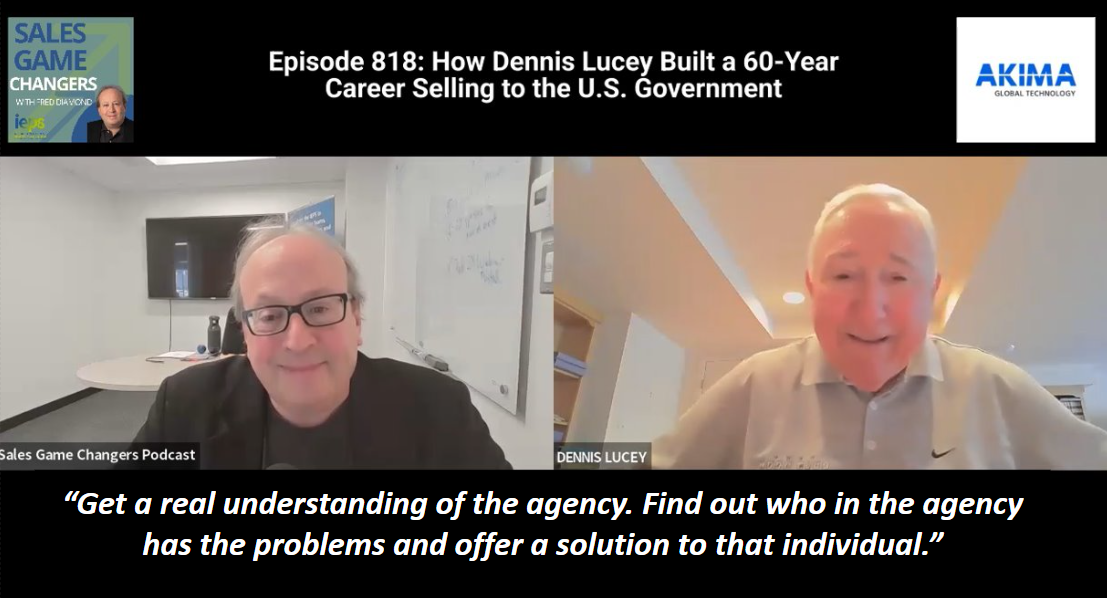
Watch the video of this podcast on YouTube here.
The Sales Game Changers Podcast was recognized by YesWare as the top sales podcast. Read the announcement here.
FeedSpot named the Sales Game Changers Podcast at a top 20 Sales Podcast and top 8 Sales Leadership Podcast!
Subscribe to the Sales Game Changers Podcast now on Apple Podcasts!
Purchase Fred Diamond’s best-sellers Love, Hope, Lyme: What Family Members, Partners, and Friends Who Love a Chronic Lyme Survivor Need to Know and Insights for Sales Game Changers now!
Find Dennis on LinkedIn.
DENNIS’ TIP: “Get a real understanding of the agency. Find out who in the agency has the problems and offer a solution to that individual.”
THE PODCAST BEGINS HERE
Fred Diamond: Dennis Lucey, I’m excited to have you on the show. You’ve been a participant in many of our Institute for Excellence in Sales events. Every first Friday of the month, if you may recall, before the pandemic, we used to do our Big Stage program, and you were a frequent attendee. It was great to have you there. It’s great to see that you’re still out there making things happen for your company and selling into the public sector. I want to get deep into your career and also what you’re seeing now and your advice for sales professionals. First off, how are you doing? It’s great to see you today.
Dennis Lucey: Great seeing you also.
Fred Diamond: Thank you so much. Your company, Akima. In 2025, Akima was ranked number 31 on Washington Technology’s top 100 government contractors. Tell us a little more about the company. What do you do? What do you focus on? What are you selling to, and why it’s been so successful?
Dennis Lucey: Akima is actually an Alaska native company. We are owned by 13,000, 14,000 Eskimos, and we can use the word Eskimo because they fish on the Bering Sea. As you know, it was actually created back in the ‘70s when the state became a state almost. They made some decisions on how to divide the land up there. We’re owned by the Eskimos. As a result of some of the issues there, the Congress in the United States needed to get the oil out in the ‘70s because of the oil crisis. As a result of that, in order to keep everybody happy, particularly the people in Alaska, they gave the Eskimos certain privileges that nobody else has.
For instance, the rules of the normal 8(a) are you can be in the program for nine years, number one. Number two, there’s a dollar limit, about $5 million on that. Number three, you can protest it, and there’s other restrictions on the normal 8(a). What they gave the Eskimos initially, and then they threw it open to every region up there, was certain privileges because of a lot of the damage down by the pipeline, and also some of the issues on ownership of that land. Number one, they said the ANC would be a perpetual 8(a) by law. This is a law now. Number two, it’d be a dollar limit up to about a hundred million, but it could go beyond that if necessary. Number two, you cannot protest it, and there’s other restrictions in that program.
Now, I’ve been in this town since the ‘60s, a long, long time. I started with the Burroughs Corporation in the mainframe business, and then I moved on to the computer side of Xerox. Then I was with a company called Storage Technology. I’ve been here at Akima for almost going on 25 years. We started small and we’ve grown quite large now. We’re big in a lot of different areas. We’re big into cyber, cloud, data analysis, AI, we repair jet engines for the Air Force. We’re in construction. Also, we look after parts of the White House Communications Agency. All of our profits go back to sustain the Alaskan Eskimos. Believe it or not, they’re probably the poorest people in the United States. Everybody says, “They got the oil up there, they must be rich.” Well, there is oil out there, but the oil has to go from the north part of Alaska to Long Beach, California, get refined all the way back again. They don’t make that much money on that oil. Hence the ANC model is critical for their livelihood.
Fred Diamond: Before I get into a little more about your career, you just gave us a touch point, what are some of the projects or some of the programs that the Alaska native companies, Akima specifically, participate in?
Dennis Lucey: We’re in many of the agencies now, both the civilian, the DOD, and the so-called three-letter agencies. Well, let’s take a look at, say Navy to start, pick one out here. The Navy has a huge, huge center in a town very few people have ever heard of called Millington, Tennessee. Millington is a suburb of Memphis. There used to be a Navy air base there. Millington now is the home of the Navy Personnel Command. It’s a big operation there. We’ve been there for many, many years working with the Navy. We also do a lot of work with the Army personnel side, which is at Fort Knox, Kentucky. We’re in a lot of different agencies, civilian, as well as DOD, as well as the three-letter agencies.
Fred Diamond: You’ve been selling 60 years. Why has this been your career focus? I’ve interviewed a lot of public sector leaders and I always like to ask that question, why have you picked this industry to singularly be your focus industry?
Dennis Lucey: I’m from San Francisco. I was trained by the Jesuits at the University of San Francisco. I came to Washington D.C. with the Burroughs Corporation in the mainframe computer business. Now, as you know, Burroughs and UNIVAC merged, and that company exists today, it’s called Unisys. I enjoyed selling, I’ve always enjoyed selling, starting with Burroughs for a couple years, then I moved on to the computer side of Xerox. I’ve always enjoyed selling, number one. Number two, I found the government marketplace to be unique and also very profitable. That’s how I got started and I’m still here.
Fred Diamond: We’re doing today’s interview in February of 2026. A lot has happened to the government marketplace, 2025 with a lot of the reduction in force and agency shifts and things along those lines. What are some of the major things that you want to get across to selling professionals that they should be aware of when selling to the federal government right now?
Dennis Lucey: I think one of the toughest jobs in selling to the government is in the area of business development. I think some small companies, and even some large companies, think all you have to do is walk into the Pentagon and you’ll walk out with a $25 million contract. It really doesn’t work that way. I don’t have any tattoos on me, but if I had tattoos, it’d be a big 25/50 on my chest. It takes up to 50 months to get a deal. Why so long? Because number one, you have to know what the transaction is. You have to really know it. They have to know who you are, they have to like you, and it just takes forever.
I think if you look at an opportunity and find it’s going to be coming out in a month, I think that’s much too late because there’s too many other players that have worked that agency for years. That’s why it takes so doggone long. I enjoy business development, although it is difficult and I get a kick out of it sometime. Even in our own company, we have some good pricing people and they say, “Hey, without my price, you’d never win a thing.” I come back and I say, “Hey, without me, you never would have anything to price?” You can see how difficult it is and how important it is to get in and get to know the agencies well.
I like people, I enjoy talking to people, and that’s how I stayed. Now today, we’re trying to keep poor people alive. I think the Eskimos are probably one of the poorest people in the United States. Our game here is to keep them alive and that’s why I keep working.
Fred Diamond: You’ve dealt with a lot of federal employees over your career. What do they want and expect from selling professionals?
Dennis Lucey: That’s a great question. I think the government people are very, very sharp, very intelligent, and that is as important to me. When I go in to visit a customer, I’m always asking them questions about themselves. I think a lot of sales types go in and start talking about their product or their company, and as a result, nothing happens. There’s an old CIO here in town, he was probably one of the first official CIOs. He always told me the story of salespeople coming in to visit him. He feels that so often they come in and they don’t know much about the agency. They don’t know much about some of his problems, and they expect him to educate them on what the problems are. I think that’s backwards. I think you have to go in and you have to be able to help people. Not so much talk about yourself or about what product you have or what service you have.
This guy was real funny. He would take calls from sales types and he’d sit down and he had a relationship with his secretary, that she would come in exactly five minutes after the talk began, and she’d say, “The secretary or the assistant secretary’s on the line for you, sir.” Well, his philosophy was this, if this call was going well, where the salesperson was going to help him and make him a better CIO, he’d say to the secretary, “Tell her/him that I will call back after this meeting.” However, if it’s going terrible, he’d say to the salesperson, “Hey, look, I must get this call. You send me the information,” and that would be the end of the call. The bottom line there is that let’s not waste our time. Let’s show them how we know what some of their problems are, and let’s offer some solutions to those problems. I think that’s the secret.
Fred Diamond: Let’s talk about that for a second. I agree with you a hundred percent, especially now, again, we’re doing today’s interview in February of 2026. Every customer on the planet can go to the internet or an AI tool, a ChatGPT or whatever, and they could type in about the technology the company is offering. I remember when I was at Apple, we used to do two-day roadmap strategy sessions for customers. Now the customer can type in, what is Apple’s product strategy for the next 10 years? What is your advice for selling professionals to be prepared for that? How have you done that, and how should sales professionals know what they need to know to get a couple steps ahead so that the CIO doesn’t take that fake call?
Dennis Lucey: I think the secret is to get to the right person. If you understand that the right person is the right person, and you understand the problems that person is facing, and you have a solution to that, I think you’re way ahead of the game. If you’re walking in a call for the first time, not knowing anything about that person and not knowing what his problems are, I think that is not going to work well.
Fred Diamond: How have you done that? Do you do a lot of research online? Do you go to meetings? What are things that you’ve done to be able to get into that meeting with the information that you need to know?
Dennis Lucey: What I’ve done for many years is to go to breakfast every morning, just about every morning. I shouldn’t put a plug in, but the Silver Diner in Tysons, I try to meet a couple companies every morning, try to understand what they’re doing, what they’re up to, and who they know. That’s the secret. I think some of the small companies really don’t know anybody. There’s obviously organizations like yours when you had that sales group. That was a great meeting group of normally business development types. I think business development types are unique people and they know quite a bit.
There’s a group here in town that I’ve been associated with since the beginning called the Capital Business Development Association. They go to dinner one night a month at the Army Navy Country Club. The secret in that club is this, you have to tell the name of your company, what you do, what you’re looking for, and if you stop there, that’s not going to be helpful to you. You have to go the next step, “Hey, I have contacts in the following agency that might be of help.” I think business development types, it’s a brotherhood, sisterhood, that are helpful, because they’re all in this together and they realize how difficult it is to even get into these needs of the government. Particularly now with so many changes happening here, it’s really important to get to know people.
Fred Diamond: There’s so many different leaders, and you could use AI all day long, but a lot of the stuff really comes from the institutional knowledge, the people who’ve been selling and they know what’s going on. I’m just curious, what don’t people know about how the federal government procures technology? What are some things that you think people don’t know you want to share with them?
Dennis Lucey: The opportunities are there. The question is how to get to the right person to do the selling within the government. A lot of companies shy away from the government, particularly out in Silicon Valley, because they think there’s too many rules, there’s too much you have to disclose, and it takes forever. Well, it does take a long time, but I think that if you understand the government and really understand what they need, I think it’s very profitable, number one. Number two, you can do a lot of good for your company and also for the country.
Fred Diamond: I’m talking to Dennis Lucey today from Akima, has been in sales into the public sector marketplace, the federal marketplace for going on six decades. Congratulations to you for your continued energy and your success. It’s still great seeing you appear at events around town and it’s always good to have the energy that you exude and your knowledge that you’re willing to share on today’s Sales Game Changers Podcast. Before I ask you for your final specific step, what would be your advice for people who are new, people who are brand new, maybe they’re out of school, maybe they’re making a career shift that are new to selling to the federal government?
Dennis Lucey: Getting back to an understanding of the government, understanding of the agency, understanding of what the problems are. I think that’s the secret, and that takes a little time. Number one, there might be other individuals in your organization that would help you there, but I think it’s tough to walk in cold and not understand what the government is doing. There’s organizations out, we mentioned CBDA, there’s other groups called Fast Rope. There’s obviously AFCEA, there’s a lot of groups like that. I think to get active in those groups, that would be a real positive thing in the sense that you’re going to get to know certain people that would be helpful to you in the sales process here.
Fred Diamond: Do you recommend that people pursue the federal government as their career focus for selling into?
Dennis Lucey: I do. I’ve been at it a long time and I think it’s a great marketplace and I think the government’s going to be around a long time.
Fred Diamond: I remember once I was on a sales call with a sales rep, this must have been 30 years ago when I was at Apple. We were driving through Downtown D.C. and he stopped his car and he told me to get out and he said, “Look at all these buildings. They’re not going to tear down these buildings.” When you get to understand the breadth that government is in, and I’m not saying this from a political statement, but with healthcare and with infrastructure and with so many things that are designed to serve the citizen, then you understand the breadth of the entity. They need tools, they need advice, they need suggestions on how to continue to do it better.
Thanks again, Dennis Lucey, for being on today’s Sales Game Changers Podcast. You’ve given us a lot of great ideas. Give us one specific action step that you recommend selling professionals take right now to take their sales career to the next level.
Dennis Lucey: Get a real understanding of the agency. Find out who in the agency has the problems and offer a solution to that individual.
Fred Diamond: You know what? That’s not hard to find. We actually did a show recently with Mark Amtower, who talked about how to find the right people on LinkedIn that you can get to. A lot of it is public information. It’s not that hard to find, but you got to put in the work and you got to understand what are the people responsible for? How willing are they to work? A lot of these people in government, people don’t realize, they want to use your technology to improve their services. There are things that make it a little bit kludgy along the way that we’re trying to continue improving, but they want to do better. They want to be of service. They want to use the right tools to build the best systems.
Dennis Lucey, congratulations on all your success. Thanks for being on today’s Sales Game Changers Podcast. My name is Fred Diamond.
Transcribed by Mariana Badillo