
Watch the video of this podcast on YouTube here.
The Sales Game Changers Podcast was recognized by YesWare as the top sales podcast. Read the announcement here.
FeedSpot named the Sales Game Changers Podcast at a top 20 Sales Podcast and top 8 Sales Leadership Podcast!
Subscribe to the Sales Game Changers Podcast now on Apple Podcasts!
Purchase Fred Diamond’s best-sellers Love, Hope, Lyme: What Family Members, Partners, and Friends Who Love a Chronic Lyme Survivor Need to Know and Insights for Sales Game Changers now!
Find Kim on LinkedIn.
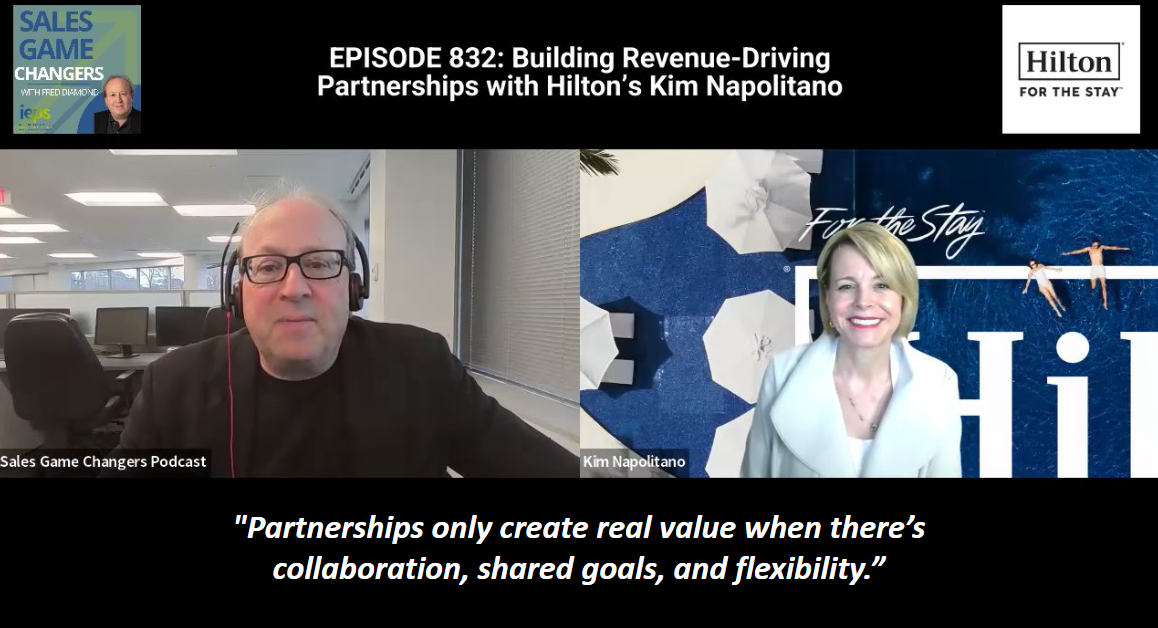
KIM’S TIP: “Partnerships only create real value when there’s collaboration, shared goals, and flexibility. If you’re just showing up transactionally, you’re missing the opportunity to create real impact.”
THE PODCAST BEGINS HERE
Fred Diamond: Kim Napolitano, you’ve been on the podcast before and we’ve gotten to know you through your role at Hilton managing the industry relationships. There’s so many that you’re now managing globally, not just in the Americas. One of the partnerships that you’ve been managing for close to four to five years now is with the Institute for Effective Professional Selling. You’ve participated in our Women in Sales Program. Two years ago, Gerilyn Horan, one of your sales leaders, received our Women in Sales Leadership Award. With all that you do in the industry, and you and I have had numerous conversations about conscious leadership and just your role in what you’re doing for sales professionals, not just in Hilton, but in the industry, and of course, we deal B2B, B2G, it’s quite remarkable.
You’re now the Executive Director, Global Industry Relations. You’re focused on strengthening Hilton’s partnerships with organizations. I’m just going to throw out some acronyms here, the ASAE, the IRF, the PCMA, you could tell us whatever detail you want to tell us about that. It’s helping Hilton contribute and shape the evolution of global travel and the meetings ecosystem.
We’re doing today’s interview at the end of March of 2026. We don’t need to talk about the state of the world, but it’s challenging. Sales professionals are going through a lot of things. Every company, especially in the hospitality space, it’s been an interesting five years for your industry in general. Get us to know you a little bit. Tell us a little bit about your role and what you’re now doing at Hilton and what you’re responsible for.
Kim Napolitano: You gave a great overview of what I’m doing. It’s very exciting, this new role, Global Industry Relations for Hilton Worldwide Sales. My responsibility is to ensure that Hilton shows up into those spaces in a meaningful way with our partners, sharing insights and learning from our partners, contributing to industry conversations, and ultimately helping shape the future while driving value for our customers and our company. We see industry relations and the partnerships as a bridge and a connection to our customers.
Fred Diamond: We’re giving you our Partner of the Year Award because you’ve been so helpful for us in understanding your industry and working with the women in sales in our community. You sent a number of the women in sales leaders at Hilton through the programs. Just define partners for our audience, Hilton partners. You’re one of our partners, but what does partnership mean to Hilton?
Kim Napolitano: Partnership to Hilton is working with organizations where we can have shared goals to help lift both enterprises up. How do we have the ability to bring thought leadership into the conversation to evolve the industry, allow us to bring our team members into the conversation to network and engage, and also an avenue for learning and development. Some of the organizations have more of a legislative component to it as well. It’s working with organizations that allow us to do just those things and be in alignment with the Hilton vision, mission, and values.
Fred Diamond: Hilton is one of the most recognized brands in the world. You’re often recognized as the top place to work, not just in hospitality, but in other industries. I’m based in Northern Virginia. Hilton moved their headquarters here a couple of years ago. I’ve seen some of your leaders speak. We’ve gotten to be fortunate to get to know more about the brand. We’ve had Frank Passanante on the podcast a couple of times. Tell us about how the industry wants to partner with Hilton. Does everybody want to partner with Hilton? Because you’re such a well-established, beloved brand, historically. Give us some insights into that.
Kim Napolitano: We are one of the most recognizable brands in the world, so I can see why people would want to align with us, and most recently being acknowledged as the number one best place to work in the world. I can see why organizations would want to align with Hilton, and we love that. We think that’s great, because we serve all people around the world. We represent more than 9,000 hotels in more than 130 countries worldwide. We take a lot of pride in being of service to people as we fill the earth with the light and warmth of hospitality.
We find that our partnerships are really important to us because they help create the bridge between our company and the broader industry community. Fred, when we were chatting about this conversation, one thing came to mind, is the fact that industry organizations and partner networks, this is where we’re able to connect with our customers and environments where we’re learning together, we’re networking together, we’re collaborating, and sometimes even advocacy for our industry to take place.
We’ve also found that these spaces allow us to share knowledge, understanding merging trends, and it helps us to contribute to conversations that help move the industry forward. We feel like this aligns so nicely to our founder’s vision of filling the earth with the light and warmth of hospitality, because he recognized what we did. He recognized there was a much bigger play in just operating a hotel. It was somehow tied to making the world a better place as people could travel the world, experience different cultures, not only see the differences in the cultures, but celebrate the similarities in cultures too.
Fred Diamond: That would definitely make the world a better place. I really enjoyed the way you explained that. I also just want to mention to people too that Hilton is an IEPS, Institute for Effective Professional Selling, Premier Sales Employer. Congratulations on receiving those designations as well. Let’s talk about you a little bit.
You manage a wide portfolio now globally of these partnerships. I love the way you talked about the value in you all coming together to make it better for people who are staying in properties and traveling. We’re all about wanting to make the world a better place too, so I love the way you say that. What brought you into this type of work? Why are you now the leader at Hilton for global partnerships?
Kim Napolitano: Fred, I was joking with some friends about this the other day. Sometimes the best opportunities in your career are the ones you didn’t plan for. I was blessed in 2022, my Senior Vice President, Frank Passanante, he’s global head of HWS and HRCC, he came and said, “Hey, we have this opportunity. It’s industry relations. We want you to take it on. We think you’ll do a great job with it.” I said yes without questioning, just, “Yes, bring it on.” Really, for us, we wanted to take it where it was and elevate it, because we knew it wasn’t just about being a member of an organization. It was really about leaning into becoming an engaged leader and trusted advisor. That just resonated with me at a level that I quite frankly never expected.
It was an incredible opportunity for me to lean in, say yes, and it just reminded me of what I tell people who are saying, “Kim, how did you grow in your career? What recommendations do you have?” When a leader is tapping you on the shoulder to take on a project or take on a new role, always say yes, because they see something in you that is allowing you to grow and evolve and supporting the enterprise at the same time.
Fred Diamond: That’s amazing, to be tapped on the shoulder at such a huge company with such a great reputation. Just to acknowledge you. That’s why we’re so proud to acknowledge you as our Partner of the Year, to get that recognition at a company that is so instrumental in people’s everyday lives. Everywhere you travel, you have to stay somewhere, and the wide breadth of Hilton properties are so amazing. Some of my favorite hotels on the planet are Hilton brands, from the highest prestige ones.
Kim Napolitano: All the Astorias, yes.
Fred Diamond: Exactly. I used to love staying there. Matter of fact, in the ‘90s, I was staying there like every month. It’s kind of cool when you have a job and you get to go to the Waldorf Astoria whenever you’re in New York, etc. But even like the Tru brand, and you and I have talked about the Hampton Inn brand, which I’m a huge fan of.
Kim Napolitano: Yeah, beautiful.
Fred Diamond: You’ve talked to me about their culture and everything. You probably have tons of partnerships. Sometimes they’re just, “Okay, great, it’s the 12-month mark. Are you going to pay us again to be your partner next year?” Maybe they’re just on a slide somewhere or on a website. What separates the partnerships that really create value for both companies moving forward?
Kim Napolitano: I think it comes down to three things, collaboration, shared goals and flexibility. I say that because partnerships that create real value for enterprises are those in which both organizations are actively working towards something meaningful. There’s open dialogue. Fred, you and I have had lots of conversations about what is important to Hilton. I believe that was one of your first questions to me when we started engaging. That allowed us to create a sense of trust, because I was able to share with you our goals, our aspirations. Then you said, “Okay, great, let’s create a plan around that.” There’s that sense of trust. Then there’s this willingness to adapt as the needs evolve. I would say, collaboration, shared goals, and flexibility.
There’s also this sense about when we are purely transactional, where we just show up and we place a logo somewhere and we just move on, that’s where you miss the real opportunity. To me, the magic is happening when both sides are invested in creating impact together. Whether that’s through thought leadership, or it’s leading some sort of effort to train our team members, things like that, but it’s what is the need of the enterprise that wants to align, and how do we grow and evolve that to ensure that they are getting out of this relationship what they need, while at the same time, IEPS is receiving something as well.
Fred Diamond: Not every company is great to partner with. It may not be part of their culture, etc. What are some mistakes that you’ve seen over the years that companies make that don’t lead to the relationships prospering as well as they could?
Kim Napolitano: I think the biggest mistake that may cause a relationship not to be strong is when you’re approaching partnerships without clear intent. You’re going to hear me say this probably throughout our conversation, what is the goal? If we don’t have a goal in mind, we don’t know what to work or back into. If we don’t know what success looks like, it is very difficult to create meaningful outcomes. Let’s face it, we have stakeholders within our organizations who are demanding and expecting that there is ROI in our engagement. It’s up to the person managing the relationship with these industry organizations to tell the story in a very thoughtful, meaningful way. I can’t do that if I don’t have a goal in place and I’m not measuring to the goals.
I would say that is probably the biggest issue that many people run into, is that they say, “Yes, sign me up,” but there’s no game plan. They probably go and participate with different events that the organization is hosting, but they’re not even going in prepared. Meaning, “Can we get a list of who’s in attendance? Okay, which of these are my customers who I need to engage with? Did I reach out to them in advance? Hey, I see that you’re here and there’s going to be a breakout on marketing, and you had shared that you wanted to learn more about marketing. Do you want to do the breakout together? Okay, great. Perfect. Let’s make sure we meet at the breakout and then let’s have a coffee afterward.” People want to engage with people who are there.
Let’s face it, as salespeople, it is up to us to make that outreach to our customers. What a nice way for our customers to feel seen when we acknowledge that, one, I see you on the registration list, two, I want to have a meaningful conversation with you, and three, I’m not making this about selling my product to you. I’m making this about let’s connect, let’s learn together, and let’s talk about what we learned. By the way, then you can lead in with the sales on the back end. That’s when I found it to be most successful.
Fred Diamond: That’s a great point. A lot of times companies will say, “Well, we never really got much out of the relationship.” But then in retrospect, did you schedule meetings? Did you come together with a plan? You’re not going to have results if there’s no plan that you can measure to.
You mentioned sales professionals. This is the Sales Game Changers Podcast. The majority of people listening here are sales professionals. Give maybe two or three tips on things that you would represent or you would suggest that they do to optimize the relationships and the partnerships that their company might have challenged them to be in.
Kim Napolitano: The first step for me is alignment. We need to define how these partnerships support our broader strategy, and then truly commit to the relationship. That means going beyond being a member of an organization. Fred, this is something that I’m like, stick my head through a brick wall. Why just sign up but not participate? I don’t get that. In a way, it’s just a complete waste of money. This means being actively engaged.
As a sales leader, if you are saying yes to the funding, taking money out of your budget for your team member or team members to be engaged with these organizations, then the next question is, great, you signed up. That’s wonderful. What committee are you on? Or what events are you joining? How are you getting engaged? Then during your weekly one-on-one conversations, bring that up, because you’re investing in them. This is an area where people can learn to lead more, because you can become a leader on the committee, you can network more. How many new contacts have you made? Who have you met? You can also bring your stakeholders into the organization from a thought leadership perspective. In turn, you’re building this trusted advisor relationship through the process, which then in theory, the revenue will flow because people see you as more than just a salesperson. You’re someone who’s providing value into the conversation.
Fred Diamond: I love that answer. Let’s say someone who’s maybe junior. Of course, we have our Emerging Leaders Program, which is run by Gina Stracuzzi, who runs the Center for Elevating Women’s Sales Leadership. It’s an interesting time right now. We’re doing today’s interview in March of 2026. There are a lot of people, Kim, who are junior in their careers. They may not realize the importance of being someone in the industry.
It’s interesting. When I do talks to young professionals about how to optimize their sales career, one thing I always say is, be known for something. Be known as maybe the cybersecurity person for the insurance industry, or something. Maybe the skill set for an industry, or the skill set for a geography. One way that you develop and establish yourself that way is by getting involved with organizations and associations. I guarantee you, if a company joins an entity, like if someone in your team reached out and said, “Hey, Kim, I’m really excited about what ASAE is doing. Can I maybe help you or participate,” I’m sure you would be interested in at least having the conversation?
Give us some insights to that on how they should do it, how sales leaders maybe should look at the young professionals. Then give us some of your advice on what they should do. It’s like the Woody Allen joke that 80% of success is showing up. You ain’t going to get known in the industry sitting at your cube or in your office or in your home office in McLean, Virginia. It’s out there. That’s the way it used to be. Give us some more insights on that, Kim.
Kim Napolitano: It’s asking. Be proactive. Tell your leader, “I want to get involved in XYZ organization.” You mentioned ASAE, American Society of Association Executives. It’s a great organization. It’s the association of associations. This is where they all come together. If I have a team member who comes and says, “I want to get involved in ASAE, MPI, PCMA, SITE,” any of these organizations, GBTA, 100%, the answer is, “Yes. What committee do you want to get involved in? Tell me what you know about the organization. What is it about the organization that’s causing you to say, I want to get involved in the organization? Have you figured out roughly how much time you have to donate to give to the organization on a monthly basis?”
As a leader, I need to be able to define that to understand, do they have the bandwidth? Well, in addition to the bandwidth, it really is, do they understand what they’re saying? Is it the right organization for them? Because I could say, “I hear what you’re saying, but you know what? You’re heavily focused in on this area of business. I’m going to recommend that you consider these two other organizations.” It’s not a no, it’s just let’s define the right organization to get involved in. Then from there, what committee do you want to get involved in? Do you know anyone who’s involved in the organization? Then I would look at it, well, do I know anyone who’s involved in the organization so I can start making some introductions? That way when they go in and they go to their first meeting, it’s not cold. You got some warm introductions to at least do the handout to say hello and give a hand up into the organization.
We’ve all been there, Fred, where we don’t know anyone, we walk in a room and we’re like, “Ah,” and everyone thinks that all salespeople are very outgoing. Well, you’d be surprised by the percentage of salespeople who are a little bit more, I would call them extroverted introverts. It takes them maybe a few moments. If we can give a little bit of a better opportunity to make it warmer, then it just allows the entry in a lot faster and more comfortable for our team members.
Fred Diamond: I agree. For the young professionals listening to today’s show or reading the transcript, and even people who are senior in their career, there’s still time. We’re based in Northern Virginia, although we have members all over the globe, a lot of our selling professionals who are involved with the IEPS are involved with maybe some public sector entities, like ACT-IAC. A lot of these organizations aren’t just about the profession, they’re about helping the customer achieve its goals or get its mission together, whatever it might be.
Now that we’re talking here, I’m reflecting back on some of the organizations I’ve been involved with and how some of the relationships are still active 20, 30 years later. It’s amazing that that comes back. I’m sure that a lot of the people that you see at these organizations that you’re partnering with are people that you’ve probably been working with for the extent of your career.
Kim, is there anything else that we missed? Anything else that you want to bring up here that you want to definitely get across to the audience?
Kim Napolitano: First and foremost, Fred, thank you. Thank you for recognizing Hilton. Thank you for recognizing me with this incredible honor. We are just thrilled to be recognized in this space. Also, for the additional recognition with the certifications that you’ve given to us as premier sales for women and general for sales as an employer, very huge honor that we received, because we take a lot of pride in that. We put our team members first. We know that when they take care of our customers and our guests, that the rest will follow. I want to say thank you for that.
As it relates to just being in the space of overseeing partnerships and relationships, what does that look like? It starts with the goal. What is it that you want to achieve, and then back into that so you can be successful? Because at the end of the day, we have to communicate up to our stakeholders to say, this is what we achieved. But if we don’t have a clear understanding of what our leaders are looking for and what the enterprise needs to make enterprise impact, we cannot tell a meaningful story. There’s so much value that comes out of these relationships. We just need to be able to continue that. But to do that, it’s through basically storytelling through data.
Fred Diamond: Once again, Kim Napolitano, congratulations on your exciting new role. Congratulations on being the IEPS Partner of the Year at our award event on April 29th in Northern Virginia. Give us a final action step. You’ve given us a lot of great ideas on how to build your partnerships and grow your business. Give us something specific, an action that people listening to today show should do right now to take their sales career to the next level.
Kim Napolitano: We love this question. I would say invest in your growth and your network. What I mean by that is find a mentor, and whether the mentor is older or younger, depending on your age range and what you believe you need to learn, lean into that. Do not be shy in asking for what you need. Also, if you can afford one, get a coach, an executive coach, and/or see if your employer will pay for a coach for you. I feel like there’s so much value that can come out of these conversations, where people who can speak to you in a way that maybe your leader does not feel comfortable speaking to you can help get you to the next level in your career.
Last but certainly not least, it’s get involved in the industry organizations, actively contribute, serve on committees, participate in these conversations, and build relationships. This is how you develop your personal brand and you expand your influence.
Fred Diamond: Those organizations, like the IEPS, we want people involved. We want to have people come to our programs and call us and want to talk about how we can move forward the industry to help everybody understand ways that they could be more successful.
Once again, my name is Fred Diamond. I want to thank Kim Napolitano for being on today’s Sales Game Changers Podcast.
Transcribed by Mariana Badillo