
This is an Office Hours: Sales Professors Unplugged sub-brand of the Sales Game Changers Podcast.
Watch the video of this podcast on YouTube here.
The Sales Game Changers Podcast was recognized by YesWare as the top sales podcast. Read the announcement here.
FeedSpot named the Sales Game Changers Podcast at a top 20 Sales Podcast and top 8 Sales Leadership Podcast!
Subscribe to the Sales Game Changers Podcast now on Apple Podcasts!
Purchase Fred Diamond’s best-sellers Love, Hope, Lyme: What Family Members, Partners, and Friends Who Love a Chronic Lyme Survivor Need to Know and Insights for Sales Game Changers now!
Find Greg on LinkedIn.
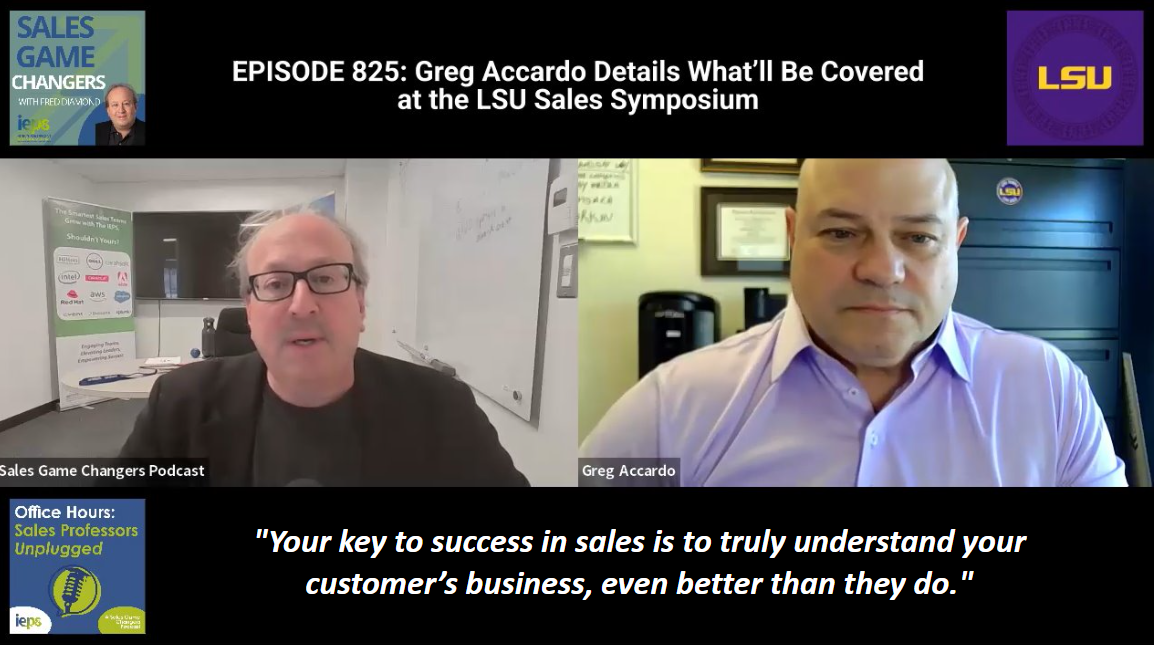
GREG’S TIP: “Your key to success in sales is to truly understand your customer’s business, even better than they do. That’s what separates you, because products are similar, but becoming a trusted resource is what makes you different.”
THE PODCAST BEGINS HERE
Fred Diamond: Greg, on April 9th in Baton Rouge at the campus, is it on the campus of LSU, your event?
Greg Accardo: That’s correct. Yeah, it will be at our Alumni Center here on campus.
Fred Diamond: Very good. I got Greg Accardo, and the program is the LSU Sales Symposium. The agenda really caught my eye. You and I have talked a couple of times before. We’ve interviewed a lot of the directors of University Sales Center Alliance programs, so we’ve been wanting to get you on the Office Hours – Sales Professors Unplugged. But since you have the symposium coming up, I want to talk about what you’re going to be covering, why you’re doing the program. You have six world-class speakers, some from business, some from academia, and I’m excited, I want to get deep into what they’re talking about. But since this is an Office Hours – Sales Professors Unplugged show, why don’t you tell us a little bit about yourself and tell us about your journey to LSU.
Greg Accardo: LSU is like a lot of other sales programs at other universities around the country. We’ve been around now for about 12 years. I was fortunate enough to be hired to be the first director of the program. Being an LSU alumni, that was a great honor, to be able to come in and take this startup from basically nothing and grow it and nurture it and made it my baby over the last 12 years. It’s been a nice ride and I thoroughly enjoyed every minute.
LSU is an R1 state school here in Louisiana. Our College of Business is probably about 3,800 students. 900 of those students are declared marketing majors. We have about 200 of those students that are declared for the sales concentration. We also offer a concentration in digital marketing and also a concentration for marketing analytics. In addition to that, we also have a sales team that competes nationally and regionally across the country. In fact, we’re gearing up for a competition. Next week we’ll be leaving. The fun thing about the sales competition is I get to interact with all the great people you talk to all the time, the other sales faculty members from around the country.
Fred Diamond: I’ve gone to a bunch of competitions all over the country. As listeners of the Office Hours Sales Game Changers Podcast know, we’re blown away by these young adults. We’re blown away at how talented they are. It’s funny, I tell people, Gartner is one of the big sponsors, and I went to a competition last year where the young adults were doing, it was a National Collegiate Sales Competition, and they were selling Gartner services. I’ve been a customer of Gartner in the past, and these young adults were better than any sales rep that I’ve ever been sold to by Gartner.
The sales program, tell us a little bit about that. Tell us about some of the curriculum. Where do the young adults want to go after they graduate? What type of companies, how do you prepare them, etc.?
Greg Accardo: Typically, I guess the best way to address that is a lot of the students who come here to pursue a degree in marketing in our college, I would say half are not really sure what they want to do. They’re at that point where they don’t know what they don’t know. Luckily for them, we feel like we offer them enough opportunities to fill in the gaps and figure out where they should be going, where their desires are, their tout, if they want to be regionally. Obviously, a lot of the big metro centers tend to be attractive. Students want to go to Dallas, they want to go to Austin, New Orleans, or maybe on the East Coast, Charlotte, New York City. But the thing that I’m proud of the most is that our students who come in and perform well in the program, I have yet to have a problem working with a student trying to find them a job. That takes care of itself.
Once they come into the program and they absorb the material we give them, they take advantage of the opportunities. Those opportunities just happen between our corporate partners, our companies that are not our corporate partners. I think maybe some of that too is we really leverage our students hard to put a lot of effort in their LinkedIn profiles, because we’re preaching them all the time that your LinkedIn is your digital footprint. It is almost now more important than a paper resume. I don’t know of a single recruiter that’s out there recruiting salespeople that’s not going to go straight to your LinkedIn page, even if they got your paper resume. It’s almost like they have to go there to see, “Let me go see the details of this person. I want to see their picture, their branding image. I want to see the titles they’ve put in here, their experiences, maybe any videos they might have added.” We really push them hard to put some effort and some time into that LinkedIn profile, and that has paid off. I will admit.
The other side of that is that we offer a lot of networking opportunities for our sales students. We do a Sales Career Expo, both spring semester and fall semester. Those are well attended by students. We gamify that event. We have a speed selling competition. We call it the Golden Ticket Championship. Students can get really competitive. There’s also an added incentive for all the sales students to complete a journey around all the companies that are at the Sales Career Expo. They can earn extra credit from some of their professors. We’ll offer them a little extra credit if they make that effort to go and do that elevator pitch to those companies, give them that resume, tell them a little bit about themselves, learn something about them. That’s paid off. I think that we’ve created the environment, we’ve created the tools, and we’ve put it all together and we just sit back and let it happen.
Fred Diamond: I agree with you about LinkedIn. Since we started doing the Office Hours – Sales Professors Unplugged, I must have gotten maybe 200, 300 outreach from selling students who were on LinkedIn who were reaching out. I see a lot of them. They all have the 500 connections that most of them should. I could see where they’re populating their LinkedIn to be oppressive, to be a good candidate with students. I agree with you too. One of the great things that I’ve learned since we’ve been doing the podcast is you’re preparing students to hit the ground running. Not just to hit the ground running, but to hit the ground running as if they’ve been working for three, four years.
All the programs that I’ve worked at, the people I’ve met, associated with yours and other programs, these students, they understand the sales process. Now, they need to learn about the company and the markets and products, which takes a little bit of time, but a lot of the employers that we’ve been talking to said that these young adults are as if they’ve been working for three years, which helps with retention, which helps with management, and it helps with leadership. It’s great to talk to you and the various people around the country that we’ve spoken to.
Now, on LinkedIn, I kept seeing these announcements about the LSU Sales Symposium, and it’s on April 9th, it’s in Baton Rouge, it’s on campus. Tell us a little bit about this program. Then I want to get into the details about your six speakers and why you picked them and what it’s going to be focusing on. Are you looking to have students or selling professionals from the Baton Rouge local industry? Who is it really for?
Greg Accardo: First of all, let me give you a little bit of a history and how the event grew into what it is now. One of the classes that I teach is the capstone course in the sales program. In the capstone course, we’re pushing the students into a live sales project where they’re selling a real product to real people. We equip them with CRMs, some AI tools, and we put them in teams with a sales manager that they select, and we drive it like a company, and they have a quota they have to meet.
We have a couple of events that are set up each semester for the class to sell participation in those events. We do a Topgolf event in the fall, and the class sells the bays on the third floor of Topgolf. But in the spring, we do a symposium. Part of this is a twofer. It’s a sales project for the students, because they have to sell the tickets and they have a quota that these teams of students have to meet. But it’s also for us to showcase some of the academic stuff that we’re doing, not only at LSU, but at other universities to give the world of sales what’s happening at the academic level and at the practitioner level. We design it in a way that salespeople and sales leaders can come to these events and walk away with something that they can take back to their company to make them better, to make them a little more productive, more efficient.
In the past years, we’ve covered the gamut. We’ve done sales technology, we’ve had sales training. We did one with women in sales. We’ve hit all the bases. This year, we decided to turn the lens around. This year the focus is going to be on the buyers. As sellers, we are really so focused on our own skillsets and our own methodologies. Do we have the utmost up-to-date tools? Are we using the right methodologies if our cadences align just right? But very little time is spent setting the buyers.
My good friend, Leff Bonney, who’s going to be the keynote speaker, gave a talk at one of our academic gatherings a few years ago. I remember Leff’s slide he put up, and the first slide was, yeah, AI has changed selling, but AI has also changed buying. That’s interesting. What has the emergence of AI done to the people who do buying? Luckily, I think there’s enough emphasis now in the academic side, is that’s now geared toward focusing on this evolution of the buying process because of technology. But what’s happening to the selling process is it’s still siloed away from the buying process, it’s aligned with the buyers and how they’re making decisions and how their buying processes have evolved and adapted. We think that we can really come away with something here that helps sellers to step back, not necessarily look at themselves so much, which is important. We know that training is important, keeping up to date, but are you doing anything that’s preventing your buyers from saying yes because your process is antiquated?
We want to dive into that topic, and that’s the theme we’re going with, is it’s not just a buying process, but it’s also the psychological impact of buyers because of the emergence of artificial intelligence, because that has now entered that space. I think Leff even said it before, is that your buyers probably have better AI tools than the sellers do. Sellers may not even be aware of this, and they’re just going into a sales situation blind without thinking about or studying, what’s going on with my customers or my prospects, and am I doing anything that’s making it harder for them to say yes?
Fred Diamond: That’s right on target with everything that we hear on the Sales Game Changers Podcast, not just the Office Hours shows. It’s been an evolution probably for the last 20 some odd years that has really accelerated over the last two and a half years with all the GPT tools. We keep talking about this all the time on almost every single Sales Game Changers Podcast and at every Institute for Effective Professional Selling event, is that if you’re not bringing real value to where the customer needs to be in a year or two years from now, they really have no need for you. Like you just said, I’ve never thought about that, but they probably do have great tools, probably better than what we’re using on the sales side.
I like the way that you’re focusing that because people would say that the customer was 57% down the road, the Challenger statistic that we’ve all been talking about for about 15 years now. It’s probably even further down with AI, because you can get so much more and better information.
Let’s talk about the agenda. You’re going to be kicking things off with George Talbert from Elon. He’s going to be speaking on From Pitch to Perspective: Why the Future of Sales Starts with the Buyer. You just gave us a great perspective. What do we expect from George?
Greg Accardo: George is a great friend of mine. He’s at Elon University. George is unique because George does a lot of consulting. In addition to his academic work and his research, a lot of companies go to George for help in solving sales-related problems. George has got a long history, a lot of years of experience working directly with big companies, trying to navigate these complex issues. When I challenged George, I said, “Hey, we’d like to have you come and be part of this event.” He said, “I’ve got a perfect presentation for it.” I don’t want to take too much away from George, but he did tell me that it’s going to be pretty impactful, and it does align with this theme that we want to help sellers to get better educated about buyers.
Fred Diamond: This topic caught my eye. Kip Knight, tell us about him, and How Sellers Can Build Custom Apps To Attract and Qualify Buyers.
Greg Accardo: Kip Knight, he’s a great LSU alumni and a great friend of the marketing department at LSU. He’s an entrepreneur. He’s been head of marketing for several companies. Right now he’s head of a startup called CMO Partners. Kip is one of those guys that you want to be around a lot because he’s got that kind of brain, almost like an Elon Musk type thinking. He’s always looking for the next best technology to attract customers and engage with people, because that’s his whole background, is marketing. He’s been a marketing executive his whole life.
He’s been dabbling in this world now with how do you create these new apps that you can use that would help your buyers find the products that they need and lead them straight to you. Kip is going to talk a little bit about this. There’s always some new software that he’s been experimenting with and he’s tested it. Kip is going to come to this more from the CMO perspective, which I think is important. We should understand what are CMOs looking at, because their whole world’s about attracting buyers.
Fred Diamond: I love the theme throughout the day. That’s going to continue with Bob Rickert, whose title is The Buyer-Seller Exchange Is Being Rewritten. You very crisply clarified that for us in the beginning of today’s Office Hours – Sales Professors. What do you want to tell us about Bob?
Greg Accardo: I met Bob about eight years ago. Bob had a book that he had published. It’s called Profit Heroes. I saw the book, I bought it, I read it, I was blown away, so I contacted Bob. I said, “Bob, look, I read your book. This is a game changer. From a sales perspective, I think this is something that’s really impactful if we could teach students how to do this.” Bob and I talked about how could I design this into a class where you’re selling the financial impact. Bob uses some spreadsheets that are calibrated. You can plug in numbers and show a customer very intuitively, if we pursue this pathway, these are some of the outcomes you can expect. I thought Bob would be perfect for this because Bob is also a consultant. I think he’s working on another book now. He’s from the Chicago area, so he is up there working with a lot of the companies in the Chicago area doing his consulting thing. But again, Bob understands, he’s at the ground level. He knows that the script is being rewritten. We want to hear his insights on what he’s seeing and bring a little different light to the subject.
Fred Diamond: I tell you, man, listening to hear you describe what’s going to be talked about at every session, it’s going to be a masterclass in what selling professionals should be doing. I applaud the young adults who are going to be listening to this as well, and so much great content from them. You mentioned Leff Bonney at FSU, who’s going to be doing the keynote speech, How Buying Behavior Has Changed in the Age of AI, which you touched on. I’ve seen Leff Speak again. He spoke at the University Sales Center Alliance annual meeting back in October at University of Texas Dallas. Obviously, a bright guy, came from industry as well. Anything else you want to tell us about what he’s going to be talking about?
Greg Accardo: Just to let everyone know, Leff is from Florida State University. He’s a tenure professor in their department of marketing, primarily in sales and sales management. But Leff is a really impressive speaker. I’ve never been to a presentation where Leff was presenting on a topic where I wasn’t just amazed. I think part of that is Leff has a big presence in the consulting world, and he is able to gather all that real-world knowledge and bring it into the academic world, making it part of his research. But he’s always finding these new things, and they’re just amazing. It’s like, why didn’t I think about that? Obviously, it made all the sense in the world to put him at the top of the bill on this and make him the keynote, because again, he was the catalyst of this. I still remember Leff’s presentation years ago about what has AI done to the buying process? Are we even looking at that? That’s been a few years, so I think Leff has got a lot of meat to put on the bone for that with all the research he’s been doing.
Fred Diamond: Speaking of research, the next topic is going to be Dan Rice. He’s going to be covering The Salesforce-Customer Interaction: Modern Perspectives from Consumer Behavior Research. University, academia, I’m excited. Can you give us some insights into what type of research he’s going to be presenting?
Greg Accardo: Dan is a colleague of mine here at LSU. Dan is also the director of the Behavioral Research Lab here in the College of Business. Part of that lab is Dan has some really advanced tools for eye tracking, facial recognition. We have technology in there where students go in to do experiments, and you can watch a video and it tracks the muscles in your face with a trend chart to see what parts of that video are positive or negative. Dan’s got some really unbelievable research that he’s been doing recently in the consumer behavior world that really fits into this whole theme about what buyers are seeing and what are they thinking. Part of what we’re going to do with Dan, Dan may even bring his technology and do a demonstration for people, where they’d look at a picture and see the heat map, where their eyes track on the picture. But Dan’s going to bring some insights on what are the modern buyers looking at? What are they thinking about? What’s motivating them? This is going to fit in really nicely with this theme, is that if you’re a seller and you want to get into the mindset of buyers, this is going to be something you’re going to want to walk away with.
Fred Diamond: Actually, we’ve worked with some companies that have created that type of technology that tracks it. It’s just fascinating. It gives you other angles on how do you engage? As we talk a lot on the Office Hours and the Sales Game Changers Podcast, everything’s about engagement. We’re doing today’s interview in early February of 2026, engagement’s gotten harder. Not just because of AI. The pandemic has shifted so many things. Most of our engagement now is over Zoom and over web-type technology, and there’s only so many things. A lot of sales professionals who were successful in the ‘80s and ‘90s that are still working, early 2000s, they miss the personal interaction. Being with a customer, there’s so much more you can gather. You could see movement, etc., you could see various signs, and that technology we’ve gotten demonstrations of, and it may not be exactly what he’s doing, but it’s similar concepts. It’s absolutely mind blowing some of the things you can discover.
You’re then going to be winding down the event, the last presentation is with our friend Howard Dover, who also has been a guest on the Sales Game Changers Podcast. He’s covering The End of Spray-and-Pray Outbound: How Precision, Relevance, and AI Are Redefining Go-To-Market. By the way, I want to applaud you for having your agenda set two months ahead. I’ve gone to conferences where it’s completely different, or there’s a lot of TBHs here. Kudos to you for filling this out. How’s Howard going to wrap things up for us?
Greg Accardo: Howard’s been a mentor of mine since the beginning. We’re great friends. We visit regularly. In case you didn’t know, or your audience doesn’t know, Howard’s got a great book out. It’s called The Sales Innovation Paradox. Highly recommend, anybody in sales or sales leadership, more importantly, should get a copy of that book and read it. But Howard’s at UT Dallas and he’s been at our event before. This is right up Howard’s wheelhouse. Howard comes to this from a perspective as a technologist. Howard understands the benefits of technology, but also understands the limits of technology, and how technology can be great in the sales world, but it can be damaging if it’s misused or overused. I think Howard’s going to turn this around and try to let sellers take a different perspective to study what technologies are being used on the other side of the table from you and how is that putting you either at advantage or at a disadvantage?
If it’s a disadvantage, maybe you need to adjust. You need to change. If you keep going the way you’re going, this situation is never going to improve itself for us as sellers. I think as sellers, it’s imperative for us to always be cognizant of what’s going on with our customers and our prospects. How are things changing in their world? If we’re not changing and adapting and evolving to make this alignment possible, we’re never going to reach the numbers we want to reach. There’s working hard and working smart. Howard’s the perfect candidate to come in to tie all this together at end of the day. Then at the end of this, when we’re done with Howard, then we’re going to have a discussion panel. What I’m working on now is bringing in some head of procurement and buyers in the local market to come. I’ve got a few who have committed, but have them sit and take questions from the audience based on all the presentations about what they’re actually doing as it relates to these presentations that everyone just heard.
Fred Diamond: That’s great. We’ve done a couple of shows on the Sales Game Changers Podcast where we’ve had customers, CIOs, CTOs, and they talked about things that are most important to them, and those shows were always great. Really understanding what do they need. I remember I interviewed a CIO on the Sales Game Changers Podcast, and I asked him, “What do you want from sales professionals who call on you?” I expected he was going to say a 10-year roadmap. He said, “Just help me understand how to navigate your company.” How do we get an invoice through? How do we get a customer support request through? That’s going to be a great way to wrap things up.
We like to end every Sales Game Changers Podcast with an action step. In the beginning of the show, you gave us a lot of good information. You’re going to be presenting great information at the symposium. For people who are just listening or reading the transcript, what is an action step, something specific that you as a sales educator would like to get across to either sales professionals or people who are already in sales, or students, to help them take their sales career to the next level?
Greg Accardo: There’s so much that I can cover with that, but I can boil it down to this, and this is the same conversation I’ll have with my students. I say, your key to success in sales is that you need to strive and really work hard to understand your customer’s business, even better than they do. It’s not so much that you’re just bringing them a solution to a problem. You need to become a resource also. That’s what separates you from your competitors, because all the products are really good, but what makes you different? That difference needs to be that you are a resource that they can rely on for advice, help, and information.
Fred Diamond: That is a great bit of advice. I love that. It goes to a lot of your theme with AI. The customer can feel that they’ve gotten everything they need from AI and from the internet, which obviously aggregates it. How do you as a sales professional make yourself distinct? How do you separate yourself from the competition? It’s exactly what you just said. It’s giving your customer some insights on where the world’s going to be in a year from now as it relates to what they’re doing. Like you’re in estate capital, how can they serve the government customer that needs to serve the citizen with whatever it might be? If they’re in financial services, how can they look out to where customers need to be a year from now, two years from now? If it’s in selling entertainment, where are customers going? How are they going to be spending their dollars? Those kinds of things.
The sales professionals now who are distinguishing themselves are the ones who are coming with those conversations. Like you just said, the customer could find out whatever they need about any product. When I was at Apple Computer, we used to do two days of product roadmap. A customer can type into their GPT, what’s Apple’s Roadmap for the next 10 years? 30 seconds later, there it is. How can you help them understand how they can serve?
Once again, congratulations. Look forward to having you have a full day at the symposium. My name is Fred Diamond. This is the Office Hours – Sales Professors Unplugged Sales Game Changers Podcast.
Transcribed by Mariana Badillo