
This is an Office Hours: Sales Professors Unplugged sub-brand of the Sales Game Changers Podcast.
Watch the video of this podcast on YouTube here.
The Sales Game Changers Podcast was recognized by YesWare as the top sales podcast. Read the announcement here.
FeedSpot named the Sales Game Changers Podcast at a top 20 Sales Podcast and top 8 Sales Leadership Podcast!
Subscribe to the Sales Game Changers Podcast now on Apple Podcasts!
Purchase Fred Diamond’s best-sellers Love, Hope, Lyme: What Family Members, Partners, and Friends Who Love a Chronic Lyme Survivor Need to Know and Insights for Sales Game Changers now!
Find Plamen on LinkedIn.
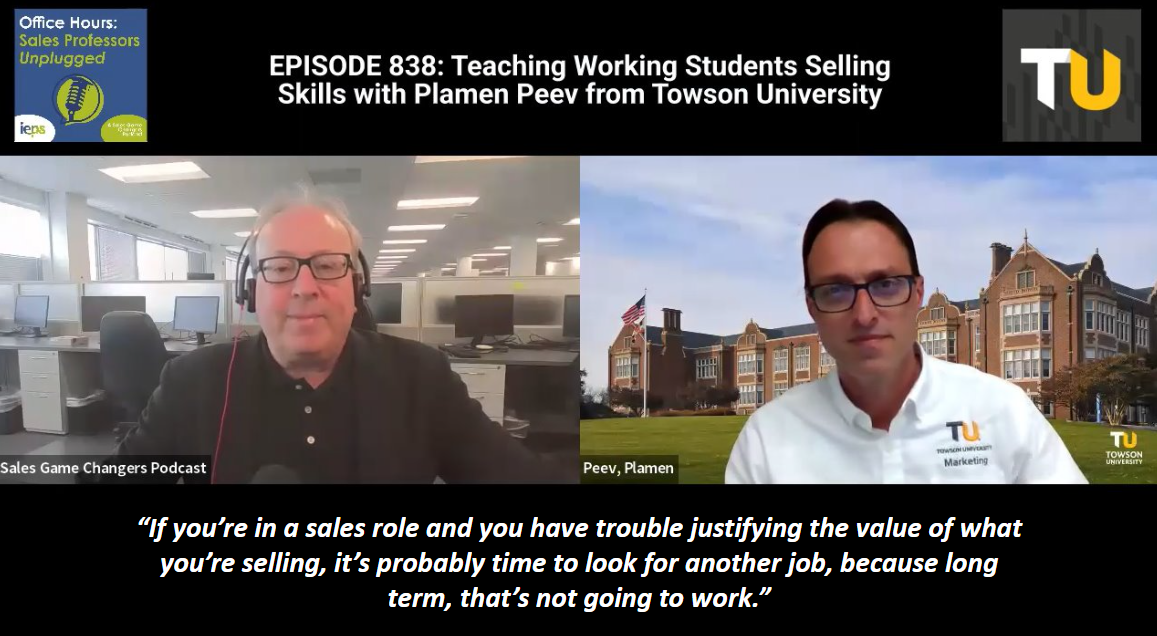
PLAMEN’S TIP: “If you’re in a sales role and you have trouble justifying the value of what you’re selling, it’s probably time to look for another job, because long term, that’s not going to work.”
THE PODCAST BEGINS HERE
Fred Diamond: We’re talking today with Plamen Peev with Towson University, not too far from me. As a lot of our listeners know, I’m based in Northern Virginia, technically Fairfax, Virginia, on the west side of the DC Beltway. You’re located on the complete other side of the Beltway further north from us. What’s interesting is a number of people who’ve been on the podcast before have reached out to me. As a matter of fact, it was our good friend, the great Kevin Carr, who introduced us originally, Kevin with Cvent. I think he was episode number nine on my podcast back in 2017 when we were first kicking off. He saw what we were doing with our program with universities and said he’s very active at Towson and he introduced us. I’m excited to talk to you about what we’re going to be talking about.
First, give us an introduction. We’ve got a bunch of questions I want to get to. Let us know about you. How did you get to this role at Towson, and whatever else you want to tell us? Then we got a bunch of great questions to ask you.
Plamen Peev: Thank you, Fred, for having me. Kevin Carr, he’s a Towson University graduate. He’s on my advisory board for the newly created Sales Center at Towson University. It was sometime last year when he made me aware of the podcast and I’ve been following it and it’s very exciting to finally be able to talk to you on the podcast. Appreciate your invitation.
I came to Towson University from the University of Georgia in 2011, when at the time, there wasn’t really anything related to sales education that was going on here. As a matter of fact, this is what probably got me the job, nobody wanted to teach sales, and they had a sales class as part of the marketing major. We started really, really small with a really small-scale sales competition. Probably this was 2015, 2016. I think it’s our 10th year actually in organizing that. The judges were mostly personal contacts, family and friends of other faculty members.
A couple of years later, we introduced sponsorship opportunities because we felt that there are a lot of companies in the area that hire our graduates for sales roles, and we saw a lot of excitement among the business community. Sales people get excited about stuff like this really, really easy. As soon as I reached out to people and said, “Hey, we’re doing this thing at Towson University.” First of all, I have been recruiting here for 10 years and I’ve never spoken to a sales professor before. I was like, “Well, that’s pretty easy because there was none.” There weren’t any sales professors per se.
Since then, we’ve used that momentum. Now we do two sales competitions per academic year. We usually have between 60 and 70 students in each. We are ready to launch a sales certificate. Maybe I’ll talk a little bit about it later in the podcast.
Fred Diamond: Let’s talk about that now. I know you have a new certification. Give us a little bit of an insight to that.
Plamen Peev: The sales certificate will be something that students are going to be getting recognized on their diploma. Don’t ask me why it’s not a sales minor. It has to do with the way the University System of Maryland operates and it’s a little bit of a political issue, a little bit of a procedural issue in terms of what the approval process is within the University System of Maryland. I’m not going to get into details about that. But we have the certification, which we currently have two classes. One is an intro level professional selling class. The other one is an advanced selling class, which is an elective. We’re going to add to these classes two newly created classes, which are sales leadership, and then we have one that I’m very excited about, the sales innovation and technology class.
These four classes, along with students participating in the sales club that we’ve created during the last year, and the sales competitions, that’s going to constitute the certification. We just went through voting on the approval at the university level. I’m fully expecting the certificate to be launched with probably 10 to 15 students in the fall, with the expectation to grow this exponentially in the next few years.
Fred Diamond: We’re doing today’s interview at the end of March of 2026. When you and I were doing the prep talk for this, you talked about the unique profile of the Towson student. It’s a diverse student population. You were telling me a lot of students are first-generation college students. Give us a little bit of a peek into that and how that is relevant to the sales program that you’re creating.
Plamen Peev: Again, coming from the University of Georgia, which is another big flagship public university, although in a different state, I was probably not quite ready. It was a little unexpected, the profile of the population at Towson University, which I knew was also a large public university, but it’s very different in demographics from the University of Maryland, College Park.
Once I got here, I found out that a lot of our students actually have full-time jobs in addition to taking classes. I would probably unofficially put that number at about 50% of the population and probably even more of them have part-time jobs. There was a definite difference in just the amount of grit that those Towson students had compared to what I’ve seen at the University of Georgia. Then I started hearing from employers, they really appreciate the grit of the Towson University graduates, and I saw that theme. I’m like, “This is stuff that’s actually very applicable to the sales profession as well.” I think we have that going for us for sure.
Fred Diamond: That’s interesting. Grit is a word that we used to use all the time on the Sales Game Changers Podcast. One thing we do at the Institute for Effective Professional Selling is we do events for selling professionals. We’ve actually done sessions just on grit. I can see a young adult with a full-time job and the commitment to go to college to take their lives and their career to the next level definitely is overcoming challenges and trying to figure out how to balance things, and I hate to use the word sacrifice, but to make prioritization of things. That’s pretty good.
You mentioned to me that you also teach a class on business etiquette. Why is that?
Plamen Peev: I feel like we benefit from a very, I don’t want to say necessarily blue-collar student population, but definitely the socioeconomic background of our students is different from the big private universities in the area, or the flagship public universities. A lot of these students are first-generation students within their families. I had a couple of conversations with students that came to me and came to my colleagues and said, “Look, I’m going through this interview process for this company and the third round of the interview is supposed to be a formal dinner. I’m freaking out a little bit because presented with all these options in terms of forks and spoons, I don’t actually know exactly how everything works here.” When you start hearing stuff like this on a consistent basis, you figure out, “Maybe we need to have an etiquette dinner.”
The marketing club decided that that we’re going to have this workshop dinner once a semester. We found a company in Towson that specializes in exactly that kind of education. We had Towson’s own Black & Gold Catering to do a six or seven course menu. As we go through the menu, the company we hired explains the importance of what’s happening during dinner, everything that goes along with it, the small talk and all the other exciting stuff. It’s eye-opening very often for us as well. We definitely have a few things to learn, but for the students that participate in that, I think it’s an amazing experience. Even if nothing else, it gives them the confidence to handle situations like that.
Fred Diamond: A lot of what we talk about at the Institute for Effective Professional Selling is how you communicate, and not to your peers. In a lot of cases, the selling professionals or the young adults who are coming out with these degrees, because of their knowledge of the sales process and what they’re being taught, they’re getting access to people that are, career-wise, above them, maybe a couple of notches above and they’re used to a certain type of interaction and communication. I’m thrilled that you’re doing that and showing them various ways of how to communicate effectively and how to present yourself, especially as they’re given this opportunity with this education to now provide value to the company.
You were telling me that almost anyone who’s enrolled at the university can take your classes, not just the sales team. Obviously, you don’t have a major or a minor, so there’s no students who are just in that path, so to speak. Is that happening, are students from all over the university finding out about your classes and then taking them?
Plamen Peev: We still have to do some missionary work in terms of getting the word out. But I can see more and more students becoming aware of the fact that there’s just a lot of opportunities in the sales profession. We teach our classes from a business-to-business perspective. That would involve a lot of industries where the salespeople have to have a little bit of knowledge of, say, chemistry or biology or some of the fields that are associated to engineering. It’s not necessarily limited to the business students.
There are a lot of manufacturers out there who are really looking for this perfect and very rare profile of somebody with the technical education background, but also knowledge of the sales process and understanding of the importance of asking the right questions and understanding the needs of the buyer, so you can actually solve the problems that the buyer is facing on a day-to-day basis. I think that’s not necessarily unique for business students. I think they were probably the first to become more aware of the fact that this is where a lot of the jobs are. Even if your job is not necessarily a sales role per se, you can apply a lot of those skills every day at work.
We’re going to expand. We’ve made some changes when it comes to our sales classes, since they required a marketing class as a prerequisite. Now, we’re going to open that up and make these classes accessible to all students in all majors. We’ve historically had a lot of mass communication students who minor in marketing, a lot of sports management majors who minor in marketing. These are majors outside of the business school. I had one year when a nursing student won second place in the sales competition. We went to the Kennesaw State competition and the companies were very interested in him because he was probably the only student out of 150 contestants with that specific profile. Also, I’m in talks with the dean of the Fisher College of Science at Towson University and he’s very open to really advertising this new certificate program to the science students as well, which I think is where we’re going to find a lot of traction.
Fred Diamond: A lot of the leaders that we interview for the Sales Game Changers Podcast and that are part of our Institute for Effective Professional Selling, maybe they came from chemistry, or they came from other sciences. One of the two things we always say is, to be successful in professional selling, you need to intimately understand your customer’s marketplace and what they do and why they do it and for whom, or you need to really, really understand what you’re selling better than anybody and how it fits in in the ecosystem with other products and other solutions, if you will. Coming out with a degree in chemistry or biology or other sides, medical, that’ll definitely give you a heads up.
Just curiously, these students, what do they want to know? Obviously, they might have heard, “If I can get a job in sales, it pays more money, better career,” all those kinds of things. What do they want to learn from you and your organization?
Plamen Peev: In the intro professional selling class, there are a couple of moments during that first semester when I can see students change their mindset in terms of how they approach thinking about professional selling. One of those moments is when I tell them, “Look, if you end up in a sales role and you really have trouble justifying the money that people are paying for your product, in other words, you’re not believing really in your product, it’s probably time for you to look for another job, because long term, this is just not going to work for you.”
When I drop sentences like this, or when we have these moments in the classroom, or telling them, “Hey, if there is no problem that I’m solving for you, I don’t really want you to buy anything from me, because what’s the point?” Creating customers that then have questions about their decisions to purchase a couple of months later, or a couple of weeks later, that’s not working well for anybody really. You see their eyes and they’re like, “Oh, okay,” so this may be different than the stereotypes that they had when they were walking in the classroom. I think they’re excited to explore sales in that sense. I think they’re eager to learn how to ask the right questions and how to listen well and how to probe for solutions. It’s this investigative work that I think is exciting for a lot of them to try to figure out an issue that maybe even the buyer is not fully aware of. I think that’s exciting for the students.
Fred Diamond: It opens up a whole new way of thinking about sales. We view sales as a being of service. The companies that work with the Institute for Effective Professional Selling are some of the top companies in the world and their customers don’t buy things, especially now, we’re doing the interview in 2026, that they don’t need, that they don’t want. Not only will they not buy, they don’t even want to engage with sales organizations unless the selling professional is bringing value for where they need to get to, that they may not understand, or that they know they need to get to, and they just want true professional assistance.
Speaking of that, you had mentioned before that there are some companies that are supporting your efforts. What do they expect from supporting your efforts, being corporate sponsors? What’s a message that you want to get across to those who may not see the value in being associated with a program such as yours at Towson State?
Plamen Peev: There are companies that have been with us pretty much from the beginning. The enterprises of the world, Cintas, Northwestern Mutual Assurance, Williams, a lot of these big companies from different industries are doing this at a national scale. I think they’re not necessarily looking for a finished product, but they want to engage with students in order to see a little bit of potential. If they see that potential and then good basis in terms of interpersonal communication and coachability, I think is very important as well, we all know, they go for it. A lot of these companies are short in terms of the positions that they have open and their ability and needs to hire more salespeople. They’re excited that a university would invest in sales education, looking for a little bit of potential in those students. They see them as gems that may need polishing and whatnot.
I think Towson University presents a little bit of a different profile. I’ve talked about grit, but also, I think that we are one of the few schools that probably reflect the population of the community in which we exist, in terms of the percentage of students that are minority students, Hispanic, African-American. We have a Greek community here, Italian community in Baltimore. Our classroom pretty much looks like any public space you would go to in the City of Baltimore, the Baltimore County, or the State of Maryland for that matter. I think that’s also something that they reach out to us with and say, “Hey, we may need a Hispanic speaker for this one role that we have open. Please keep us in mind and let me know if there is a student that maybe fits that profile.” I think that’s also something that companies are becoming more and more aware of, that they have to have people that look and sound in a way that fits the customer base that is being served.
Fred Diamond: Just to remind people, Towson is basically around Baltimore, Maryland, not too far from there?
Plamen Peev: Yes. We are right inside the Beltway, technically a couple of miles into Baltimore County, but very close to the City of Baltimore. It’s about 15, 20 minutes right from Downtown, from the Inner Harbor.
Fred Diamond: Well, thanks for giving us the introduction to your program. Congratulations on your success with the new certification program coming out. It’s very exciting to see. Is there anything else that you wanted to bring up that we didn’t get a chance to address briefly?
Plamen Peev: Getting the word out is important for us at this point, especially now that we have some infrastructure in place in the sense of our officially-recognized sales center at the university. We are members of the University Sales Center Alliance, which is how we connected as well. We have the certificate launching in the fall, and also, we’re looking to have the blueprint for a new sales lab in the next business building, the building you see behind me. It really is the oldest building on campus and it’s very beautiful on the outside, but on the inside, we can really use a building with a little more modern space and arrangement.
Fred Diamond: I did a show recently with a guy named Frank Hauck who built the Sales Performance Lab at Bryant University. Feel free to reach out to him or Dr. Boyer over at Bryant on some of their ideas.
Plamen Peev: Yeah, I talked to Stefanie actually at our last meeting at the USCA in Dallas. You were there as well.
Fred Diamond: Go listen to the show that we did with Frank, a Bryant grad who supported that. Plamen Peev, thank you so much for all the great insights. Give us one specific action step that people listening to the Sales Game Changers Podcast today should implement right now to take their sales or sales leadership career to the next level.
Plamen Peev: We’re really hoping that our sales certificate actually is going to grow to serve the community of some lifelong learners as well. We see that as a dual-purpose program, which is going to serve traditional students at Towson University, but also we’re hoping to be able to offer specific classes and workshops on a piecemeal basis for anybody who’s got their degree in say healthcare or engineering, but then coming back at a certain later point in their career wanting to get more training on the sales side of things, which is very often what people switch to at some point their careers. We’re really hoping to be able to serve that population as well in the future, so something to look out for.
Fred Diamond: Once again, I want to thank Plamen Peev for being on today’s Office Hours – Sales Professors Unplugged of the Sales Game Changers Podcast. Thank you so much. My name is Fred Diamond.
Transcribed by Mariana Badillo