
This is an Office Hours: Sales Professors Unplugged sub-brand of the Sales Game Changers Podcast.
Watch the video of this podcast on YouTube here.
The Sales Game Changers Podcast was recognized by YesWare as the top sales podcast. Read the announcement here.
FeedSpot named the Sales Game Changers Podcast at a top 20 Sales Podcast and top 8 Sales Leadership Podcast!
Subscribe to the Sales Game Changers Podcast now on Apple Podcasts!
Purchase Fred Diamond’s best-sellers Love, Hope, Lyme: What Family Members, Partners, and Friends Who Love a Chronic Lyme Survivor Need to Know and Insights for Sales Game Changers now!
Find Lorenzo on LinkedIn.
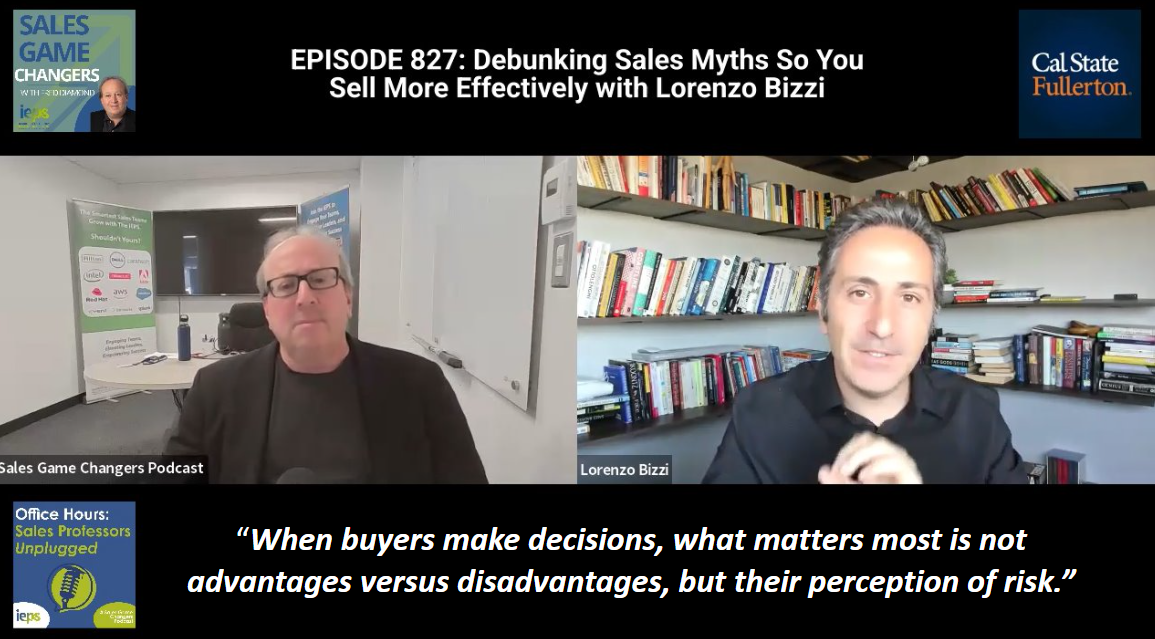
LORENZO’S TIP: “When buyers make decisions, what matters most is not advantages versus disadvantages, but their perception of risk. Reducing uncertainty is what leads to the sale.”
THE PODCAST BEGINS HERE
Fred Diamond: Dr. Bizzi, I’m very excited to have you on the show. You’re the author of what I thought was a great book, Myths vs. Science of Selling. You’re not necessarily a sales professor. A lot of the professors that I’ve been interviewing on the Office Hours – Sales Professors Unplugged show are typically in the sales department, typically with universities that are part of the University Sales Center Alliance. You’re a strategy professor, but you wrote a book on the Myths vs. Science of Selling. It’s really, really good. It’s an interesting approach that you take where you talk about a common myth that people may have about sales. Then you go into why that myth might have perpetuated. Then you talk about what’s real in that particular space. Then you give advice on what selling professionals can be doing. It’s a very well-done book.
You cover a lot of ground, and actually you tell a lot of great stories. You talk about some famous sales leaders from way back in the day, like the Zig Ziglars of the world. Kudos to you on the research and the content that you have in the book. I could tell as I was reading it, you’re very, very good at research and you put a lot of time and energy into thinking this thing through. Before I get into some of the details of the book, introduce yourself, tell us a little bit about you so that we can understand who you are and a little more background on what you do.
Lorenzo Bizzi: It’s a pleasure for me to be here and to have the opportunity of having this conversation about work that I spent four years to develop this book and a lot of effort to try to make something impactful. As you correctly said, I’m a professor of strategy rather than a professor of sales. But as I’ve always taught MBA students, in our MBA program, we actually do real consulting work with local businesses. These are generally B2B businesses, and the majority of the times, the projects are about sales. That’s where I developed expertise on B2B sales.
Most times I see very, very strong links between strategy and B2B sales. That would not apply to B2C for sure, but a lot of times, since you have to explain to the buyer how your product or your service is going to improve their business, this is very, very similar to strategy. In fact, a lot of the contents in my book overlap. There’s an overlap between strategy and sales. That’s why I developed an expertise and a strong interest in B2B sales specifically. The book does not really offer a lot of content and insight for B2C, but it’s particularly valuable for both B2B and B2G. I’ve been working four years on this book. I’ve been doing consulting and teaching for 13 years here in California, and this is where I got my idea to try to build my book.
Fred Diamond: It’s a great point that you just made there. You start off a lot of the chapters talking about things like you need to be an extrovert to be successful in sales. On the Sales Game Changers Podcast, we’re all about B2B, and we have a lot of guests and listeners who are in the B2G, the business to government space. There’s a lot of nuance to it because of the customer regulations and things like that and how they go about buying. But the way that they make their decisions are very, very similar to B2B. There’s a lot that you need to know. You talk about things like, do you need to be in a relationship to get sales? You make really good points, which is it helps, but that’s not going to get you the sale. The way that the customer buys, the way that the customer discerns.
Talk about that for a little bit. Talk about the concepts of popular advice. A lot of times people will say to someone, “You’ll be very good in sales because you’re a great talker.” Or, “You have a great personality,” and that’ll only get you so far. Talk about the big difference between popular advice and real hardcore research.
Lorenzo Bizzi: The main premise of the book is that there is a gap between popular advice and what research shows. The reason is very simple. Nowadays, everybody has a voice and the space is extremely crowded. A lot of YouTube stars, a lot of influencers, a lot of social media people. Everybody has a voice, everybody talks, and it’s very difficult to get noticed if you want to say something about an advice for sales. The way in which people respond to this pressure is by exaggerating claims. How can I be heard if I just say something that is true? Sometimes truth is mild. The truth is not exaggerated, truth is not empathic, truth is not emotional. A lot of people tend to exaggerate claims then to say, “This is the one thing that is going to make you super rich.” The one secret, secret is a beautiful word, all the time we mention secret, “This is a secret nobody knows, but I’m going to tell you, and it’s going to make you instantly rich.”
When I started reading a lot of sales books, it was feeling uncomfortable. This idea that we have to always exaggerate claims, and that’s not true. A lot of times, researchers with many, many years of work produced a lot of beautiful insights that sales professionals do not know. Here I got my motivation of trying to say, “Look, this is what the advice says, and this is what research says.” Most of the times the advice can actually be true, but the impact is enormously exaggerated.
I just say, for example, goal settings, set ambitious sales goals. That is important. Setting ambitious goals helps performance, but just a bit. While, if you read books, it says it’s going to change your life. You can dream whatever you want to get, and you’re going to get it. This is unfortunate because it then creates false expectations. People, at first when they read the books, they’re super excited. But then after they get this illusion, and unfortunately, they leave sales. What I really hate about the profession is that turnover in B2B sales is enormous. I blame it to a lot of the articles and books that create false expectations, making people believe that success is instant, that they’re going to be able to implement this one secret and right after they’re going to be able to succeed. That is false, and it eventually creates disillusions, excitement at first, then disillusionment.
Now, you mentioned, for example, the personality, how being an extrovert can help, how curating rapport in a sales relationship can be important. This is very important, but it’s not enough to bring the sale. I’m going to talk more about it. The way in which you build rapport, your personality, perhaps your extraversion, we can talk a little bit more about extraversion because it’s a very interesting construct, but your personality can influence the extent to which the buyer pays attention to what you say. Nobody pays attention to someone they don’t like. Everybody pays attention to someone they like, but paying attention is different from purchasing.
I pay attention, I listen more to what you have to say. If the product is good, then I’m going to buy. But if the product is bad and I’m paying more attention to what you say, then I’m actually less likely to buy. There has to be both personality, both rapport, both paying attention to what the buyers are saying, combined with a very strong sales conversation focused on rationality and on explaining well the product or services that are likely to impact the business and eventually result in ROI. That is really what brings a sale. Your personality, your rapport can empower listening, but then that listening must be converted to a sale with a very powerful sales conversation.
Fred Diamond: That is a great point. As I was reading the book, I was thinking a lot about the evolution of professional selling. My organization used to be known as the Institute for Excellence in Sales. In May of 2025, we changed the name to the Institute for Effective Professional Selling. We created our Center for Elevating Women in Sales Leadership.
I remember, we have a good friend at the Institute for Effective Professional Selling, his name is Tom Snyder. He runs a company called Funnel Clarity. He’s also written a couple books. When he speaks, he talks about how as late as 1980 on the census, if you were in sales, the only option you had was peddler. If you were in sales and on the census, you chose what business you do. The only one that was there was peddler. When you think of a peddler, you think of a guy in a monkey in a carnival type of a thing.
Now, when we think about the B2B sales that we’re doing, it’s very hard for a couple reasons. One is, you’re selling something that first of all could be very expensive. Second of all, there’s very low risk from your customers. They need to make sure that they’re making the right decision. A lot of times, what your customers, in IT, operations, finance, supply chain logistics, those are usually pretty complex operations. It’s not like an enthusiastic call is going to get them to write a check for $50 million worth of AI software. It might take a year or two, three. Then you got to think about competition and cooperation and partnerships. As I’m reading your book, I’m thinking in my mind about sales professionals I’ve met over the years and how they have evolved and how right now for the sales professionals who are listening, and to be frank with you, Dr. Bizzi, for the sales professionals who are in their 30s, 40s, it’s a whole different world. There’s a lot more complexity. You need to know more about the customer and their business to be successful, or else the customer doesn’t really need to spend time with you.
Lorenzo Bizzi: Yes, absolutely. Things have changed so much, complexity has increased, but the game is now more interesting. If there is more complexity, that means that intelligence, preparation, and research are more relevant to close the deal. Now sales has become a game in which you can really attract interesting people, motivated people, and intelligent people, because the sales conversation with buyers has become more complicated.
In the past, people were underprepared. A lot of times the sales profession was not appealing. Now, really developing a strong conversation with buyers to understand and to explain how your product and service can get into their business, can reinforce their competitive advantage, can help them be protected against the attack of the competition. This is a beautiful conversation. Now this has made the job of a sales professional extremely rich. It’s essential to be able to break the problem down well.
As I do consulting with businesses, I realize that B2B sales is very, very proximal to what a consultant does when they’re making recommendations for anything to improve in the company. You help the client break the problem down. You help understand the source of the problem. You provide strong evidence in support of your claim and hypothesis, and then you justify and explain well how your solution is likely to impact the profitability of the company. It’s exactly the same as a B2B sales professional. A B2B sales professional is like a consultant, not just merely in the sense of consultative selling, we all know about it, but in the idea of, “I help you break your problem down, we go inside your organization together so that you get more insight into what really could cause the problem.” This creates a beautiful connection.
You’re not just someone there to try to sell, but as you help them better understand their own problems, then I can develop trust and I want to talk with you. I want to do business with you. This increase in the importance of expertise has made the game more complex, but at the same time, more interesting, and has made the professionals, B2B sales or B2G sales professionals, much more insightful, much more powerful, and much more able to give a wonderful career to individuals.
Fred Diamond: I love the way you said that, you said it very, very well. The sales professionals that we see being valuable right now and successful are those that are truly bringing value to the customers on where the customer needs to go without being told. Without the customer saying, “How can you help me get here?” the sales professionals need to know where the customer’s going, or else they really don’t need to spend time with them.
I remember, as late as 15 years ago, a sales professional was where the information was gotten. I remember being in two-day-long meetings where our sales reps would present vision, strategy, roadmaps, things like that. Now the customer can go to Claude or ChatGPT and type in what is Apple’s product strategy for the next five years and within 30 seconds, it’ll appear.
You cover a lot of ground in the book, and you make a great point that there’s no one secret to success. I love the way we’re talking here, and this is why we changed our name to the Institute for Effective Professional Selling. Professional Selling. If you are a professional, what does a professional do? Give us some of your insights in having read the book. What are some of the things right now that selling professionals, B2B or B2G, must be doing to be successful?
Lorenzo Bizzi: It’s a beautiful point that you say, Fred, the stress on the word professional, because it’s also important to notice that when you ask buyers what perceptions they have about salespeople, a lot of time professional is not the first thing that comes to mind. When you think about what people associate the sellers, the sellers a lot of times are not trusted individuals. They’re trying to manipulate you. You have a good idea that we need to transform salespeople into professionals.
Now, there are a lot of advice. I’d like to maybe focus on one, one interesting piece of advice that I found insightful in the book, is the idea of listening to the customers. Everybody says you have to listen to the customers. This is no news. But when you look at the books, a lot of times the advice for listening is you repeat what they’re saying, you paraphrase what they’re saying, you nod. In other words, active listening forces you to think about how to respond when someone is talking, so you’re not really listening. When someone is talking in your mind, you already have the script and you’re selecting what answer you have to provide from a tree that was given to you in advance. You’re not really listening. Listening is not about responding, of course, it is about responding, but not only about responding, it’s about sensing. Sensing is about understanding what the others are doing.
How do you empower your understanding? Attention is extremely difficult. When people talk to you, especially about complex businesses, being able to understand what they’re saying is very difficult. We retain only a fraction of what people are saying, and then when we repeat and we respond, the buyer says, “This person shows a very shallow understanding of my situation.” That’s where preparation upfront becomes important. The more we study, the more we are expert of the problem, it’s not just important because it helps you sell more, it helps you converse better, but because it helps sensing more. It’s less effortful if you’re an expert of the problem, of the company, of the industry to pay attention. This is where expertise and professionalism come into the equation. The more you know about the industry, the competitor, the company, and the problem, the less effort you have when you listen to what they say, and you are able to get, instead of 20%, 50%, 80% of what they’re saying. When you respond, you show that you’re actually smart and you’re someone you need to have a conversation with.
Really listening is not about responding, nodding, paraphrasing, “Hmm, that’s very nice.” That’s what you read in books. Listening is about sensing and being better able to absorb the information that the others are saying. In order to do that, the only way is to develop expertise that will allow you to switch from remembering 20% of what they say to remembering 80% of what they say.
Fred Diamond: That’s such a great point. In the early days of the Sales Game Changers Podcast, I used to do the interviews in-person and I would go to a VP of sales office. Then when the pandemic happened, obviously everything went over to Zoom, and the conversation shifted more to, “What do I do today?” Or, “What should I be doing now?” One of the questions that I would ask the sales leaders that I would interview, typically VPs of companies like Microsoft and Oracle and IBM, is what are you great at? People would always say, “I’m a great listener. 66%, I have two ears and one mouth. Use them in that order.”
After getting that answer time and time again, I started saying, “Okay. Well, help my audience. How can they become better listeners?” They hit on some of the things that you talked about, preparation, becoming an expert, asking better questions, training yourself. I like the way you just said, most people, when they talk about listening, they’re basically listening for their opportunity to talk. In sales it’s the same thing. It’s like, “Oh, okay. Interesting. Okay. Oh, huh, interesting.” But I know I need to get to my three questions. It’s like, “Interesting. Well, it’s interesting you would say that because where do you see-” I love the way you said that.
Talk about maybe the concept of reducing uncertainty in the sales process. I think that’s going to be very important, because a lot of people who are listening are sales leaders, and they manage people, and everybody has a quota and everybody has a number that they need to get to. We’re doing today’s interview in January of 2026 and for some reason, a lot of the companies that are members of the Institute for Effective Professional Selling, their fiscal year ends January 31st. A number of them have said to me today that they’re closing in. Talk about the concept of reducing uncertainty when sales leadership is striving for certainty. When are we going to close this deal? How much is it going to be for? Because I need to tell my boss, who needs to tell his boss, who needs to tell our CFO for reporting.
Lorenzo Bizzi: This is a fascinating topic, and I believe one of the most important points that I discuss in the book. Whenever a buyer makes a purchase, you can actually break it down into a matrix with two variables. One is my judgment on the product, I like it, I don’t like it. The other one is the uncertainty or certainty of my judgment, I think I like it, versus, I’m sure I like it, or, I think I don’t like it, versus, I’m sure I don’t like it. You can imagine this matrix. Most of the classic advice focuses on changing the judgment and shifting it from, I don’t like this product, to, I like this product. I say in the book that the most important point is actually shifting the judgment from, I think I like it, or, I think I don’t like it, to, I’m sure. It’s really what matters the most to the sales, especially in a B2B or a B2G context. I’ll tell you why.
Research shows that when buyers make decisions, what’s most important is paradoxically not advantages versus disadvantages, but is my fear, my perception of risk. We assess the risk. We want to feel safe. Making buyers feel safer is more important than explaining the advantages and convincing them the advantages are higher than the disadvantages. This is paradoxical, because we are always thinking, “Yeah, I got to put all the advantages, make clear all the disadvantages.” But you see, the advice of trying to shift from, I don’t like this product, to, I like this product, as a result makes sales professionals inflate the benefits and hide the disadvantages.
This unfortunately creates more uncertainty because if the buyer is an expert, the buyer’s going to say, “Hey, what’s going on? I don’t trust anymore what you’re saying.” My perception of uncertainty increases, and I’m not going to like to buy. In the human brains, when it comes to purchases, it’s more important there’s a feeling of comfort and a feeling of safety. If you are able to reduce their perception of uncertainty in the process, you make it very clear, they feel comfortable, they feel comfort. This is way more important than convincing them the advantages are superior to the disadvantages, then they can gauge. This is important. We first responded to a situation of uncertainty with fear and distance. You need to make them closer to you, and you make them closer to you only by reducing their perceived uncertainty.
Fred Diamond: I love the way you explained it. I’ve been saying for years that sales professionals need to put themselves in the shoes of the customer. Most customers in IT, or in operations, or logistics, or finance, they don’t want to lose their job. They want to hold onto their job. They don’t want to be the guy or lady who spent $50 million on a financial reporting system that was never implemented. They want security mostly in those positions that purchase B2B related things. They want to hold onto the job. The way you lose your job, besides obviously remote layoffs, etc., is by not making glaring errors. That’s such a great point. I used to sell ERP solutions 30 years ago, and everybody talked about the guy who brought in the $500 million SAP system that was never implemented, etc.
It’s been great talking to you, Dr. Bizzi. The book is Myths vs. Science of Selling: When Research Reveals the Opposite of Common Belief. You go through a couple dozen areas like we discussed here, where you talk about the misconceptions, the myths, if you will, why they’re wrong, what’s factual, and then how selling professionals can utilize this to be more successful in their sales conversations and their process.
I want to hit on one thing before I ask you for your final thought. A lot of salespeople want to be liked. You mentioned rapport before, but it doesn’t work anymore the way it used to. Customers, yes, they do want to like you, but they want to implement solutions that are going to help their company or organization achieve its goals this year or next year or two years from now, whatever it might be. Talk about that concept for a little bit, the whole idea of rapport. Yeah, it’s nice to have, but it’s not going to get you to your quota.
Lorenzo Bizzi: Liking still matters, and I’m going to have to tell you, Fred, liking will matter even more in these times of AI, in which personal rapport becomes more important. Trust is going to be more difficult to acquire the stronger AI is, because every sales professional is going to be able to come up with the most beautiful stellar presentation. The buyer is not going to really believe those numbers. Anybody can show fantastic numbers, fantastic projections, beautiful stories. I don’t know how much that really comes from you or it comes from AI. Personal rapport and liking is still important and will become even more important.
The mistake of sales professionals is to believe that liking is enough, and most importantly, that liking can replace a weak sales conversation. “Since they like me, the product doesn’t need to be that good anyway. They’re going to buy it.” That’s wrong. They interact. Liking. With a strong sales conversation, with a strong idea of why the product is good or better, leads to the sale. Liking is not a substitute for a poor conversation. That’s where people make most mistakes. “I’ll just focus on being liked. Then the sale is going to come.” No. Liking without a strong sales conversation leads to nothing. Liking combined with a strong, rational, powerful sales conversation that reduces uncertainty will lead to the sale. Liking still remains important, but like I said before, liking gives the attention, which is the precondition to be able to develop a conversation. But then again, still we need to focus on reducing the uncertainty, and that’s when the sale is going to happen.
Fred Diamond: I love that you’re covering this because we’re over 800 Sales Game Changers Podcast episodes at the Institute for Effective Professional Selling, events like our Women in Sales Leadership Forum, our Emerging Leaders Program, that is such an important message is, what’s the most important thing to the customer? At the end of the day, I’ve been saying this for years, it’s avoiding risk. How can you present this?
We’re talking to Dr. Lorenzo Bizzi from California State University at Fullerton. Give us something specific. We’ve covered a lot of ground here, but something specific you recommend our listeners do right now after listening to the show, watching it on YouTube, or reading the transcript to take their sales career to the next level.
Lorenzo Bizzi: This is a very beautiful question. The book itself has a lot of very specific actionable steps. The last part of each chapter, I have over 30 chapters, that goes into specific actions, how you can convert the conversation, transform it into a specific set of actions. There are a lot of little specific sets of actions, exactly what you have to say and what you have to do in this specific situation. But if I would say, what is the most important point of the book, is that I’m not this scholar or the professor that claims to go there, criticizes popular advice, science is right versus popular advice is wrong. That is not the goal. I always believe that if you tell people what to do, they won’t do it. But if you make them think about it, then they’re more likely to implement any recommendation.
Yes, I have a lot of very little pieces of advice at the end of each chapter, but the key goal of the book is that each chapter creates a contrast. This is what popular advice says. This is what research says. I’m not going to be bold and say research is right. Popular advice is wrong. But by creating a contrast, you stimulate the mind of the readers. The whole goal of the book, although it provides a lot of little pieces of advice, is not actually to tell you what you have to do, but it’s to stimulate your thinking. If I give you contrasts, you’re forced to think and you’re forced to take your own position. Then after, when I provide the little piece of advice, you’ll say, “Okay, I’m going to do it,” or, “I’m not going to do it.” But if you only tell people do this, they’re not going to do it. Make people think, stimulate their minds, create contrasts. That, in my point of view, is the only way in which you’re going to make people do some of the actions that you recommend.
Fred Diamond: I noticed in the book you talked about System 1 versus System 2 thinking, which is what you’re covering right now. I was very happy to see that because you’re absolutely right. It’s one thing we learned a long time ago, is that customers get more value in what they discover and what they decide to do versus what you tell them to do. Throughout your book, you’re talking about ways to get the customer to discover that type of thinking.
Once again, Dr. Lorenzo Bizzi, California State University at Fullerton. Thank you so much for being on today’s Office Hours – Sales Professors Unplugged. My name is Fred Diamond.
Transcribed by Mariana Badillo