
Watch the video of this podcast on YouTube here.
The Sales Game Changers Podcast was recognized by YesWare as the top sales podcast. Read the announcement here.
FeedSpot named the Sales Game Changers Podcast at a top 20 Sales Podcast and top 8 Sales Leadership Podcast!
Subscribe to the Sales Game Changers Podcast now on Apple Podcasts!
Purchase Fred Diamond’s best-sellers Love, Hope, Lyme: What Family Members, Partners, and Friends Who Love a Chronic Lyme Survivor Need to Know and Insights for Sales Game Changers now!
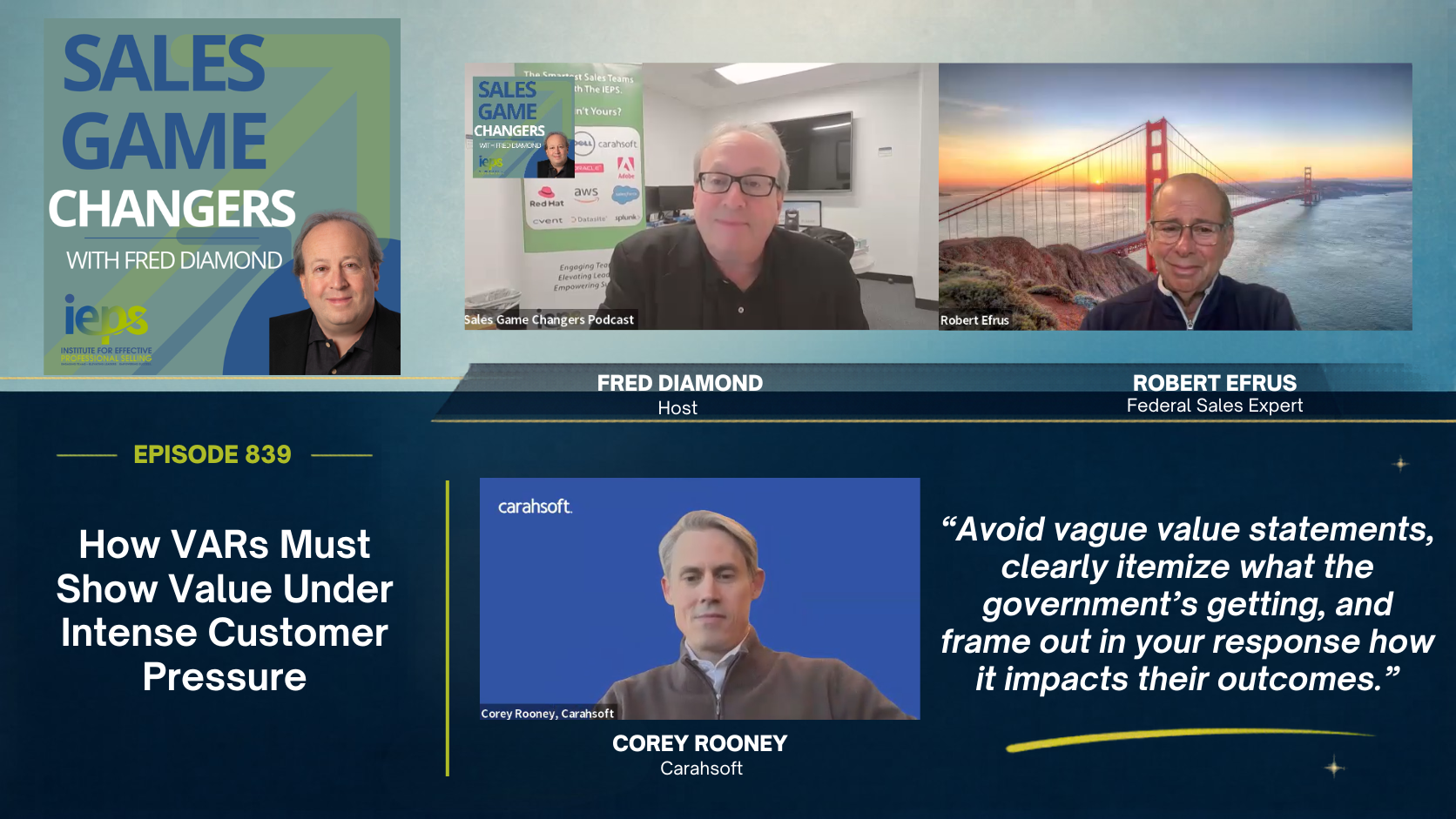
Today’s show featured an interview with Corey Rooney, Director of Channel Partner Business Development at Carahsoft, and Federal Business Development and Marketing expert Robert Efrus.
Find Corey on LinkedIn. Find Robert on LinkedIn.
COREY’S ADVICE: “Avoid vague value statements, clearly itemize what the government’s getting, and frame out in your response how it impacts their outcomes.”
ROBERT’S ADVICE: “The most important thing is to first understand the environment your customer is operating in, what the mission requirements are of their agency, what the priorities are of the current leadership, before you even have the conversation.”
THE PODCAST BEGINS HERE
Fred Diamond: I’m excited today. We’re doing todays show in April of 2026. We have Rob Efrus and Corey Rooney with Carahsoft. Corey is the senior director for partner business development at Carahsoft. Rob, we had you on the show in December. It was right after you did the 16th Annual Budget Breakfast at the Carahsoft Conference & Collaboration Center, and we went deep into what you talked about then and the changing landscape for companies that are selling to B2G, specifically to the federal government.
On April 4th of 2026, you did the 4th version of that presentation to the partner community within the Carahsoft ecosystem. Corey, you were a major part of that, which we’ll talk about in a second. You gave very decisive, very insightful thoughts of where we are now as a selling community, as a support community to our customers, and to be frank, what value-added resellers, what companies that are distributing and selling technology to the government you got to be doing, you need to do, because so much has changed.
Rob, before I turn it over to you to set the table, Corey, this is your first appearance on the Sales Game Changers Podcast. I have a feeling it’s going to be the first of many. We’ve had many of your peers at Carahsoft on the show. We actually just posted a show with Sehar Wahla, who manages the AWS business. We’re doing a great event on May 14th at the Carahsoft Conference & Collaboration Center. Give us a brief intro to you. Then, Rob, I’m going to ask you to set the stage of why we’re doing this show today.
Corey Rooney: I have a couple of roles here at Carahsoft, but in the context of what we’re talking about today, I oversee a team that supports our corporate nationwide resellers, our strategic resellers, our tactical resellers, our value-added resellers, which includes all the long-tail and the new reseller and value-added reseller partner onboarding. We transact with over 4,500 roughly a year. Over almost half of those are transacting in the US federal market. I’ve got a team supporting their growth, business development, joint sales and marketing campaigns. That team has been growing significantly over the last few years and we’re working to have a many to one scale at Carahsoft of resources that are supporting the dedicated value-added reseller and solution provider growth ecosystem because it’s near and dear to our hearts and that ecosystem, that landscape is cherished by Carahsoft. We wouldn’t be able to do what we do to support our vendors without that broad scale.
Fred Diamond: Many of the partners that we’re talking about participate in the Institute for Effective Professional Selling programs. We’re very fortunate to be in this community. Rob, I’m just going to state and then people can Google you and find you, you are the expert on public sector budgeting. Again, 16th breakfast you did back in December, earlier this month was the 4th. I’m just going to make that statement so that we can get right into the content.
Rob, talk about some of the administration’s guidelines, the priorities that have got us here to this point.
Rob Efrus: In terms of setting the stage, we’re about a year and a half almost into the Trump administration 47. The Trump team has made IT modernization a major priority, which is great news from a selling perspective. In addition, as part of that goal, there’s also been a concerted effort to improve how the government acquires technology to make it more efficient to eliminate the silo purchasing and to overall try and unify the process by which government agencies acquire software, hardware, and related services such that the government isn’t buying things over and over with different pricing, etc.
This has put pressure on a number of stakeholder groups in our community, including the software manufacturers, including the resellers, including the systems integrators. The net effect of all of this is that those sales personnel that are working in a channel related role are needing to stay more on their toes in terms of understanding what these changes are and how specifically they impact the channel. From a reseller perspective, this requires, I believe, a reselling motion that many professionals in this channel environment are not used to. That is to demonstrate the value of the reseller in terms of supporting customer requirements, in terms of getting the best deal, etc.
In addition, it also requires a little more awareness of what changes are coming down from the top. The general services administration and the office of management and budget in particular are the two main agents of change affecting the channel environment in particular. There’s a specific initiative called OneGov being administered out of GSA that really for the large enterprise software vendors has been disruptive, frankly, where there have been efforts to go direct to manufacturers on the belief that this is a more efficient route.
The selling motion that is new and different is that the reseller community needs to be more proactive, not only in understanding these changes, but demonstrating the value of the reseller channel to end user customers, to contracting officers, to program managers who are getting signals from the top in order to make these changes, but often are doing so, in my opinion, in a ready, fire, aim manner that sometimes throws the baby out with the bathwater.
Fred Diamond: That’s very well said there. It’s just so many things have changed. Like you said, we’re 18 months into the new administration. They want to modernize government, but that affects everybody that sells things to the government. Every company has had to rethink how they go about their marketing.
Corey, Carahsoft is at the center of this. 4,500 resellers you work with and over a thousand vendors/manufacturers bringing critical solutions to the government to achieve their goals. Give us some of your insights into how we should be working with VARs and what VARs should be doing.
Corey Rooney: There’s been this illusion of what the value-added reseller and solution provider community is bringing to the table. All they see at first glance, the government industry thinks, “Hey, it’s just the margin and they’re passing paper.” Really, that illusion doesn’t take into full account of what a lot of our partners are doing on a day-to-day basis. I speak with a lot of partners. I speak with a lot of value-added resellers. I speak with a lot of solution providers, a lot of system integrators. The idea that, hey, they’re just taking an order and passing along and marking it up is completely incomplete when you look at all they’re doing, coming into bringing in expert advice, doing the research and analysis and helping the government and customers vet new and existing technologies, the requirement analysis, managing all the supply chain risk management, the performance reporting, all the installation integration and training that’s required, certification testing, the list goes on and on.
We have partners that are doing a tremendous, tremendous job taking the message of the manufacturers, taking the solutions they’ve built, in many cases at a commercial level, and translating that into the needs of the government. We’re very fortunate to have a big, broad ecosystem of partners. It does seem like the pressure has become a little bit more intense on some of those partners. I’ve spoken to some and they’re getting that pressure, but they’re also leading in with value. It takes sometimes thousands of hours of critical work between the manufacturer, the work that we’re doing to support all of these partners to get them enabled, educated, provide resources to do all the configuration, to help program manage some of these large and complex opportunities.
It’s not just about passing paper and it hasn’t been for quite some time. I think for good or for bad, this is a little bit of a push to help this ecosystem evolve into providing more of the value that is expected from these customers that are still coming to a lot of these partners and saying, “Hey, we need your help.” It’s been an interesting ride that frankly we’ve been well positioned here at Carahsoft for the last many years to help take that message from those manufacturers, add in a lot of value by helping translate to that market, and then enabling our ecosystem partners to really go drive that value.
Fred Diamond: Rob, give us some insights into what is going on inside of the government for the technology buyer. They’re also going through major challenges too. We talked about this back in December. There was a large reduction in force with government. A lot of people took the option to retire and to move on, less with more, etc. Rob, give us some of your insights for the people listening about what’s going on inside the government, the government employee, not just only the ones who are making the administrative decisions, but the ones who are buying technology and have to solve the challenges that government solves, infrastructure, service to the citizen, military support, whatever it might be.
Rob Efrus: I could name at least three specific trends that are worth noting. The first is there’s a major effort to reform the procurement rules governing IT purchasing. The federal acquisition regs are currently undergoing an overhaul. This is more at the 30,000 foot level, but the emphasis there is on more commerciality, less customization, buying and paying for services to modify a commercial product to meet very custom requirements. All of that is flowing down to the contracting professionals in government agencies, and you add to that this specific effort to try and disintermediate the traditional buying patterns of IT products and services.
I say disintermediate to the extent that the government and through the general services administration, second major point, where GSA has expanded its portfolio in terms of being the entity that is seeking to make those purchasing motions more uniform and more applicable across government to enable to minimize stovepipe purchasing and to ensure that the government is getting the best price at the agency-by-agency level across government instead of within a specific agency.
I say that and use GSA as an example, they’ve lost thousands and thousands of personnel through retirements and furloughs, etc., and so it’s a bit of a contrast. On the one hand, their mission is expanding, GSA’s, but on the other, there are less federal employees able to help. Then you’ve got from the political level, as I briefly described earlier, this push by federal CIOs, by the Office of Management and Budget and the E-Government and Technology Office, and of course, the political appointees within GSA to put greater pressure on manufacturers, hardware and software, to sell their products directly to the government and cut out the distributors and the resellers on the assumption that that is a more efficient way to purchase given the margin-related concerns that Corey mentioned. You add all that up and it’s a period of great change combined with a greater acceleration of technology’s life cycle. Talk about AI in particular, how that’s dramatically impacting everything that the government does.
Last point, the government is seeking to modify the procurement roles that I mentioned earlier to encourage non-traditional vendors into the marketplace. We’re seeing this mostly right now within the Department of War, but as part of that effort to make the defense industrial-based more robust and resilient, a lot of the rules requiring those non-traditional vendors have been modified such that it’s a heck of a lot easier to get into the federal market than it has been in the past. You can be sure that those non-traditional vendors as part of their table stakes are being encouraged to go directly to the government, assume all of that liability, which is a tough sell for a smaller company. Those three or four things are trends that are dramatically impacting the folks in the middle, the reseller community.
Fred Diamond: Corey, I know there’s a couple of examples of success. There’s got to be hundreds of thousands, but give us a couple of them, some that you’ve seen first-hand.
Corey Rooney: You’ve also been leading in with some of these defense disruptors. Their go-to-market, the build-first, buy-later, that works for certain use cases. That’s a strong business model when operating in a war environment and operating in the defense sector. There are certain use cases where that model works, but we’ve got a really great ecosystem, and some of those more complex stuff, that build versus buy doesn’t always work. When you’re building complex systems, there isn’t a single button to push.
You’re going to need to rely on ecosystem partners that can integrate those technologies, not necessarily from an implementation side, but to really scope and configure and understand the needs of the government, because some of these larger entities, they have great sales teams specifically around the US federal government, but being able to navigate better together messaging, being able to figure out where they can complement one another, we’re working with lots of partners.
The CDWs of the world, I think what Ben and Corey Stonehocker are doing, takes a real heavy lift to go after contract vehicle like maps. I know the solicitation alone is over 300 pages long and the volume that comes out based upon the needs of those types of customers can be overwhelming for a single entity. You need companies like those, you need companies like ThunderCat, you need companies like NewTek that can manage these extreme volumes of solicitations, be able to handle that and be able to navigate that at a price and it’s fair and reasonable and it’s providing a lot of value.
We’ve got a lot of partners like CTG, for example, they’re doing a lot of good things around data center infrastructure and modernization. Red River and what David Raffetto and Jeff Brown are doing over there, it’s been really strong. Even WWT, they’re out hosting the Army Lieutenant Generals and the G6 staff at their global headquarters, walking them through their ATC, showing the new technologies, and getting them in front of those technologies. There is good work that’s being done out there at the early stages to help really figure out those needs of the customers and then translate that into what’s something they can consume and implement at a reasonable time and value that’s not going to take them 12, 24, 36 months in order to be able to implement something based upon a set of requirements. A lot of great partners out there.
We’ve got another, and I’ll call out August Schell, they’ve recently negotiated an ELA where they had to do customized license management portals. Could an OEM do that? Perhaps, but can any small vendor who doesn’t really know the FAR, doesn’t hold clearances, doesn’t have an ISO 9000 or 9001 cert, and might not even know what CMMC stands for, can they handle that type of effort? Probably not. We’re at a time where in order to implement something like that would be overwhelmingly costly for a small vendor or even a medium sized vendor to implement. We’ve got a lot of great examples out there. I could keep talking, but we’re excited by the different, call it spectrum of capabilities that a lot of these partners are providing to the US federal government.
Fred Diamond: I spent a lot of my career working on the OEM, the manufacturer side, and software and hardware. One thing that I learned is we were really good at making things. We weren’t particularly great at what happened at the ground level. One of the key words that we keep using that’s emerged over the last couple of years is ecosystem. We’ve used that word many, many times. It used to be channel partners, whatever, but the whole ecosystem, there’s so many pieces that come into play and there are so many niche things that make things successful.
Corey, I’m going to ask you about things that you’re doing with the OEM community to get the messages more effectively across to the customers. But, Rob, before I get to that last question with Corey, give us some more insights on, you work with manufacturers, OEMs, you work with the VARs, and the channels. Also, you come from government, you know what they do intimately. If I’m a selling professional at a company that we’re talking about here, what should my conversations be like with the government employees, the ones who are in the various places where you alluded to in the previous answer?
One word we use a lot is empathy, on the podcast and at the IEPS. Give us some of your recommendations if I’m a VAR listening to this, I’m an account executive at a VAR selling to maybe one or two agencies. Usually, if I’m that person, I’m selling to one place. Maybe I have a couple of accounts within that one department or agency. Give us three or four salient things that you recommend how they’d be talking and what they should be talking about.
Rob Efrus: The most important answer to that question is to first understand the environment in which the end user government employee or contracting officer, what their environment is. Part of that environment is external to their agency as it relates to the type of policies, like OneGov, like acquisition reform, like efforts to bring in nontraditional vendors, understand that environment. Because going into and speaking with a government employee without understanding their world, at least having a cursory understanding of their world, what the mission requirements are of their agency, what the priorities are of the current leadership. Bonus points, what are some of the congressional oversight concerns that are impacting the behavior of the agency, before you even have that conversation, that’s the most important thing. I would suggest, and we can loop back on this, that the visibility into that environment, I would argue needs to be much broader than those working in the channel are traditionally focused on, which is primarily a transaction related perspective. That would be the first step.
The second is in discussing the solution offering to have an idea as to how that offering aligns with those priorities, whether it’s from the procurement perspective, whether it’s from the mission perspective, whether it’s from the cost reduction perspective, the personal career advancement objectives of the person or persons that you’re speaking to. The government employees, it is supposed to be a meritocracy and career development is always a priority of every government employee you’re speaking to, including those four or five thousand or so at the political level. You need to adapt that message to the audience you’re speaking with.
Don’t just talk about, this is the obvious one, features and benefits, but really link those mission-related requirements and those that I listed off there, and to make sure, lastly, that the people that you’re speaking with understand the value that you’re adding to the deal. Whether that’s greater efficiency, lower spend, more alignment with mission requirements, etc.
Fred Diamond: That’s a great point. Actually, the most uttered word on the Sales Game Changers Podcast is value. We use it many times here to talk about value-added reseller. The value is changed now because of the pressures that are under not just in B2G and public sector, but all the markets that any of our listeners are selling to.
Corey, just briefly, I know you’re doing a lot of work with the OEM community to refine their message to their partner channel to get the message to the customer effectively, why don’t you share one or two things that Carahsoft is doing there.
Corey Rooney: We do a lot from a partner-enabled perspective. We do activation days. We do partner enablement training certification days. We do on-site boot camps and helping get some of our partners technically certified translate that message. There isn’t a day that goes by in our office where it doesn’t feel like there’s a manufacturer in here with a partner, not only enabling, but also working with the partner to help them sharpen their message and going after and starting conversations with those customers.
We do a lot of power blitzing where we’ll get the manufacturer in with a partner, with our sales teams, pull together a really strategic outreach list and go through that, talk through what our message is, make those phone calls, start to set those meetings, see how that message is resonating, and then tweak and adjust as necessary. We found a tremendous amount of success with that, especially in some of the more bleeding edge cybersecurity and AI vendors. That’s been a really, really important and helpful and impactful sales play that I think goes beyond what you just consider a typical prospecting outreach campaign. Those are a few examples of what they’re seeing real high success with and high-value impact.
Fred Diamond: Actually, you got to do the work. You got to do it smart. One thing that we’re getting from today’s conversation is that you got to be smarter in how you go about yourself as a selling professional. Craig Abod, the president of Carahsoft, has said, “You got to perfect your craft.” I love the line from the Godfather too, “This is the career we’ve chosen.” You need to be the best you can be. The reality is, if you’re not, you’re toast. The customer will not need you if you’re not providing this value and you’re just going to be shut out of deals.
We end the show with a specific action step. You both have given us a lot of great ideas that we’re going to continue to get out there. Give us something nice and concise, an action step that you recommend to people listening do right now after listening to the show, watching on YouTube, or reading the transcript. Rob, why don’t you go first? Something nice, concise, and crisp they must do right now.
Rob Efrus: It’s been my experience that within the ecosystem of hardware, software manufacturers and resellers, that the reseller community traditionally has been the least strategic in looking at the marketplace. I say that and I’m painting with a broad brush to make a point that the channel is focused on transactions. One of the reasons I started working with Craig Abod and Carahsoft a long time ago was that he clearly broke that mold and was thinking way more strategically than most distributors and resellers in the federal IT space.
The first suggestion is be more strategic about how you are viewing the trends and purchasing behaviors of the government customer, and specifically, to stay on top of the latest news coming out of the IT VAR community in terms of what’s coming out of GSA, what’s coming out of OMB to disrupt and change that environment.
The second major point is that a lot of the push to go direct between the government and manufacturers results in a sole source behavior on the part of the government, where they are seeking to go direct to a manufacturer and have created a sole source justification that supports that behavior. The folks in the reseller community need to be tuned in to when a sole source and justification comes out as part of a request for quotes that it’s not just, well, they’re seeking to go sole source and therefore we’re not going to touch it. That’s not the way to handle that.
You want to work with your contract management team and your bid and proposal team to have arguments conveyed to the contracting officer managing that acquisition that state clearly how going through the channel is a better deal for the government in terms of time, in terms of cost, and in terms of expected outcomes.
In the event that that intent to go direct is not moved by your company’s response to that, there is always the protest option. I don’t say that lightly, but my observation having been in this space for a long time is that a lot of these acquisitions where the government is going direct are unchallenged. Yes, it’s a risk in protesting, yes, there’s the potential for a black eye, but on the other hand, those kinds of protests happen every day in the defense world, in the aerospace world. That’s a last resort, but you need to be aware of that last resort to strengthen your response to these efforts to go direct.
From the selling professional perspective, I’ll close with, those folks in the middle, if you will, need to be way more proactive in understanding the selling environment beyond the specific transactions that you’re looking at in terms of all of these pressures, so that you’re armed with, as Corey referenced, a very strong value proposition to counter these efforts to go direct. In terms of what’s going to be the impact on the mission, what’s going to be the impact on the cost, and are those costs being truly accounted for, and put that seed of doubt in the government customer’s mind and to try and make that case persuasively. I’ll close with that. There’s a role for government affairs people and lobbyists, but that’s not what I’m talking about I’m talking about your day-to-day interactions with the various stakeholders, the program officials, the contracting officers, and include in those conversations these kind of themes so that they’re aware that you’re watching what’s going on and that you have persuasive arguments to suggest that going direct is potentially a risky proposition.
Fred Diamond: Corey, bring us home, something specific people should do.
Corey Rooney: Rob brought up a great point, being strategic. We used to have a joke, and still do, is the work that I’m doing today sometimes doesn’t pay off for 12 to 18 months. That seems like in the current climate it’s shortening down, especially with things like memory costs going up and government getting more efficient at the competition processes, bid processes, GSA and NASA doing a great job, or some of that, but I’ll start with what to avoid.
If you’re getting put in a situation where the government’s asking you, “Hey, why can’t we go direct?” The OEM pays us, not the government, not your funding, and avoid vague value statements. What we’ve been focusing on with our partners is really a transparent framing, clearly itemize what the government’s getting, frame out in your response the compliance, the accountability, the aggregation support, the need to be in the systems for award management, all the financing aspects of it.
Rob hit the nail on the head, it’s what the government outcomes are, the lower risk, the reduced life cycle costs, faster acquisition and having to have a vendor and a manufacturer that doesn’t know how to do business with the government, and that improved compliance and optimization. Then provide that data-driven proof, real examples, the down times that you’re avoiding, direct deal costs, the invoicing potential delays, support burden, having full-time employee impacts.
That’s really what we’re focused on, is the government is negotiating these GSA OneGov agreements, and they’re a great idea. We’ve done 17 of them, all of them are through our GSA schedule and available to our partners that have agreements with us, they can sell leveraging that and work with Carahsoft to navigate the partnership programs that allow them to really take that message and bring it into their bag and portfolio when they’re out there talking to customers. We’ve got a great list of partners that are teamed up with us and even have dealer and agent agreements.
Transparent framing, focusing on government outcomes, data-driven proof, those are really what’s driving the message, and that I think, if we’re all focused on that, those stresses and bringing that message to the customer, then I think we’ll be in an okay place 12, 24, 36 months down the line. We all just need to collaborate a lot more closely and really communicate the value that we’re doing from the start of the conversation all the way through to that bid going out, all the way to that order getting placed, and even more importantly, what happens after that technology gets delivered, what they’re doing to implement, what they’re doing to support the use case, avoiding shelf life for technology. We spend a lot of time helping our partners do that, communicating that value, and really focusing on what comes next after that customer buys that technology and tries to go to implement to make it successful to the mission.
Fred Diamond: I want to thank Corey Rooney and Rob Efrus with Carahsoft. My name is Fred Diamond. This is the Sales Game Changers Podcast.
Transcribed by Mariana Badillo