
Watch the video of this podcast on YouTube here.
The Sales Game Changers Podcast was recognized by YesWare as the top sales podcast. Read the announcement here.
FeedSpot named the Sales Game Changers Podcast at a top 20 Sales Podcast and top 8 Sales Leadership Podcast!
Subscribe to the Sales Game Changers Podcast now on Apple Podcasts!
Purchase Fred Diamond’s best-sellers Love, Hope, Lyme: What Family Members, Partners, and Friends Who Love a Chronic Lyme Survivor Need to Know and Insights for Sales Game Changers now!
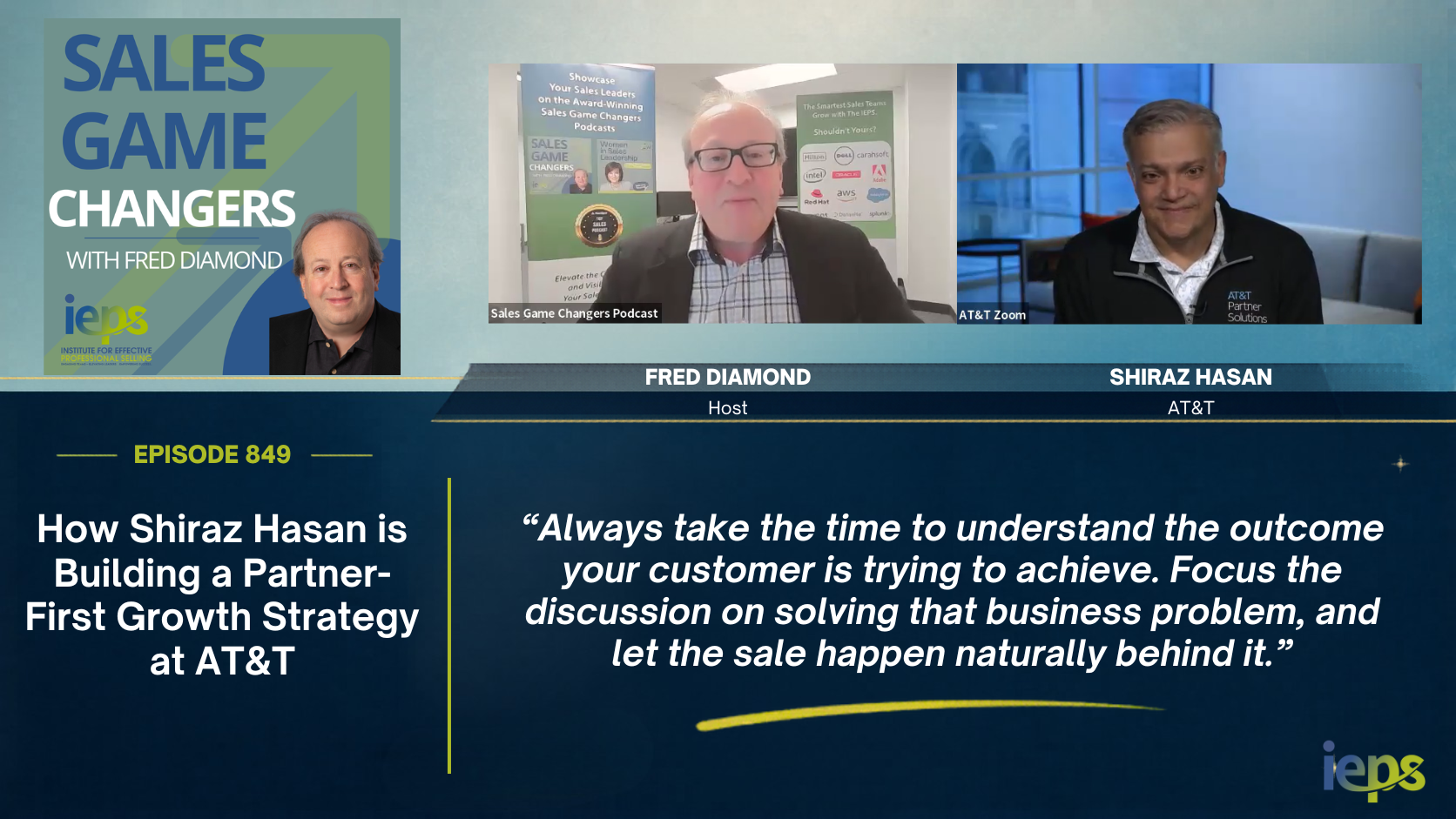
Today’s show featured an interview with Shiraz Hasan, Head of Channel Sales at AT&T.
Find Shiraz on LinkedIn.
SHIRAZ’ TIP: “Always take the time to understand the outcome your customer is trying to achieve. Focus the discussion on solving that business problem, and let the sale happen naturally behind it.”
THE PODCAST BEGINS HERE
Fred Diamond: I’m very excited. We’re doing a lot of shows now with those who are leading channels and alliances. AT&T, one of the greatest brands in the history of technology and communication, Shiraz Hasan, I’m excited. We’re doing today’s interview in May of 2026. I’m really excited to hear what AT&T is doing and how AT&T is transforming partner relationships, etc.
Shiraz, give us a brief introduction. Let us know who you are. We have some great questions lined up I’m excited to get to.
Shiraz Hasan: I run AT&T’s Alliance Channel. What that means is I have responsibility over the value-added reseller, the technology solutions distributor community, or the TSDs, and we have our SP channel. In layman’s term, if I’m responsible for AT&T’s distribution through third party, where we do the resell through medium, small, and large businesses, and we allow these partners to help us sell into each one of these different segments of the business.
I just hit two years in this program with AT&T. I actually started my career early on at AT&T, did about 14, 15 years, did a lot of work in the IoT space, then went out and did a couple of startup stints and worked in the UCaaS space and then came back about two years ago and excited to be here.
Fred Diamond: AT&T is such a broad brand, obviously one of the longest brands of all time. I use AT&T for my phone service, but give us a little more perspective on what are some of the AT&T products that are sold into the marketplace via the channel so that people understand who we’re talking to and what you do.
Shiraz Hasan: AT&T is a very large organization. We have our consumer segment, an online segment, and the AT&T business segment. We operate within the AT&T business segment and I run what we call indirect distribution for our business customers. The idea is to take our fiber and mobile products and services that we offer out to our customers, leveraging the vast presence our channel has and allow our partners to be able to solve customer problems, leveraging our mobile 5G, IoT, and fiber capabilities.
Fred Diamond: It’s an interesting time. We do a lot of shows with the OEM and the manufacturers and it’s a challenging time for the channel to show its value. We talk about that frequently. I’m excited to get some of your ideas on that. Partner-first, what does partner-first actually look like at AT&T today, day to day? Where are most partners succeeding and where do you think some of the partners are getting it wrong?
Shiraz Hasan: I’ll start with partner-first. It’s not just a slogo internally for us. It’s really become how we operate day to day. The idea really is to make sure that we make it simple and frictionless for our partners to be able to do business with us and be able to take our connectivity products and services out to the customers. We don’t have enough feet on the street from a direct sales perspective. We have a fantastic online presence, but we can’t get to all the customers that we want to get to through an omnichannel approach. We really, truly decided as a strategy for the company to really expand our distribution, especially in business, and leverage the partner ecosystem and allow the customers to operate with us in the manner that they want to leveraging the partner’s breadth and space.
The other thing that I’ll say is companies that get it wrong are the ones that try to fit the partners into a model that they already have and try to work around the friction. What we’re trying to really do over the last couple of years, and our results are showing it last year and this year especially, is we are creating an environment in which it becomes easier and easier, reduces the number of handoffs that the partners have to go through to solve the business problem that they’re looking for the end customers.
Partners have choices. They can work with many different carriers and vendors. Our goal is to make the process simple, easy, frictionless, and do we run into problems still? Yes, of course, but it is to me the best experience in the industry. They come and talk to us and they engage our channel teams into extending our mobile and fiber services out to our customers.
Fred Diamond: What is the average tenure for the partners? I’m presuming you’ve worked with for scores. You mentioned looking to bring in new. Give us the mix, if you will.
Shiraz Hasan: I think from an AT&T perspective, we have multiple different programs within the channel. We have a wholesale channel that a peer of mine runs. Within the retail channel, I have four or five different programs. We have the value-added reseller program, we have the TSD program and we have our SP program. The tenure in each one really is different. We have partners that have been with us for 10, 12, 15 years. We have some partners that have many employees within their organizations that are former AT&T folks, that know our systems, know our processes, and have a strong level of comfort with how to go get things done within our environment and they can help us navigate the partner environment, so it varies.
Since I’ve taken the program over, we also have added a lot of newer partners that have seen some of the friction that we’ve taken away from the system and joined the program. We have a good slew of new. What I tell all the partners that have joined the program is we don’t believe for a second that we know everything on how it needs to be done in a partner program. We have a pretty good idea it’s working extremely well, but we are very open to partners coming in, providing some input, and continue to formulate this program in a way that best fits for them. We leverage the experience we have with the partners. We’re also taking the learnings from the new folks that are coming in as well.
Fred Diamond: Things are changing everywhere. I like that there are former AT&T people in the channel who are willing to give you that feedback. They also understand the internal systems and how to get things done. How is AT&T partner solutions designed around how partners actually sell and scale today versus maybe how vendors wish that they would?
Shiraz Hasan: We have multiple options for our partners that are out there. We have a wholesale program. Partners that want to own the customer, rebrand our connectivity, and sell it under a different brand, we allow our partners to do that. I have a peer of mine, she runs that business. Then within the resell program, there’s partners that predominantly play in what I will call the hardware space, from a mobility perspective. They’re selling routers, monitors, printers, tablets, even non-stock handsets. They just want an easy, simple way to extend our mobile connectivity out into those devices. We have a value-added resell program that does that.
Then we have partners that are predominantly focused on fiber. They just want to be able to quote, price, and contract customers as quickly as possible in a very effective way. They want us to be able to provide that service fast. We work through them in a slightly different model under the TSD space.
What’s unique about our program and what a lot of the partners run is our overall converged strategy. We have a very strong fiber network and we are one of the leaders in the wireless 5G space. What we’ve been able to do is across all these different programs work with our partners and expand their distribution and their offerings by saying, working with AT&T. Not only you can offer a fiber solution, but you can also take those customers who you’ve sold fiber to and then go back and sell mobility. Same goes the other way around. If you’ve sold a lot of mobility, you can go back and sell fiber.
What is really great in multiple experiences that I’ve had with this channel is our channel partners do a phenomenal job of building a trusted relationship with these customers. Once they’ve bought something from them to sell that second, third, fourth product, it’s a lot easier for these partners. It’s upon us to continue to just enable them with the multiple products that we have in the portfolio and just allow them to take that to the market.
Fred Diamond: Probably the most uttered word in the history of the over 850 Sales Game Changers Podcast episodes is trust. It’s so critical right now. Customers are challenged with so many things. We are as vendors, of course, the channel, but customers are challenged with so many things with the end users and servicing them quickly as the customer gets access to more information. It was that they were getting more information over the last 15, 20 years because of the internet, and as we all know, over the last 18 some odd months, getting access from AI has definitely hastened that. It’s made us sharpen the game. It’s made the partners sharpen the game and those of us who are working with the partners. Where does the indirect channel give AT&T a competitive advantage that direct sales just isn’t able to cover?
Shiraz Hasan: I think it’s multiple aspects of it. First and foremost is reach. We just don’t have enough feet on the street to be able to reach all the customers that we want to go. That cuts across our enterprise space, our public sector space, and even when you get into medium and small business spaces.
The other thing is partners have this trusted relationship with the end customers. They have the ability to also bring in multiple aspects of the solutions that surround the connectivity aspect. They have UCaaS, CCaaS security, and a lot of life cycle management services that they are brilliant at performing for the end customers. If you’re a medium and small size business, and I’ll just use that as an example for a second, you really don’t want to worry about the speed at which the internet’s going to come in, or how many gigabytes or terabytes of data I’m going to use.
What you want to be able to say, “Hey, the business problem that I have, can this connectivity solution, encompassed with other products and services, allow me to run my business effectively and efficiently and worry free?” If we can answer those three questions with a yes, most medium and small businesses that don’t have typically a large IT staff or aren’t looking to employ a lot of folks to go manage this, prefer to do business with these partners because they not only provide that solution, they provide many services around it where the partner can go sell the solution to the customer and they can forget it. It just works month in and month out and it continues to allow them to run the business that they are in versus worrying about the connectivity.
Fred Diamond: You’ve mentioned the word frictionless a couple of times. I worked at Apple Computer in the beginning of my career in channel management. We had an expression, make it easy to do business with Apple. There were signs all over the warehouses and customer service centers. You mentioned how you’re trying to remove the friction. What are some of the biggest friction points? It’s interesting, a lot of people who are listening to the podcast, are looking for ways to get better, from the OEM, to the partner, to the customer. What are some of the biggest friction points that partners face today? How are you, Shiraz Hasan, and the partner organization at AT&T trying to remove them?
Shiraz Hasan: I would say we’ve done a couple of things. Number one is we have taken direct and indirect channel friction out of the equation across all segments. We’ve simplified our ROE, or rules of engagement model. When you’re a partner with the AT&T partner solutions organization, you no longer have to worry about where an entity may sit within inside of AT&T business. If you bring us business, if it’s net new to us and it’s incremental, there’s a simplified single rules of engagement across the board for you. That was the number one feedback I heard as I came onboard. I’ve got to give a lot of credit to my team. They provided really great feedback of if we want to truly scale, this is the one thing that we’ve got to do. We’ve taken that off the table.
The other thing that we’ve also done is internally, we’ve invested in tools and processes. we’re continuing to do that over the next couple of years. That is adding some velocity at which our partners can get price, quote, and when they get a customer nodding and saying, “Yes, I’m ready to move forward,” a contract out to that end customer. If you’re a partner listening, those are the things you expect from your partners or supplier. Those are the things where we have made a lot of investment in removing the friction by simplifying the ROE, improving your experience.
Do we believe we still have some work to do on the experience side? Absolutely. But I would tell you what I tell the founders and the entrepreneurs that are in this world that I love working with, is don’t judge us on how things have been historically. Judge the managers on how they are today and are they better than where they have been. I would say any partner, Fred, that you talk to of ours, they will tell you they were better 12 months ago than 24 months ago, and they are much better now than they were 12 months. It’s a commitment of AT&T’s continued investment and there isn’t an entity within AT&T business or into AT&T that isn’t committed to this cause to make sure that we get our distribution right.
Fred Diamond: I’m glad to hear that. How long has AT&T been in business? It’s got to be 150 years.
Shiraz Hasan: We just celebrated the 150-year anniversary of the first phone call. I don’t know if you saw that or not, but absolutely, it’s been a very long time.
Fred Diamond: It’s amazing because customers are changing and business is changing. Like you said, a year ago or two years ago, it became apparent that if a customer calls in, we need to get them to where they need to get to. As compared to, I’ve seen so many companies fail at this, where they tell their customer, “You’re calling the wrong place,” or, “You need to deal with this,” which doesn’t make sense with their business. I applaud you for the awareness to make changes like that.
Let’s talk a little bit about flexibility models. Your team has mentioned like reseller and co-sale. How does it translate into growth for partners? A pre-question is, do most of your partners want to grow? Is that something that they’re coming to you with? “Shiraz Hasan, here’s my goal. We want to grow, either into this market or new revenue.” Is that a common thread that you hear with resellers?
Shiraz Hasan: Absolutely. I think partners absolutely want to grow. What we consistently hear is they want to grow and they want to grow profitably for the business. They’re willing to make investments into their respective companies. What they’re asking us is for stability and simplification of ROE. We’ve done that. They’ve given us tremendous amount of feedback on how do we make it simpler and easier from a systems and a tools perspective for them to do business with us. There isn’t a single partner that we sit down, whether we do QBRs or the ones that are on advisory councils with us, when they come in and advise. They’re consistently talking to us about the investments they’re making and their growth path.
One of the things that we’ve done is we’ve also aligned our, for example, the organization that I run, is the channel manager goals. If you’re supporting a partner, your success is dependent upon the success of that same partner. We’ve aligned channel management team roles and responsibilities and their success metrics to the partners that they’re supporting. We’re in the boat with you, we make money when you make money as a team and as an organization. We want to make sure that every piece of business that’s coming in is coming in profitably and is coming in the right way. Most of our partners are raising their hands and going, “Sign me up, I’m all in.”
We’ve made this an extremely collaborative experience because I truly believe, if our partners are successful and they’re able to grow in a profitable manner, it’ll automatically grow our business. With the distribution conversation I just had, it’ll grow the overall AT&T business the right way if we’re able to do that.
Fred Diamond: As you’re saying that, I’m reminded, unfortunately, of how frequently not everybody realizes that, that it needs to be win-win and bringing value to the customer. I’m going to give you an opportunity to get specific. How should partners be thinking about leveraging AT&T’s leadership in fiber and 5G to drive revenue in areas like AI, IoT, and the edge? Give some specific examples here of that’s a value-added opportunity. Give us the pitch on that.
Shiraz Hasan: I think if you’re a partner listening to this and you’re thinking about partnering with someone in the communication space, we are very uniquely positioned with one of the largest fiber footprints and we have publicly stated that we are also making huge investments into expanding that fiber infrastructure. Then you couple that with the investment we’re making in 5G, some of the acquisitions that we’ve recently made that give us the spectrum and the capacity to continue to enhance our mobile capabilities. If you’re looking at where the growth in this industry is going to come from, it is really going to come from taking advantage of the high bandwidth, high speed circuits that are going to empower all the data that’s going to get generated through the investments that are going on in AI, Fred.
We are working with very large customers, including hyperscalers, where they need bigger and bigger pipes. Our partners can help us deliver those pipes as well to the end customers. Our partners are also selling IoT 5G solutions for us, whether it’s in the sensor data, whether it’s for fixed wireless solutions, and they can take advantage of the investment we’ve made in fiber and mobility to formulate customer solutions for the end customers and solve the problem.
As AI becomes more and more prevalent, when you’re looking at working with partners that are in the data center space or are really looking to innovate with AI, you can work with those customers and go leverage AT&T’s fiber capabilities to help them transmit that data in a reliable, secure way from one data center to the other, or to the edge where they really need the compute power at times.
Fred Diamond: This is the Sales Game Changers Podcast and we’re doing today’s interview in May of 2026. What is your advice for alliance managers, for channel partner managers? How can they be as valuable and successful as they can be today? If you had someone who’s on your team or someone who’s thinking about joining AT&T, what would be your advice for them to optimize their career opportunities right now?
Shiraz Hasan: I would say two things. Number one, look to make sure that this is the best place for you. Take the time to understand our channel program that we have, bring the relationships that you have with the entities in the ecosystem with you. There are many different ways we go to market within AT&T business, whether it’s direct or in the indirect space. Find what you are passionate about. I’m a strong believer in if you wake up in the morning and you’re excited and happy about what you do, you are automatically a few percentages more productive and helpful.
If you truly want to help medium, small, large businesses grow along with the company that you work for, channel is the best place for you to be in, because we partner with companies across that spectrum and help them grow. If you like working in a collaborative manner and helping solve business problems, be in the channel sales program. If you like building programs, we have a great channel marketing team as well. We can add you to there as well. If you’re a partner listening to this and are looking to join a partner ecosystem that is growing at double digit growth rates, and you want to get on the AI, 5G, IoT, and the fiber growth that we’re on, come and join us.
Fred Diamond: If a channel CEO came to you and said, “Shiraz, what could we be doing better?” You mentioned opportunities business-wise, but from a sales perspective, from a business development perspective, what would be your advice to a standard typical AT&T partner who said, “What should I be doing better, Shiraz, to be more successful?”
Shiraz Hasan: I think one of the things that I would say is, first and foremost, listen. Take a step back and listen to your partner community. Don’t try and impose a one-size-fit-all policy. I think you’ve got to have some flexibility in the type of programs you have. Work with the partners in the way that they want to go to market, and most importantly, keep the end customer in mind. What is the industry, what is the segment that that’s a sweet spot in for, and design your program with some flexibility around that. If you get those two or three things right and then create a model that’s frictionless like we talked about earlier, Fred, I think those are the recipes for a beautiful, beautiful program, from my perspective.
Fred Diamond: Shiraz Hasan, congratulations on your success. A lot of great things are happening at AT&T. Appreciate all the insights. For people listening to the show or reading the transcript right now, give us one specific action that the selling professionals listening should take right now at this moment after having just listened to the show to get more success.
Shiraz Hasan: Having been in sales for about 20 years now and having done direct sales, indirect sales, technology sales, I would say for anyone that goes into sales, and I say this to one of my kids who is starting college now and is looking to get into business development, had his first door-to-door sales job this past summer, and he did great, is always take the time to understand the outcome your customer is driving to do. Focus the discussion on solving that business problem and let the sale happen naturally behind it and you’ll always be successful in sales.
Fred Diamond: Great advice. Once again, Shiraz Hasan with AT&T, thank you so much for being on today’s Sales Game Changers Podcast. My name is Fred Diamond.
Transcribed by Mariana Badillo