
Watch the video of this podcast on YouTube here.
The Sales Game Changers Podcast was recognized by YesWare as the top sales podcast. Read the announcement here.
FeedSpot named the Sales Game Changers Podcast at a top 20 Sales Podcast and top 8 Sales Leadership Podcast!
Subscribe to the Sales Game Changers Podcast now on Apple Podcasts!
Purchase Fred Diamond’s best-sellers Love, Hope, Lyme: What Family Members, Partners, and Friends Who Love a Chronic Lyme Survivor Need to Know and Insights for Sales Game Changers now!
Today’s show featured an interview with Dr. Steve Gladis, Executive Coach, Author, and Professor at George Mason University.
Find Steve on LinkedIn.
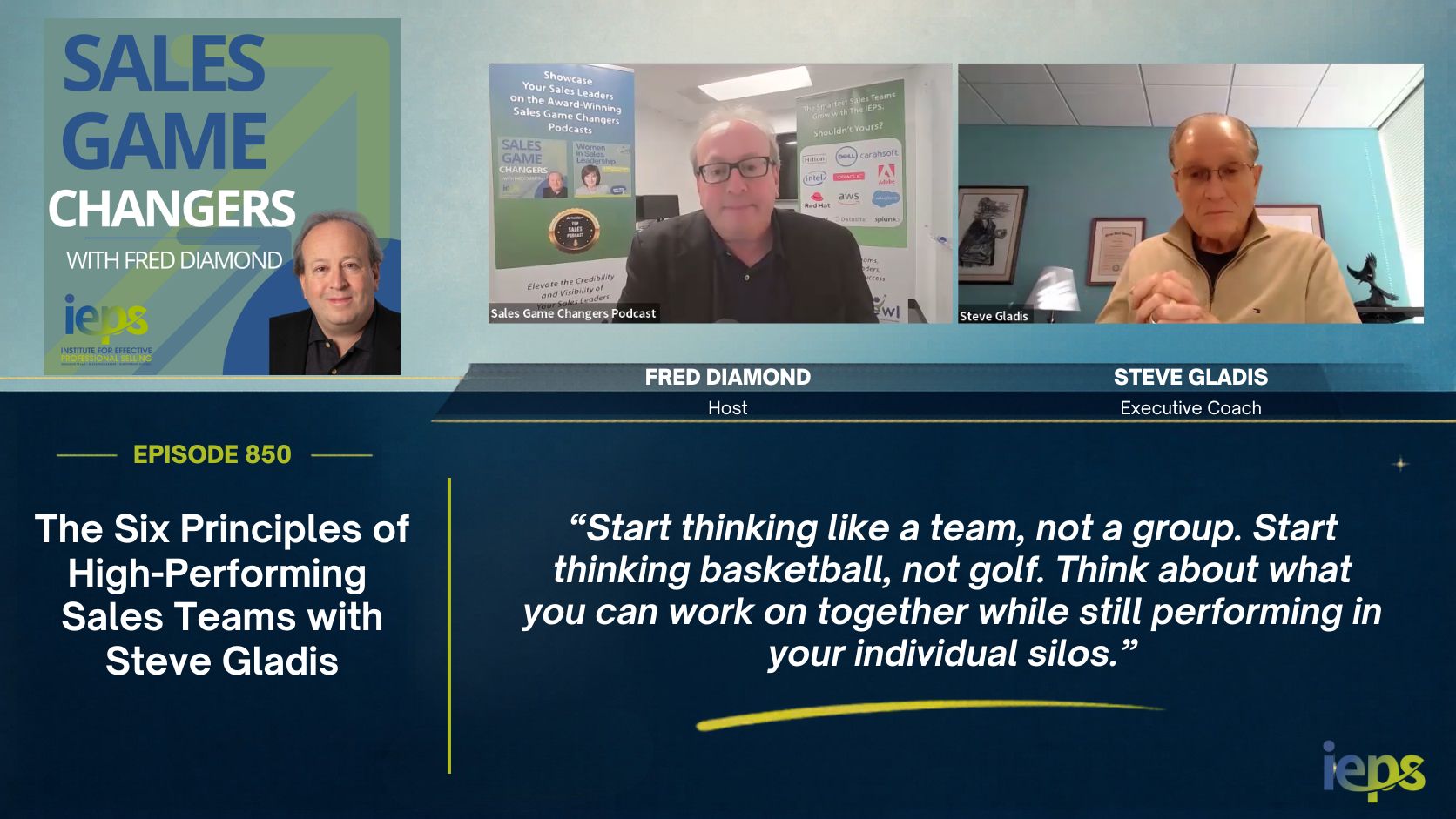
STEVE’S TIP: “Start thinking like a team, not a group. Start thinking basketball, not golf. Think about what you can work on together while still performing in your individual silos.”
THE PODCAST BEGINS HERE
Fred Diamond: Dr. Steve Gladis, it’s great to see you here. I’ve known you for a while and I’m excited. This is the first time we’re going to have you on the Sales Game Changers Podcast. We’re going to be talking about the six principles of leadership, which can apply to leadership in almost any business setting. We’re going to tie them specifically to sales leadership, because the IEPS, our whole mission is to help sales leaders engage their teams and customers, elevate their leaders to new heights, and empower their success to generate more revenue to be more effective.
Give us a brief introduction to yourself and we’re going to be hitting the six principles. Tell us who you are and why you’re here and I’m excited to go through the six principles.
Steve Gladis: I teach at George Mason, have for a number of years. Before that I was at the University of Virginia and before that was with the FBI. I have an interesting, different background, but I’ve been an academic all my life and I’m a writer. I’ve written a number of books on leadership, about 25 actually. Now I’m into writing novels, which is fun, about my FBI career. A lot of fun.
This particular book we’re going to talk about today is called Leading Teams. It’s really about what it takes for teams to survive and it’s not what everybody thinks. Everybody thinks, we all have to get along. We all have to love each other, do off-sites, and all that stuff. While that helps, it isn’t really what makes teams work, and we know this by research done at Harvard. That’s what I’m about. This particular interview hopefully is about that and how you can apply it to your sales team.
Fred Diamond: We’re doing today’s interview in May of 2026. The last 18 months have been a real challenging time. Sales is always a challenge, of course, but the last 18 some odd months, maybe two years. A lot of the people who listen to today’s show, they’re in B2B, a lot of them are in B2G, business to government, sales. The government has seen a reduction in force. DOGE has come in and in theory, made government more efficient. Steve, at the same time, the government budget has grown for IT and it’s close to 138 billion. There’s still tons of opportunities for companies that are doing things right. They need to shift, leaders need to be more effective, and we’re going to be talking about that today.
I know they’re broken down into two sets of three. There are the essential conditions and then the enabling conditions. Let’s just start at the top with number one and we’ll go through the list.
Steve Gladis: The first is, do you have a real team? Most teams are teams in name only. They call themselves the sales team. They call themselves the executive team. But most of the times they’re like golf teams. They report up to the same person, but they’re not like basketball teams, which integrate with each other and work with each other, what I do affects you kind of thing. That’s really the first question. You’d be surprised how few teams are really teams. Are they interdependent? Do they work together? Does my work affect your work? Is it a stable team?
Unstable teams are not effective at all because people keep coming and going. They don’t know the history. They don’t know the culture. It’s very disruptive to the team. In fact, the history of basketball teams, the ones that stay together the longest win the most championships. Look at the Chicago Bulls and other teams like that. They’re a team that stuck together. That’s really the first one of the essential conditions, is to have a real team. Is your sales team a team? Probably not. I’m guessing most sales teams, I have been involved in sales teams, most sales teams are not. They are individual performers who want to get their bonuses and they’re going to keep their customers and clients to themselves, they’re not going to share them. Those teams don’t do as well as a team, as an entity, as the ones that actually work together and say, “Hey, cover my lead. I’m going on vacation. You take the commission.” It really is a very different game for most people.
Fred Diamond: Let’s talk about the definition. Let’s say we have a leader who manages the district team for a particular product at the company that they work for. Usually in those situations, they use the team pretty frequently. They all report up maybe to a district sales manager or a regional VP or something, but they all have their own quotas, their own territories, their own accounts that they’re responsible for. Maybe they have some people who work with them, someone in marketing, maybe somebody in engineering, maybe somebody in contracts. But to make sure I’m clear here, what you’re saying is if the guy has five accounts and another person on the team has five accounts, and another person has five, by definition, you’re saying they’re not really a team which will lead to success.
Steve Gladis: Yeah, I would say they’re not. Unless they begin to work together and share leads and do additive work together, they’re really not a team. You might as well just have five different companies. That isn’t to say that they can’t have their own teams. If you’re in tech sales, you need to have a tech guy and engineer with you, yet you don’t want them talking themselves to the client. You want them as a technical backup, maybe working with you, but typically you want the sales guy talking in English so that the customer can understand. I know, I’ve done this before, and believe me, I love my tech guys, but sometimes they talk at a level that people can’t understand.
That could be a team in itself, but the team above it, all those sales guys and sales managers, they should be working toward a common goal that allows for cross-functional stuff, a lot of interdependence. The more interdependence you have with teams, the more likely they are to hold together. I know it’s difficult because a lot of sales guys want to be, “Hey, I made my quota. I don’t care about your quota.” There is a company that you’re working for whose quota really matters, and that’s the essential role that I think companies should acquiesce to, if you would call it.
Fred Diamond: I think we should go through all six and then we’ll come back and then I’ll have some clarifying questions, because I’m thinking like, so the guy or woman who leads that team that we’re talking about, he or she has a quota that they want to achieve. In theory, the entire, quote/unquote, group, I wonder if I should even use the word team or just say group.
Steve Gladis: Most of them are groups, yeah, they really are groups, gatherings, gaggles, if you will, but they’re not teams.
Fred Diamond: Let’s go through the list here and we’ll come back and see if we can put it together.
Steve Gladis: Do you have the right people? Is there diversity in your group? If you look around and they’re all men, you’ve got a team that’s a problem. If it becomes a team and not just a group, you’ve got a team that’s not going to win. Some research talks about 50% women is probably where you want to be if you want a team that actually works well together. Do they have the skills that you need? Are they trained? You keep training them on new skills. If your sales teams aren’t using AI, I won’t call them stupid, but they’re behind the curve. They’re going to lose. It’s skillfully using AI. There’s AI and there’s AI. It’s this idea of the right people?
The third one is, do you have a compelling purpose? Does the team have what we would consider a compelling purpose? I had a guy in here yesterday, I said, “What’s your future goal?”
He says, “$10 million.”
I said, “Do you think that’s going to really excite people that’s the goal? That excites you because you want the money, but that’s not vision. Your vision is to be the leader in your area, to break new ground, to excite people, and things like that.” That’s what people get excited about, is this idea of a sense of purpose and challenge of what you’re doing for the industry, not $10 million. A number never gets people excited.
Then the three enabling conditions are, is there a sound structure? Is your team designed around a team goal? Do you have the right team size? If you have a team of more than nine people, it no longer is a team. It’s what we used to call a hootenanny, a bunch of people getting together and having a good time, or not. Then is there a sense of team norms in terms of this team structure? What are our norms? What do we hire and fire over? What are the things we expect of people in our teams?
The fifth one is support, that people have the reward. This is really important for sales teams. Do they have the rewards that they need? Most sales teams, as you know, people are rewarded based on their quotas. What we would suggest is that you can certainly reward people, but you should reward the team. It should be a team component that says, “Hey, as a team, we made the goal,” so that there’s more likelihood that people will work together toward that common goal of the manager, of the company.
The last thing is, does the team have, and also do we have information that we need? Do we have the education, stuff like that, and the resources that we need? I was working with one group that didn’t have nearly any amount of resources they need to be successful, until they had that. When they finally got that, they succeeded, but it was because they were so under-sourced, so to speak.
The last one is team coaching, and that is, do you have somebody who’s actually getting the team together periodically to work on the team, not in the team? That’s a real important deal. A lot of people, like in marriage, they work in the marriage and they do the day-to-day stuff, but they don’t really work on the marriage. They don’t really go out for dinner. They don’t sit down and talk. They don’t go on vacations by themselves. That’s what we mean by working on the team.
We work with teams usually on a monthly basis for a year, really, to get them working together and talking about, “Hey, what are some of the things that we’re doing right? What are some of the things we need to change? How do we need to change with this new AI stuff? We’ve got a lot of employees that are upset about being laid off. What are we going to do? How are we going to present that?” Those are the kinds of things we talk about on a monthly basis and we’ve problem solved with them.
The teams that work together like that over time with an outside coach, it doesn’t even have to be an outside coach, you can use an interior coach, but bigger teams, more sophisticated teams really need an outside coach to help them work through some of the issues. Those are the six issues.
Fred Diamond: At the Institute for Effective Professional Selling, we have a couple of programs. We have our Women in Sales Leadership Forum, which basically works for women in sales leaders, typically director and above, from companies such as Oracle, Microsoft, Adobe, Carahsoft, etc. We have a program that we’re very excited about, which is called Emerging Sales Leader Program. Those are typically men and women who are entering management or leadership for the first time. A lot of times, Steve, those people are good individual performers who get promoted. You’re our top sales guy. Here’s what we’re going to do. We’re going to put you inside leading a team. We don’t always find that that’s the right fit. That’s a classic conundrum of organizational growth.
Give us some of your advice for companies that are bringing new people into sales leadership for the first time. Maybe they’re managing the inside sales group or a bunch of SDRs or a small territory. We’ve always found that those people are left on their own. Especially over the last couple years, there’s been a lot more of, “Okay, Bill, you’re promoted,” or, “Sue, here’s your salary increase,” here’s whatever it might be. What would be your advice for companies to ensure that those people are successful?
Steve Gladis: The old conundrum is the car salesman. You promote the best salesman to manager, you lose your best salesman and you get a lousy manager. That’s the old joke, and it’s true. What I would suggest, especially depending on the size of the company, if you’re going to promote somebody where millions of dollars are at stake, or hundreds of thousands, I would invest in some form of coaching.
One of my former clients, and now coming back to me, is starting to do something we told them 10 years ago to do, which is to develop a leadership development organization so that you get to promote people from potentials to managers to vice presidents, create a process by which people can learn what it is to be a manager. I am pushing this book because I think it’s that good. There’s a book called The Four Elements of a Great Team Leader, which if you took that book today and had somebody internal who knew something about training, you could convert that into a leadership process. It’s based on a ton of research. It’s easy to understand. Those are the kinds of things that I would do. I would just adopt the book at a minimum. But if you can’t afford to get a coach and if you can’t afford that, develop a training organization within your own organization to sustain itself, also to move it through a process of leadership development. If you’re not investing in leadership development, you’re not going to get leaders. You’re going to have a lot of failures.
Fred Diamond: Let’s go back to that example you just used, where the top sales rep is now promoted to manager. I don’t know what the percentage is, but it’s got to be relatively high, where the sales rep gets into that role and they’re happy about it, but then they realize they’re making less money, they’re working harder. Now they have the headaches of eight people on their team as compared to just their own. Can those people be saved? Can people who find themselves, “You know what? This isn’t really what I wanted.” Can a company make them successful? Or what have you found? Is it best just to push them back to become an IC, individual contributor, or can those people be developed into great managers?
Steve Gladis: I think anybody can be. I don’t think great managers are born. They don’t come out of the womb and say, “I’m going to be the Batman of the world.” That never happens. Everything is a learned behavior. It just depends on whether, A, the person wants to learn it, and B, the company’s willing to help them sustain that. What happens is small companies don’t invest in things like that until there’s a real problem. You see 25 million, I’m just giving you numbers, 25 million or so, they really get stuck getting serious about this. Then 50 million, they really are serious about it, because they realize that they’re starting to lose people to other companies. Then it becomes a competitive advantage.
You want to build a culture that people stay with. People stay with cultures if they trust you. In terms of trust, there’s three elements of trust. Does the company have character to it? Does it do what it says it’s going to do? Is the company made of competence? The people in the company, the leaders, are they competent? Thirdly, and most importantly, is caring. Does this company care enough about me to train me to invest in me? If you have those three things, character, as a company, competence and caring, you’ll keep people a long time.
Turnover is the most expensive thing you can have. I’d rather work with somebody to keep them who’s been successful in the culture rather than get the money. If they want to revert back to it, and some do, they want to go back to selling because this isn’t what I really wanted to do. When I started a company, I didn’t want to start a company that had 1,000 people in it. I just wanted a small company that I could do the things I like to do. That’s a real decision you have to make.
Fred Diamond: I have a question about the original thing you said. The two sets, the first is essential. The number one thing is, is it really a team? Let’s go back to the example I used before, where someone in a large company manages eight people. All the eight people have their individual responsibilities, their accounts, their quotas. Of course, it rolls up to me as the leader of the team. But in reality, they’re not really a team. They’re eight people who have quotas that they need to achieve. But I still need them to perform.
Even though it’s not really a team, does that really matter in this case? Is that, “Okay, you know what? We really don’t have a team. I just need to make sure that eight of the individuals perform as well as they could.” Or is there value in me trying to do things to make them a team, although they’re not responsible for each other’s quotas and they don’t back cover. Maybe they talk to each other, maybe some of the older ones mentor, I’ll let you take that question.
Steve Gladis: No, I think it’s the latter. I think if you really wanted to be a team, you’re always going to get X percentage out of treating it like a group, where you have four individual sales teams of five teams like that. You’re always going to get a certain level of performance, but you’re not going to get winning team performance. You just won’t. Even an executive team where marketing and sales and CMO and so forth, when they don’t work on common threaded things like talent development or budget performance, when they don’t work on things that cross each other, and they don’t knit together with a common set of goals, they don’t work as well and you turn people over. When people start to work together and talk about, “Okay, sure, you can have individual responsibilities, but there’s also team responsibilities.” I might be a father, but I also am a businessman, I’m this and that. We’re not just one thing. I think that’s where teams make mistakes, especially sales teams.
I come from a family of sales. I know how to sell, I’ve taught sales, my family was in sales. I know what that’s like to covet your leads and build clients up and take care of your team, and this is my team. What you don’t want is internal competitiveness. You want external competitive and internal collaboration, whatever you have to do. We help teams set up goals, objectives, norms. We actually have strategies for each team. We know the corporate strategy, but we have a strategy for, how is this team going to work? That’s an important distinction, I think.
Fred Diamond: We have a lot of new sales leaders, sales managers. They’ve been promoted and it’s tough. Like I said before, a lot of times they’re tapped on the shoulder and the company may invest in some things, but there’s not a whole lot of classes for sales managers. Some great books, there is some great curriculum, but a lot of times companies won’t invest, but they will send people to the Institute for Effective Professional Selling to participate in our programs.
If you had to recommend two things to the sales leader, the new sales leader, tell me the two things that you would recommend to them to get them on a path of much larger career success. Again, just promoted, you’re now managing six people. As a matter of fact, my daughter was just promoted. She works at Hershey’s and she was an individual contributor, had a territory, and she was just promoted to manage six people in a brand-new territory. What would you tell her? Sales leader, sales manager, her name is Abby, what are the two things that you would tell her to focus on to ensure she’s on a path of success?
Steve Gladis: I would say number one, find a mentor. Find somebody that really cares about you as a person and talk to them, have somebody to talk to, because you’re going to run up against all kinds of things. Have somebody you can turn to and say, “Hey, this guy’s doing this. Got any thoughts on that? You’ve been through this?” “Yeah, I’ve been through this 20 times. Here’s what I’ve done.” Maybe it won’t work for you, because not everybody can do the same thing. First of all, I’d say try to find a mentor.
The second thing, honest to God, and this is so self-serving I almost hate to say it, read that book, The Four Elements of a Great Team Leader. It is 60 pages long, it’s got a 10-page summary in the beginning, and it is the result of 25 years of research on teams. I’m telling you, it’s worth her looking at. She will get it immediately. If she has questions about it, I’m always open to a phone call.
Fred Diamond: Once again, we spoke to Dr. Steve Gladis today. Steve, it’s great to have you on the Sales Game Changers Podcast. You’ve given us so many great ideas that people need to take advantage of to be successful as a sales leader, and it’s the most challenging time. Like I said, we’ve gone through so much in the last 18 months, but you still need to perform, and you still need to lead teams, and you still need to serve your customer. The most effective way you can serve your customer, I agree with what you’re saying, is to build strong teams so that you’re addressing what they need to achieve, and you’re thinking about all the elements that are part of their equation there.
Give us one specific action step. You just gave us two for my daughter, Abby, but one more for sales leaders out there that you recommend they do right now. Mentor was great, read the book, The Four Elements of a Great Team Leader, give us one final thing to leave us off here.
Steve Gladis: I would say start thinking like a team, not a group. Start thinking about if we were a basketball team, start thinking basketball, not golf. People love golf, I’m not trying to piss off the golfers here, but I’m not talking about adding up low scores and we win or whatever. I’m talking about start thinking like a basketball team. That’s the analogy I use all the time. It really works. If you think about, what are the things you can work on together while still performing in your individual silos? That would be my hope.
Fred Diamond: I like that. Shifting the mentality of actually being part of a team. As you were talking before about the Bulls, I’m visualizing how those team together in the various roles. On most of those teams, you have two or three world-class leaders and then you have other people who do other things, who get rebounds, who focus on defense or whatever it might be.
Once again, Dr. Steve Gladis, I’m glad we finally had you on today’s Sales Game Changers Podcast. My name is Fred Diamond.
Transcribed by Mariana Badillo