
This is an Office Hours: Sales Professors Unplugged sub-brand of the Sales Game Changers Podcast.
Watch the video of this podcast on YouTube here.
The Sales Game Changers Podcast was recognized by YesWare as the top sales podcast. Read the announcement here.
FeedSpot named the Sales Game Changers Podcast at a top 20 Sales Podcast and top 8 Sales Leadership Podcast!
Subscribe to the Sales Game Changers Podcast now on Apple Podcasts!
Purchase Fred Diamond’s best-sellers Love, Hope, Lyme: What Family Members, Partners, and Friends Who Love a Chronic Lyme Survivor Need to Know and Insights for Sales Game Changers now!
Find Brian on LinkedIn.
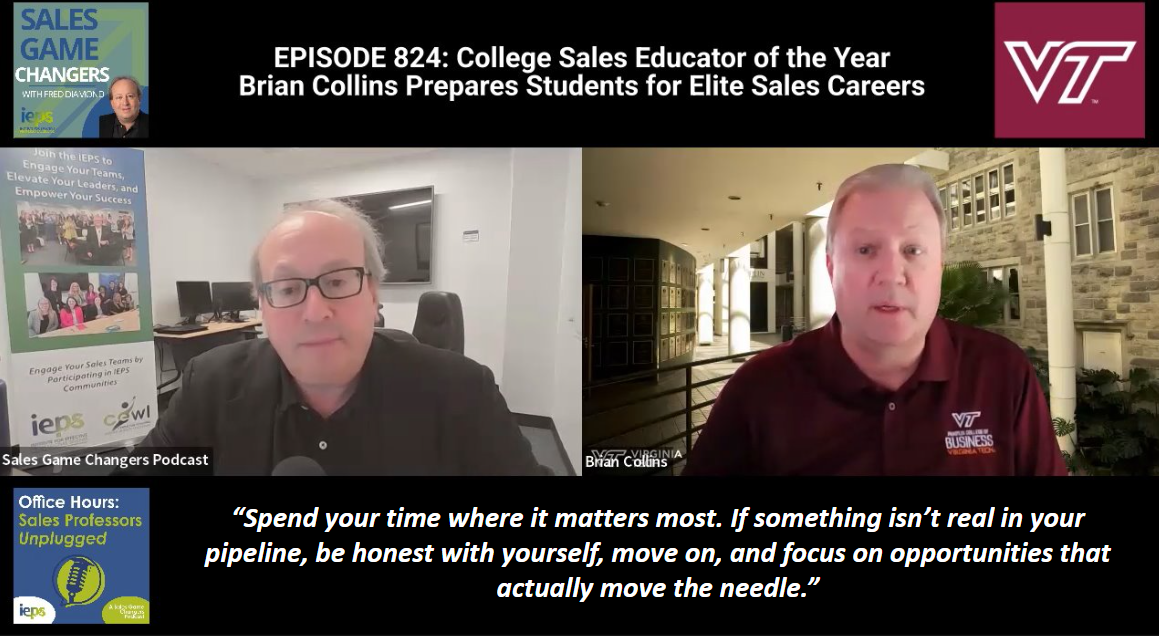
BRIAN’S TIP: “Spend your time where it matters most. If something isn’t real in your pipeline, be honest with yourself, move on, and focus on opportunities that actually move the needle.”
THE PODCAST BEGINS HERE
Fred Diamond: I’m very excited. We have Brian Collins, Office Hours – Sales Professors Unplugged. Brian, even more excited, you are the 2026 Institute for Effective Professional Selling College Sales Educator of the Year. That is going to be presented to you on April 29th. It’s going to be at the 16th annual IEPS Sales Excellence Awards. Just as a quick notification, we also give out an award at that event called the Jay Nussbaum Rising Sales Star Award. We’re excited, one of your former students, Kevin Riley, is going to be the recipient of that. It’s a great day of celebrating Virginia Tech, you, the program that you’ve developed. How do you feel about being the first College Sales Educator of the Year recipient from the IEPS?
Brian Collins: Great question. Very humbling. I know when we first met and we were talking about that, to be considered for something like that or for such a prestigious award with all the sales professors that are around the country, and people that I know, and mentors that I’ve had, and people that I’ve worked with, really, really humbling and very thankful that you considered me for that.
Fred Diamond: We’ve gotten to know a lot of the professors who are running programs associated with the University Sales Center Alliance. I know you’ve been very involved in that organization and some of the committees. This is the first year we’re giving out that award. It just made sense because at the IEPS, we’re spending a lot of time with universities that have these programs, like we’re going to be talking about, to prepare young adults, your students for careers in professional selling, and at great companies, B2B, some cases B2G, business to government. Some cases, I guess it might be more corporate B2C, if you will, but there’s just a lot of synergy with what we do with the IEPS and the work that you’re doing to prepare these young adults for great jobs.
I know one of the ways we got originally attracted to you, or got to know you, was one of our corporate partners, Cvent, Darrell Gehrt at Cvent has been a big supporter of yours. I believe he was your board of directors’ president at one point. He had been talking for years about the great work that you’ve been doing at Virginia Tech.
I’m the author of Insights for Sales Game Changers. We frequently do programs with sales organizations, not just new sales professionals, but at Cvent, we would talk to a lot of the young sales professionals. I would sign my book and I would say, “Where’d you go to school?”
“I went to Virginia Tech. My name is Bill.”
“Thanks, Bill. Hi, what’s your name? Where’d you go to school?”
“I’m Mary. I went to Virginia Tech.”
“Okay. Hi, Mary,” blah, blah, I sign the book. “Hey, what’s your name?”
“My name is Jared. I went to Virginia Tech,” and Virginia Tech, Virginia Tech, and not just Cvent, but so many companies in the Northern Virginia and the D.C. business community.
Tell us a little more about yourself. Give us some insights into your journey to Virginia Tech. Like I mentioned, you’re also the director of the Sales Center at Virginia Tech. Tell us what that entails.
Brian Collins: To start, I am a Hokie. I graduated from Virginia Tech years ago with a BS in finance and a minor in English and an MBA in finance. I’m definitely a Hokie born and bred, was 23 years or so in the real world, mergers and acquisitions, sales, national sales, all of those types of things, and had an opportunity to come back to Virginia Tech to take over the program. I was on a couple of different boards at that time, president of a couple of different boards, and they called me and said, “Hey, we need somebody to help us with the program. Can you take it over? The professor that was here, unfortunately, had to exit.”
I thought that was going to be a one-year thing, and that was 11 years ago. Time flies. I literally thought it was going to be one thing I would just come and help out for the year and go back into industry, and I loved it. It’s something that going through and understanding where the kids are learning, how they’re learning, how they can use that to better themselves, to get good jobs, to do all those things, my priorities changed. My priorities really changed from going out and grabbing that next deal to coming back and giving back to my university and giving back to the students that are here.
As director of the sales program, I’m responsible for running all the curriculum to responsible for doing everything with our sponsors. You mentioned Cvent. They’ve been with us, one of the few that have been with us through the beginning. There are a couple others out there, PepsiCo, memoryBlue, just to name a few that have been around since we started, and helped us build this program. It’s not just me. We get a lot of feedback from our sponsors. They keep us up to date. They tell us, “Hey, we’re seeing this in the industry, maybe you should make some changes to your curriculum or think about it.” We all discuss it and we all look at it. If it’s a good thing, then we go do it.
The director part was more about building the program, building out the sponsors, taking care of everything. In the last 11 years we’ve done that. Now we’re growing to do more things and coming into the future.
Fred Diamond: You very kindly had me come down a couple of times to do some book signings. It was great to see blue chip companies, Home Depot, PepsiCo, Cvent, CoStar. It’s a great list of companies that you’ve forged relationships with, and these are big companies. These are global brands, obviously. It was great to see the interaction when I’d been down there a couple of times at the career fair with the young adults who were looking to grow.
Actually, one of the cool things too is a number of your students come from this area. I’m based in Northern Virginia, right outside of D.C., and it was fun. Some of the students came up to me and said, “My dad is a member of the IEPS, or has come to your events, Fred, over the years.” We’re more corporate-focused right now, and a couple of them I’ve linked into. It’s nice whenever I’ll post, I’ll see one of your students comment or like. It’s the ties between what you’ve done in the business community. You’re amazing.
You mentioned curriculum. Give us a little more insight into your curriculum. Maybe some of the classes you offer. Do you offer a major or a minor or certificate? Tell us about that.
Brian Collins: That’s a great question, because a lot of the sales programs are very different across the country. We started as a minor and have been a minor for the last 10 and a half years. That also entails concentrations as well. Classes that you take are beginning sales, principles of selling, is what we call it, where you just start learning about B2B sales. Then we have the more senior level, which is usually what I teach, strategic sales force management, which is how you manage your sales folks.
Then advanced professional sales, which is, for those people that are sales out there, a lot of us are listening to this, it’s basically a role play class. We take them through real live role plays that are from our sponsors, things that have happened or things that are happening, and they go through and they compete. Both of my classes are competitive classes. They’re competing for micro scholarships in amounts of 1,500, 1,000, and 750. It’s actually just like the real world, we try to incent them on doing well and doing better.
Very excited to say that we were just approved to be a major. As of 2026 in the fall, Virginia Tech will have a professional sales major, one of probably less than 10 universities that I know of across the country that have a full major under marketing and professional sales to go forward. You’ll still be able to get the minor if you’re outside of the school of business, but hopefully those people in the school of business will now either double major, or if they’re in marketing, choose the professional sales as their focus.
Fred Diamond: That is great. I’ve gotten to know a lot of the universities at the University Sales Center Alliance. One of my little favorite things to do is when I talk to someone new about this, I’ll say, “How many universities in North America do you think have a sales major, minor, or certificate?” The number is probably 70 that have something like that. It’s great to see Virginia Tech coming out with the major in September of 2026.
I’m just curious. You mentioned they came after you about 11 years ago and said, “Brian, we want to help you create this program.” Give a little bit of insight into how your program fits in with the rest of the university. Obviously, you’re inside the Pamplin School, so how does it fit in there? Then how does it fit in overall? Do people know that there’s an official sales program, professional selling program? Give us some insights into that.
Brian Collins: Do they know is a great question. Actually, one of the things that we require our students to do is to go tell people. It’s actually one of the things that we, in my strategic sales force class, they have something called spread the word. They are required to call up professors that are at Virginia Tech and get time on their schedule, go into their class, and present on the professional sales program. The way we run this is any major can declare a minor. From that perspective, we have a number of different disciplines that come in. That allows us to go tell that story in a lot of different places.
Working into Pamplin, Pamplin has been a great place to try to be innovative. They’ve allowed us to take that lead. Both previous Dean Sumichrast and our current Dean Sarker, have both allowed us to be that cutting edge part of the school and try things out. You were asking a little bit about the curriculum. One of the things we also do is everybody that goes through our program, every student, comes out with at least 10 certifications. Those are certifications in things like HubSpot, SmartBox, Salesforce.com, Clay, AI. Lots of different things that we do on that side that Virginia Tech is now saying, “Hey, that was pretty cool. We should do that too.” We’ve done internships, things like that, and now Virginia Tech is going to be requiring us going forward and starting with the incoming class of 2026.
Seeing those things come to fruition across the campus have been pretty neat. To be able to be a part of that and to have some runway to allow us to make those decisions. Fitting into Pamplin has been wonderful. We get a lot of support. We’re very lucky. Sales, as everyone, especially on this podcast, knows, permeates all. If you’re a computer science major, if you’re an engineer, if you’re a chemistry major, ultimately sales are what’s going to hide to keep your job and create that income. It’s nice having students from all those backgrounds that come in and take the classes.
Fred Diamond: I love that spread the word idea. It reminds me word of mouth. But I’ve said for years that the best sales person in any company is the receptionist. Obviously, now with voice mail and stuff, it’s easier to get past that person, but everyone’s in sales. Everyone needs to understand what the company does. Having that legion of students out there spreading the word, that’s a brilliant idea.
Back to your students. What are some of the things that they want to learn? You just mentioned 10 certifications. I didn’t know about that. That’s great to hear. One of the words we use for sales professionals who are exceptional is curiosity. What do they want to learn? What are they curious about? Give us some insights. Related to that, what are some of the skill sets that you emphasize that you believe that they need to be good at?
Brian Collins: Thinking about what we try to do and what we try to give them as tools in your tool belt, if you will, is trying to work with them on communication skills, I think is a big thing for them. One of the things that’s hard is these things right here, phones and our computers. The generation that we have now is bombarded with technology. How do we step back and teach them the communication part? All good salespeople know you got to listen. That’s one of the first things we have to do, is ask good questions and be quiet and listen. But that’s hard sometimes to teach that because that’s not skill sets necessarily that they’ve learned over the time that they’ve gone to school and things like that, especially in the COVID years and things, which we’re now getting beyond. But that definitely took an effect on that, of how do you teach those skill sets of business?
We focus on B2B sales at Virginia Tech. Nothing wrong with B2C sales. It’s fantastic. We just choose to focus on B2B. In those conversations, you’ve got to learn how to build trust. You’ve got to learn how to ask good questions. You got to learn how to make a good discovery call, how to listen. The very first thing I ever tell my students when they walk in is it’s not about you, it’s about them. It’s about your client. They don’t care if you need to hit your quota. That’s not on their radar. Their radar is they have issues and if you could help them with those issues and find out what they are, hopefully you’re successful.
Being inquisitive, I think your curiosity is definitely something that’s there, teaching them how to ask those questions, helping them understand that you’re not going to sell every single day. Maybe you will, but more than likely, it’s going to take you a little bit of time to build that relationship. That’s really what this is all about. People buy from people they like. Right now we can all go on the internet and we can find 20 companies that sell the same thing. But if we can find that individual that we deal with that we really like and that we have a good relationship with and we trust, we’re more likely to buy from them than we are from someone else.
Teaching those skill sets, I think are things that students thrive. They don’t really have, they embrace, they go through. Our students are very coachable. I think from that standpoint, they’re thirsty to learn. Giving them something new and challenging them, they really step up. I’m very lucky I have great students.
Fred Diamond: I recently coached a student, not at Virginia Tech, at a different school. She said, “How do I make it through the day when people keep saying no?” I said, “You know what? Learn why they’re saying no and be happy when you get a yes. Then figure out, how do I get more yeses?” Because as we know, especially now, it’s harder to get through. It’s hard to get in the door because of security, and people are working not necessarily at offices anymore. You got to be creative. You got to think things through. You got to understand the value that you’re bringing. A lot of the skills that you’re teaching these young adults is so critical for success.
Brian, we touched on your relationship with corporate sponsors a couple of times. What do they want? Why would a company invest in being a sponsor at a program like Virginia Tech? What kind of return do they want to see from this? What do you tell them that they may not know?
Brian Collins: In looking at the program and looking at when we first started to set it up, I’m a finance person by trade. Good or bad, I look through the lens of finance, and ROI was extremely important to me. What is the return on investment? That’s a really good question that you posed. We set up things and the reason why we wanted to be for them is things like having their own recruiting day. Rather than going to a large recruiting event that has 3,000 people at it, we can pare that down to one that has 300 that all students want to be a salesman.
It allows them to cut through a lot of the, I don’t want to say noise, but a lot of the things that are out there, and get to the true students who are studying that and going through. Our statistics show that our kids ramp up 50% faster. When they go into a job, they stay 100% longer. If you’re thinking about, “Hey, I’ve got to spend all this money on training in the first year and things,” one, you’re not going to spend as much because our kids are going to be ready to go. Two, they’re going to be producing for you for a longer time period. An ROI for most of our sponsors is one. They hire one and they’re already way ahead compared to what they’re paying us for those particular students.
I think two, the other part of that is they get to come into class. The only way to come into our class and to get in front of our students is if you are a sponsor. There are special events that the only way you’re allowed to be at those events is if you’re that. That constant of getting students from the time they’re sophomores all the way up through their senior year, getting familiar with the companies, that also helps because the students know the company. By the time they go to work for Gartner, they know who Gartner is and they know what Gartner does. That’s a big positive as well for the companies, the sharing of the culture.
Also, they get a lot of interns out of it, and internships in sophomore and junior years. They get to see what that student looks like, how they approach business, all of those things, and see that it’s a fit, maybe culturally or personally, whatever. You have a lot less failure. All of that adds into that ROI of, “I’m going to spend a little bit of money up front, but on the back end, I’m going to be able to go through and see kids that are going to stay long or produce for me quicker. I get my money back really fast.”
I think the last item I’ll leave with at is also the input on the program. We just recently, actually this past Friday, we had our sales board meeting. One of the things we always do is, tell us what you’re seeing. That’s a lot, where we mentioned certifications earlier, that’s where that idea came from. We have a sales technology class, and that whole class, that whole certification came from our board who said, “Hey, you’re graduating great kids. They’re fantastic. They need more knowledge of CRM. They need more knowledge on how to go through and manage a pipeline. They need to know all that kind of stuff before they come to us.” We said, “Sounds great. Let’s figure out how to do it.” That’s where a lot of those certifications come from. They get to see the kids. They get to interview them. They get special recruiting. They also get input to the program. All those things add up to an ROI for them.
Fred Diamond: I want to follow up on that last thing that you just said. That’s great that you’re getting the corporate input and the corporations are saying they need to be more tech ready and more tech savvy on some of the tools that they’re going to be using out there. Just one thing I want to highlight is the whole concept of retention. Every corporate sponsor that I’ve spoken to, not just Virginia Tech, but they know that they’re getting students, first of all, who have been educated on how to sell.
Now, of course, once you’re out in the real world and one of the things which I’m going to ask you about here is, the world’s moving fast. Obviously, AI, etc., which we’re going to talk about here in a second. They need to learn how to be flexible and adjustable and agile and all those kinds of things. But the students who are coming out of these programs like Virginia Tech and a lot of the other USCA schools, they’re three years ahead, five years maybe, of a new hire, and they want to be in sales. It’s not like, “Well, I heard I can make a lot of money. I’m a chemistry major.” They have chosen because they’ve seen a parent or a relative, where they’ve gone to Virginia Tech and somehow the word was spread that got them to take a look at a class or a career fair. It’s huge value, which is why we’re continuing to do these.
I’m just curious, what are some of the big trends right now? We talk a lot about the trends in professional selling, obviously with AI and more and more digital type of engagement happening. Tell us a little bit about what are some of the main trends you’re seeing, especially as you’re getting ready to launch a major. Just hit on maybe one or two, Brian.
Brian Collins: I think AI is definitely one that’s on the tip of everybody’s tongue right now. It’s hard to avoid. We’ve chosen, in our sales program, to embrace that. There are some universities and some professors who will say, “I want them to ignore AI. It’s not allowed in my class. We’re not going to do that.” We don’t do that in sales. We view it as a way to work smarter, not harder. That process of going through, we make sure our kids are documenting what they’re doing. But from the standpoint of going out and making an email as something for a role play, they’ve got to contact a client that we’re playing.
Create your email and then put it into Copilot, Chat, whatever you want, see what that comes back with. Does it give you any ideas that maybe you didn’t know, or some things that were tweaks that were good? It doesn’t mean you use that as the sole provider, but it does mean that you can use it for support and maybe make your message more targeted and better received. You mentioned earlier, people may not be in their offices, it may not be easy to get in touch with them. It’s a whole lot harder maybe now than it used to be. How can we target those things that makes it about them, that makes them want to respond? Well, there’s some things out there that can help you with that. Why not use it?
When we talk to our sponsors, a lot of them are the same. They’re using that to make it more targeted and to get into those areas. Using things like LinkedIn and going through some of their products that a lot of the companies use, and being very targeted and special with the way you do that. I think AI is definitely going to make a change. I’m looking and I don’t know. I could be way wrong on this, and nobody really knows, I’m wondering how long the SDR position will be like it is now. If you have a computer, just for example, who will call 24 hours a day, never get sick, never cares about saying no, never cares, it’s just dialing the next number to get you that appointment, potentially to me, that means SDRs, we may need fewer. But the good news is, I think the BDRs, we need more, because they’re going to have more to follow up on. That depends on your company, what you use. In our world, SDRs are usually the ones generating some of those initial contexts. BDRs are usually the ones that are trying to close it.
I think that you’re going to see a change too. Again, I may be wrong, this may be way in the future, but as quickly as things are happening, as prices come down, to be able to afford that, I think you’ll see more and more people think about investing in that world. I may be naive, I don’t think you’re ever in the B2B world going to take away the human factor. I think people like to deal with people and I think, ultimately, you’re going to still have people involved in that process. I think it’s just going to change. I think it’s just going to modify and become a little bit different. You know what? Good news about salespeople, we all know what change is. Change happens every day. If there’s anybody equipped to handle that, it’s probably sales. I’m not really worried about our students adapting. I’m just trying to figure out what’s coming.
Fred Diamond: Once again, Brian, great stuff. Congratulations on the success of the program. Give us a final thought, something specific for us to put into play, perhaps, to wind down today’s show.
Brian Collins: As you look at your business, go back through and really be honest with yourself. One of the things that I always tried to do when I was managing salespeople, and then also when I was managing my own pipeline, too, is spend the time where you’re going to be most beneficial. Sometimes we try to leave things in thinking they’re going to happen and knowing really in the back of our mind that they aren’t. Make the decision, move forward, save yourself some time. The one thing that we all don’t have is time. If we’re spending our time on the wrong things, it’s not going to help you in your career.
That also, too, as your halftime, which is few and far between, get yourself some more education, and I don’t necessarily mean going to Virginia Tech. We’d love to have you, but podcasts, things like that. I’ll give a plug right now for you. I use your podcasts in my class. Our students, I’ll have them listen to sales professionals and listen to what their experience has been and how they’ve gone through. I’ve done that for years now. It’s learning from others and taking that in, and I think anytime you can do that. It could be a continuous learner, manage your pipeline, and do the best you can. You’re going to have good days and bad days, we all know that, hopefully you have more good ones.
Fred Diamond: Absolutely, keep moving forward. All right. Brian Collins, Virginia Tech. Thank you so much. My name is Fred Diamond. This is the Sales Game Changers Office Hours – Sales Professors Unplugged Podcast.
Transcribed by Mariana Badillo