
This is a Marketing and Selling Effectiveness sub-brand of the Sales Game Changers Podcast.
Watch the video of this podcast on YouTube here.
The Sales Game Changers Podcast was recognized by YesWare as the top sales podcast. Read the announcement here.
FeedSpot named the Sales Game Changers Podcast at a top 20 Sales Podcast and top 8 Sales Leadership Podcast!
Subscribe to the Sales Game Changers Podcast now on Apple Podcasts!
Purchase Fred Diamond’s best-sellers Love, Hope, Lyme: What Family Members, Partners, and Friends Who Love a Chronic Lyme Survivor Need to Know and Insights for Sales Game Changers now!
Find Kelli on LinkedIn.
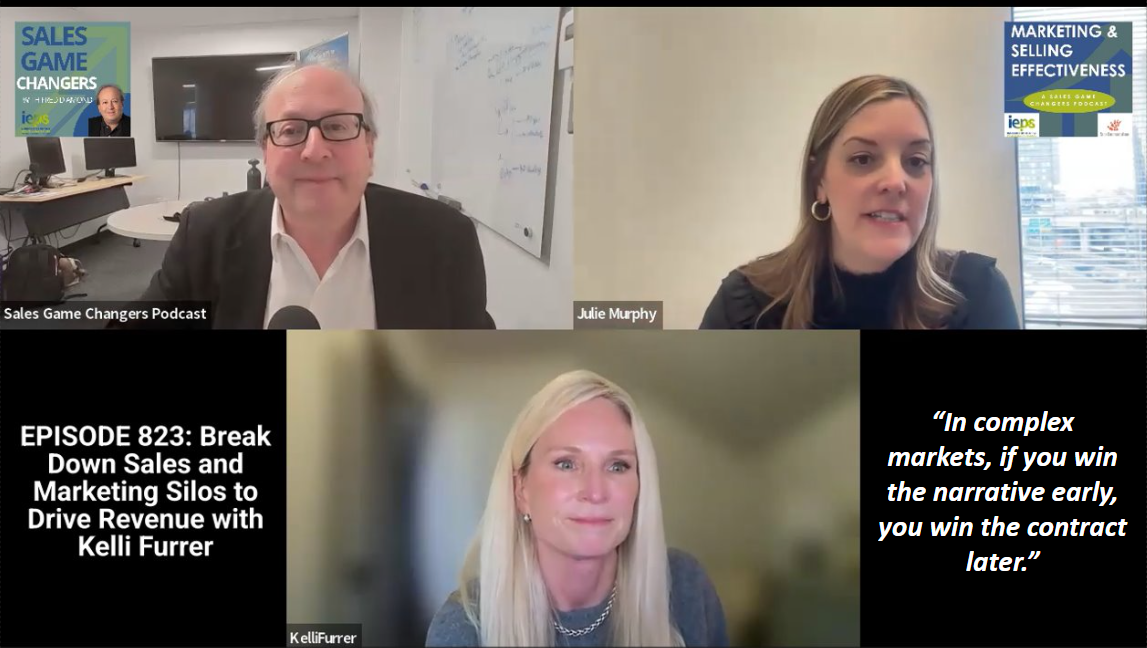
KELLI’S TIP: “In complex markets, if you win the narrative early, you win the contract later. Marketing doesn’t close the deal, but it shapes the conditions for it long before the opportunity appears.”
THE PODCAST BEGINS HERE
Fred Diamond: Julie Murphy, it’s great to have you back. It’s great to be doing another Marketing and Selling Effectiveness show. Sage Communications is a Selling Essentials Marketplace Partner of the IEPS. We get a lot of people reaching out to us, looking for recommendations for sales resources, and we’re always thrilled to recommend Sage Communications.
Julie Murphy: Thank you for that. We really appreciate. As you know, Sage is a full service PR marketing firm and we love working with IEPS and supporting all of your events because it’s so important to align sales and marketing, which is what this podcast is all about. I’m really excited because we have a fantastic guest today, Kelli Furrer, who I’ve known for many years. Many companies keep the sales and marketing functions separate, which is one of the reasons why we wanted to start this podcast, to really break down those barriers.
In this case, with Kelli, it’s my great pleasure to welcome her because she is both the Chief Marketing Officer and the Chief Revenue Officer at Slingshot. Slingshot is one of those companies that is at the leading edge of that, of understanding how important it is, where marketing can impact the sales pipeline and function. Before Slingshot, Kelli was at Dell. She’s a perfect guest to have on our podcast to talk about marketing and sales alignment. Welcome, Kelli. We’re excited to have you.
Kelli Furrer: Thanks, Julie. I’m super excited to be here. Fred, it’s nice to be on a podcast with you.
Fred Diamond: It’s great to talk to you. Like Julie said, we do this particular sub-brand of the Sales Game Changers Podcast because it’s just so critical for marketing and the selling organizations to align together. There’s not as much time, customers are more demanding. Sales and marketing are getting more involved at earlier places and different places through the sales process. I’m excited to hear some of your perspective.
To get us started, tell us a little bit about Slingshot Aerospace. I’m just curious, you made the shift from Dell to this industry. What is it about the space and the government technology sectors, where you spend a lot of your career, that inspires you?
Kelli Furrer: When my friends ask me, they say, “You’re working for a space company? What does that mean?” I start with a simple explanation, which is that Slingshot Aerospace is a leader in AI-powered solutions for satellite tracking, space traffic coordination, and space modeling and simulation. In even more simple terms, I say, we really help customers understand what’s happening in orbit. We use our own system of sensors that are placed in locations around the world, take millions of images, and put advanced AI on top of that so that we can track those satellites and debris as they’re rotating around the Earth to predict potential collisions and simulate scenarios really before they happen so that operators can make smart, fast decisions in a very crowded environment.
Once you get a little bit into the space of space, I think that what I’m really inspired by is really building a domain that’s still being defined. Space science and technology are really smashing together here, and space is no longer just about exploration. It’s infrastructure, which is the world that I come from. It’s economic and it’s strategic. We’re at this inflection point where a small number of companies will shape how this domain operates for decades going forward. Being part of building that responsibly, intelligently, and at scale is incredibly motivating and fun for me.
Julie Murphy: Slingshot is growing so quickly, and as you mentioned, the space industry is exploding right now. When you’re in a high-growth environment like that, I’m curious, because you’re one of the few executives that lead both marketing and sales within an organization, and those two teams haven’t always played nice with each other in the past, but are really so critical to each other’s success. I’m curious how you’ve seen that relationship between marketing and sales evolve through the years.
Kelli Furrer: You and I have known each other for a long time, and you know that my career has lived at the intersection of sales and marketing. I’ve always believed that marketing exists to make sales jobs easier by building trust and clarity and demand before a rep ever gets on the phone or shows up at an event. Wearing both the CRO and the CMO hat isn’t really about holding the two titles. It’s really about owning the entire front-end system of our business so we can coordinate it from end to end. With that I say, marketing ensures that our positioning maps the real customer priorities, the actual problems they’re funded and they’re on mission to solve. Then revenue leadership ensures that we’re accessible through the right buying pathways.
We were talking about Carahsoft, that is a great buying pathway for the US government. Whether that’s enterprise procurement, channel partnerships, marketplace models, or long cycle bespoke contracting environments, but together we design the revenue model to support the platform at scale, not just one program at a time. Those two things living together, what’s changed over the years is that the line between sales and marketing has become much more data driven and systems oriented than it was 15 years ago, when we were doing this earlier in our careers.
It’s no longer marketing generates leads in a stove pipe and then sales closes the leads. It’s a shared revenue engine and messaging, product packaging, pricing, enablement, customer expansion, all of those things have to align. In a small business like Slingshot, we really have to be very efficient about how we bring them together, and not just a small business, but a complex tech market, especially where now we have AI, we have data platforms, and integrative systems. The story you tell, the way you sell, and the way you deliver, all of those things have to reinforce each other, and that is something that I talk about a lot, the Slingshot flywheel. If there’s a gap between the narrative and execution, the market sees it immediately, that alignment that we’re talking about here between sales and marketing, it is a structural requirement in today’s market.
Fred Diamond: Let’s get a little more specific, a little more down in the weeds, if you will. How do you structure your team and your processes to ensure that marketing is enabling sales, and vice versa? Give us some of your insights into, like I said, in the weeds, at the ground level, what are some things that you’ve done that have helped this process happen that our listeners would see value from?
Kelli Furrer: We’re still a relatively small team, so structure matters a lot in our environment. You don’t have the luxury of redundancy. Every function has to directly move the revenue needle. My belief is simple, sales and marketing shouldn’t operate as centralized silos, like we just talked about. The execution roles, which I consider to be field marketing, partner marketing, and enablement, they should be embedded with the sales regions. They need to know who the customers are, understand the buying dynamics, and really support specific revenue outcomes, not just campaigns.
At our size, that also means really tight operating discipline, shared pipeline goals. I expect my marketers to know as much about the pipeline as I expect the sales people, because the fast feedback loops are so important. If we’re doing something in marketing that’s not helping a rep close or expand the account, then we need to adjust it really quickly. Marketing’s job isn’t just to generate and work on activity. It’s really to create leverage. We ask ourselves every day, with a small team, we have to be helping to create that leverage. Alignment for us is really the force multiplier.
Julie Murphy: When you think about something like the type of work that Slingshot does, space domain awareness and AI and your sensor network, it’s pretty technical. How do you think the sales team should help the marketing team, specifically with messaging, in a space where it is technical, and what role does thought leadership play in really communicating and connecting with your customers?
Kelli Furrer: In technical markets, the message is everything. You can lose people more quickly than you can probably win them over. Because every buying decision includes both business stakeholders and technical stakeholders, the messaging is really, really important. A lot of my sales team have engineering or very deep technical backgrounds, which is a huge advantage. They can absolutely nerd out on the space stuff and that credibility really matters. But the real skill is the translation. The message has to be simple enough that a non-technical buyer can remember it, repeat it, and explain it to someone else internally.
I think there’s like 16 stakeholders involved in a buying decision today, because being able to repeat it internally, that’s how the decisions actually move forward. The story gets retold in a meeting you’re not in. We rely heavily on sales in the message development. They know what resonates, where people get stuck, and what language creates clarity versus confusion. That’s also where thought leadership plays a role, not as marketing fluff, but as a credibility tool. The best thought leadership makes that technical story accessible without dumbing it down. It gives both the engineer and the executive a way to say, “Yes, that’s the problem. Here’s why it matters,” and more importantly, “This is what we can do about it.”
Fred Diamond: I’m curious if there’s any examples that come to mind of something specific, from a content side or a marketing side or awareness building side, that you could attribute to having helped make a deal happen?
Kelli Furrer: I’ve been at Slingshot for about a year and a half now. I’d say a great example is our recent $27 million Space Force award to power their AI-driven training environment. For the past year and a half, two years before I even got to Slingshot, we’ve been building a simple thesis that in complex domains, more data wins. More data plus more compute leads to better decisions and better outcomes. We’ve consistently positioned our global sensor network. It’s what I talked to you about at the very beginning when I was describing Slingshot as the data advantage, and TALOS, which is our Thinking Agent for Logical Operations in Space, as the AI that turns that data into machine speed and action.
Over time, that evolved into a bigger idea, which is AI native space training. Operators shouldn’t train against scripted scenarios. They should train against adaptive intelligent opponents powered by real data. That’s that real data coming off of our sensor network 24/7/365. When the US Space Force and the OTTI, the Operational Test and Training command opportunity emerged, the market already understood our worldview. We weren’t introducing a concept. We were executing on a thesis that we had been reinforcing for years. This became our first large prime contract, integrating alongside major industry players and delivering a platform level capability. That only happens when customers see you more as a vendor. Marketing didn’t close that deal, but it helped shape the conditions for it along the way, because what I believe is, in complex markets, if you win the narrative early, you win the contract later.
Julie Murphy: Kelli, you’ve been a part of this business for a long time. I have a fun one for you. If there’s one marketing or sales buzzword that you’d be happy if you never saw again or would love to see retired, what would it be?
Kelli Furrer: I don’t know that I need it to be retired or never say it again, because I do say it daily, but I think the buzzword today is AI powered. That is used everywhere. I also used it, but it’s become a blanket label that everybody uses. But real AI is not a marketing adjective. It’s a serious data science workload. At a technical level, what we’re talking about with AI powered, you’re talking about machine learning at scale, feature engineering, vector math, and models operating over data sets that are so large they can only be processed by machines and not by humans. It requires clean training data, compute infrastructure, evaluation loops, and continuous retraining. Those are disciplines we are deeply involved in every single day.
When I say AI powered, it’s not a marketing adjective. It is the business that we are in and the output shouldn’t just be AI. The output should be measurable decision advantage, faster classification, better prediction using that data, higher confidence, and ultimately lower latency and more decision advantage. When a company says AI powered but can’t explain that data foundation, the model behavior, or what decision is improved by it, it’s usually just branding. For me, I put a second level threshold for, what do they really mean when they say AI powered? Because it is a very important word in today’s economy.
Fred Diamond: That’s a great answer. Now that you’re answering it that way, I wasn’t sure what you were going to say is the buzzword, but it’s so commonly used that it doesn’t really take on the vastness of what true AI really does provide. It’s not just typing into Chat. There are so many things that can be utilized to form truly intense answers that are needed to project business and the world for that matter. It’s an eerie statement by me on this podcast, but I loved your answer there.
Julie, this has been a great interview. Thanks for bringing Kelli on the show. Kelli, thank you so much for your insights. I know you’ve only been at Slingshot for a year and a half or so, but best of luck on your continued success there and for what you all are bringing to the marketplace and for all of your recent success.
You’ve given us some great ideas here. Give us something specific, one action that our listeners should implement right now after listening to the show or reading the transcript. Something specific you recommend that they do.
Kelli Furrer: Julie and I, we have this long-standing relationship, and she’s known me both as a salesperson and a marketer. If I could give one piece of advice, it would be this, early in your career, and I tell my kids this, intentionally curate cross-functional experience. If you want to be a great marketer, carry a sales bag first, sit in the discomfort of having a quota, learn what objections sound like in real time, understand how hard it is to move a deal forward, because it is hard to be a professional salesperson. If you want to be great in sales, spend time in marketing, learn positioning, learn how markets are shaped before a buyer ever even takes a meeting, understand pipeline build and messaging strategy.
The best leaders I’ve seen aren’t deep in just one lane. They understand how the whole revenue system works together, and when you’ve lived in multiple functions, you can make better decisions, you build more empathy for your co-workers and your teammates and you can just simply move faster. I think the fastest way to level up your career is to go one function to the left or one function to the right and then back again, and really that’s going to do a lot to amplify results.
Julie Murphy: That’s really great advice Kelli, and I also think it builds empathy, because we’re talking about when groups don’t collaborate as well. If one group is saying, this isn’t working for me, if you’ve been in their shoes before, you can better understand why and maybe how you can help fix the situation. I love that advice. That’s really good.
Fred Diamond: Yeah, it’s very solid. Once again, Kelli Furrer, thank you so much. Julie’s been speaking about you for years, so it’s great that we can finally get you on the show and communicate your wisdom and your excellence. On behalf of Julie Murphy, my name is Fred Diamond. This is the Marketing and Selling Effectiveness Sales Game Changers Podcast.
Transcribed by Mariana Badillo