
This is an Office Hours: Sales Professors Unplugged sub-brand of the Sales Game Changers Podcast.
Watch the video of this podcast on YouTube here.
The Sales Game Changers Podcast was recognized by YesWare as the top sales podcast. Read the announcement here.
FeedSpot named the Sales Game Changers Podcast at a top 20 Sales Podcast and top 8 Sales Leadership Podcast!
Subscribe to the Sales Game Changers Podcast now on Apple Podcasts!
Purchase Fred Diamond’s best-sellers Love, Hope, Lyme: What Family Members, Partners, and Friends Who Love a Chronic Lyme Survivor Need to Know and Insights for Sales Game Changers now!
Find Howard on LinkedIn.
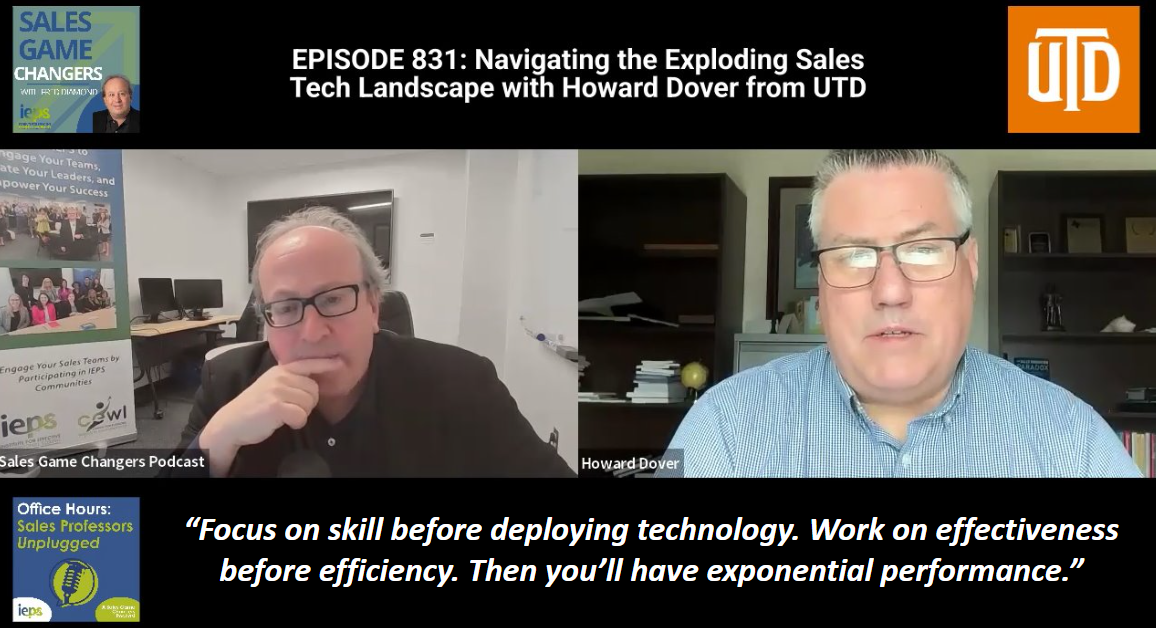
HOWARD’S TIP: “Focus on skill before deploying technology. Work on effectiveness before efficiency. If you can focus at the individual, the org level, or the manager level at effectiveness first, then you bring in efficiency, you’ll have exponential performance.”
THE PODCAST BEGINS HERE
Fred Diamond: Dr. Howard Dover, I’m very excited to have you on the show. We’re going to be talking about something very exciting that has emerged from what our good friend Nancy Nardin had created and how she gifted all her Sales Landscape files to the University of Texas in Dallas and what’s happened since then, what you’ve done. But before we get started with that, give us a little bit of a background on yourself. Let our audience know who you are and why we’re talking to you today.
Howard Dover: I’ve been at the University of Texas at Dallas for 13 years. When I arrived, I formed the center here for professional sales. About five years before that, I graduated my PhD in quantitative methodologies at the University of Texas at Dallas, and headed out to your neck of the woods there in the Mid-Atlantic region for my first job at Salisbury University, planning to be a quantitative researcher that taught classes at Salisbury University. Then the great recession hit and changed my whole life.
As I began to realize that there’s what we teach and what industry needs and there was a gap, I really probably unhealthily so I have not wanted that gap to exist the rest of my life. I constantly am out there trying to understand where is the puck moving, in the hockey vernacular, and trying to figure out how to skate to the puck and get my students ready for two to three years out, if at all possible, which is a bit bold. Sometimes we miss, but most of the time we’re talking with great partners who lead us along the way of where the puck’s going.
Fred Diamond: Actually, I was down on your campus for a USDA meeting in 2025. I got to speak to some of your students who’ve graduated and have moved on. I got to spend a little bit of time down at the center and it’s great. I love the work that you’re doing. I’m excited about what we’re going to be talking about today. Nancy Nardin, who is a friend of ours, she had created some amazing research into martech and sales tech companies and had actually even helped us out at the Institute for Effective Professional Selling with identifying some of the best companies in that space that we might want to talk to at the IEPS to sponsor some of our programs.
I know she had retired a couple years ago, lost a little bit of track. I saw an announcement that you had made that she had gifted her Sales Landscape files to the University of Texas, Dallas. You’ve done some amazing stuff, which we’re going to be talking about. I’m just curious, how did that whole process come down? Why did you accept this gift?
Howard Dover: I have to go a little bit back. If you follow the history of Nancy’s landscape, Sales Benchmark Index purchased Nancy Nardin’s company, and it became the SBI Sales Landscape for a few years, and Nancy worked for SBI. Then there came a period in which I assume the initial contract was over. We had conversations with SBI and we had conversations with Nancy at that moment to say, “Hey, maybe that’s something we might want to do.” It was a round-robin discussion. It took about a year and it came down to Nancy saying, “Well, why don’t you just take it over?” I have huge respect for Nancy. By the way, Nicholas 3K does similar work. I always want to let people know that G2 does this work and Gartner does this work, IDC does this work.
What I see the value of the landscape is the digital artifact that shows the growth and the magnitude of the sales platforms that exist in our space. To me, that’s the contribution. Nancy did a lot of other things to support her business, but the real product of her work was that landscape. I use that all over the world in keynotes and academic presentations, and it was a barometer. Every time I would use it, I’d I put it up on the screen, I usually use Nancy’s because I know Nancy, and I’d say, “How many of you have seen this?” It would be a barometer no matter where I was presenting anywhere in the world, academic or industry, because if not enough people raise their hand, I knew I had to slow down. I had to talk about context and technology impact and how it’s moving.
If more than 30%, 40%, 50% of the people would raise their hand, then I could go forward. I could say, “All right. Well, let’s talk about the trend lines in this.” I found the work that Nancy did so invaluable to me. I had to go talk to the dean and say, “Hey, good news and bad news, we have the opportunity to receive a digital artifact and files and take over a project.” I said, “The good news is that we could do this. The bad news is that it takes work to do this.” I said, “We’d have to allocate some students every semester throughout the year to do the work that Nancy’s team used to do. Then we’ll publish this twice a year,” is our goal at the moment. We’d love to get to quarterly, but I think it’s going to be twice a year.
Kudos to Hasan, Hasan Pirkul is our Dean, he’s been our dean for over 25 years. He said, “So everybody in the world is going to have to come look at UTD’s website to figure out where the technology is being launched?” He said, “Yes, I want to do that.” We have two part time workers that work consistently throughout the year. We published the first version in January of this year. It was actually complete in October, but we’re a government entity, so it does take us a few more steps to be able to put it out there than a private entity, because we have lots of rules and regulations for the State of Texas, and other challenges within our internal website teams. We have hoops we get to go through that no one else has to go through. We were able to release it, but we’re already in the process of releasing. Now, the first release stayed true to Nancy’s categories.
Fred Diamond: Before you go into that, I know it, so I jumped right in. A lot of our audience may not know exactly what the sales landscape is. Give us a description of generally what it is before we get into some of the details.
Howard Dover: The last release included the posting of 4000 different logos and categorize those logos by the work and function that is being done. You have the top of funnel, the middle of funnel, and then the management structure. You’re then categorizing where do these logos fit in the work that’s being done by a sales organization. Once again, to me, the value of the landscape artifact, the digital artifact that gets published a couple of times a year now, is we get a snapshot in time to say, what does it look like right now?
Our goal is not to do what G2 does, which is you can go into a category and find all the companies, or Gartner, and go in and figure out which ones are doing great, which ones are not doing great. We don’t do a magic quadrant. We’re just providing that categorization and geography presentation. It’s a landscape. It’s a visual display of all of the apps that exist in the sales space.
Now, do we get them all? Probably not. You can send an email to us. We have a form on our website. If you feel we missed you, you can tell us. You can hand raise and we’ll look at your company and properly categorize you. That’s the goal and that’s the output. We also get to know a lot of data. Nancy didn’t always track the historic movements. For us, that’s actually the advantage of being academics, is we’re capturing moments in time. Then we know the growth and the decline of different segments.
Fred Diamond: Let’s talk about that specifically. You had posted something up on LinkedIn, and it intrigued me for the reasons that we described in the beginning of this. You had mentioned in your post that, and I think you might actually have some updates on this, you went from 800 companies originally down to 600. Then you added another 4,000. If you want to update those numbers, that’s great. Feel free to tell us now. Then why do you think this happened? Tell us a little bit more about those insights.
Howard Dover: There’s always shift in in this space. This is the SAS vs SAS based companies for the most part. We’re seeing entrance and exits pretty consistently, acquisitions and bankruptcy. There’s a lot of movement. When you realize that when Nancy last published and SBI last published, it was three years ago. If you look three years back, we got it with 1,600, of which only 600 were alive. But then we added back in another 3,500, bringing us to 4,000 logos. That’s separate logo drops within the categories representing about 32,000 brands. But this is the interesting thing, Fred.
We published that, our last snapshot was October, we took a new snapshot in February. We’re up 25% on logos, just four months in the categories. For example, this one is going to surprise you, AI sales assistants are up 20% for the year. If you want to look at another popping one is if we look at sales engagement, which is strange to me, that’s up 18%. Then one of the hot items right now is sales coaching, which is just under 20%, lots of movement in that sales coaching space. One that actually dropped is buyer intent providers is down 20%.
Fred Diamond: Just curious, 4,000 some odd companies, how big is the biggest? I’m guessing the smallest is some guy in his basement somewhere. Is that the range? How big is the biggest company?
Howard Dover: Once again, I want to define what we’re doing, what we’re not doing. We don’t necessarily look at that storyline, but you wouldn’t be surprised. Microsoft, Salesforce, these are the biggest. Then you got the small, some of them we don’t get visibility until we see it. I’m always constantly looking on LinkedIn and various other sources to say, “Hey, is it in our database? Do we have it?” and we begin tracking it. But we source the data through G2, and you can look at Crunchbase, and you can look at Gartner reports, and things like that. Those are our primary sources.
Once again, the project isn’t so much finding that data. It’s recategorizing them into the landscape categories and then providing that visual display. It would seem that this is pretty straightforward, but Nancy had a team that did this. Now, they did other things. Can you imagine, Fred, being the one or two kids on our campus that this is what they’re doing? Is they’re going out and identifying each of these new entrants into the field, they’re looking at the acquisitions, who got acquired? Where did they go? We’ve had three students do it up till now. They end up walking out of here, just they’re the walking genius on sales technology.
Fred Diamond: I think it’s gold for those students. One of the great things is, at the IEPS, we’ve gotten to know a lot of the universities that have selling programs. We’ve gotten to know either a major, minor, or certificate, or concentration. I’ve spoken to a lot of the students. One of the great things and one of the reasons why we’ve gotten behind the Office Hours – Sales Professors Unplugged, as I mentioned before, we’re going to be giving out our first University Sales Educator of the Year award to Brian Collins from Virginia Tech. The community of students are so passionate about this world that we live in, the professional selling world.
Not everyone’s going to make it hugely successful, but a lot of them will. A lot of them are very passionate about the technology, and they’re very passionate about the tools. I know you’re going to be hitting the road and sharing some of the insights at various places this spring. Give us some insights into what some of the things are you’re going to be presenting.
Howard Dover: I think one of the things, we talked about some of the trend line pieces. Some of the areas that are new, some of the new areas that are just brand-new categories, digital sales rooms, demo automation software, super minds, this area of super minds and this idea that we have an AI avatar that really operates as an AE, maybe even an SDR, of course, the massive growth area of AI sales assistance. The challenge with the category of AI sales assistance is the fact that it’s probably too big of a category. It’s a big category. That’s going to be part of the work moving forward, is updating the categories from three years ago.
We’ve already completed iteration one of that project. Now we’re in the building phase of the next landscape. It’ll be a two-phase process where we’ll take our existing perfect mapping and we’ll probably do an intermediate update, and then probably late summer, we’ll be able to add the new categorization where we don’t have perfect mapping, because that work takes a lot longer to say, “Here’s brand new areas,” because with new technology comes new motion, comes new skill.
Some of it is old skill that just needs to be tweaked a little bit. I like the word motion because I don’t think skill changes dramatically. I think the motion changes. For example, when we look at the recent gold medal performance of the American skater, Miss Liu, her skills were the equivalent of many of her peers. The skills that she had to deploy, the necessary elements of her skating routine were the same, and the skills required to do those are pretty consistently defined. But the motions that she did were different and elevated.
My friend Juliana Stancampiano from Oxygen Exp was the person who brought that into the Sales Enablement Society, like, “I love the word motion.” The idea of we have skill and then we have motion, and motion is the way we execute the skill. That can be varied and nuanced and the nuance creates exponential performance if we understand the differences.
Fred Diamond: I understand that you also created a course at University of Texas Dallas called AI Within the Sales Technology Landscape, which was based on some of the data that you captured. First of all, is that true? Second of all, if it is, what do you teach in the class? What’s the value? What’s a student going to get if they come through that class?
Howard Dover: Let me go a little deeper, if I can. Gartner put out a research item in January of 2025, saying that, I thought it was 70 plus percent of all CROs needed or wanted to hire a generative AI sales specialist in 2025. The first question I had is, what is a generative AI sales specialist? It doesn’t matter, when given that title, over 70% of CROs said they needed to hire one. We looked at that and the University of Texas at Dallas was formed by TI and they gave the land to the state and said, “We want you to be a relevant university. If you stay a relevant university, we’ll keep funding you for everything you need.” We’ve been moving to market since our founding in 1969.
To me when I saw that, I said, “Well, then we’re going to create a certificate in AI for sales.” We already had two courses that were very AI heavy, and my dean insisted we create an AI for sales class, and we own the landscapes. We know the data. We simply took Gartner’s action-oriented design, as from their keynote from last year’s CSO Summit, and said, “Let’s move into the landscape and get our students to be thinking around action orientation to build agentic concepts and test the agentic concepts of the landscape, including risk of replacement by low-code, no-code solutions.” It was a very early class and we all said, “Hey, nobody knows how to teach this. We’re going to learn together.”
We took aspects of the landscape. Each team took a piece of the landscape and found a product, described the product, then using action-oriented design thinking, they determined what actions were being done by the software, of those actions, which of them could be replaced with LLMs and which could be replaced with agentic using low-code, no-code solutions. That was the whole class.
Fred Diamond: We also had one of your professors, Semira Amirpour, on the Office Hours Sales Game Changers Podcast. I encourage people who are listening to this to go listen to her show. She went into a little more detail about the relationship with TI and how the university was created, etc.
I’m going to ask you, what’s the benefit of all this to selling organizations? But before I do, I’m just curious, you’re an academic, but you’re also in the professional sales world. What were some of your ahas? Once you took over this project and once you started leading the people who were doing the research and the updating, what were the one or two things that were, “Ah, gee, I didn’t realize that.” I’m just curious, if you can think of anything.
Howard Dover: You know Terry Loe. Terry Loe helped me out almost a decade and a half ago when I was getting into this, but my aha moment came when I came to Dallas. I think it was one of the sales summits put on by Tim Clark when he was back at Salesforce, and he created these sales summits inside of Dreamforce. Even LinkedIn had their national event in New York. It was the two of them. I attended both of them that year. I heard these people talking about exponential performance. The technology was enabling.
I remember distinctly a presentation from a guy, Brian, I’m forgetting his last name, from Microsoft. He presented in Vegas at LinkedIn. He’s showing that people who socially sell are 2x, 4x, and 7x performance. I went up to him after the thing and I said, “What?” Because here I’m teaching, I’m just teaching stuff, which I think is a fair thing to say, when I was teaching back then it was stuff, and I looked at that and said, “I got to figure out what I should be teaching.” Because there’s exponential performance on the table. Lady at IBM was showing that she had a 3x performance differential when she did a project.
I started realizing that technology properly deployed with proper skill and motion creates exponential performance. This has become my thrust for probably a decade. I wrote a book called the Sales Innovation Paradox saying, “With all the technology, why haven’t we experienced more exponential performance?” Instead, we hired more salespeople and had lower quota attainment. Makes no sense given the massive technology. That’s why I love the landscape, because to me, the landscape is that evidence of the explosion of technology and yet the reduction of performance. The waste that’s occurring, the lower efficacy that’s going on. Yet when you train people around skill, motion, and give them the proper resources, you don’t give them the proper resources without the training and the skill. You look at the skill, you look at the motion, you look at the difference in the way you are precise and relevant when you’re communicating, it lists everything.
You get a student who’s in Mexico City just posted her first full year over at Salesforce in Mexico, one of our alumni. She’s 256% of her quota. I’m not surprised, Fred. We hear those numbers. My favorite one this last year was 1,000%. That’s that exponential performance. That’s where I say I’m skating to where the pucks headed. The game we’re playing is young people don’t know what they don’t know. We can train them to perform at peak levels.
Fred Diamond: That is very, very cool. I’d love to learn more. I’ll ask you one final question. Is this a product now? Can selling organizations purchase this, or you’re just making this available to the world on the University of Texas Dallas’ website?
Howard Dover: The landscape, it’s out on the UTD website.
Fred Diamond: Is there anything to buy or is it just available?
Howard Dover: If you go to the UTD Center for Professional Sales’ website, you can find the landscape. Then you can also find something called our pulse report, which would probably take another podcast actually, but we’re skating to where the pucks going to be. When you deploy AI technology, your problem is no longer skill. It’s attribution. What are the attributes the salesperson needs if the AI is going to increase the expectation, which it is and does? You got to increase the curiosity and the business acumen of the salesperson. We’ve been working on what we call the business acumen project for three years at UTD.
Fred Diamond: I mentioned I had Semira Amirpour on the show. She went into detail about your program and what students get and the curriculum that you offer and the value to the various companies that may want to be corporate sponsors. Is there anything you want to get us updated on that’s happening at University of Texas Dallas that we should let the audience know? This is a huge thing, but is there anything else that you want to share before I ask you for your final action step?
Howard Dover: I think this idea around the business acumen and the concepts of precision relevance. This idea that we live in a world where we can be extremely precise. We live in a world where we can be AI augmented to be extremely relevant for the moment that we are allowed to be precise. When we do that, we end up with exponential performance. This is something any company can do. To do that, you do need to make sure that your people have increased acumen and they need to be genuinely curious. That’s why we’ve been working on that project for a couple of years. Can we build it? We have an answer. The answer is yes. We’re trying to prove it very meticulously, which is hard to do, but we’re working on it. We think we’re there.
Fred Diamond: That is amazing. Again, congratulations. When I saw your announcement, I mentioned in the early part of this podcast that we’re fond of Nancy and she was very kind to us at the Institute for Effective Professional Selling. I was very excited to see the developments and I applaud you on what’s happened and what’s going to continue happening.
Dr. Howard Dover, University of Texas Dallas, gives a final action step. You’ve given us a lot of great ideas along the way. For people listening to the show or reading the transcript, give us something specific that they should do right now to take their sales career to the next level.
Howard Dover: Focus on skill before deploying technology. Work on effectiveness before efficiency. If you can focus at the individual, the org level, or the manager level at effectiveness, first, then you bring in efficiency, you’ll have exponential performance.
Fred Diamond: I love how you’ve tied those together throughout the course of today’s podcast. Once again, this is the Office Hours – Sales Professors Unplugged. I want to thank Dr. Howard Dover for being on today’s show. My name is Fred Diamond.
Transcribed by Mariana Badillo