
Watch the video of this podcast on YouTube here.
The Sales Game Changers Podcast was recognized by YesWare as the top sales podcast. Read the announcement here.
FeedSpot named the Sales Game Changers Podcast at a top 20 Sales Podcast and top 8 Sales Leadership Podcast!
Subscribe to the Sales Game Changers Podcast now on Apple Podcasts!
Purchase Fred Diamond’s best-sellers Love, Hope, Lyme: What Family Members, Partners, and Friends Who Love a Chronic Lyme Survivor Need to Know and Insights for Sales Game Changers now!
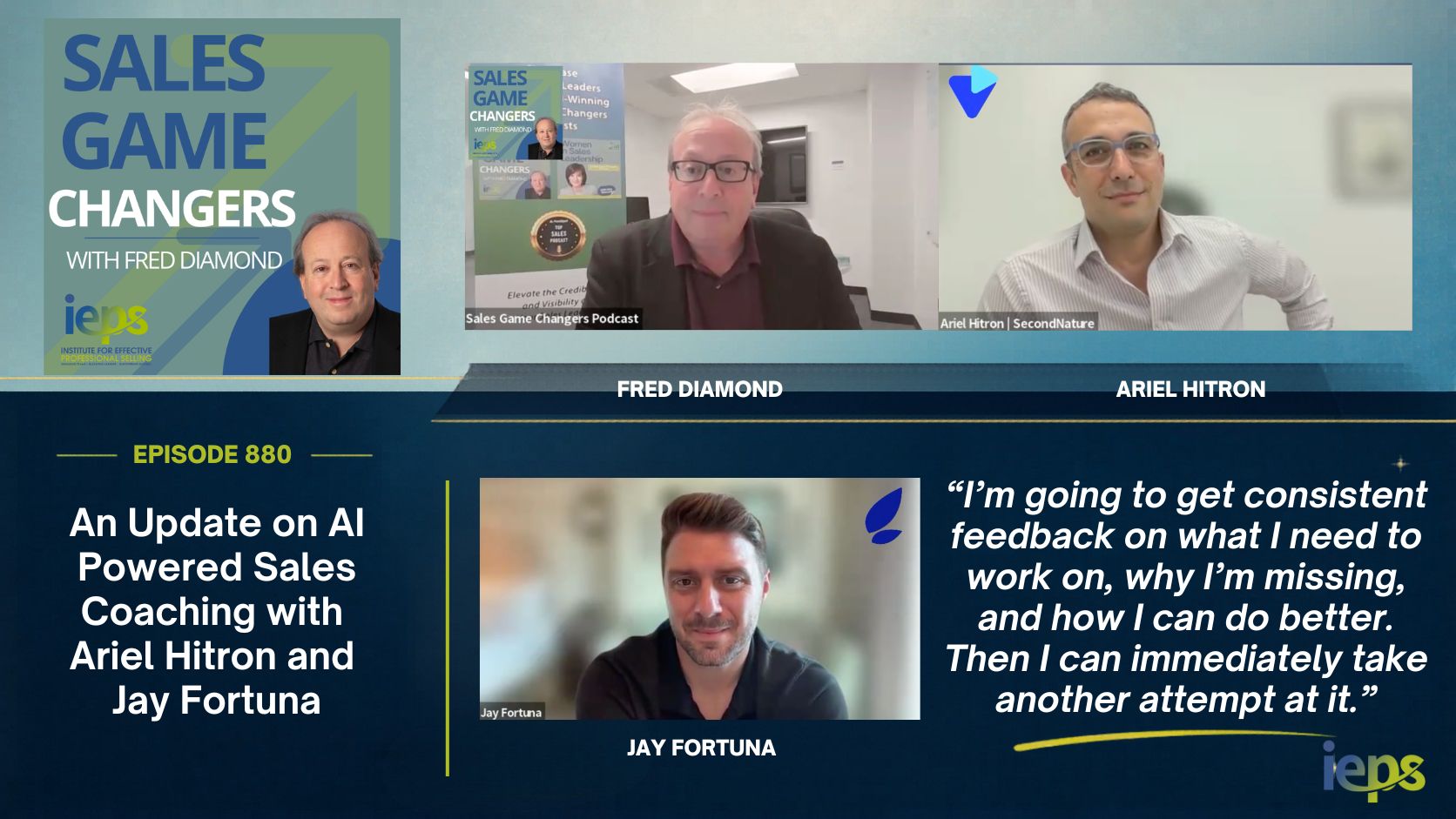
Today’s show featured an interview with Ariel Hitron, Co-Founder and CEO of Second Nature AI; and Jay Fortuna, Senior Vice President of Talent and Operations at GoHealth.
Find Ariel on LinkedIn. Find Jay on LinkedIn.
ARIEL’S TIP: “The top sellers always think they know everything, and then they come into that and they see that there’s some things that they don’t know. We all have something to learn. Then you see them improve and then everyone else flocks into that.”
JAY’S TIP: “I’m going to get consistent feedback on what it is that I need to work on. It is going to be very clear to me of what it is, why I’m missing, how I’m getting scored on it, how I can do better. Then I can immediately take another attempt at it.”
THE PODCAST BEGINS HERE
Fred Diamond: I’m very excited. AI for Selling Effectiveness is something that we talk about all the time on the Sales Game Changers Podcast and at the Institute for Effective Professional Selling. We have Ariel with Second Nature. Ariel, introduce us and tell us a little bit about your product. I said you need to bring on a user. We have Jay Fortuna is going to be with us here in a second. We’re going to have a nice conversation about why the tool was created, what it does, why Second Nature brought this to market. Then we’re also going to be talking to Jay about how he’s using the technology to make his sales professionals more effective. Because at the end of the day, we’re all about selling effectiveness. We’re all about helping B2B or B2G selling professionals take their revenue and their sales careers and their performance to the next level.
Ariel, get us started here. Tell us a little bit about the product and a little bit about the company. Then, Jay, when he’s done, give us a little bit about you and your company and why you’re using this tool.
Ariel Hitron: My name is Ariel Hitron, co-founder and CEO of Second Nature. We started the company back in 2019, before ChatGPT was about, before AI was as cool as it is right now. The vision stayed more or less the same, which is helping sellers just get better at what they do on an ongoing basis. I think it came from my personal journey. I’m an ex-engineer turned into product manager, then turned all of a sudden into a sales leader, had to lead like 25 people into sales, and I thought sales is so easy. It’s so easy. You have all the product specs, you have all the features, you have all this and that, just read them the features and they’ll fall in your lap. So easy. Then I realized that I was so far from the truth.
That inspired me to start thinking about, okay, how do I upscale myself first, and then the team that I was leading. Based on that, we planted the seed to go in and build this technology that ended up being Second Nature.
Fred Diamond: Yes, all you need is the product, sales is so easy. Jay, we’re doing today’s interview in August of 2026, sales is getting harder, even with AI. It’s getting harder for a couple reasons. The customers are using AI. They can find out whatever they need to know about your company in 10 seconds. They don’t need selling professionals to come and give us like a half-day presentation, they could find that in seconds. AI is going to get the selling professional, it should help them research, should help them do some development of content and messaging, and it should help them get skilled in how to interact, but the sales rep needs to take it the final 10 yards.
Jay Fortuna: Definitely getting really good at understanding those features. We don’t have to have the feature sheet anymore as a salesperson and just give them that which, to Ariel’s point, we never did. We always need to be able to create a relationship. I’ve worked with Second Nature now for about five years, essentially, when I started to look for a solution to a problem I was having as a sales leader. I will tell you that the number one issue I had when we started working with Second Nature was hiring an astronomical amount of sales reps to keep a fraction of them in the seats. I had one year where I hired 7,000 agents to keep 2,000 of them in the seats for inside sales. Yeah, it’s a high turnover profession, but that’s not going to allow us to be effective and efficient and to hit our bottom line.
I started to think about, okay, we have to keep people here. Why are they leaving? Started to figure out, well, the job’s difficult. They’re not good at this. They’re not making money the way they want to. We can fix that with coaching. We’ll make our managers better coaches. That’s the solution, “I’m just going to make our managers better coaches,” like Ariel said. It’s just that easy. Just do it. Snap your fingers.
But more importantly, is I realized, as we were onboarding, because we were onboarding a lot of people, there’s a major cost that goes along with that. If I think about how long it took us to onboard at that time, it’s about 11 weeks to bring on a new sales agent. Then it took another six months to get them up to speed truly. Just get them through training for 11 weeks, we’re not making a dollar. Then to truly ramp them was about six months. Very, very, very cost heavy.
How do we fix that? Well, let’s take a look at training. Why is it 11 weeks? What’s going on? We realized there’s a lot of role play? That’s when we reached out to Second Nature, because they had a solution that would solve a business problem for us. We started to get our people better faster, then get them through training quicker, I can cut down my learning curves. That’s truly how we all started to work together. I will talk a lot more about that on the show, of how we got there, but it’s essentially what I’ve been focused on throughout my career, solving business problems. As a sales leader, we get to do that a lot. Second Nature just happened to be the partner that I went with for making that happen and I’ve never looked back. They’ve been incredible from that standpoint.
Fred Diamond: Ariel, you must have spoken to at least dozens, if not hundreds, of sales leaders like Jay, who say things like that, coaching is the most important thing. Matter of fact, I can probably think at least on dozens of the Sales Game Changers Podcasts where I would ask the sales leader, what are you great at? What is your skill? They would always say coaching, that great sales leaders are great coaches. Most organizations struggle to deliver it.
Why do you think coaching is still broken? How did that lead to you developing this particular solution?
Ariel Hitron: A few things. I think that, first of all, good coaching takes a lot of time. It takes a lot of time. If you’re coaching someone, say they’re working in B2B sales and they’re working on a deal, you want to coach them on the deal, you have to listen to their coach, you have to familiarize yourself with the deal, you have to know where they’re at, because otherwise you’re just gathering information, you’re not coaching.
You have to do a lot of preparation, then the delivery, coaching is very personal. You cannot coach 100 people at once. Then you’re training, you’re giving something that’s off the shelf. But if you’re doing something that’s very specific, very personalized, then it has to be one-on-one. If you’re the coach and you’re investing time in learning everything about that deal or that person, and then delivering the coaching, and then eventually giving something back in some more structured way as a takeaway, as a next step, as the things that they have to improve, that takes a lot of time. As a manager that manages eight reps or six reps, there’s only so many hours in a day. I think that’s one, it takes a lot of time and a lot of effort.
Second is that you know how it goes in sales many times. You take the top seller, you promote them to be a manager or a coach, and that’s it. Then the coaching looks like, “Look, here’s how I’ve been doing it,” and they give their spill, which is not exactly coaching. Or they go on a call with you and they say, “Okay, okay, now I’ll do it and you observe,” it’s not really coaching. I think that even great sellers are not always the best coaches. That’s a different skill set that you have to embed.
The last thing is that you have to be consistent, especially if you look at an organization that you have thousands of sellers, you have to be consistent in the way that you’re doing coaching. If you have thousands of sellers, you have hundreds of managers, each one of them is doing it slightly different. You cannot create consistency and provide a playbook for the entire organization. I think that’s another challenge. I think that AI solves for all of those aspects. It has all the time in the world. It can do all the prep work for you and really get familiarized with your deals and your progress and your places where you need a little bit more help. It can give you very structured feedback and it can be consistent across the board for everyone. I think those are the areas that makes AI a really great candidate for providing coaching.
Fred Diamond: Jay, I have a question for you as a senior sales leader, well-seasoned, etc. I interviewed someone last week, a VP of sales at a well-known tech brand. We talked about coaching selling professionals. He made an interesting point, he used a sports analogy. He said some of his people get coached by him being in their face. Some of them get coached by giving them a pat on the back. Some get coached by just letting them be, maybe with an occasional note or something like that.
I’m just curious on your thoughts on that, having probably coached thousands of salespeople by this point. Then why is AI, why is the solution of Second Nature specifically, why is it so good to coach various types of selling professionals?
Jay Fortuna: I’m actually going to talk on that and then add in something else with you as well. When you think about practice, and I love that you talked about the sports professional, because I think about that particular thing a lot. I played every sport you can imagine growing up. We practiced constantly. That’s all we did, was practice. I don’t remember games as much as I remember practice, but as sales professionals, all we do is go live. We go live, we go live, we go live. It is in that moment where maybe you can get some coaching. It’s very rare that sales leaders want to pull someone off the job to get coaching.
That’s the first problem that we truly run into, is just that we don’t do enough of it. We still consistently have not been able to do enough of it, and that’s to Ariel’s point, because I can’t. I have 10 direct reports, I only have so many hours in a day, so what happens is these individuals historically have gone without coaching. That’s the biggest issue that we have, is lack of.
When we do find time for coaching, to your point, it’s knowing how to coach people the right way to get something out of them. It’s also just understanding that they need consistency and a message to see where it is they can get better, and get enough attempts to get better at the thing as they’re learning where they missed. That’s what I love about the AI tools, specifically Second Nature. I’m going to get consistent feedback on what it is that I need to work on. It is going to be very clear to me of what it is, why I’m missing, how I’m getting scored on it, how I can do better. Then I can immediately take another attempt at it. I can go right in that moment and I can get the feedback, and it’ll tell me again what happened. If I miss once or twice or three times even, it’s not going to get irritated with me.
I will tell you, even the best sales coaches, by the third time that they’re repeating themselves on how you could do that better, they do what Ariel says, which is, “I’ll take the next call with you. I’ll join you. I’ll take care of it.” You’re like, “No, no, no, that’s not coaching. Now you’re playing. I need you to go and continue to coach to make more people better.” The tool allows for that. I can take as many reps as I need to in a time period that is way condensed and consolidated, and I can hear things in an unbiased fashion.
Jay Fortuna, the sales professional, may think that the way that I do it is the best. It’s not. I may think that, but it’s not. AI can unbiasedly tell me where I can be better and not try and replicate me into 13 other people. It can take what those people are doing, hear their tone, their inflection, speed of speech, and then we can go down the compliance, features, benefits, did you sell to this? Did you use the Challenger Sales model? Did you do needs analysis? You can go into all those components and not miss anything. It’s never going to forget something, but it can still coach on one topic at a time.
Fred Diamond: I’m just curious on two things. Ariel, I want you to chime in as well. How do the reps use this? Do you tell them to put time on their calendar? Do they do it on Saturday? Do they expect to do it, like you were just saying, after a call that maybe didn’t go well? How do you manage the reps using the technology? How have they responded? Then, Ariel, the same question, how have you worked with your customers to get them to have their reps use the technology as compared to the reps saying, “It’s just another tool. I may or may not use it.” I’m just curious also, Ariel, from your experience, is it 100% usage and success at your customers? Is it maybe 20%, the old 80/20 rule, the top 20 are using it, and it’s helping them get better?
Jay Fortuna: The thing that I love about it is, to your point, when do they do it? They can technically do it whenever. We have that ability. I don’t have to wait for a manager to set a meeting for two people to be available. I can have a really bad call. I can have an objection that I didn’t overcome correctly. I can have a bad introduction, a bad close. I can go and jump in and do those specific things at any point in time. I can say, “Look, I’ve just missed on two of them. I need to go take one really quick to go through it. Let me hear it. Let me get the feedback.” That’s something that can happen instantly in that moment.
There are other times, though, when I will use it for onboarding and we will schedule it out for them. Depends on the sales floor. I’m sure Ariel can talk more about other customers. In our case, we have a lot of hourly employees that we have scheduled, the phones are ringing for inbound needs that we bought, so we do try and give them blocks, of saying, “Hey, here are some of the opportunities you have throughout your day to do either post call work that you need to do, a little bit of development time,” and they try and scheduled in there. But at least we know if someone has an over-day, or if I’m like, “Okay, well, I’m over my last eight, something’s not right.” We can pull them and say, “Go ahead, let’s hear where you were at. Let’s listen to a couple calls. Let’s talk to the ASMs. Let’s see where we can get you better and get you to snap there.”
What’s beautiful is without making it gamified on our end, I don’t have to force gamification, I have sales people that are instantly gamifying things to get a high score because that’s how they’re driven. They’ll go and they’ll take one and you’re like, “You got a 96,” and they’re like, “Yeah, I know. I’m going back. I want a 99 or 100.” They have that mentality. I love that because that is where right now you’re getting not only repetitions, but really good repetitions at the end. There’s a point where it’s like diminishing or something like stop chasing your 98 to 100, it’s okay. It’s going to be all right in that moment. We got to coach to that more than anything because they get excited about getting better because they know that as they get better, they do see the results immediately in the work that they’re doing.
Nothing makes them happier than, “Okay, I went and took a simulation. I scored well on it. I got on my next one or two calls and I closed something that I wasn’t closing all day or all week.” They can test that same theory with different types of customers, which is fantastic for them as well because some people naturally can speak to an individual that’s either similar to them or like someone they know really well. They’re like, “I got this down.” Every time that phone rings and they get that person online that they’re, “I know how to sell this person. They’re great.”
It’s the one that they get like this, “Oh, no. I don’t know how to talk to that person. I don’t know how to connect with them.” Then they can go take those reps for that particular type of customer, which then makes them immediately feel more comfortable on the phone. A more comfortable salesperson, better results.
Fred Diamond: Ariel, how are you seeing usage going across some of the companies that you work with?
Ariel Hitron: I think Jay hit the nail on the head, as he always does. I think that we’re seeing different companies with different sales motions use it slightly differently. We have companies who have a more transactional sales motion or commercial sales, where people are short sales cycles, either one close or a couple of weeks close. Then you can see that all really quickly, because once you get confident, you can get those numbers running. Then we have customers like SAP or Oracle, where the sales cycle can take like 12 months. Then it’s more about how do you coach two different sales stages? How do you coach for the different personas? How do you coach for those different places where it’s less trivial in there?
I’d say also that with this kind of environment, if you’re new, then you know that you don’t know and then you’re on boarding. You also have the time because you have no quota yet. You’re just all in on learning as fast as you can. Then the adoption is trivial. Then when there’s something new in the company, there’s a new product, nobody expects you to know how to sell them. There’s a new regulation that you have to adhere to. You don’t know about this regulation. You have to get comfortable with it. You don’t want to embarrass yourself in front of customers saying the wrong thing so you can practice that. Or if you’re a low performer and you know you have to get better, it’s really easy to understand why you have to do that. I’d say those are the obvious ones.
I think that the less obvious ones are when you go beyond the off the shelf and something that’s very specific to you. I’m working on a deal right now, I’m all in on this sunglasses hat or whatever it is that I’m selling into. What do I have to do next? How do I get it in my head in order to do next in this specific deal? That’s really what the manager who’s well informed and listened to all of my calls could do. Now I can do it really well in giving me guidance and roleplays and thinking about what I’ve missed within my sales process, specifically to this deal. Nothing that’s generic but very specific and that really helps increase adoption.
The last thing is that since people are smart, and they’re smart and they’re very efficient with their time because they want to find the fastest way to get to their goal, and their goal is the sale. Once they see it’s working and the ones who are using it are selling more and closing more confident, then you can see them flock into this. Start with your top sellers. Show that they can learn. Also, the top sellers always think they know everything, and then they come into that and they see that there’s some things that they don’t know. We all have something to learn. Then you see them improve and then everyone else flocks into that.
Fred Diamond: Jay, one of the benefits of using technology and tools is that, yes, obviously we see here how it can improve the selling professional on your team by practicing. Ariel just mentioned that sales professionals are smart, but it’s a skill. To become more effective, you need to practice. You need to think, you need to work on so many aspects to take your sales performance to the next level, as any professional would do. What have you learned as a management team? What are some of the observations that you all had made having invested in the technology, seeing your people use it, watching them use it, I presume. What are some of the shifts maybe or lessons that you and your direct reports, your leaders have learned?
Jay Fortuna: A couple of things that truly come to mind now that we learned really quickly. The first thing was where we thought we had a flawless process, we didn’t. We learned how we didn’t have a flawless process by the scores that people were getting, by how many times they were taking certain things. We were able to dissect components of our business, specifically our sales calls, our cycles, and saying, “We designed and engineered this to do X. Why is it Y?” I’m thinking about the person who’s just always like, “Well, no, this peg goes in this hole all the time.” You’re like, “No, no, no. We didn’t design it to do that. We didn’t realize that it wasn’t getting done that way,” because you can’t get through enough bulk at the level that we’re dealing with customers, to say, “Okay, we can pinpoint where the problem is.” The managers might not be identifying it because they’re more focused on, “Let me just get that person over the hump and move through.”
But with the amount of data we were getting and being able to say, okay, we see that we’re scoring terrible on this part of the call or on this compliance component or whatever it may be. But that’s not a training issue. That’s not a coaching issue. That’s an operations issue. But we can fix our operation component because our coaching tool showed us where we were missing. That was a huge thing for us. That raised our compliance scores alone in operational changes, let alone the practice, they got them better.
The second thing that I will say that we learned really quickly is though the tool was brought on for our sales and customer service agents, our frontline agents, we were able to get our managers learning how to have more effective conversations and have better coaching sessions when they were doing live coaching sessions. They were getting a lot more coaching sessions going on with the tool, but they were still doing live coaching, as they should, and they should be picking up on things. We were learning that they were becoming better communicators and coaches on how to do the process that we created by putting them through simulations on coaching. It was a double-sided tool where I’m like, “Okay, I got the coach coaching the coach. This is fantastic. I’m getting more reach on that.” You’re getting these exponential gains, and those are things that in hindsight, obviously, that would have happened. But in that moment where you’re going through your use case of, this is how I’m going to do it, and then it works, then you start to think of all the other things we can do.
To Ariel’s point, our high performers generally like that. They do. A lot of them do know a lot of stuff, which is great. But when they come in, they figure out by taking one of these and they’re like, “I didn’t get that right.” One out of ten is like, “Man, that’s not right. I’m right. That’s not right.” But nine out of ten are like, “I could do this differently and I’ll get better results. That result means more money in my pocket.” The coin operated and you’re like, “All right, we’re good to go.” Those are just things that we picked up on really quickly as we rolled the tool out there. We’re like, those are operational changes that we didn’t see in making our coaches better coaches through the coaching tool.
Fred Diamond: Jay, we’re talking here about how you’ve invested in AI for the coaching process. Can you briefly give us some other insights on where you’re using AI for your sales organization, and where have you seen it be most effective?
Jay Fortuna: This is one of my most effective tools, I’ll say for sure. But we have it in a bunch of different spots. There’s guided tools that we have that actually bring people through screens that are AI operated and driven. One that we did very specifically that I fell in love with early on is we had a knowledge management system that was just like everybody else’s. Keyword search, hunt-and-peck type of scenarios, and we took that and we turned it into an NLP bot that essentially now our agents can talk to and ask questions, just like they would ask their manager, and they were asking their manager and then having to wait for a response, and managers were getting bogged down with answering every single question that an agent had. This tool started to do that.
When you think about how when ChatGPT came out, heavily regulated, internal tool, we’re going to open up ChatGPT and let something else take place. Basically, what we said is, hey, here’s where you can look for information, and then we tested it up, down, backwards, and sideways. Those responses we were getting back were really helpful and it was saving a ton of time. Time saved for a sales agent means I can get to another call, another call means another potential sale. Compliance scores went up because they could find the information that they needed at their fingertips.
We did start to go through a little bit of a process where you’re giving our debt tool some, how could I overcome this objection? Some sales skills and tactics that you just couldn’t get every manager to get to their person in time. No more power holds. No more, hold on, let me go look for that information. You put them on the power hold and you’re like, “I need someone to help me,” and we created something that we’re doing. Those are a lot of the tools that we put in place. Second Nature for our coaching in role plays, we had an NLP bot, and then the third one, guided through screen specifically for changes that happen in the system, compliance updates, and for new employees.
Fred Diamond: Ariel. you’re obviously trying to sell this technology. You’re talking to a lot of companies. You have some blue-chip customers that are on your website like Zoom and Oracle and Adobe, and of course, Jay’s company. Jay, did we mention your company name by the way? I don’t think we have yet. Tell us briefly your company name and what you sell.
Jay Fortuna: Company name’s GoHealth, insurance, Medicare brokerage sales, life insurance products, along those lines, based out of Chicago.
Fred Diamond: Ariel, you’re talking to companies all the time. Your organization is trying to sell. I presume that your reps are also using the technology to be coached. Are you meeting VPs of sales who are brand new who have woken up and said, “Gee, we should probably use AI.” Where is the customer right now? You’re talking to so many of them about bringing this in. Give us a peek. We’re doing today’s interview August of 2026. Are companies just waking up or a lot of them using many tools and they specifically know they need to use something for coaching? give us a perspective on that.
Ariel Hitron: Doing it for many years, I’ve seen how the industry evolved as well. I think that everybody realizes that they have to have AI somewhere and they’re scratching their head of where it will be effective, especially in the go-to-market. There are a few areas that are more advanced than other. I think that coaching is one of those more mature areas where people now are clinging to. We see it in our customer base.
When we started, it was super innovative and it was just the innovators like Jay that pushed forward and done things like that. Today we’re seeing large insurance companies. We’re seeing large pharma. We’re seeing tech behemoths. We’re seeing very traditional companies are now implementing it at scale. I think that we’re past the early adopters into the early majority in that adoption cycle, and the ROI is very crisp on that. I think that in some areas of AI, you still have more of a pilot budget or trial budget. Here we’re already part of the main budget there.
I think that organizations that roll it out very successfully, it’s not about the AI or the tool or the technology, it’s about the people who own the rollout and how they behave. You have to define a clear owner within the team to do this. You have to define exactly what you’re trying to solve for, at least initially. Do you want to onboard people faster? Do you want to get them more proficient? Do you want them to close faster? Do you want them to roll out changes because your industry is moving very fast? You have to meet competitive pressure that also is changing very fast? What is the thing that you’re trying to solve for? Then have executive support from the top saying, “This is something we want to solve for. This is the platform that we’re aiming for.”
Then define the KPIs for that and what do you measure on an ongoing basis? This is not measuring the tool, it’s measuring the program that you’re putting in place, and then obviously building that program, and what are the cadences? What are the game dynamics? What is the involvement of the manager? How you get everyone around that initiative to improve onboarding, to improve competitiveness, to improve time to market, to improve all of these things are important. I’d say these are the things that I’ve found organizations who are ahead in deploying this and really see double the sales, cut significant time in onboarding, improving the win rates, all of these things are happening then.
Fred Diamond: I want to thank Ariel Hitron with Second Nature, Jay Fortuna, for sharing how you’re using AI for coaching today. My name is Fred Diamond and this is the Sales Game Changers Podcast.
Transcribed by Mariana Badillo