
This is a Women in Sales Leadership sub-brand of the Sales Game Changers Podcast.
Watch the video of this podcast on YouTube here.
The Sales Game Changers Podcast was recognized by YesWare as the top sales podcast. Read the announcement here.
FeedSpot named the Sales Game Changers Podcast at a top 20 Sales Podcast and top 8 Sales Leadership Podcast!
Subscribe to the Sales Game Changers Podcast now on Apple Podcasts!
Purchase Fred Diamond’s best-sellers Love, Hope, Lyme: What Family Members, Partners, and Friends Who Love a Chronic Lyme Survivor Need to Know and Insights for Sales Game Changers now!
Find Courtney on LinkedIn.
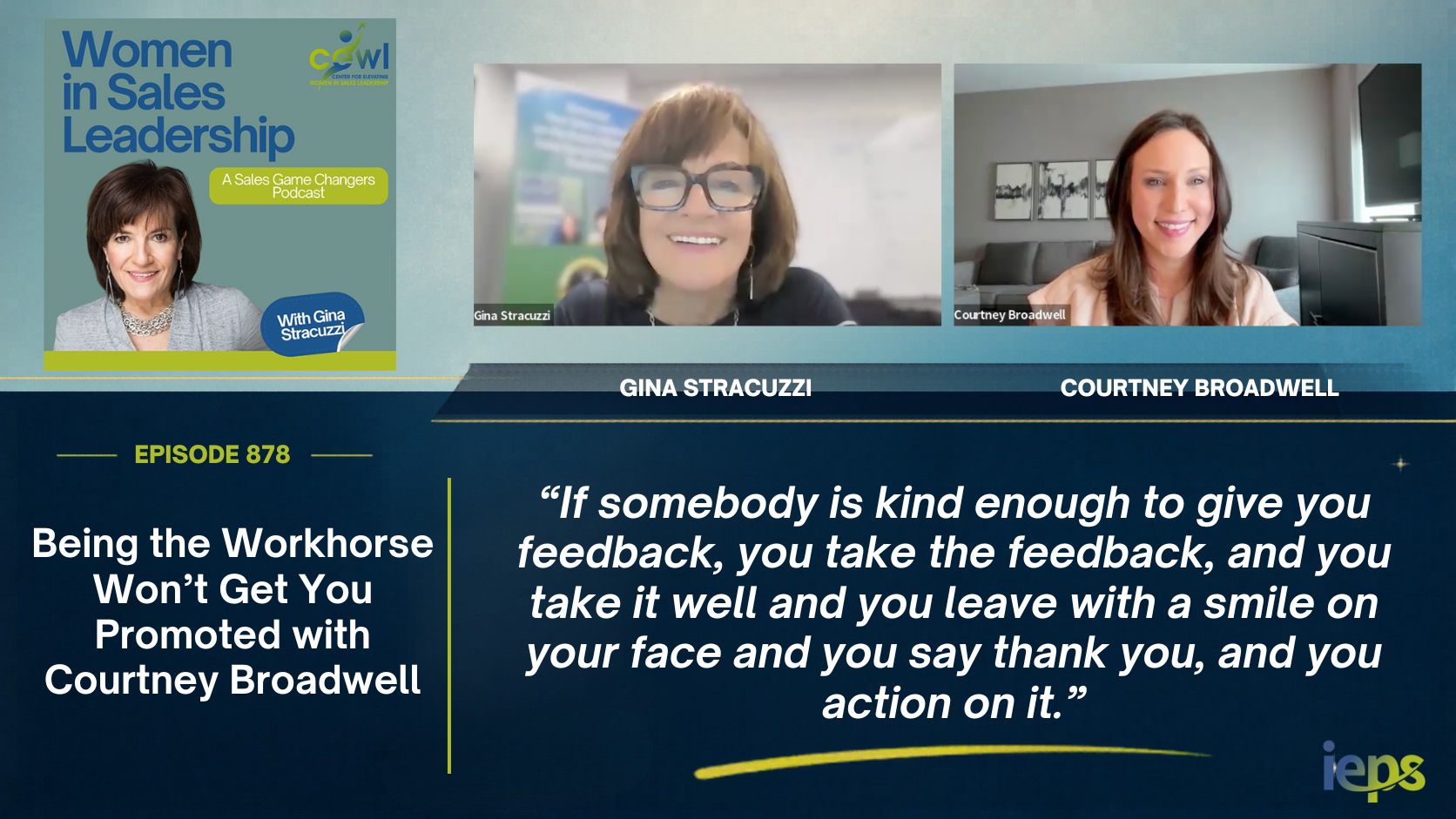
COURTNEY’S TIP: “If somebody is kind enough to give you feedback, you take the feedback, and you take it well and you leave with a smile on your face and you say thank you, and you action on it.”
THE PODCAST BEGINS HERE
Gina Stracuzzi: Today with me, I have Courtney Broadwell. She is VP of channels at Geordie. Welcome, Courtney.
Courtney Broadwell: Thanks, Gina. Thanks so much for having me today. It’s really wonderful to be here chatting with you.
Gina Stracuzzi: Our pleasure. Tell us a little bit about yourself and how you got to be where you are today.
Courtney Broadwell: I actually started my career at a startup. I’m currently a serial startuper. But my first startup was one that I think most people have heard of. It was a company called Veeam Software, that’s still kicking today. They’re doing very well and they’re the leader in the space. But started off there transitioning from a different industry. I started off in a role, cold calling and dialing for dollars. Those days were some of the most fun of my career.
I spent eight years at Veeam, where I did multiple roles. I started off in sales. When I saw what a true partner leader could do, I was very interested, because it brings so much more scale than your average seller. It’s not for everyone, but I knew immediately that it was for me. I took the opportunity that I had to grow at Veeam. I did multiple partner roles. I worked with a lot of different types of partners and I helped our sales team and our company grow and contributed in a very big way. When I left Veeam, they were over a billion dollars in revenue and had half a million customers, which is just crazy in today’s world that we’re in with all of these different companies popping up every single day.
Then after Veeam, I feel like I had a pretty good foundation for a good breadth of understanding of the partner space. I went over to a small company in the application security space called Snyk, which is a pretty big brand name in security today. I started the partner org there, had a ton of fun at Snyk. After five years, went to a company called Cyera, which was, still is, a data security company that was leading the pack. I think really nailed making that data security category a true category versus a feature, built the partner team there.
In April of this year, I really just knew that I wanted to move into a company that was addressing AI security, and specifically agentic security. I found the team at Geordie, and Geordie is the leader in AI agent security and governance that’s built for enterprise teams that are adopting agentic AI at scale. It’s a really fun time to be building with Geordie right now. Right now, we’re a 50-person company. We’re addressing one of the world’s biggest challenges right now, how do you secure agentic AI as everyone is starting to adopt it? It’s bringing a ton of risk to organizations and we are just having a ton of fun doing it.
Gina Stracuzzi: It sounds like you’re not only in a fast-paced startup arena, which is not for the weak of heart, but you’re doing something that is so cutting edge at this point, and really such a focus. It must be insane there at days.
Courtney Broadwell: It is. I was talking to a partner recently who is an AI specialist and he said, “If someone really tells you they’re an AI specialist, they’re just full of it, because things are moving so fast in this space you can’t keep up, even when it’s your whole job to keep up.” It feels a bit overwhelming at time, as I think everyone feels a bit overwhelmed by AI, but it’s really meaningful at the same time when you’re really helping address this huge problem that I think is really an existential crisis that the world is facing, when you think about it.
Gina Stracuzzi: You are so right. We hear that a lot, that it is almost impossible to keep up with the changes. So many companies talk about they’re buying all these tools and they’re telling their salespeople, “You have to use them.” It’s almost too overwhelming. I think people just end up relying on your basics. There needs to be like a whole industry, which could be your next startup maybe, just trying to help people wrap their minds around it long enough to use it before it changes.
Courtney Broadwell: I think that’s a really good point. I think you just have to take it one task at a time, figure out one thing that you feel like you can automate a bit with AI, with little risk that comes with it, because with everything that you’re automating with AI, there is risk that comes with that. But just think about the little mundane things that you do where you could become a super version of yourself.
I feel like with every company I’ve gone to, I’m always more impressed with their tech stack than the last, but here at Geordie, just all of the different tools that we have that we’re using, it’s very cutting edge. I feel super cool when I go to work every day and I play around with different things that I never thought I’d do, never thought I’d be coding in my life. It’s just really fun to learn.
Gina Stracuzzi: That is the cool thing about startups, is that you get to try things that you probably wouldn’t in an established company, because those roles are very well defined. You’re clearly drawn to the build-it-from-zero. When you get into these roles, what’s the first thing that you tackle when you go into a startup with no partner program?
Courtney Broadwell: You just hit something that’s so true. There are two different types of people. There are builders and there are people who like to maintain and refine, and I don’t think one is better than the other, and I think they’re both equally hard in their own ways. But to me, I’ve done both, and it’s extremely rewarding to build, because I wake up every single morning just so energized and have the ability to see oftentimes a pretty massive impact even from the day before in what I’ve done. It’s almost like a little high that you get every day just from what you’re able to do.
I think that when you start thinking about the weeks and the months that pass by, you’ve really impacted the entire trajectory of the company, like every single person has, and it’s powerful. There’s just a real sense of team also at this size. When you’re working together towards a common goal, it just feels so satisfying when you hit those goals.
Some days I wake up and I just can’t believe that I get to do this job with such an awesome group of people, and I tell a lot of them a lot, especially the people who are younger in career, like, “These are the days. Three years from now we’ll be talking about these days we’re in now, so we need to stop and smell the roses a little bit,” because it does go by fast when you’re moving so fast.
When I join a company like Geordie, I think the first thing that I do is align internally, because even though we’re small, we have company goals. I need to make sure that I’m aligning myself to our company goals and what my actions are, because there’s not a repeatable playbook that you take to every company in the partner space. It’s super complex. I don’t think there’s ever been a more exciting time to be in partnerships with what’s happening with the AI providers really shifting everyone’s role.
I also think that founders will have a limited understanding of partnering and what the real potential of that is. They might have perceptions from the past, and it’s my job to either validate or prove them wrong. I also can’t help our broader team identify the right partnerships and also align with my strategy if I’m not aligned with every single stakeholder in the business. I think the work we do in the technology space is also hyper-competitive and I have to get everyone marching towards the same goal and aligning to our broader company goals. I’ve learned that doing this, getting buy-in, articulating my value back to the company and to the leaders of the company is the most important thing that I can do to be taken seriously and to continue to grow in my career.
Gina Stracuzzi: You’ve touched on so many things that I would like to continue down those paths. I remember having really heady jobs, a couple of them over my career, and you are absolutely right about the excitement and the feeling like you’re just doing something so monumental. It’s a great feeling.
I want to turn the conversation a little bit and talk about women in roles, because so often in companies, women will get funneled into individual contributor roles for years before they get considered for strategic or leadership tracks. How did you make the jump from direct sales into channels and partnerships? What would you tell women who are early in their career who want to make a similar move?
Courtney Broadwell: It’s a really good talk track because, I will be honest, I got stuck in that slump for a few years and was frustrated and didn’t really understand why. I had a mentor, who is still just a really good friend and mentor to me, that really showed me that I just wasn’t being impactful enough with how I was using my time. I wasn’t being impactful enough with how I was articulating my value back up, managing up. Also, I didn’t know how to say no. I was just a workhorse. I don’t think that’s super strategic, when you’re just saying yes to everything with no focus.
One of the things that I also have noticed is that women are often mentored to focus on things that they’re already good at. You’re taught, leverage the power of your network, and maintain relationships, and other soft skills. I do think that most women’s brains are built differently than men, and we’re naturally good at those things. My blood boils a bit when I hear advice like this to women, not because it’s not good advice, but because that’s not actually what helps you grow within a business. It’s a part of it, and you absolutely need relationships in a network, but if you’re just seen as that workhorse and you’re not highly impactful, and you’re not aligned to the business objectives, someone else is going to get selected for that promotion you want, or the role that you’ve been chasing. It’s hard.
I have personal experience living through that, and once I got over that slump, I feel like I moved so fast and I accelerated. I do think women have a little bit of a superpower in this regard. If you can get that business acumen and the self-promotion right, and use those soft skills you naturally have, I really believe women can do just about anything they set their minds to.
Gina Stracuzzi: You hit on something that’s really crucial to that, and that is strategically saying yes. You need to raise your hand, you need to be seen, you need to put yourself out there by the same token, as you were alluding to, that when you say yes to everything, that’s not giving you a chance to really shine at something really strategic or important. It’s just, “Courtney is the person we can go to to put out a fire or clean up a mess,” and that’s not what you want. You really want to get known to be something like the go-to person for something, and that’s advice that Fred Diamond, my business partner, gives to young career people all the time. Get to be known for something really important so people know that, like in your instance, Courtney is the person you need to talk to about this. That really can change the trajectory of your career.
Courtney Broadwell: A hundred percent. I think it’s hard though. It’s hard to figure that out. I also think at the same time, you need to ask for feedback and you need to be willing to take the feedback. Because when you think about it from the view of someone who gives feedback, it’s hard to give feedback, especially when you don’t really have skin in the game with that person, if you’re just being asked for feedback. If somebody is kind enough to give you feedback, you take the feedback, and you take it well and you leave with a smile on your face and you say thank you, and you action on it.
I think that’s also equally important, because we’re surrounded by people who are equally or better than we are at some things. I’m a big fan of you find people to surround you that have different strengths, and you ask them for feedback constantly. You’re not going to be good at everything. Nobody can be good at everything, but I think if you have certain people that you trust that are good at the things that you’re not good at, it helps you grow as well.
Gina Stracuzzi: There are times too when people can give you feedback and you may not know how to action it. I hope that if you are brave enough to ask for feedback, you will be brave enough to say, “How would you suggest I fix it? What would you suggest I do? How can I do this differently?” Because if you don’t know where to go with that feedback, then it’s just words.
Courtney Broadwell: Yeah, it’s such a good point. I think that’s how you develop really good relationships and mentorships. I think being brave and being bold and continuously digging and asking more questions, those are always good indicators when I have people doing those things. It makes me super happy when people trust me enough to come and ask for those things.
Gina Stracuzzi: We talk about that in our programs all the time. It’s kind of like professors and teachers. They love it when people ask questions and want help, rather than everyone sitting there going, “Yeah, I get it.”
Courtney Broadwell: I heard a funny quote once that was like, “There’s no such thing as a dumb question, just a dumb answer.” I like to tell people that, like don’t be afraid to ask things. It’s how you grow.
Gina Stracuzzi: It’s great advice. When we spoke previously, you had talked about how startups give people a chance to touch every part of the business. That is so true, and I’ve been in a few startups myself, and it is exciting. Can you talk about the moment when there was a breadth of exposure that ended up being the right thing for you that really accelerated your career, or told you like, “I’m really interested in this piece?”
Courtney Broadwell: It is crazy how just you can get a breadth of experience and it’s because startups operate just with so much speed and more tolerance for risk than large organizations. Part of that is because they’re small and they’re not publicly traded companies, but most of it is because you’ll just have a lot more responsibility on your plate. In my role, I interact with every single team at the company. I interact with our legal team for contracts, our HR team for hiring, multiple areas of marketing, the sales team, operations, customer success, products, executives, I probably left some off, but you name it, I have to work with them in some capacity. That’s just when we’re building partnerships.
I don’t think there’s an area I don’t touch, but when you’re an IC, you’ll be tossed into things at a startup that you typically wouldn’t be at a larger company just because we need feedback on what you’re seeing in the field. I’ll come to you and ask for help building certain documents for partners based on the feedback that you’re hearing from customers and the challenges you’re seeing. You’ll get to interview candidates that you probably wouldn’t get to if you’re at a larger company, and you have the ability to learn and absorb so much. Again, really understand more about the business, which is hard to do sometimes when you’re at a large company and you are working on a very specific goal.
I think also, when I talked earlier about how it feels like an extreme version of a team when you’re small, everyone’s interested in what you’re doing, everyone’s getting feedback and giving feedback to each other. It just doesn’t scale as well when you’re large. I think it’s hard. Sometimes things get lost a bit in just the numbers.
It’s so funny. I think about the first time I had to help prepare for a board meeting at a previous company. It was so eye-opening, because you go to sales kickoff or company meeting and you hear the company goals and the objectives and the revenue targets. But I think really seeing how the board thinks about the business was really impactful for me, because it’s just different. It’s not just like, “Hey, here’s the goal. Let’s go chase it. Here’s how you individually do it.” But it’s really how do we think about this at a much larger scale? How do you think about it beyond just this quarter, beyond this year?
It really helped me understand how to get a bit sharper with how I self-promote, like what I was talking about earlier. Also, the saying no thing. Everything I do needs to be tied back to this. If I’m not doing something that ties back to a board level initiative, I probably shouldn’t be doing it, because my time is limited, just like everybody’s is.
This helped me just be punchier with my messaging to my executives. It helped show my impact better. It also really helped my communication with our executives, because when I sent something over, they knew that I was articulating a message that they needed to look at, and they needed to listen to, and that it was something important.
Gina Stracuzzi: That is a really good point, that quite often in a larger company, you don’t get those opportunities to interact with the board. That’s a pretty rare experience. That really will make you, well, it should anyway, stand up and take notice and present your A game the whole way. A lot of times when we’re working, we’re just part of a collaboration of stuff and we do our input and somebody polishes it up, and then maybe the executive level sees it. Having to present at that level is just invaluable experience.
Courtney Broadwell: Yeah, it pushes you in a really positive way, but definitely pushes you. I like to be pushed and I think that’s how you grow. It’s a good way to do it.
Gina Stracuzzi: The tech space, even at large companies, is still heavily male dominated. Certainly, in venture capitalism and even the startup world, it’s still heavily male. It’s turning, but you’ve been in this space for a while now. What has it been like navigating that space and what’s changed? Or even from the start of your career, what have you seen changes and where do you think we’re headed with this?
Courtney Broadwell: We’ve come a long way, honestly. I went to a concert when I was like 25 years old, and this is going somewhere, hear me out. There was an all-female band on stage and they gave a shout out to all the women in music that had paved the way for them to be on that stage and have the big stage and the audience that they did. I still think about that today.
I think about it as it relates to the world that we’re in. Everyone has a responsibility to the women around us, the women that are starting their careers, the women that will be here after we’re all riding off into the sunset. I think the good thing over the last, I would say, eight-ish years, is that there’s more intentionality about being inclusive, about thinking about that. I do see many large companies and startups alike focusing on this.
However, I always like when I’m the only woman in the room and I call it out. Oftentimes I am the only woman in the room. I don’t think men think about it until it is called out. But honestly, it starts a good conversation. I really do see a lot of empathy for men that I work with both internally and externally at the companies I’ve been at. I’m lucky now that our company has prioritized putting women in leadership when we’re small, because it will scale with the company. It brings diversity and thought, and I think stronger outcomes for the company when you’ve got good diversity and thought.
But I think ultimately, calling it out in a non-combative way is a really good way to just get the conversation started, and ensuring that we’re drilling it into the heads of our colleagues and our allies that surround us. Because being a good business partner and a good friend really makes people want to listen and help. I think we also have to mentor and sponsor other women, but we have to encourage men to do that too, because I think they have a different perspective, and it’s important that we understand everyone’s perspective.
Gina Stracuzzi: As a matter of fact, Fred and I spoke to a whole class of brand-new salespeople yesterday. That was one of the points that I brought up, was seek out mentors, but make sure that they are male and female. You need both perspectives and we need the allies, and made sure all the young men in the group knew that they need to be strong allies too.
To your point, it’s quite interesting how quite often men who really mean well don’t even recognize what’s happening in a room until it’s called out. I had a guest on the show recently and she was talking about how she was in a meeting that was primarily men and she was trying to get even a chance to speak and she wasn’t getting that opportunity. She leaned to the gentleman next to her and told him her idea. At first, I was like, “Don’t give it away.” She said, “I just want you to say this out loud,” and he did and he got the floor immediately and they were like, “That’s a great thought. Great idea. Thanks so much,” and he’s like, “Yeah, it’s not mine. It’s hers. We’ve all been sitting around here talking over her and not giving her a chance to speak.” He told her later, he’s like, “I never realized how much that happens, and ever since then, I’m so acutely aware of it. It’s painful.”
To your point, when you call people out in a non-combative way, it really does make a difference. If you get the good allies and they are everywhere, ask them for help. Ask them to listen up and watch for these things happening, because it can change everything in a heartbeat if a guy speaks up on behalf of the women in the room.
Courtney Broadwell: Absolutely. I totally agree with you.
Gina Stracuzzi: Let’s talk a little bit about someone who might be listening, who’s considering a startup. Now, a lot of people have been let go with big riffs at these much larger companies. They just come in and clear the field, so to speak. It leaves a lot of good people, one, trying to figure out what happened to their careers, but two, trying to consider what to do next. When you and I first spoke, you were suggesting that maybe those people should start looking at startup opportunities.
I really liked the sound of that, because I think for people of a certain age, startups are really hard. I can appreciate that because it takes an energy level and you have to be able to do the chaos. What would you suggest to people who, especially women, who might find themselves in this situation all of a sudden?
Courtney Broadwell: I think you’re right. I think that big tech is actually less stable than the startup space. When I poked my head out there to start looking for new roles in this space in April, I couldn’t believe the number of founders that were getting just a great amount of funding, really solving hard problems, and getting great traction. I think that there is more stability in the startup space. But I think you have to figure out what makes you feel fulfilled and satisfied with your work and ultimately what your goals are. I also think you have to remember that there’s different stages of startups too. You can go to an early one like Geordie, which is Series A, 50 people, or you can go to a larger one like a Series C or D company that have a thousand people. It’s a very different type of experience, but just as impactful.
I’m a big believer in working for startups because they’re solving some of these challenges in a really dynamic way. We always need different schools of thought. We have people from large companies, we have people from other startups, we have people from mid-sized scale up companies. I think that that’s important. It’s important that we also consider people that are not serial startupers and that we also hire from outside of network. Because I see people in the startup space getting trapped in that like, “We’re just going to bring everybody we know over,” and it’s not super dynamic, honestly.
But you’re right, the pace can be pretty hard. I have a family, I have children, and I’m in a hotel today, I’ve been gone a lot of weeks recently. I think that some weeks are harder than others. I’m thankful for technology and FaceTime and things like that when I’m away. This is kind of a controversial statement, but I don’t think there is such a thing as work-life balance. I really don’t. AI and phones and computers and just after COVID, I feel like there was no tolerance for downtime. I think it’s made it impossible. You just have to figure out what works for you. What is sacred time? How do you build that into your day? At the end of the day, you need to put 110% into it and be proud of what you do.
I don’t think that most big tech companies, they’re working any less than we are. I think they’re just doing a different kind of work. There can be burnout in those types of companies too. You just have to be conscious of taking care of yourself and feeling passionate about what you’re doing. My three-year-old told me the other night he wanted to work for Geordie when he gets older, and that made me super happy because I’m like, “It’s infectious even to him, and he doesn’t know what Geordie does.”
I do encourage people who are getting laid off, look at this space, find something interesting, and really push yourself hard to learn. Because I think that the skills that you bring to a startup can help them really up-level what they’re doing. Most of these companies are in a constant up-leveling motion. You try to move from one stage to the next and add a little bit more process, add a little bit more refinement. You also have to keep in mind, you can’t come in and everything’s perfect automatically, but just moving at the pace that the company is, and listening.
Gina Stracuzzi: It’s interesting because in the Women in Sales Leadership Forum that I run, just the last cohort, there were three women in there that had left big organizations and gone to startups and then went back to big organizations. Two of them absolutely loved the startup environment, but then got hired back by the companies that let them go. One was just like, “Absolutely not. It’s just not for me.” To your point, you really have to know your own temperament and know if you can handle the kind of organized chaos that can be a startup environment. It’s good advice. More people should probably look at it without the trepidation necessarily. I hadn’t actually thought about the tiers of startups before. How does one find out information about where a startup is in their growth?
Courtney Broadwell: It’s a great question. Typically, you can just Google it. You can look at their website. They’ll always have information or a blog or press release on when they’ve gotten their latest round of funding. You can see where they’re at in their journey, you can look at the number of employees, the types of customers they have, and that’ll give you a really good indication on where they’re at in their journey. Then be bold, reach out to the founder, reach out to the sales leader or the technical leader or whatever role you’re looking at, and just get more information about the company.
I also keep in mind when I’m interviewing people to come work for me or to work for Geordie, it’s a big decision for the candidate as well. I make sure that they feel very comfortable and have talked to all the people within the organization that they would like to, because you’re right, it feels a bit risky sometimes when it’s early on, when you might not know people at the company.
You made a funny point about people who’ve gone to startups and gone back. I’ve also seen people who have felt like they learned so much at a startup, about the broader parts of the business, they were able to go back to their previous company and take a role much higher than what they would have done in five, ten years at the company they were at. I think it can also help accelerate things for you in a way if you want to go back to a big company at some point.
Gina Stracuzzi: That’s a really great point, especially if you feel at all stuck in your career. It could be just what you need.
Courtney Broadwell: Good kick in the rear end.
Gina Stracuzzi: Exactly. Well, this has been just a fabulous conversation. I’ve really, really enjoyed it. We are now at the part of our conversation where we like to ask our guests for one piece of final advice, something that people can put into place today to take their careers to the next level. What would you suggest?
Courtney Broadwell: The biggest thing that you should do is think about how you want to grow, work on a plan, figure out where you want to be, and work backwards on a plan to get there. I think that you should be bold, you should be brave. You should try something new, whether it’s asking for feedback, asking for someone to be your mentor, going to look at working for a startup. You’ll be really amazed with what you’re able to accomplish and what you’re able to learn.
You, the listener, you’re incredible. I think that there are so many women out there in the world that just aren’t doing enough, aren’t maximizing their potential. I want you to go out there, take a deep breath, roll your shoulders up, and go do something really awesome today to help yourself grow.
Gina Stracuzzi: Thank you very much, Courtney Broadwell. We really appreciate it. I hope you’ll come back and visit us in a couple of years and let us know what you’re doing.
Transcribed by Mariana Badillo